
More on the City's Next Mayor
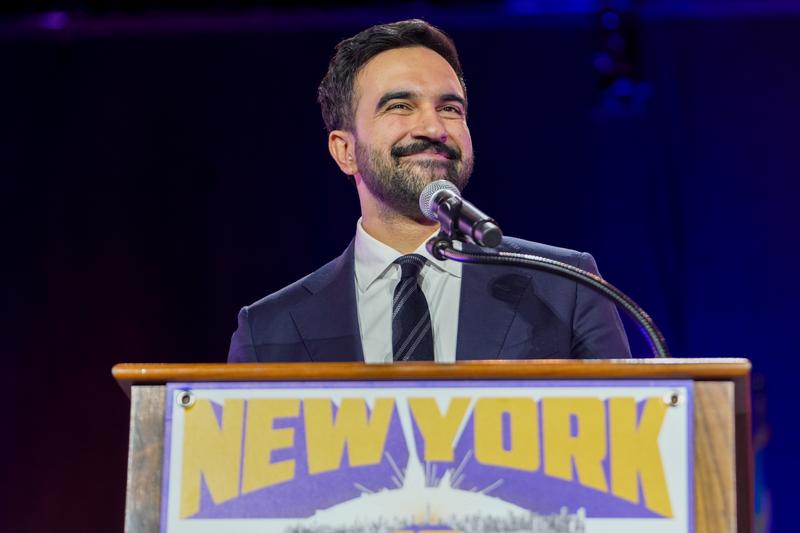
( Stephani Spindel/VIEWpress / Getty Images )
[MUSIC]
Brian Lehrer: Brian Lehrer on WNYC. More on the election results now locally and nationally with Christina Greer, who follows both as Fordham University political science professor, co host of the podcast FAQNYC, and author of the book Black Ethnics: Race, Immigration, and the Pursuit of the American Dream. Christina, thanks for some time this morning. Welcome back to WNYC.
Christina Greer: Thanks, Brian. Of course, I'm here the day after an election.
Brian Lehrer: Listeners, the phones remain open for any question or reaction. 212-433-WNYC call or text 212-433-9692. Christina, here's the New York Times headline. "Despite spending $40 million, super PACs could not pull Cuomo to victory." It says, "Billionaires like Bill Ackman and former Mayor Michael Bloomberg pumped millions of dollars into super PACs supporting Mr. Cuomo with the hopes of defeating Mr. Mamdani. Super PACs supporting Cuomo have raised more than $40 million, while those supporting Mamdani have raised about 10 million. It was not decisive," concludes that thought in the New York Times. Are you surprised that the very large spending gap to support Cuomo vs Mamdani didn't matter more than it did?
Christina Greer: No, I'm not surprised, Brian. There are two things. One, Zohran Mamdani built a movement, and he got especially young people and new voters off of social media and into the streets, and really invested in his campaign clear message from day one, and just galvanized a lot of New Yorkers where they could see themselves in the message. Then, when you ask Cuomo supporters, "What is the vision of Andrew Cuomo for New York?" They couldn't tell you. It was a very anti-Mamdani message, but it wasn't a people-powered message, and it didn't have anything to say about his particular vision for New York City. Even on the [crosstalk]
Brian Lehrer: Can I jump in on that for just a second?
Christina Greer: Yes, go ahead.
Brian Lehrer: I was wondering what was on their campaign websites on election day itself. I went to the Mamdani one and there was a blurb about affordability. I went to the Cuomo one and there was a big sign on it. In addition to saying he's a competent leader or something like that, it said, "Say no to Zoh." The biggest thing for Cuomo, I think, it appeared to probably everybody down the stretch, but there it was on the front page of his website on election day was stopping Mamdani rather than what he could do.
Christina Greer: Exactly. I think I said this on the podcast last night: don't Bill Thompson yourself. By that, I mean Bill Thompson I think in some ways a lot of folks thought that he thought that they were voting for him, and they were voting against Bloomberg, and he wasn't successful. There's a difference with Cuomo in the sense that--
Brian Lehrer: Bloomberg's third reelection.
Christina Greer: 2009.
Brian Lehrer: Third election. Right, and Bill Thompson, for people who don't know, is the Democratic nominee. Sorry, go ahead.
Christina Greer: Sorry about that. Sorry, New York, for those of you who are just here. I think Cuomo, without giving a real vision, made it pretty apparent that he's coming back into a city that he hasn't lived in in quite some time. He literally looked confused as to the coalitions; these are different types of people, they're different languages, different ethnicities, different religions. I think that the Cuomo vision of what New York was just doesn't exist anymore. I think Mamdani really tapped into this 21st-century version of New York City.
Brian Lehrer: At the end of the race, the Times article continues, the political ads dipped into what Mr. Mamdani called naked bigotry and Islamophobia. An ad from one super PAC for our city, that's a Cuomo super PAC, placed a picture of a smiling Mamdani in front of the collapsing World Trade Center. Christina, you've seen a lot of ugly campaigning in this world. Did this surprise you as to where the Andrew Cuomo camp was willing to go?
Christina Greer: No. When you see candidates are desperate and without a vision, and they know that they're losing, these are these last-ditch attempts at misinformation, disinformation, and a type of campaigning that a lot of people don't have a stomach for. Negative ads do work because there's an element of truth in certain negative ads, but this type of negative campaigning isn't attractive. Don't forget, Brian, I'm with young people. I have the privilege of teaching young people every day. They are really offended by the fact that, after all this time, Cuomo still couldn't seem to learn how to pronounce Mamdani's name on any debate stage or whenever he spoke about him.
If we can say Shostakovich and Tchaikovsky and the Kosciuszko Bridge, it's head-scratching that he can't seem to get vowel, consonant, vowel, consonant, vowel, consonant. That seemed deliberate in a lot of ways to a lot of young people. There's just not a stomach for that, for a lot of New Yorkers in, again, a 21st-century politicking and coalition building.
Brian Lehrer: Carolyn in Bethlehem, Connecticut, you're on WNYC. Hi, Carolyn.
Carolyn: Hi, Brian. This is very, very small town feedback. It's a very rural agricultural town. A lot of people struggle, especially now with the cutbacks on food aid. Leading up to our local election, I noticed that all of the big MAGA Trump banners at some houses were just slowly but surely coming down. When this election that took place yesterday happened, almost all the lawn signs were for the Democratic team. There was a handful of houses that really stuck to the Republican lawn sign, but it was a clean sweep. There wasn't even a shot for the Republican ticket in our little town. I'm astonished because it's a very red town, but it's been changing.
It's been a little more on the purple side, especially as more people relocated full-time during the pandemic. I think it's very interesting that how badly Donald Trump is handling people's pain is even biting him in the, you know what, in a small rural town. I'm very heartened.
Brian Lehrer: Really, really interesting, Carolyn. Thank you for checking in with that. The autumn leaves and MAGA signs being swept away at the same time. Political indicator. That's so fascinating. Hinda, in Mercer County, you're on WNYC. Hello, Hinda.
Hinda: Hi, how are you, Brian? Longtime listener. I just want to say that it wasn't just the Democrats who won yesterday. It was democracy. It was we, the people. We turned out seven million strong last month. We turned out by the millions yesterday. By the way, I grew up in Brooklyn, so I can't not love Mamdani. He also understands the concept of we the people, of community, that we're all in this together, and we don't need that dark money. They can take that dark money, and they can throw it in the trash, or they can recycle it to sponsor programs for our people, social programs, food.
Trump's policies are not, not tolerating people's pain. Trump's policies are brazenly sadistic. We have to learn from many of our allies, which are social democracies. Let's educate our populace about what socialism is, that we need to take care of our people. We're in this together. Bravo, Mamdani. Bravo, Mikie Sherrill and everybody else, and the people.
Brian Lehrer: Thank you very much. Did I hear Cuomo near the end, Christina, compare Mamdani's democratic socialism to Venezuela and Cuba? Did you hear that clip?
Christina Greer: [chuckles] I did not hear that clip. I wouldn't be surprised by that clip.
Brian Lehrer: I'll have to go back and see if it was Cuomo or somebody else. The caller references democratic socialism, and if Mamdani has an international model, I imagine he would say it might be some of the Scandinavian countries, which rank as the happiest in the world in these international happiness indices, not the dictatorships of Maduro's Venezuela or Castro's Cuba.
Christina Greer: Right. So many people don't have problems with socialism for the wealthy. The problem is it never trickles down to the working class. That was a big tenet of Mamdani's argument to so many millions of New Yorkers.
Brian Lehrer: I mentioned in the intro your book Black Ethnics: Race, Immigration, and the Pursuit of the American Dream. I fail to mention your newer book, How to Build a Democracy: From Fannie Lou Hamer and Barbara Jordan to Stacey Abrams. Where would Zohran Mamdani fit into that arc?
Christina Greer: I think he'd be in the bucket with Stacey Abrams. The argument of the book is essentially if the outsider activists organizing tactics of Fannie Lou Hamer met up with the insider strategic oratory skills and legislative prowess of Barbara Jordan, 50 years later, you get a Stacey Abrams. It is my hope that Zohran Mamdani can take some of the skill set and the foundation he has organizing, obviously taxi medallion workers or taxi workers for their medallions, and the work that he did with loan forgiveness before he became elected.
I know that he doesn't have a long legislative record, but I'm hopeful that he can surround himself with people that can help with this insider outsider strategy so that we can still make sure it's people-powered and going to the people and asking them what they need and then working on policy based on that. As opposed to hiring consultants that tell the executives what's going on and it's oftentimes off the mark.
Brian Lehrer: Here's that Cuomo reference. Sure enough, at the Chinatown Senior center the other day, as reported by AM New York, Cuomo warned voters that Mamdani would turn New York City into a "socialist city". He said, "Socialism has not worked anywhere on the globe, not in Venezuela, not in Cuba, and it's not going to work in New York City." He did actually invoke Cuba and Venezuela to put Mamdani in context for some voters. Here's the Mamdani clip that I want you to react to from his victory speech last night.
Mamdani: We will build a city hall that stands steadfast alongside Jewish New Yorkers and does not waver in the fight against the scourge of anti Semitism.
[cheering]
Mamdani: Where the more than one million Muslims know that they belong-
[cheering]
Mamdani: -not just in the five boroughs of this city, but in the halls of power.
[cheering]
Mamdani: No more will New York be a city where you can traffic in Islamophobia and win an election.
Brian Lehrer: There's the challenge for Mamdani. One of the challenges for him to reunite those Jewish New Yorkers who have been very suspicious of him and Muslim New Yorkers, and other New Yorkers who are core to his coalition. I do see that Governor Hochul tweeted this morning, "The Magen David Yeshiva in Brooklyn was one of several Jewish sites defiled last night with spray-painted swastikas. I strongly condemn this hateful display of antisemitism." From Governor Hochul in a post on X this morning. I don't know if she's implying that some people felt empowered to do that by the election of Mamdani, but he'll have to respond to it. Here's part of the challenge, right?
Christina Greer: Absolutely. I think we're going to have conversations about religion, not just antisemitism, but also Islamophobia, that we've never had as a city. Brian, after 911, we should have and could have had some hard conversations, and we didn't. I think some of those emotions are going to be excavated because, for some New Yorkers, they were very clear during the primary. They just thought Mandani was an anti-Semite, and there's pretty much nothing he can do or say to change their minds on that. There are going to be ways where he's going to work with lots of different organizations to have this collective vision, as he's been pretty clear about.
I think he also has to understand there are going to be some people that see if you are Muslim, then they translate that somehow randomly into being anti-Semitic or anti-Christian, which is obviously not the case with our mayor-elect. I think this is going to be the first time in a long time that we have a multifaceted conversation about religion in the city.
Brian Lehrer: In our last minute, you watch state politics as well as New York City politics. What do you think Mamdani's new governing coalition means at the state level, specifically for the universal free child care that he says is his number one policy goal? I'm thinking of when Mayor de Blasio got Albany's attention with his universal pre-K proposal for the city. Then, Governor Cuomo adopted it for a statewide policy, partly to take credit away from the mayor. Then there it was statewide. Hochul talks about childcare. Do you see anything like that possible with Mamdani and Hochul now?
Christina Greer: I'm very optimistic, Brian. I know that that might be in the minority. However, Kathy Hochul is up for reelection next year. There are going to be a lot of bargains that she needs to make. There are a lot of coalitions that she's going to have to form. She's seen how many people turned out for Mamdani, how he can build a movement and momentum, and she's going to have a primary by her own lieutenant governor and maybe some other folks. I think Mamdani has six months before the right and the left turn on him. I think Kathy Hochul's got six months once we get sworn in in January, six months before her primary, I think the two of them will work together to have mutual success.
I think it mutually benefits both of them to have some wins on the docket by June. I'm pretty optimistic that Zohran Mamdani will be able to get a few things done with the aid of the governor.
Brian Lehrer: Christina Greer, Fordham University political science professor, co-host of the podcast FAQNYC, and author of the books Black Ethnics: Race, Immigration, and the Pursuit of the American Dream, and How to Build a Democracy: From Fannie Lou Hamer and Barbara Jordan to Stacey Abramslack. Christina, thanks for joining us.
Christina Greer: Anytime, Brian.
Brian Lehrer: More talk about the election tomorrow. Stay tuned for Alison now.
Copyright © 2025 New York Public Radio. All rights reserved. Visit our website terms of use at www.wnyc.org for further information.
New York Public Radio transcripts are created on a rush deadline, often by contractors. This text may not be in its final form and may be updated or revised in the future. Accuracy and availability may vary. The authoritative record of New York Public Radio’s programming is the audio record.
