
Monsanto's Roundup at the Supreme Court
[music]
Brian Lehrer: It's the Brian Lehrer show on WNYC. Good morning, everyone. On yesterday's show, many of you heard. We talked about RFK Jr.'s testimony before seven congressional committees last week. One of the issues we touched on was that members of the MAHA movement are becoming disillusioned with Kennedy and President Trump because the administration went soft on glyphosate, the active ingredient in the herbicide Roundup, one of the most widely used herbicides in the world on home lawns and gardens, as well as commercial agriculture.
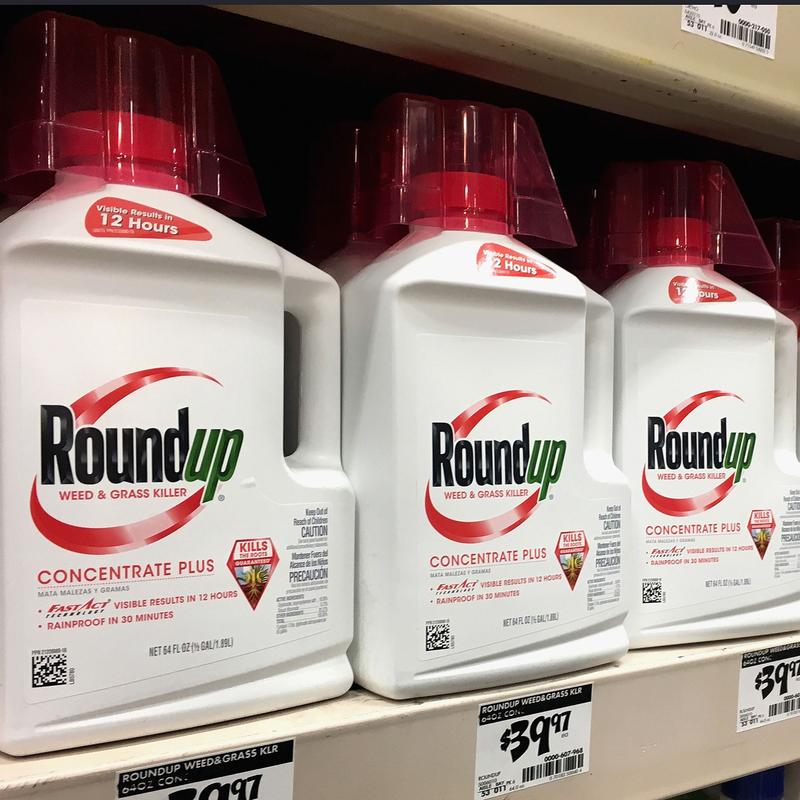
As it happens, yesterday was also the day of Supreme Court oral arguments in a major case concerning glyphosate. Let's play a few clips from the hearing and take a closer look. Glyphosate has been linked to cancer by the World Health Organization. It's been the subject of tens of thousands of lawsuits and is a chemical that many scientists, environmental advocates, and public health researchers have been sounding the alarm about for a very long time. Yet it is sprayed on crops across America, sold at every hardware store, and its label carries no cancer warning. That's because the EPA has not decided that it warrants one.
The Supreme Court case revolves around a man named John Durnell. He spent two decades spraying Roundup around his neighborhood. He was later diagnosed with non-Hodgkin's lymphoma. A Missouri jury awarded Durnell over a million dollars and found that Monsanto failed to warn him of the cancer risk. Now Monsanto, owned by a German conglomerate, Bayer, wants the Supreme Court to throw that verdict and that monetary award out. The Trump administration Solicitor General showed up to argue on Monsanto's side, even as RFK Jr., who once won a nearly $290 million verdict against Monsanto, sits in the Cabinet and sits quietly by or even in support.
The politics here are something, MAHA activists, the Make America Healthy Again movement that helped deliver Trump's 2024 win, largely because they, like RFK, were outside the court yesterday, chanting, "People versus poison," frustrated at the very administration they helped put in power. Tens of thousands of similar lawsuits, we should say, hang in the balance. We'll talk about all this now with two guests. Lianne Sheppard is the Rohm Haas endowed professor of Public Health at the University of Washington. Maureen Groppe covers the Supreme Court for USA Today. We've got a legal expert and an environmental science expert. Maureen and Professor Sheppard. Welcome to WNYC.
Lianne Sheppard: Happy to be here.
Maureen Groppe: Thank you for having me.
Brian Lehrer: The EPA says glyphosate is not likely to be carcinogenic. The World Health Organization says it's a probable carcinogen. Those are two of the most authoritative scientific bodies in the world, and they've reached opposite conclusions about the same chemical. Professor Sheppard, how is that possible?
Lianne Sheppard: They did their reviews differently. They had different criteria, and EPA didn't even follow its own guidelines. That their human health risk assessment was actually vacated by the Ninth Circuit Court much later. I don't think we can believe the EPA's conclusion.
Brian Lehrer: Take me a step further into that. If you are right, how did the EPA's method of deciding whether something is a likely carcinogen gets so corrupted? This would have been before Trump or no?
Lianne Sheppard: Yes, the review happened in 2016. I actually participated on the scientific advisory panel that did that review. EPA did not follow their own guidelines. There's also some nuances in what they were doing. First of all, they focused on dietary exposure, which is much lower than what landscapers and, for instance, Turnell was exposed to, people that spray it routinely as part of their work. Second of all, they focused on pure glyphosate, which nobody uses because what is sold is a glyphosate-based herbicide or a formulation which is mixed with surfactants and other so-called inert ingredients. They're inert because they're not the active ingredient of the pesticide, this case, the herbicide glyphosate. They may not be inert from a health point of view.
Brian Lehrer: Before we get to the legal issues with our other guests, you're talking about the Obama EPA. I'm still curious how and why you think the EPA would not follow its own guidelines, would take roots of exposure that don't reflect the real kinds of exposure that people have in the real world. I mean, why would they do that?
Lianne Sheppard: There's a lot of industry capture, particularly with respect to the Office of Pesticide Program at the EPA. There is a really good older article by Sharon Lerner called Department of Yes, that goes into this in detail. There's just been very strong industry influence that has impacted the way that EPA has done its work.
Brian Lehrer: Maureen, the Supreme Court, as I understand it, is actually not being asked to decide whether glyphosate causes cancer. What exactly is the legal question?
Maureen Groppe: Yes, that's right. The question that they have to answer is whether this federal law that regulates pesticides regulates this herbicide because the EPA, as your other guest said, has not determined that this causes cancer. Does that mean that that's what's controlling here, or can people like Mr. Durnell, can they sue under state law and say that the company failed to provide a cancer warning on their product? The question is, does the federal regulation of this preempt the kind of lawsuit that Mr. Durnell and tens of thousands of other people have brought or want to bring?
Brian Lehrer: Monsanto's lawyer is Paul Clement. Some of our listeners may know the name. As a former US Solicitor General, he said this in yesterday's oral arguments.
Paul Clement: It's probably the most like studied herbicide in the history of man. They've all reached the conclusion, based on more data and the expert analysis they can do that there isn't a risk here. You shouldn't let a single Missouri jury second-guess that judgment.
Brian Lehrer: Yet to listen to a clip from history regarding RFK Jr., who was on the side of Monsanto in this case, he said this as recently as January.
RFK Jr.: I believe that glyphosate causes cancer.
Brian Lehrer: If you can put on a political analyst hat as well as a legal analyst hat, Maureen, how do those things fit together?
Maureen Groppe: This issue of whether this roundup causes cancer has been hotly debated. Now it's become this interesting political issue, too. As you mentioned, there were lots of people demonstrating outside the Supreme Court during the oral arguments. Before I went into the court to hear the arguments, I was able to speak to two of them, a couple who had come from Southern California, all the way from California, just to stand outside the court with their signs trying to say that this company should not get the liability protections. I asked them if they were Trump supporters, and they said they were and that they were very disappointed in the decision by his administration to back glyphosate. That the president has-- he has tried to encourage domestic production of glyphosate.
As you mentioned, the Justice Department was there arguing on behalf of the company in court. That's a change in position from the position the Justice Department took under the Biden administration. Right now, in addition to this lawsuit, the company is trying to get legislation passed in states and in Congress to give them protection from liability. That's causing problems for passage of farm bill legislation right now in Congress because of the controversy over whether the company should get this protection or not.
Brian Lehrer: Professor Sheppard, for you as the environmental scientist here, do you have a take on RFK changing positions, literally from January when that clip was, to February when Trump signed that executive order, and then Kennedy wrote this, the executive order to boost domestic glyphosate production. Kennedy wrote, "President Trump did not build our current system, he inherited it. I support President Trump's executive order to bring agricultural chemical production back to the United States and end our near-total reliance on adversarial nations." Suddenly, he wasn't talking about whether it causes cancer. He was talking about what nations get over on us on economic production. Right?
Lianne Sheppard: I find it hard to speak for how and why he changed his position. I think that the health evidence is clear. Glyphosate and glyphosate-based herbicides cause cancer. The comprehensive evidence supports this conclusion. The strongest evidence is for an increased risk of non-Hodgkin lymphoma, which is a cancer of the lymphatic system. There's also other evidence that it increases the risk of multiple other adverse health effects. Particularly, it's notable that children, infant and fetuses, are the most susceptible. That's the perspective that I hold, and I can't speak for why he changed his mind and his tune.
Brian Lehrer: You mentioned non-Hodgkin's lymphoma, which keeps coming up in these lawsuits, including in John Durnell's case that's now before the Supreme Court. Is there something specific about the biology of glyphosate that would make it particularly linked to that type of cancer? Do you know the mechanism, or is the association only statistical at this point, and you can't say exactly how?
Lianne Sheppard: There is an emerging hypothesis that I think is quite powerful, that glyphosate sequesters in bone, and that that is where the cancer forms. That's why blood cancers are the most likely cause of cancer. It's quite clear that glyphosate is genotoxic. Yes, it's emerging that the blood cancers are probably the most important ones. It has a very short half-life in the body, and so you should pee out like most of it in about 6, 8 hours. Yet glyphosate is detected in the urine of 70% to 80% of all the US population. That's based on NHANES data.
An important question is why are we all showing evidence of glyphosate in our bodies when the half-life is so short, if most of us are exposed predominantly through diet? One of the reasons may be that it's sequestering in bone and coming out more slowly. This is where the mechanism for non-Hodgkin lymphoma is happening.
Brian Lehrer: If so much of the US population has glyphosate in their blood, and yet a very small percentage comes down with non-Hodgkin's lymphoma. Is that an argument for or against the association?
Lianne Sheppard: It makes it challenging to uncover the evidence scientifically. Let me talk to you about what it means from a public health point of view. I believe that we're-- unless we're really strict organic diet people, we are being microdosed with glyphosate all the time through our diet. The public health impact, let's say that one in a million people will get non-Hodgkin lymphoma from their low-dose dietary exposure. Yet one in a thousand landscapers who spray it all the time get it on their skin or around it, or get a much higher dose, are going to get non-Hodgkin lymphoma.
In the country, there's 300 million people that eat every day, more than that. Say that's how many are eating a non-organic diet. That's 300 excess cases of cancer. Yet there's only say 10,000 landscapers. That's only 10 landscapers that are going to get non-Hodgkin lymphoma. It's a lot easier scientifically to show the link between the landscapers' exposure and non-Hodgkin lymphoma because of the higher dose.
Brian Lehrer: Do you think that's been shown? Because it's certainly those workers who are at the most risk. Has that been epidemiologically proven?
Lianne Sheppard: Epidemiology is a science that shows associations, so proving the link is extremely challenging. That said that the strongest evidence is in the people that are most highly exposed. That's why the Agricultural Health study, the study of pesticide applicators. That's what the evidence in the epidemiologic study shows is the highest exposed people are the highest risk and the strongest association.
Brian Lehrer: Maureen, back to you as the Supreme Court reporter. Monto's big argument is uniformity. Again, the justices aren't going to rule on whether glyphosate causes cancer. They're going to rule on this uniformity argument that you can't have 50 states or 50 different juries-- in this case, it was a Missouri court ruling, setting their own standards on warning labels. Chief Justice Roberts pressed them on that.
Maureen Groppe: Yes, we heard-- Probably the strongest voice of support for Monsanto's position came from Justice Brett Kavanaugh, who, as you said, kept raising this uniformity issue. More than once, the Chief Justice, John Roberts, another fellow conservative, he kept probing whether states have any role, the idea that they have no role in this. He probed that more than once. Also, Justice Ketanji Brown Jackson, one of the liberals, joined him in that and brought up the fact that the EPA has required only 15 years to update the standards. Of course, they're delayed. They still have not performed the most recent update. They're behind in that.
The chief justice was saying, well, it's not necessarily the case that these state courts are doing something different from what the EPA is doing. Maybe it's just that they are being more responsive to changing information, new information about this product.
Brian Lehrer: Right. It's interesting that you cited that, because that's the one clip of Chief Justice Roberts that we pulled, which makes him sound like he's on the side of Missouri, not the Trump administration. Let's listen.
Chief Justice John Roberts: It's not necessarily the case that they're doing something inconsistent with what EPA would do. It's simply a fact that they're responsive to the new information more quickly than the federal government is.
Brian Lehrer: Maureen, do you have a take, as sometimes Supreme Court reporters do after oral arguments, as to where this is headed?
Maureen Groppe: Yes, it was hard for me to say for sure. You have to count to five. Five is the majority on the court. It's always tricky to judge for moral arguments because the chief justice, in particular, he likes to ask questions of both sides. I think myself and many other of the reporters who were covering the oral arguments yesterday came away not sure which way they're going to go. Things can change. Even if you hear oral arguments, you think it sounds like they're going to go one direction, when they sit down, whatever justice is assigned to write this decision, when he or she sits down to write it, sometimes things can change based on they're trying to write the justification and the process, I think.
I'm not sure that's-- They might change your mind, or one of the other justices might change their mind and change who's in the majority and which side is in the minority. There was no clear indication to me from the oral arguments about how the justices are going to rule.
Brian Lehrer: Professor Sheppard, you'll get the last question. Let's say this goes Monsanto's way and the Trump administration's way. What's the next line of, I guess, activism for people like yourself who think glyphosate is carcinogenic or otherwise hazardous to try to protect landscapers or anybody else?
Lianne Sheppard: As a public health professional, I'm concerned not as an activist, but just about communicating the evidence to the public so that they can protect themselves. I think even now, people can be smart about how they use the product if they choose to spray it around their home and make sure that they wear chemically resistant gloves and protect their skin from exposure and not get it in their eyes, not ingest it.
From a dietary point of view, if you can afford it, eat an organic diet. If you can't afford it, be selective about the foods that you choose to eat organic, and particularly stay away from the foods that tend to be exposed to glyphosate right before they're harvested. Those are the pre-harvest desiccation foods like oats, wheat, legumes, like chickpeas. Those are the ones to prioritize for organic diet.
Brian Lehrer: Lianne Sheppard is the Rohm and Haas endowed professor of Public Health at the University of Washington. Maureen Groppe covers the Supreme Court for USA Today. Thank you both very much for joining us.
Maureen Groppe: Thanks for having me.
Lianne Sheppard: Thank you for having me.
Brian Lehrer: Brian Lehrer on WNYC. Senator Cory Booker next. Stay with us.
Copyright © 2026 New York Public Radio. All rights reserved. Visit our website terms of use at www.wnyc.org for further information.
New York Public Radio transcripts are created on a rush deadline, often by contractors. This text may not be in its final form and may be updated or revised in the future. Accuracy and availability may vary. The authoritative record of New York Public Radio’s programming is the audio record.
