
Monday Morning Politics with Leader Jeffries
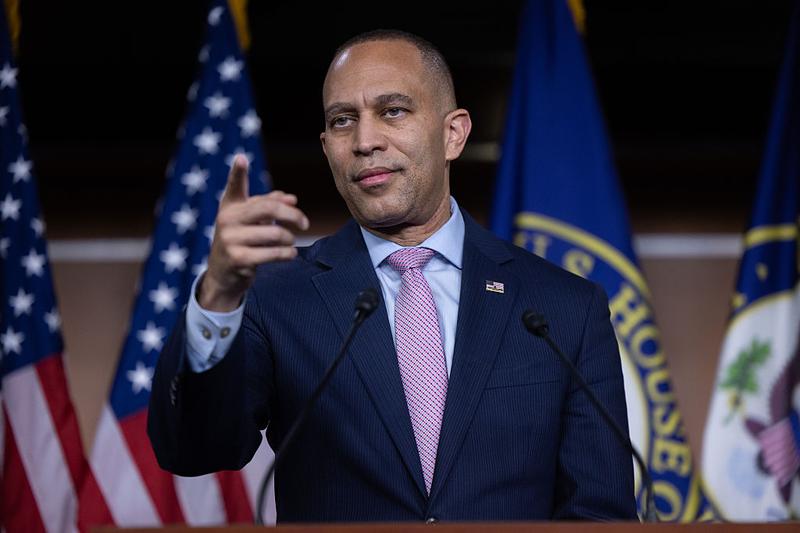
( Nathan Posner/Anadolu via Getty Images / Getty Images )
[MUSIC]
Brian Lehrer: Brian Lehrer on WNYC. Now, Brooklyn Congressman and House Minority Leader Hakeem Jeffries. With so much going on, the Trump-Mamdani meeting on Friday, the push to get Affordable Care Act subsidies extended before the price spike would kick in on January 1st, the Marjorie Taylor Greene resignation, the Epstein files vote, and the coming midterm elections, including Mayor-elect Mamdani's endorsement of Jeffries over a potential primary challenger from the left, city councilman from Brooklyn, Chi Ossé. Here's Mamdani with Kristen Welker on NBC's Meet the Press yesterday.
Kristen Welker: Democrats win the midterms. Do you want to see Leader Jeffries become the speaker of the House?
Mayor-elect Mamdani: Yes.
Brian Lehrer: With that one-word answer as prelude, Leader Jeffries, we always appreciate when you come on with us. Welcome back to WNYC.
Congressman and House Minority Leader Hakeem Jeffries: Good morning. Great to be on.
Brian Lehrer: Would you start there? It looks like Mayor-elect Mamdani's influence headed off a DSA endorsement of a primary challenge by Ossé with a DSA vote against him on Saturday night. What's your reaction?
Congressman and House Minority Leader Hakeem Jeffries: Primaries are a part of life in terms of the House of Representatives in particular. We run every two years. Certainly thankful for the mayor elect's words, but more importantly for the manner in which he's approached the transition into being the mayor of the City of New York, with an emphasis on getting things done in terms of the affordability message that was a big part of his tremendous success, and of course, looking out for the public safety of the people of the City of New York. I think it's incumbent upon all of us in the city, whether one supported the mayor-elect or did not support the mayor-elect, to ensure that he's successful, because if he is successful as mayor, then the City of New York, the people that we're all privileged to represent, will be successful moving forward over the next four years.
Brian Lehrer: You only endorsed the mayor-elect very late in the campaign, and yet he protected you in this way. How do you see your relationship with him evolving more broadly, I guess, in the last few weeks since election day?
Congressman and House Minority Leader Hakeem Jeffries: We had a 43-day government shutdown, the longest shutdown in American history. As I indicated throughout the fall general election here at home in New York City, that I would weigh in in advance of early voting and did. Certainly, my statement in that regard speaks for itself.
I think what we've seen throughout the primary into the general election and subsequent to Zohran's win during the general election is a focus on the things that matter on the issues of concern to everyday New Yorkers, the number one issue being making sure we can actually live in a city that's affordable for working class New Yorkers, for everyday New Yorkers, for young New Yorkers, and for middle class New Yorkers, and that we don't simply become a city for the wealthy, the well off, and the well-connected.
That's not the type of New York City that I grew up in, in a working-class neighborhood in Crown Heights. Both of my parents, public servants, and were able to go on to make a decent living for myself and for my younger brother, for the people that I grew up with in Crown Heights, in Bedford-Stuyvesant, throughout central Brooklyn, and beyond. It's clear that Zohran is working hard to try to preserve that kind of New York City. it's a powerful message and one that I'm hopeful that people from all sides of the ideological spectrum, as we recently saw with President Donald Trump, will embrace.
Brian Lehrer: Any regrets, therefore? Sounding as much on the same page with the mayor-elect as you do now, any regrets for waiting for so long to endorse him and maybe raising more doubts among some New York voters as a result of your reluctance?
Congressman and House Minority Leader Hakeem Jeffries: I don't think there was any doubts that I raised at any point during the general election. I think I was very clear in the two meetings that we had and the meetings that were held thereafter. I think we all are looking forward, not backward. We spent seven-plus weeks in the middle of large parts of the general election campaign, the largest government shutdown in American history, pushing back on behalf of tens of millions of Americans.
I was involved in that fight, helped to lead that fight. It was a big part of why we as House Democrats serve in the United States House of Representatives, because we want to make life better for the American people. There are challenges that the country is facing that I look forward to continuing to be a big part of as we move forward.
Brian Lehrer: Listeners, we can take some phone calls for Congressman Hakeem Jeffries from his district here locally in Brooklyn, or since he's obviously a national figure as well, from anywhere else. 212433-WNYC, 212-433-9692, or you can ask him a question via text message. We'll keep looking at those. Here's one that picks up on what you were just saying, emphasizing affordability. Eric in Brooklyn, you're on WNYC. Hello, Eric.
Eric Weltman: Good morning. My name is Eric Weltman, and I'm a senior organizer with Food & Water Watch. First, I want to thank you, Congressman Jeffries, for urging Governor Hochul to block the Williams NESE frack gas pipeline. I wanted to pitch some ideas for an affordability agenda, one that takes on the greedy corporations driving up our bills while polluting our environment, three ideas in particular to promote safe, affordable water, energy, and food while creating good jobs.
First, Congressman Jeffries, a national moratorium on energy and water-hungry data centers. Second, boosting federal funding for clean water projects. Third, taking on corporate consolidation and control of the food sector.
Brian Lehrer: Eric, thank you for those three. Do you want to respond to any of those?
Congressman and House Minority Leader Hakeem Jeffries: I certainly thank the caller for raising some important, interesting ideas in terms of tackling the core issue of the high cost of living in the country. I think the point that we as House Democrats have been making repeatedly is that Republicans have broken their promise. Their core promise to the American people throughout the 2024 campaign was that they were going to lower the high cost of living. In fact, Donald Trump said, "I'm going to lower costs on day one." We know costs aren't going down, they're going up, and a lot of that has to do with Republican actions, including the Trump tariffs, which is making life more expensive.
Electricity bills are through the roof under this Republican administration. Part of the problem for that is the attack on the clean energy economy. I think part of what we need to do is reverse some of the damage that was done to clean energy jobs, to the clean energy sector, to wind, and solar, and power generation as part of their one big ugly bill, where despite the promises made by many traditional Republicans in the House of Representatives that they would not touch the clean energy tax credits that were working and that were part of the Inflation Reduction act, they ripped them away at the demand of the oil and gas companies and Donald Trump.
That's a problem. It's making life more expensive. It's one of the reasons why electricity bills are skyrocketing all across America. I think to the extent we're focused on dealing with these issues related to affordability, particularly in the context of energy, that's where we should start.
Brian Lehrer: On the Affordable Care Act, I don't have to tell you that the extended subsidies will expire at the end of the year, and premiums are projected to double without those. The Senate Republicans primary to vote, the Senate Republicans, but not House Speaker Mike Johnson. Now I see reporting that President Trump will propose a two-year extension with some other changes. Have you seen details of that yet?
Congressman and House Minority Leader Hakeem Jeffries: Not seen details. Donald Trump has not had any conversation with any Democrats on Capitol Hill, as far as I know, about moving forward. For weeks, we made clear that on December 31st, tens of millions of Americans were going to experience dramatically increased health care premiums because of the Republican refusal to extend the Affordable Care Act tax credits, the same group of people who, back in July, with great urgency, enacted the largest cut to Medicaid in American history. As a result of their actions, hospitals, nursing homes, community-based health centers are closing.
We know in that same big one ugly bill, what they did was also rip food away from the mouths of hungry children, seniors, and veterans by enacting a $186 billion cut to SNAP, the largest cut to nutritional assistance in American history. They did all of that in order to pass massive tax breaks for their billionaire donors, which they made permanent. Now, at the 11th hour, Donald Trump purportedly has a proposal.
Here's our view as House Democrats. We've put forth a three-year extension of the Affordable Care Act tax credits to make sure that working-class Americans, everyday Americans, and middle-class Americans can have the same level of certainty as it relates to their health insurance costs that Republicans just provided to their billionaire donors in enacting massive tax cuts for them, and then making those tax cuts permanent.
Brian Lehrer: What could House Democrats support? The reporting I cited said Trump will propose a two-year extension. You just said a three-year extension of the extended ACA subsidies. Reportedly, the president wants a few things like lower income limits for getting any subsidy, and no version of Obamacare policies that have premiums of $0. Can you confirm that or say if you're open to those? Maybe you're not so far away if you're talking about two-year extension versus three-year extension.
Congressman and House Minority Leader Hakeem Jeffries: We'll have to look at the details of President Trump's purported proposal and its impact on small business owners, on entrepreneurs, on working and middle-class individuals in an environment where life in this country is already too expensive. It's interesting to me that the president and Republicans seem interested in taking things away from folks as oppossed to being additive. That said, if there's a proposal that is offered up, we'll evaluate it on the merits, look at the four corners of it, and then figure out how to proceed.
It's unfortunate that though Democrats started aggressively making clear as soon as early September that we needed to deal with this prior to October 1st, when notices were going to go out to tens of millions of people about their health insurance, that Republicans have delayed and delayed and delayed. Now at the 11th hour, let's see whether their proposal has any merit.
Brian Lehrer: Listener texts, "I'm curious what Jefferies thinks of Mamdani's handling of the recent incident at the synagogue." Another listener, maybe on the other side of Middle East politics, is criticizing you for taking contributions from AIPAC, and asks if that contributes to your position on what the listener calls genocide. What about either of those things? Do you take donations from AIPAC? If so, why? What influence do they think they have on your positions regarding the Middle East?
With the incident last week at Park East Synagogue, with reportedly protesters calling to "take another settler out and globalize the intifada," and things like that, and Mamdani saying nobody should be intimidated going into a house of worship, but also synagogues and other religious institutions shouldn't violate international law, listener wants to know what you thought of that.
Congressman and House Minority Leader Hakeem Jeffries: I'm unfamiliar with the specifics of Mayor Mamdani's or Mayor-elect Mamdani's remarks and connected with the synagogue. I certainly strongly agree with the position that no one should ever be intimidated as it relates to their ability to freely and fairly practice their religion.
There's real concern, of course, that we've seen over the last several years with the rise in antisemitic incidents, several of which have occurred in the congressional district that I represent. It's one of the reasons why I publicly express support for the mayor-elect's decision to retain Jessica Tisch as police commissioner, which I believe sends a strong signal in terms of his commitment to public safety for every single community.
Now, it's interesting that some people want to circulate this talking point about receiving money from AIPAC. AIPAC, to the extent it has a political action committee, can contribute in a given election cycle $5,000 or $10,000 per cycle. That's it, $5,000 or $10,000 per cycle. Now, last cycle, I believe I raised over $20 million simply connected to my own reelection, much of which I raised and then gave to the Democratic Congressional Campaign Committee as part of our effort to push back against Republicans and elect House Democrats throughout the nation.
The overwhelming majority of my contributions come from everyday Americans. I think the average contribution this year is about $28 per contributor. I don't really fully understand why there are some folks who seem interested in peddling a narrative that's totally divorced from the factual reality of the type of fundraising activity that I engage in. In fact, I think my average contribution is lower than any other person in the City of New York, possibly with the exception of Representative-elect or Representative Alexandria Ocasio-Cortez. When I take positions, it's on the merits of those positions.
Are there pro-Israel donors from my community who contribute to my re-election campaign? Of course, there are, because I represent a significant number of pro-Israel people in Brooklyn, New York. Now, here's my view on the situation in the Middle East. I'm thankful that we have a ceasefire. It needs to be permanent. We want it to hold. I'm thankful that the hostages have been returned back to their families. I'm thankful that the conflict, which was bloody and there was a lot of devastation that occurred that everyone should be willing to acknowledge, and there were a lot of Palestinian civilians who were in harm's way for two years through no fault of their own--
I'm thankful that all of that has come to a conclusion. Now we actually need to find a path toward a just and lasting peace, reconstruct Gaza, make sure that Israel remains safe and secure moving forward, and that we can have a two state solution where you have a safe and secure Israel living side by side in peace and prosperity with a demilitarized Palestinian state, free of Hamas, but a Palestinian state that allows for the legitimate aspirations of self-determination and dignity of the Palestinian people to be realized.
That's my position. It's always been my position. I think that's a common sense, mainstream position that is designed to benefit the region, certainly our ally Israel, the free world, and, of course, the close partnership that we continue to have between our countries and the United States.
Brian Lehrer: Linda in Brooklyn, you're on WNYC with House Minority Leader and Brooklyn Congressman Hakeem Jeffries. Hello.
Linda: Yes, hello. Good morning, Hakeem Jeffries. How are you?
Congressman and House Minority Leader Hakeem Jeffries: Good. Good morning. Thanks for being on.
Brian Lehrer: Good morning. Thank you. I'd like to thank you for all that you've done for the New Yorkers, for all of us. I actually wanted to know what your plan is in terms of making housing more affordable, specifically for our young people. I have two sons who are born and raised in New York. They are college graduates, they work hard, and they cannot afford to live in the city. I want to know if there's a proposed plan for there really to be affordable housing. I know we use that term lightly, but, unfortunately, it has not actually manifested.
Brian Lehrer: Linda, thank you very much. We know that's one of the reasons Mayor-elect Mamdani was elected. How about a federal role in that? Do you see one?
Congressman and House Minority Leader Hakeem Jeffries: Absolutely. Linda, thank you so much for calling in and for that very important point that you made, I think there are far too many young people in this city, and certainly that's the case throughout the country, who don't believe that the American dream, which has always been largely anchored in home ownership, can be achieved. That's a shame, because in this great country of ours, when you work hard and play by the rules, you should be able to live a comfortable life and live what I've sometimes referred to as the good life. Good paying job, good housing, good health care, good education, and ultimately a good retirement.
There are far too many people, particularly young people, who are working hard and playing by the rules, doing what they were told to do, but are unable to get to that last step, living the good life, achieving the American dream. It's important for us to lean in on this question of the high cost of living aggressively and across every level of government, city, state, and federal. To your question, Brian, certainly the federal government needs to get into the business of affordable housing.
Now, there are several things that can be done. Use the tax code to incentivize the construction of housing that people can afford. That means a dramatic expansion of the low-income housing tax credit. That means making sure that we are incentivizing and making it more affordable for people to pay a down payment on their first home, similar to what President Obama did in the aftermath of the Great Recession. That's a program that I think we can consider to reviving, which is a significant tax credit that can be used to defray the down payment cost, which often prevent people from being able to purchase homes.
We can also look at portability in terms of how you can transfer mortgage rates that are lower, as opposed to them basically fluctuating depending on whatever the moment that exists. That locks housing into place and prevents young people from being able to take over mortgages that might otherwise be affordable. There's a variety of different things that we will propose over the next year and work hard to implement if the American people give us the privilege of serving in the majority after the midterm elections.
Brian Lehrer: Before you go, I read that Mamdani met with you for advice before meeting with Trump. Whatever you told him, maybe every Democrat would like to hear it if that kind of praise from the president is the result. What did you advise the mayor-elect?
Congressman and House Minority Leader Hakeem Jeffries: All credit goes to the mayor-elect for how he's conducted himself and the manner in which that meeting went. The only thing that I suggested to the Mayor-elect Mamdani is that keep the focus, of course, on the issues that matter to New Yorkers, that's affordability and public safety, and hopefully lay out your vision for how you can continue to keep New York City the greatest city in the world. Perhaps that's something that will appeal to President Trump because it's a city that also gave him and his family a pathway into what they've been able to experience.
I think what the mayor-elect ultimately is trying to achieve is to make sure that New York City can continue to be that city of explosive opportunity for people who were born here and for people who come from other parts of the country or other parts of the world.
Brian Lehrer: Lots of people have theories about why President Trump was so complimentary to Mamdani at the White House on Friday. Do you? Then we're out of time.
Congressman and House Minority Leader Hakeem Jeffries: Listen, I think Republicans are on the run in terms of their failure to deliver policies that actually make life more affordable for the American people. We saw that decisively in their electoral defeats that took place. The American people are running away from Republican extremism and running toward the Democratic values that we've been articulating, fighting to drive down the high cost of living, fighting to fix our broken health care system, and fighting to clean up corruption, and making clear to the American people that you deserve better than what they've gotten from Donald Trump and Republicans since January 20th.
Perhaps it was an acknowledgement, of course, that the vision that was articulated throughout the campaign and continues to be articulated as Mayor-elect Mamdani transitions from where he is now to taking over the city on January 1st is one that New Yorkers embraced. It's one that was embraced by the people of New Jersey with Mikie Sherrill and her decisive win. It's one that was embraced by the people of Virginia when Abigail Spanberger won a historic victory, and Democrats swept across the state up and down the ballot as we did throughout the nation.
Maybe it's part of a retreat that we're seeing from Donald Trump, recognizing that they better start embracing and addressing the issues that matter for the American people, or they're going to get wiped out in the midterm elections next year.
Brian Lehrer: Can I throw in one other quick one that I forgot to ask you earlier? I told the caller to our previous segment that I would relay the question that he asked about why you voted with a lot of Republicans on a resolution that denounces socialism. First of all, is that accurate? If so, why?
Congressman and House Minority Leader Hakeem Jeffries: It was a resolution that I previously voted against. It, of course, is a resolution that does not have the force of law. It was a resolution that did not specifically mention anything other than the horrors that were inflicted on the American people or on people across the world by individuals like Pol Pot, individuals like Stalin, and some of the worst instances specifically being mentioned by name of socialism gone wrong in terms of its adverse impact on people throughout the world.
Brian Lehrer: That was implicitly a criticism of Mamdani?
Congressman and House Minority Leader Hakeem Jeffries: No.
Brian Lehrer: We started with a one-word answer from him, yes, to whether you should be the speaker after next year's election. We'll end with that one-word answer from you. House minority leader for the moment, Hakeem Jeffries, and, of course, Brooklyn congressman, we always appreciate when you come on with us and speak to your constituents and our listeners around the country. Thank you very much for today.
Congressman and House Minority Leader Hakeem Jeffries: Thank you.
Copyright © 2025 New York Public Radio. All rights reserved. Visit our website terms of use at www.wnyc.org for further information.
New York Public Radio transcripts are created on a rush deadline, often by contractors. This text may not be in its final form and may be updated or revised in the future. Accuracy and availability may vary. The authoritative record of New York Public Radio’s programming is the audio record.
