
Monday Morning Politics: US Goals and Iran Leadership
[MUSIC]
Brian Lehrer: It's the Brian Lehrer Show on WNYC. Good morning, everyone. As this week begins with intensity at home and abroad, dramatic developments in the war with Iran and the aftermath. Maybe you missed this because it happened over the weekend of a white supremacist rally aimed at Mayor Mamdani outside Gracie Mansion, and a potentially deadly response with several explosive devices by some counter protesters that the city is calling ISIS-inspired terrorism.
City officials have been holding a news conference about that in the last hour. WNYC mayor reporter Elizabeth Kim will join us during the program with excerpts and what, if any, longer-term implications there may be for from the weekend incident. In the meantime, the mayor released this statement already, it said, "Yesterday--" which was actually Saturday. He released this on Sunday. "Yesterday, white supremacist Jack Lang organized a protest outside Gracie Mansion rooted in bigotry and racism. Such hate has no place in New York City."
"What followed," the mayor wrote, "was even more disturbing. Violence at a protest is never acceptable. The attempt to use an explosive device and hurt others is not only criminal, it is reprehensible and the antithesis of who we are." The mayor added, "I want to thank the brave men and women of the NYPD who acted quickly to keep New Yorkers safe. Our officers ran toward danger without hesitation, demonstrating once again the courage and dedication it takes to protect the city every single day." That for Mayor Mamdani. We'll see how they build on that this morning. Liz will come on with us in a bit with excerpts from the news conference. The mayor I saw was speaking, also the police commissioner, Jessica Tisch.
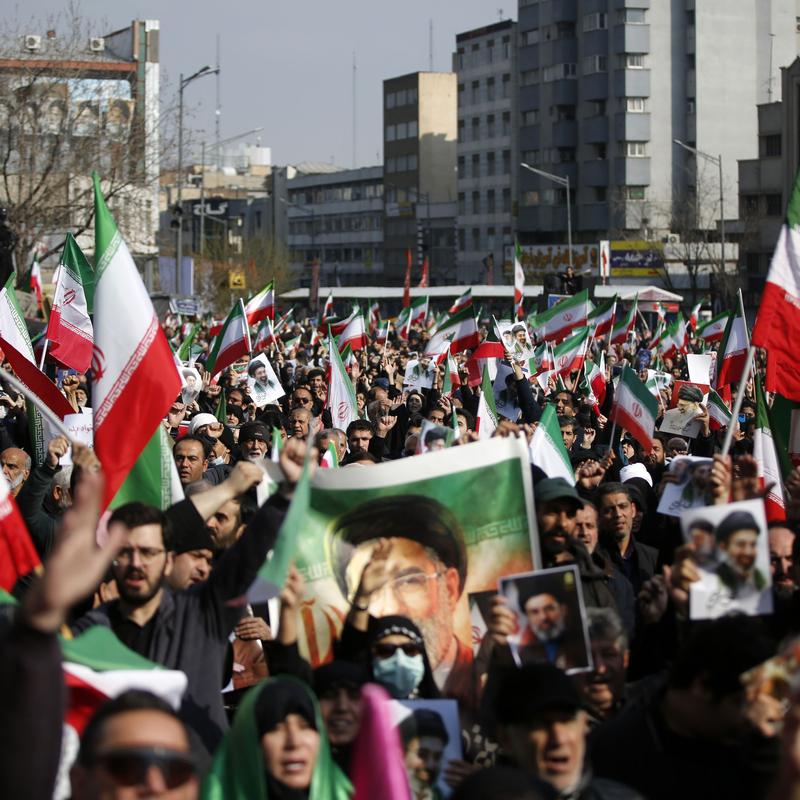
Regarding the war, a seventh American has now been confirmed dead in the war against Iran. President Trump keeps moving the goalposts for when he will declare mission accomplished. The Iranian leadership, as you may have heard, has now named Ayatollah Khamenei's son as, as the new supreme leader, which means a new person, but not regime change. No more democracy, just as much theocracy.
Trump, who has gone back and forth on whether regime change is a goal or just weakening Iran's ability to build nuclear weapons and wage regional wars, is now saying any new leader, "is not going to last long" without his approval, according to ABC News, who Trump said that to. Here's Trump's UN Ambassador, Mike Waltz, kind of backing that up, but maybe also fogging it up again on ABC this week, yesterday.
Mike Waltz: He wants to see leadership in Iran that no longer threatens the United States or allies in the region, that isn't attacking civilian airports, ports, shipping terminals, hotels and lashing out in the way that it is that can't hold energy supplies hostage in terms of the rest of the world and certainly isn't going to continue to do everything that they can to build a nuclear weapon. It has to be someone that we can deal with. It has to be someone that doesn't threaten Americans, attack Americans, and try to attack us and our allies at any given chance.
Brian Lehrer: That's UN Ambassador Mike Waltz on ABC yesterday. Is that digging in on regime change or just saying the US Will destroy their capabilities enough that no new leader can threaten in the ways Khamenei did? In our Brian Lehrer Show newsletter this week, we invited you as readers to say why you think the US really went to war against Iran and if you support the war. We asked, of course, because President Trump and his cabinet members have been all over the place in saying why or what their goals are.
We've got about 90 responsible responses, most opposed to the war. Here's a sampling of your theories as to why we're doing this. One person simply writes," Trump's ego. They were a lot like that." That put it succinctly. Another, "Because an Iranian tried to kill Trump, one that came up a lot in addition to Trump's ego." One person just wrote, "The Epstein files. We had various versions of that." Another common theme is captured in these responses.
One person wrote, "Trump wants to be a wartime president egged on by the defense and IT contractors who profit from war, and by Netanyahu who needs war to maintain his hold on the Knesset." Another like that adds Saudi Arabia says, "Trump's megalomaniacal hubris and king aspirations coupled with undue influence of the Arab states and Netanyahu." One more with a three part answer. "One distract from the Epstein files. Two Beebe forced the hand of Trump using USA-provided intelligence about Ayatollah's location," very specific and reportedly true.
"Three, nothing like focusing on an external enemy to rally the base for the midterm elections." One interesting response in support of the war from one of our readers also had a caveat. It said, "I support the war, but because the Iranian clerics have viciously ruled the country and supported proxies who dominated neighboring countries." That person added, "I oppose Trump's disregard for Congress's role in going to war. Another two part thought, this one from an opponent of the war who wrote, "Absolutely against the war, while recognizing that the death of Khamenei is to be applauded."
There's a sampling of responses that some of you wrote to our newsletter question. We'll have another newsletter out this Thursday. They come out every Thursday. Now here's another factor in why the US Went to war that wasn't in the newsletter responses because this reporting is new. The Wall Street Journal has an article today called Lindsey Graham's Quest to Sell Trump on Striking Iran. South Carolina Republican Senator Lindsey Graham.
Lindsey Graham's Quest to Sell Trump on Striking Iran. It says, "Some Democrats and even Republicans point the finger at Graham, who they think goaded Trump into a Middle east conflict with little plan for how the situation will play out long term. " That from the Wall Street Journal. Here's the South Carolina senator on FOX arguing for the president to go even further.
Lindsey Graham: I am a big admirer of Ronald Reagan, but I'm here to tell you that Donald Trump, in my opinion, is the gold standard for Republicans, maybe any president, when it comes to foreign policy. Maduro, everybody talked about him. Well, Donald Trump's got him in jail. Cuba's next. They're going to fall. This communist dictatorship in Cuba, their days are numbered. The Iranian regime, the mothership of international terrorism, is about to collapse.
Brian Lehrer: You get that part tucked in the middle there? Cuba's next. Senator Lindsey Graham on Fox. The Wall Street Journal article says Graham, "Spoke with Israeli Prime Minister Benjamin Netanyahu, coaching him, coaching Netanyahu on how to lobby the president for action." Now that article was by Wall Street Journal political investigations reporter Josh Dawsey. With us now, Wall Street Journal national political reporter Sabrina Siddiqui, who's been covering the war policy and developments. Hi, Sabrina. Thanks for coming on with us for our listeners while you're having to cover things simultaneously. Welcome back to WNYC.
Sabrina Siddiqui: Good morning. Great to be on with you.
Brian Lehrer: That Lindsey Graham article was by your colleague Josh Dawsey. What does it tell you about how the president might have decided this was a series of risks worth taking?
Sabrina Siddiqui: I think it's a really fascinating look at how President Trump has been willing to entertain someone like Senator Lindsey Graham, who has long wanted regime change in Iran and just more broadly has a much more hawkish kind of traditional neoconservative approach to foreign policy that Trump had in some ways or at least rhetorically moved the Republican Party away from in his first term. I think what Graham's motivations were here were to try and influence Trump's thinking away from the more isolationist figures within the MAGA movement.
It really this article, which I'd encourage people to read, unpacks the efforts that Graham went to, not just in terms of his lobbying of Trump to take what is a very risky gambit in his presidency, but also frequently traveling to Israel and as you said in our article, really coaching even Benjamin Netanyahu on how to proceed in his own efforts to lobby Trump to back military action in Iran and essentially try and ensure that Trump was listening to more of the pro interventionist wing of the party and not people within the White House who Graham refers to as the non entanglement crowd. It's just a really striking look at who had the presidency ear in these pivotal moments.
Brian Lehrer: I didn't see in the article, and tell me if you have anything on this, how Graham may have coached Netanyahu to convince Trump to go to war. Was it by telling him he's the greatest world leader in human history-- Trump likes to hear those things-- or some other way?
Sabrina Siddiqui: I do think that some of the messaging was surely in line with that. Graham, his own messaging to Trump, and I'm sure he urged Netanyahu to echo this, did sort of suggest that, "You would be the only president who's willing to do this. Even Republican presidents have not been willing to go this far." One thing that Graham told my colleague as part of his reporting is that he traveled to Israel several times in recent weeks and met with the country's intelligence agency and suggested that the Israeli government, and intelligence agency, told him things that even the US Government wouldn't tell him. I think what he persuaded Netanyahu to do was to show President Trump the kind of intelligence that would persuade him to move forward.
Another interesting tidbit in that piece is that Senator Graham also spoke with the Saudi Crown Prince Mohammed bin Salman to make sure that he was aware of what was happening behind the scenes. The exact quote from Graham was, "I went to MBS to say, 'Okay, I think this is going down.'" This is part of Lindsey Graham's long game. He's kind of advocated for military intervention in Iran for a long time. It looks like he was able to convince Trump that this could be a real legacy, defining moment, even if it comes with all the risks that the White House is now facing when it comes to the political reaction to the war.
Brian Lehrer: Yes, he's been advocating it for a long time. I should have pulled this clip, but it made me think of way back, maybe around 2007, something like that, when Lindsey Graham and Senator John McCain were the big hawks or two of the biggest hawks, during the Bush administration. McCain got caught on tape, and it didn't help him in his presidential campaign in 2008. Kind of doing a takeoff on the old Beach Boys song Barbara Ann.
Instead of Barbara Ann, McCain was singing, "Bomb, bomb, bomb, bomb, bomb, Iran." That was embarrassing when they got leaked, but McCain and Graham were on that page and even way back then. It's interesting what you say, if Graham was coaching Netanyahu to tell Trump that, "Hey, no other president, not even other Republican presidents would do this," because that's exactly what we heard coming out of Trump's own mouth on the Saturday morning video last Saturday morning, where he announced the start of the war.
No other president. He was addressing the Iranian people, supposedly, "No other president would do this for you. I'm doing this for you." It's interesting if that was a game of telephone from Lindsey Graham's brain to Netanyahu's lips to Trump's lips to Trump's lips.
Sabrina Siddiqui: I think that is actually very much what we've seen, is that when it comes to President Trump, a lot of the lobbying that people try to do in order to persuade him to take steps in any kind of direction is to really appeal to his ego because that's how he talks about himself. He has this very self aggrandizing tone and just attitude more broadly. He's the greatest at everything ever. I think that it's just like a way of appealing to him in the way that I think Republicans know works.
I think coming back for a second to the piece about the isolationists within the MAGA wing, I think that's also just a very interesting part of all this because there's been this idea that Trump is more of an isolationist. He's always talked, again, rhetorically about scaling back US involvement in military conflict overseas, but his actions have not actually necessarily matched the rhetoric he has been willing to show both in his first term and in this second term right now, sure, to a greater extent in this term where he'd had the raid in Venezuela, we have this war in Iran, they're high in Cuba.
In general, President Trump has shown a willingness, and this was true in his first term as well, to use military force when needed and to continue and back US Military campaigns in other countries. I think that that's important because, yes, there are a lot of prominent right-wing influencers who are criticizing the President over Iran and who disagree with his decision to take military action in the region, but Republicans give him a lot of latitude on these issues.
Because of this way in which he tries to project strength, he tries to frame this as an act of showing that America is still tough, that America's the leader on the world stage, you actually still see strong support from Republicans when it comes to the President's decision to go to war in Iran. Most polls are showing that a majority of Americans oppose the war, at least the initial polls. The reason it's fairly split and why it's not an overwhelming majority that's against the war is because Republicans are driving up the numbers of those who favor what the President is doing.
I think while a lot of people have focused on the split from some of the more prominent MAGA influencers or between the more prominent MAGA influencers and Trump over Iran, it's also true that Republicans are willing to give the President a lot of leeway when it comes to foreign policy and national security. I think that you're not seeing a significant breakup when it comes to Trump and his base in the actual numbers so far, how long this continues, and if it spirals out of control. That's something that could absolutely change the equation.
Brian Lehrer: Yes. I think you can see the contradiction in the phrase "Make America Great Again," because on the one hand, it's a sort of domestic culture war prompt. It has gone along with no more forever wars. We can spend the government's money on Americans, not on protecting people in Iraq or Afghanistan or however they wanted to spin it as other countries getting over on us. The word "great," Make America Great Again, implies that kind of big dog dominance, which we know is part of Trump's personality. There's that contradiction in Make America Great Again. I don't know if you've ever thought about that in that way.
Sabrina Siddiqui: It's really interesting. We've heard a lot from the people who are angry when it comes to the President's base. Like the MAGA coalition is, what happened to America first? I think that there's been a lot of frustration while, like I said, the polling shows that most Republicans are still behind Trump even amid this war. There's been a lot of frustration that we've heard from some of his supporters about the fact that he's so focused on foreign policy in this second term, which is also expected to be his last term.
From the President's vantage point and the administration's vantage point, it's quite clear that a lot of this is legacy building in their mind. The people elected him in large part because they were frustrated over the economy, inflation, cost of living. That was such a big driver in the 2024. People were angry that the cost of groceries were too high. Just costs of living in general were too high. People can't afford to buy a house, they can't afford to pay rent.
Regardless of what the record shows, he's always been seen as being stronger on the economy when it comes to the various issues that we often poll test at the Wall Street Journal. I think that frustration is what we've seen when it comes to this kind of contrast, and like Make America Great Again and America First. Then he spent this year taking the US into Venezuela, going to war with Iran.
He's obviously spent a lot of time, again, eyeing possible next steps in Cuba. I think it's not in line with what the American people's priorities are. Poll after poll has shown us that foreign policy ranks low as an issue when it comes to voter priorities. Will that change? If anything, it might change. If this becomes a catastrophe, then it might become a real deciding vote, especially in an all-important midterm election year where Republicans are on the defensive.
Brian Lehrer: Yes, foreign policy always ranks low year after year, generation after generation in voters' minds, unless there's something intense and very recent going on like the period right after 9/11. You're a national political reporter. I think you were just starting to touch on this. Are national Republican strategists starting to figure out what they think this means potentially for the midterm elections or how to spin it or is it too early because it really depends on how this plays out to the political credit of the administration or not in the coming weeks?
Sabrina Siddiqui: When I talk to Republican strategists and pollsters, they say that it really depends on how long this drags on. What they often say is it's March, people are not going to the polls until November, and their attention spans are very short. Now, that doesn't mean that they're not worried, just because what we've seen is that Democrats hold the upper hand, and any midterm election is challenging for the incumbency.
It comes back to this idea that they would much rather Trump had just been focused on the economy. This is not the issue that Republicans want to be front and center when they're trying to defend both chambers of Congress and have these very narrow majorities. Trump is already undergoing pressure to address surging gas prices. I think that while-- [crosstalk]
Brian Lehrer: Because of the war?
Sabrina Siddiqui: Yes, exactly, because of the war. The administration is kind of dismissing these concerns, saying that the higher costs will ease once the war ends. When will that be? First the administration was saying that this is a very narrow operation and it's just going to be a matter of weeks. I think they said something like four weeks. Then we've heard some projections from other parts of the administration suggesting that-- I know, at least CENTCOM has suggested that the war will likely last through September.
I think that that's exactly where Republicans are concerned. If it's something that is over within the next few weeks and then by November, no one's talking about it, it's a thing of the past, then it's not as big of an issue, but that's very unlikely. It's very unlikely that this will, in fact, be a very narrow, short-lived conflict. Again, it's just another example of Trump not addressing the issue that is front of mind for voters and feeds into this idea that he's not doing anything to alleviate the economic pain that voters are feeling, and instead, his attention is focused overseas.
Brian Lehrer: Listeners, we can keep going on the question from the newsletter as well as anything else about the latest developments. 212-433-WNYC, call or text. Newsletter question was last Thursday, and most of our responses came in Thursday and Friday. Why do you think today that the US Is doing this? What do you think the end of it should be? Even if you're totally against having started this, it's on. The question of now what remains very relevant, or any questions you have for The Wall Street Journal's Sabrina Siddiqui. 212-433-9692, as the Brian Lehrer Show continues.
[MUSIC]
Brian Lehrer on WNYC, as we talk about war developments and related things with Wall Street Journal national political reporter Sabrina Siddiqui. Among the things we're discussing is the Journal's article. I'm looking for the headline again right now about Lindsey Graham, but it's about how Lindsey Graham goaded Trump into this war. We played the clip earlier of Graham on ABC yesterday, saying, "Cuba's next." Before we get to some listener calls and texts, how serious is this for you, who report on the White House in this context a lot? How serious is this, "Cuba's next"?
Sabrina Siddiqui: I do think that there had been a lot of speculation that what President Trump and his administration were doing in Venezuela was effectively a precursor to other ambitions in Cuba. I think because he has been fairly unchecked in the actions that he's taken so far, there's not a lot of sense that anyone would block him from pursuing regime change in Cuba as well. I think that it's something that the president has talked about a great deal, and it's also something that importantly, Secretary of State Marco Rubio, who played a very key role in the administration's Venezuela strategy.
It's something that Secretary of State Marco Rubio has also long wanted to do is pursue regime change in Cuba. I think, especially given what we've seen in terms of the very aggressive approach that this administration has taken to meet its objectives, I would take it just as seriously as any as the president's actions in Venezuela and Iran.
Brian Lehrer: Some of the things coming in in text messages from our listeners, one has another theory about why Trump might have launched this war: "Provoke terrorism to justify election interference." I guess they mean some kind of state of emergency declaration. Another listener who's more supportive writes, "Isn't it smart for the US to fight Russia in a proxy war? Fight Russia in a proxy war by removing Iran's weaponry that it was selling to Putin to kill Ukrainians."
Actually, that's another angle the last few days or something related to that is that Putin has been giving Iran intelligence about the location of American targets in the Gulf. Have you seen that one, Sabrina? Because Trump is perpetually soft on Putin. Now if Putin is giving Iran intelligence on where to find American targets and destroy American things, possibly kill American people, does that drive a wedge between them in any meaningful way?
Sabrina Siddiqui: I think it could. It is true, based on the reports, that Russia is providing Iran with information that would help them target and attack US Forces in the Middle East. It's yet another sign that there's another US adversary that is taking part, even if indirectly, in this war. It also shows the ways in which this conflict is very quickly expanding, given Russia is, of course, one of the America's main nuclear-armed competitors, and has very extensive capabilities when it comes to intelligence. I think what's interesting about Trump and Putin is that in President Trump's first term, he was, as we all know, famously very friendly with Putin.
You stood next to him in Helsinki and took Putin's side on the question of whether or not Russia had meddled in the 2016 election over the findings of the US government. He was willing to give Putin a lot of leeway in his first term. In the second term, it's been a little bit different because I think, as we were talking about President Trump and legacy building and his focus on foreign policy in the second term, the president and his administration have also been pursuing an end to the war in Ukraine and been very extensively engaged in peace talks.
There's been a slightly tougher approach that Trump has taken toward Putin as part of those peace talks. He has grown very frustrated with Putin. I think this could add to that frustration without question. I would say it's not exactly the same relationship it was in President Trump's first term and in President Trump's second term, where he's very eager to have been able to strike a peace deal between Russia and Ukraine. His patience with Putin was already waning on that front. This is something that I think would drive even more of a wedge between Trump and Putin.
Brian Lehrer: I'm not so sure about patience was waning on that front. I mean, he went to war against Iran, which really was no immediate threat to the United States, everybody says, even if it was an ongoing threat to some other countries in that region, talking about going to war against Cuba, which is not any kind of threat to the United States, but people are dying by the tens or hundreds of thousands in Ukraine.
Trump keeps kicking the can down the road and not really doing much to actually pressure Putin. He denounces Zelensky as much as he denounces Putin and all of that, but that's really for another show. We had that one text that was saying this works against Putin, this war in Iran. A lot of people have said, yes, it has the side effect at least of weakening China as well as Russia. Frank in Brooklyn has a different take on that, I think. Frank, you're on WNYC. Hello.
Frank: Hello. Hi. I'm a longtime sustaining member. I like to know if this will embolden China to cause some problems with Taiwan while Trump and Europe are busy with Iran.
Brian Lehrer: Anything on that, Sabrina?
Sabrina Siddiqui: Sorry, I actually had a momentary connection. Could you just repeat what the caller said?
Brian Lehrer: Sure. He's wondering if this emboldens China to attack Taiwan while the US is so embroiled in the Middle East with its focus there.
Sabrina Siddiqui: I think that it's a little bit hard to say. I do think that there's always going to be a concern, given the US is entangled in this conflict and its attention is focused there, that it's an opportunity for other actors in other parts of the world to take advantage. I think that that's something that is always going to be a question when it comes to just where the administration's focus and where its priorities are.
I haven't heard a lot of talk about just how serious of a threat that is. Obviously, there's also supposed to be a meeting between President Trump and Xi Jinping at some point in the near future, and so I think that would be a key part of those discussions. It's not entirely clear just how much this would potentially impact Taiwan specifically, but it's something that I think certainly warrants attention.
Brian Lehrer: Here's another text from a listener that says, "Iranian American here. It is an illegal war. No congressional approval. All Iranians, 85% to 90% pray for regime change. If it ends with the regime still intact, the regime will take it out on the Iranian people again," writes that Iranian American. What did Trump say on Saturday about when he'll declare this over? Listen.
President Trump: It’s where they cry uncle or when they can’t fight any longer, and there’s nobody around to cry uncle-- that could happen too, because we've wiped out their leadership numerous times already. It's if they surrender or if there is nobody around to surrender.
Brian Lehrer: "If there's nobody around to surrender. We've wiped out their leadership numerous times already." That was before, later Saturday or early Sunday, they announced that the son of Khamenei, Mojtaba Khamenei, has now been chosen the new supreme leader. You reported on another Trump quote the other day: "Khamenei's son is unacceptable to me. We want someone that will bring harmony and peace to Iran." What does "unacceptable to me" mean? Do we really know?
Sabrina Siddiqui: We don't really know. I mean, look, the president has said that he wants to have a direct hand in determining who the next leader of Iran will be. They're all over the place on whether or not this is a regime change war. For Trump to say that he wants to be able to choose the next leader is pretty much plainly admitting and acknowledging that, yes, in fact, this war is at least in part about regime change.
When it comes to Mojtaba Khamenei, I think that he's a very interesting figure because he's not held up until now any public position. He's someone who was rarely seen at public events and didn't really give speeches. He has grown very powerful in the shadows by building ties over the course of decades with key figures in Iran's intelligence and national security apparatus. I think that he, in many ways, was being groomed to possibly succeed his father, who already had health problems before he was killed.
I think that it's going to be a very interesting thing to watch. It would still be, I think, expected that it would be somewhat of a continuation in terms of how he might rule over Iran. We also have to see how the Trump administration reacts because you have President Trump out there saying that the younger Khamenei won't be there for very long. What exactly does he mean by that? We don't entirely know.
I do think it's just important to come back to this idea that Pete Hegseth said in the early days that this was not a regime change war, but the regime did change. Now you have Trump in recent days making it very clear that, "Yes, in fact, this is, in essence, a regime change war. I must have a hand in deciding who the next leader of Iran will be."
Brian Lehrer: Ali in Queens, you're on WNYC. Hello, Ali.
Ali: Brian, thank you for taking my call. I've been trying to call you for past five days. I'm tired of all your experts. I am from Iran. I was involved in revolution. I don't know what is going on in our country. First of all, 70% of Iranian these countries, they make their money by dealing with the regime. They made the money. FBI have cases after case in San Jose, California, Washington, DC. There are CIA assets that are Republican donors. This has to stop. There is no change of regime in Iran.
It will never happen. Not this regime. They learned from Marcos of Philippines, they learned from Charles Falls. I don't want to tell you how many friends I have in this regime. Nothing is going to happen. I don't know who forced us to go to this war. You just secure this regime. We have underground airports, all the assets of Iran, submarines. Where are our submarines? In China. Nothing has happened to this regime. Your expert keeps coming up for past four or five days. I'm so tired of them. You guys keep saying that Iranians are happy this regime change.
Brian Lehrer: Ali, let me follow up on one thing that they would all argue, all the experts, all the people I think on both sides of the island government that Iran's military is being severely weakened. Its missile supply, its anti missile supply, its capability to enrich uranium, its navy, its air force if nothing else. That's not to take into account or that's not in this question to mention all the moral questions about any war. The school that was hit, presumably, they weren't targeting a school, but 175 mostly children killed. That school was near a military base, we are told. All of the negatives here. If the goal is to destroy Iran's capacity to create military mayhem in the region, then maybe they're accomplishing at least that goal. What do you think about that, Ali?
Ali: May I have your, May I have your permission to answer you?
Brian Lehrer: Yes. I'm asking you the question.
Ali: First of all, your expert knows that the Hussein University in Tehran, which they heeded [inaudible 00:38:31] regime, has inventory of ballistic missiles, weapons underground. We have stuff that was built during the Shah that these guys, my friends that are still in this regime, I graduated from them from university. Some served in the government of Iran Revolutionary Guard Intelligence Office. The inventory of the weapons in Iran will never be depleted.
Brian Lehrer: Ali, I'm going to leave it there and I really appreciate your calling. I'm going to get a response. Sabrina, it's an interesting theory that the Iranian regime has more weapons than we tend to think we know about stashed here and there, including with allied countries to it. I don't know. It certainly raises the question of is all this death of innocence along the way, of everybody else who's involved, who's not supposed to be a target, if all the suffering is morally worth it, because does it even accomplish anything? I guess only time will tell, unless you have anything to add.
Sabrina Siddiqui: I think it's hard to say. Only time will tell. I do think it's Important, though, when you're talking about the moral question here of whether or not the objectives are, "worth it" to try and center the civilians who are always at the center or always bear the brunt of any war. You mentioned the girls' school, which has obviously been one of the most devastating tragedies to come from this short-lived conflict so far.
Since the US And Israeli strikes on Iran began, in addition to schools, there are other historic landmarks that have been severely damaged, as well as a hospital. Already the human rights groups are estimating that nearly 1,200 civilians have been killed, including nearly 200 children. A lot of people are suggesting-- at least on the ground, you have some residents who've told reporters that it seems like a dystopian nightmare. I think that that that is to me, and I think to a lot of people, always going to be a key question.
Of course, we've seen in previous very recent conflicts that the US has engaged in that oftentimes either it's built on false pretenses or the objectives are not, in fact, met. You look at what happened after a nearly two-decade war in Afghanistan. At the end of it all, it's the civilians who paid the price. That's why I wanted to just mention what the impact has already been when it comes to civilian casualties and the destruction of civilian infrastructure in Iran.
Brian Lehrer: Thank you for that. I want to touch one more thing before you go, and it is about civilian infrastructure, because another major issue, and I know you've been covering it, is the widening of the war in various ways, how it's involving the Gulf Arab states generally, how both sides are now hitting civilian infrastructure, like water desalinization plants and oil refineries. It even brings us back to Lindsey Graham, oddly enough, who, despite being such a hawk, who, as the Wall Street Journal reporting today indicates, the article's word, goaded Trump into this war.
He now tweeted a warning to Israel, who of course, Lindsey Graham considers an ally, to be careful what they hit because they've been hitting oil refineries that Graham says the Iranians will need after regime change to rebuild their country and rebuild their economy. Both sides now hitting desalinization plants in one country or another that could lead to fresh drinking water shortages both in Iran and in some of the Gulf states. You reported before the weekend that foreign ministers of the Arab League were planning an emergency meeting for Sunday to discuss Iran's attack on several countries in the region, meeting requested by Saudi Arabia, according to Arab officials you quoted. Do you know if that meeting happened?
Sabrina Siddiqui: That meeting was held on Sunday, as you said. There were a couple of readouts. They didn't give a whole lot of information beyond saying that the meeting discussed the Iranian attacks and territorial integrity of several Arab countries and the serious risks that this conflict poses to the security and stability of Arab states and the region more broadly. I think just to your broader point in the run-up there, this has really already inflamed a lot of old tensions.
Saudi Arabia and Iran have long been engaged in this proxy war, and now you're seeing this in tensions, the US urging Americans to leave Saudi Arabia. Importantly, because we were talking about the regime change question, if the American military effort does not actually end in regime change, if it does not actually meaningfully change anything about Iran's behavior, then there's a lot of concern among countries such as Saudi Arabia and Qatar and others that they would in essence have to then live with the consequences of this war and what would most likely be a wounded, but also resentful Iran, given the-- [crosstalk]
Brian Lehrer: Resentful and revengeful to go to the word you used.
Sabrina Siddiqui: Exactly. In many ways, this just underscores the enduring risks that a lot of countries in the Gulf have felt for some time. That is why they had actually for a long time tried to pursue a strategy of rapprochement, and, of course, now the US has pulled everyone in another direction.
Brian Lehrer: Sabrina Siddiqui, national political reporter for the Wall Street Journal, thank you so much for giving us this much time today.
Sabrina Siddiqui: Thank you so much. Great to be with you.
Copyright © 2026 New York Public Radio. All rights reserved. Visit our website terms of use at www.wnyc.org for further information.
New York Public Radio transcripts are created on a rush deadline, often by contractors. This text may not be in its final form and may be updated or revised in the future. Accuracy and availability may vary. The authoritative record of New York Public Radio’s programming is the audio record.
