
Monday Morning Politics: Trump Meddles with Latin American Presidents; Pauses Migration from "Third-World"; And More
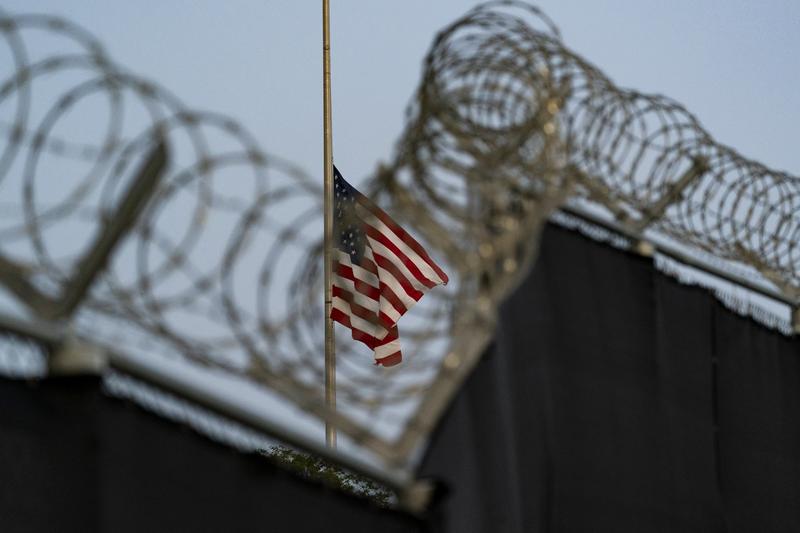
( Alex Brandon )
[music]
Brian Lehrer: It's The Brian Lehrer Show on WNYC. Good morning, everyone. Hope you all had a good Thanksgiving weekend. I want to say thank you to everyone who worked this weekend while everyone else had time off, all the retail workers and restaurant workers and taxi and rideshare drivers and all first responders, law enforcement and medical first responders of all kinds everywhere.
I'm sure your work was even more poignant than usual after the horrible shooting of two National Guard members on the day before Thanksgiving in DC. Let's remember their names. West Virginia National Guard member Sarah Beckstrom, just 20 years old, was murdered in the shooting. Andrew Wolfe, age 24, survived but is currently hospitalized and listed in serious condition.
You know who else worked a lot this weekend while you may have been relaxing and not following the news? President Trump did a lot. He talked about removing one Latin American head of state who accuses of directing drug smuggling into the United States while he pardoned another Latin American head of state convicted here of exactly that. He continued to go back and forth on who to blame for the lack of resolution on the Russia-Ukraine peace plan drafts they've been working on.
The President also responded to the National Guard shooting with a sweeping new immigration crackdown. Now, the shooting was reportedly by one person acting alone who was reportedly having major mental health problems. The President keyed on one fact about the person that he was from Afghanistan. In fact, as you may have heard if you followed any news this weekend, he had helped the United States in the war in Afghanistan and was given asylum in this country this year by the Trump administration because the Taliban would probably have wanted to kill him.
As The New York Times reports, "The State Department announced on Friday night that it was halting visas for Afghans, including those who had helped the United States during the war in their country." Additionally, the President announced on Thanksgiving Day that he will "permanently pause migration" from what he called third world countries. He put 19 specific countries on a list for that permanent pause. Democratic Senator Chris Van Hollen of Maryland had a reaction to that yesterday on ABC this week.
Chris Van Hollen: I do think it is outrageous and unfair to try to punish an entire class of people for the evil acts of one person. That is collective punishment. These are individuals who worked side by side with America in the fight against the Taliban. If they were sent back now, the Taliban may likely kill them.
Brian Lehrer: Senator Chris Van Hollen on ABC this week. With us now on these developments and more is New Yorker magazine, Washington, DC staff writer Susan Glasser. She is well placed to discuss all this US foreign policy news as a former editor-in-chief of Foreign Policy magazine, having covered the Iraq and Afghanistan wars and four years as Moscow co-bureau chief for The Washington Post. Her books include Kremlin Rising, The Man who Ran Washington, and The Divider, the more recent best selling history of Donald Trump in the White House, which she co-wrote with her husband, Peter Baker. Susan, we always appreciate when you come on with us. Happy belated Thanksgiving, and welcome back to WNYC.
Susan Glasser: Well, thank you so much, Brian. I am a little bit overwhelmed, to be honest, listening to you recount all the ups and downs, shall we call them, of the Thanksgiving weekend when it comes to the President of the United States. It's quite a list, isn't it?
Brian Lehrer: It sure is. We thought it was a holiday weekend time off. Can you describe in any more detail what the President's policy response was to the shooting of the National Guard members and how much of this is real policy that that will affect people's lives as opposed to the President venting or posturing?
Susan Glasser: I mean, this is an important question, of course, and I'm glad you started out as we should with this being an incredible tragedy. I mean, think about how young those two National Guard soldiers were and literally just brand new to the role as well, just having shown up essentially, it's very painful and a terrible story on the eve of the holiday. It doesn't make it less painful that the President has chosen to exploit this essentially to pursue a laundry list of policies, stringent anti-immigration policies that he was interested and his advisors like Stephen Miller were interested in pursuing.
Anyways, that word that Chris Van Hollen used, the phrase that he used was collective punishment. That was the one that sprung to my mind as well, the actions of a single clearly unhinged individual should not call forth retaliation and retribution on citizens of perhaps dozens of nations, and yet that's exactly what the response was of Trump and his administration. We've seen it before. It's the classic Rahm Emanuel, a crisis is a terrible thing to waste kind of an approach by the White House, it seems to me, where they have a pre-existing laundry list of policies and they use the opportunity of some terrible event to go ahead and try to put those through.
Brian Lehrer: Right. We played the Chris Van Hollen clip about collective punishment for the act of one individual and the prospect that these thousands of Afghans, I mean, this population of all people who helped the US fight the Taliban, might be sent back to that regime that would consider them traitors. Why wouldn't they, of all immigrants, be considered heroes and especially welcome, unless they prove themselves to be otherwise, as this one individual obviously did?
Susan Glasser: You just nailed it with that. That's exactly what I've been thinking over the last few days. I would point out also that it was many Republicans, including senior officials of Trump's own government, who were demanding that more and more such people be let in in the aftermath of the chaotic US withdrawal from Afghanistan in the summer of 2021. There's a quote from Mike Walz, who was Trump's first second-term national security adviser, now UN Ambassador essentially demanding more Afghans be admitted and calling them heroes, as many of them were.
It's particularly painful and personal to me, I have to say, Brian, because I've been thinking so much the last few days over my own translator. When I was in Afghanistan in 2001 and 2002, the first Afghan translator I worked with was a young, very smart medical student in the Eastern Afghan city of Jalalabad who helped me to cover the Battle of Tora Bora for The Washington Post, something that I would say neither of our mothers approved of, to be clear.
He went on to finish medical school. He became a respected doctor, ran his own clinic in the City of Jalalabad, married, had, I believe, six children. We fell out of contact. He contacted me in the middle of this chaotic American withdrawal from Afghanistan, said that he was under risk, known to favor the West and also to have worked with Americans previously through a long series of extraordinary coincidences and a lot of great things happening from people.
This man and his family was evacuated to the United States. About six months later, he called me from the border of Canada and he said, "I am thinking of leaving the United States and going to Canada because I believe it will be easier for my family to gain permanent legal status there, to be able to go to school, for me to work again as a doctor. That's what I am." I paused for a second and I thought. He also said, "Because it's not as racist there." It was a really painful moment given how much so many people had done to get him to the United States. In the end, I told him that I thought it was probably the right decision, and I think that it was.
Brian Lehrer: That's sad. That is really sad. Now, listeners. I wonder if any Afghans are listening right now who helped the United States in the war in Afghanistan, who are now here who would like to say something. 212-433-WNYC. I don't know if anybody from that population happens to be listening right now, but if you are, you'll get first priority on the phones. 212-433-9692.
Anyone else on any of these stories this morning, the policy response to the shooting of the National Guard members in DC, targeting alleged drug smugglers from Venezuela while pardoning the former head of state from Honduras convicted of exactly that, or US, Russia, Ukraine, or also, we'll touch on the national politics ramifications of the election of Mayor-elect Mamdani and the friendly Trump appearance with him or anything related to those developments over what might have been a quiet Thanksgiving weekend for you, but not necessarily for the world. 212-433-WNYC with Susan Glasser, Washington, DC staff writer for The New Yorker. 212-433-9692. You can call or you can text.
On the broader crackdown, Susan, on a total of 19 countries as a response to the shooting, here's Homeland Security Secretary Kristi Noem. Also on ABC this week, like Senator Van Hollen was.
Kristi Noem: If you don't know who they are, if they're coming from a country that's not stable and doesn't have a government that can help you vet them, that we shouldn't allow it.
Brian Lehrer: Is there a catch-22 there or a real policy dilemma? I mean, any country definitely wants to vet people coming in, but if you're seeking asylum here, asylum in particular, it's likely because the country you're fleeing is unstable and they're putting you specifically in danger. At least that's your claim. How can that standard be to only accept asylees when those countries that they want to flee, vet them?
Susan Glasser: Brian, can you hear me?
Brian Lehrer: Now we got you.
Susan Glasser: Oh, okay. Yes, I think you're exactly right. I was on with a former congressman who made exactly that point yesterday. The administration can't just make up a law because they feel like it. That's just not how it works. Their job is to faithfully execute the laws that have been passed by Congress. That is not what the Homeland Security secretary is outlining is something that bears no resemblance to the actual law of asylum and how it is to work in this country. It also is a fallacy. I mean, it would be impossible by that standard to come from anywhere except a very stable dictatorship, frankly, which seems to be the kind of government that Trump and many of his advisors are most comfortable working with.
It's such a painful thing, taking it one level of altitude up, that so much of what we're seeing over the first nine months of this second term in Trump's office is the deliberate targeting of vulnerable populations, whether that is immigrants who are already here in this country, who are being rounded up, some of them without cause. We know people were horrified by reports over the Thanksgiving weekend of a tactic being used by immigration authorities, of having literally arresting people in the middle of interviews with their married spouse. Things like that really tell you about the targeting of individuals in our society who are the least able to push back against these techniques and tactics.
Asylum seekers, of course, have made a decision to leave their lives, to uproot themselves from the world that they know in extreme circumstances. That makes this all the more painful. We'll see already almost everything that Trump has done on the immigration front has been challenged legally. We don't really have a full picture yet of where the line will settle once all the litigation has been undertaken. Of course, what Trump is trying to do is to create facts on the ground before there are court rulings that tell him to stop doing these things.
Brian Lehrer: You talked before about how this murder plus assault, attempted murder as an individual incident might be an excuse, an opportunity for the President to do some things that he wanted to do anyway. Some texts that we're getting along these lines. Listener writes, "This is simply about racism. Trump and his acolytes are taking the act of one individual and generalizing, stereotyping, and stigmatizing tens of millions."
Another one along these lines writes, "Are we going to send back the European heritage white males that their great grandparents came from, who are the bulk of the mass shooters?" Another one, "Two National Guard members wouldn't have been harmed if Trump didn't send them to DC. The Trump administration is responsible for their deaths."
On those first couple of texts, and this being an opportunity, could this just be an excuse for the President to do what he always wanted to do, and that is limit immigration from what he called over the weekend Third World countries and other groups that he considers, we might say, just too foreign? We remember his attempt to block all Muslims from entering at the start of his first term.
Here's a clip of the Republican governor of West Virginia, Patrick Morrissey, on NPR over the weekend. Of course, the National Guard members who were shot were from West Virginia, and he paid tribute to them, of course, but asked if Trump's broad immigration crackdown was an appropriate response, the governor said this.
Patrick Morrissey: Not only was there potentially inadequate vetting, but you have a lot of people that are introducing a different element into the US, and even if you talk about one violent predator out of every hundred or thousand or a million, we have to tighten that up. These are people that we don't want coming in.
Brian Lehrer: One violent predator out of every hundred thousand or a million. Again, to the text that I read out from one of the listeners, what if they had applied that standard to people from Italy when the Mafia was taking hold as a thing in this country? In addition to mentioning vetting, which is of course very fair, he said, "Introducing a different element into the US." That jumped out at me and reminded me of something President Trump said in his UN General Assembly speech this fall, Susan, where I thought he said the quiet part out loud about an underlying reason for his mass deportation program.
He usually hangs it on things like wanting violent criminal migrants deported, which again, is fair to protect Americans. At the UN, encouraging less immigration to many countries, the President said this.
Donald Trump: Proud nations must be allowed to protect their communities and prevent their societies from being overwhelmed by people they have never seen before, with different customs, religions, with different everything.
Brian Lehrer: Do you hear those clips as of a piece, Susan, or revealing a deeper cultural concern than about individuals who commit crimes?
Susan Glasser: Absolutely, Brian, absolutely. We've seen this kind of sentiment in our society before. This was a persistent theme of American politics in the late 19th century, in the early 20th century. It led to the imposition, the passage by Congress of various laws that are now considered shameful laws restricting people on the basis of what country they came from or their ethnic origin. There's a long strain of this. There's a whole party in the US in the 19th century, the know nothings.
It's painful to hear it in a modern context. It's absolutely consistent with Donald Trump's views. First of all, he's always viewed this kind of anti-immigration strand of his own politics as one of the main reasons that he became president not once, but twice. He sees it, A, as a political winner for him, B, it's a core set of views that he has consistently.
Remember the controversy in Trump's first term when it was reported that he had said in front of members of Congress that he didn't want people from shithole countries coming into the United States? Well, this is the same viewpoint that he clearly has now here in his second term as well. It's this element, it's this signaling also and messaging to the part of Trump's MAGA base that essentially is pursuing a, what you might call a kind of a white nationalist or a Christian nationalist perspective about the United States, that they want to shut the doors of the country to people who they believe don't belong here. It's very painful element of our current politics that the President believes that this is good politics for him.
Brian Lehrer: Listeners, if you heard a little gap in Susan's last answer there is because she used the whole word that you're not allowed to say on the radio for how Trump previously characterized ass whole countries as we tend to say here.
Susan Glasser: Not my word. Not my word.
Brian Lehrer: No, you were just quoting the President of the United States, but we still have to buy abide by FCC laws. All right. To those related points, here is O'Brien in East Orange, you're on WNYC. Hello, O'Brien.
O'Brien: Hello. Good morning. My question is, with the pause in asylum applications, does that also apply to the Afrikaners that the President wanted to grant asylum for minority persecution?
Brian Lehrer: You mean Afrikaans, the white South Africans?
O'Brien: Yes.
Brian Lehrer: Susan.
Susan Glasser: It's a good question. I'm going to strongly think that no is the answer. This is not just a preoccupation of Trump early in his second term, by the way. I noted that just recently Trump was again posting on social media about what he claims is the genocide, although there is no evidence of that being the case, but what he claims is the genocide of white South African Afrikaners. He has made an exception, in fact, to his otherwise strong opposition to basically most categories of asylum seekers in order to expedite the arrival in the United States of this one small category of people.
Again, the inversion of truth and reality, I know, is something that a lot of people see as one of the main hallmarks of Trumpism. I think this particular issue is one that, for me, is just the most glaring, where you have Trump claiming the persecution of white Afrikaners is the biggest issue in the world while shutting out thousands or hundreds of thousands of people from this country who were legitimately fleeing the worst kinds of war and ethnic violence and persecution.
Brian Lehrer: I was watching a CNN documentary the other day from South Africa where they were talking to a lot of white people, including a lot of white farmers who feel that there is sometimes violence there, but none of them were saying that it was primarily racially motivated or that the word genocide is being used among them in that country.
Also, Susan, I don't know if you have any stats on this, but I've heard people say that this offer of refugee status to white South Africans because of the alleged white genocide or interest in white genocide just isn't being taken up by anybody. It's not like there's a flood of refugees who are white South Africans coming to this country where they've been invited to come now, like there are refugees from other countries who the President doesn't want here. Do you know?
Susan Glasser: Well, it's very interesting you say that. I don't know exactly. I will say this, and this is important to remind people, by the way, that as of the end of October, Trump made a decision to cap refugee admissions at a record low of just 7,500 refugees for the fiscal 2026 year and restricting access to program for many other groups. In fact, because it's so low, most of the people in that 7,500 were going to be white South Africans.
Again, just to give you some context for how much he's already gone after asylum seeker, so in a way, this whole latest attack on this has already happened in a practical sense, in the last year of Joe Biden's presidency, the previous limit was 125,000. Trump has already cut that to 7,500. Again, the vast majority would be white South Africans. It's just a dramatic change, first of all. Second of all, in a world of a lot of things that we consider to be outrages, I don't know where this one ranks, but it's an overlooked outrage, again, targeted at many of the world's most vulnerable people.
Brian Lehrer: Here's a point of history from Dominique in St. Augustine, Florida, as it relates to this conversation, and I think interested in correcting something that I said. Dominique, you're on WNYC with Susan Glasser from The New Yorker and me. Hi.
Dominique: Hi. I mean, just a little point of correction you mentioned. Can you imagine them limiting immigration because of what the Italians activity in the Mafia? Well, they did do that. That was called the 1924 National Origins Act. It was also the pretext of the small number of Italians who were involved in the Mafia was extrapolated out to hundreds of thousands of people such that the numbers of immigrants from Southern and Eastern Europe who were not considered white at that time was drastically limited. I guess, as a historian, I'd love to encourage the use of history to look back at what was already done in the past and rather than sort of pitting past immigrants against current immigrants.
Brian Lehrer: Yes, it's a great point. I take your point, and I see that you're an immigration historian. I guess we could say there was always resistance to what whoever was here saw as cultural change that they didn't want. The British said it about the Germans coming here, and then they all said it about the Irish and Italian and Jewish immigrants, as you're pointing out. That backlash resulted in the 1924 Immigration Act, which largely closed off immigration from those places and a lot of other places. This is a recurring in US immigration history pattern, and here we are again. Would you put it something like that, Dominique?
Dominique: I would. I would go a little bit further and say, just as a hundred years ago, Italians and other "undesirable immigrants" were labeled not white. It's quite likely that 100 years from now, Afghans and other immigrants will be adopted into sort of that white fold. I think for those of us who are interested in the study of history, I think it's very important to look at similarities as well as differences across time.
Brian Lehrer: Thank you very much for your call. We really appreciate it. We're going to take a break and continue with Susan Glasser, Washington staff writer for The New Yorker. We're going to start to talk about the shocking development regarding some of the US attacks on suspected drug boats coming from Venezuela and why this may have now ramifications for the tenure of Pete Hegseth as defense secretary because of something that he allegedly did that's reported in The Washington Post with respect to at least one of these boats that even Republicans in Congress are now seriously questioning. We'll also talk about DC after the election of Zohran Mamdani. Stay with us.
[music]
Brian Lehrer on WNYC as we continue to talk Monday morning politics as we often do to begin the week, this week with Susan Glasser, Washington, DC staff writer for The New Yorker, and you at 212-433-WNYC with your calls and your texts. Susan, Venezuela, where relevant to what we were discussing before, so many asylum seekers in the US have been from in recent years, pretty much every one of-- at least both US Parties agrees President Maduro there is awful. President Trump announced this weekend that the US is closing Venezuelan airspace. Do you understand yet if that is an actual no fly zone to be enforced by the US Military?
Susan Glasser: The fact that we're asking the question, by the way, Brian, is really underscores the complete confusion and uncertainty when the President has sort of mobilized an extraordinary military presence threatening Venezuela without any clarity around why he's doing it, what exactly he's doing, to what end, whether there's any political agreement inside the US or among those opponents of the Maduro government. It's one of the most kind of bizarre and ill-considered military mobilizations I can ever recall, frankly.
No, I don't think we have any more clarity. It doesn't appear to be a no fly zone of the kind that the US and its allies had over Iraq at various points during Saddam Hussein's government, for example. I'm not sure exactly what it means, except it's another of increasing escalating threats that also comes at a time when there's apparently been backstage diplomacy between President Trump and Maduro as well. A lot of confusion. The military, the naval presence right now off of Venezuela is really remarkable. Basically, we've taken a huge percentage of the US Navy and sent it into an area that would not normally be considered a major national security threat of any kind to the United States.
Brian Lehrer: As everybody knows, the US has been attacking alleged drug boats from Venezuela. The Washington Post had an article this weekend with an allegation that Defense Secretary Pete Hegseth ordered survivors killed after one of those attacks had already rendered them not a threat. Even some Republicans in Congress seem to be alarmed by that, including Don Bacon of Nebraska in this clip on ABC this week.
Don Bacon: If it was as if the article said that is a violation of the law of war. When people want to surrender, you don't kill them, and they have to pose an imminent threat. It's hard to believe that two people on a raft trying to survive would pose an imminent threat.
Brian Lehrer: Republican Congressman Don Bacon of Nebraska. Susan, Secretary Hegseth denies The Washington Poststory, we should say. Is there a way Congress can confirm if it's true or not?
Susan Glasser: Yes, absolutely. I thought it was notable considering how resistant Republicans in both the House and Senate have been up until now on exercising any significant oversight over the Trump administration that you did have the Republican shares in both the House and the Senate join with their Democratic counterparts over the weekend and say that they would investigate this, that they would hold public oversight hearings.
I, for one, would certainly like to hear the under-oath testimony of the US combatant commander for that region, who apparently reportedly stepped down rather than to follow the administration's plans for this escalating military campaign against boats in the Caribbean. Reports are that close to 100 people have already been killed by these strikes, even before this really important Washington Post report about this one particular strike in September.
What I was hearing from my friends in national security sources was a real alarm, that this was an example of the administration blatantly disregarding the law of armed conflict and US law when it came to this mobilization. I would point out that the administration's public argument for why they're pursuing this is that they are in a conflict with drug traffickers who they are trying to stop from coming to the United States.
The punishment for drug trafficking in the United States is not summary execution without trial or jury. That isn't how it works in the US. Even if that's exactly who these people are, and we don't really know who these people are who are being attacked with the full force of the US Military, they are not subject to summary execution.
I know you've mentioned a few times in this program, but it's worth pointing out the juxtaposition between a war that the administration says that it's launching against drug traffickers from Venezuela and pardoning the former leader of Honduras who actually was convicted of being a huge drug trafficker. This was a major victory for the US Department of Justice when they secured this conviction just last year. It seems to be that it's part of Donald Trump's fellow feeling towards those who are victims of what he calls political persecution. Basically, if you're a crooked leader of a country and you've been forced to justice, Donald Trump will take your side because he sees it as part of his own grievance with those who sought to hold him accountable for his actions.
Brian Lehrer: Most of our listeners, most people in this country, never heard the name of the former president of Honduras, Juan Orlando Hernández. He was convicted as a former head of state in this country for cocaine trafficking into the United States.
Susan Glasser: That's exactly right. Again, it was a major Justice Department effort. It involved prosecutors, including, by the way, interestingly enough, some of the evidence for this was built, as I understand it, in the first Trump term by his Justice Department. One of the prosecutors involved was someone who then went on to work very closely for him, Emil Bove.
Again, the idea of turning that into a partisan issue, when American justice and prosecutors across different Republican and Democratic administrations went after the former president of Honduras' one conviction. Some of the stories are truly, truly eye popping. Bribes from the leaders of a Mexican drug cartel. I mean, hundreds of tons of, by the way, of drugs that he was convicted of bringing into the United States through his corrupted regime. I mean, again, it's just exactly the kind of crime that if you actually were an administration committed to a war on drugs, you would think that you would be touting as an example of what American justice can do.
Again, I come back to where we started this conversation about Venezuela being very confused. What is the purpose of this incredible blustery display of military force? What is the purpose of what appear to be almost summary executions of people on boats that are alleged to be drug traffickers? They've not felt any need to release any evidence about who these people are, by the way, which again, is remarkable. That's just not how the American system works. This mystery social media posting over Thanksgiving saying that the aerospace over Venezuela is closed. To what end? I mean, can you describe, Brian, what is this kind of semi-war that we're in?
Brian Lehrer: I cannot. I think Amy in Jersey City has a question about it. Amy, you're on WNYC with Susan Glasser, hello. Amy in Jersey City, do we have you?
Amy: Yes, you do.
Brian Lehrer: Hi.
Amy: Hi. Yes, I want to know why. Who give this man the authority to just go into another country and just start blasting people out of the water and then don't give an explanation? I mean, what world are we living in?
Brian Lehrer: Under what authority, Susan, is what she's asking. Amy, I think you had told our screener you wanted to ask something specifically about the airspace, right?
Amy: Right. I mean, why are we controlling another country's airspace?
Brian Lehrer: Amy, thank you, Susan, you said before, we don't really know if they're applying a no fly zone like the US did over Iraq once upon a time, as you were reminding us when Saddam Hussein was the head of state, the dictator there. Does Trump seek to shoot down planes, passenger planes, or what other kinds of planes that might be coming into or out of Venezuelan airspace? Is there any clarity on that?
Susan Glasser: No, there's no clarity. I certainly should say I don't believe that Trump has any interest in shooting down passenger planes. I think the indication is the fear is that commercial air traffic could fall afoul of unintentional attack in an area of heightened military activity. We've seen that, of course, happen very, very tragically over Ukraine. You'll recall the shoot down of the Malaysian Airlines by what have subsequently found to be Russian-affiliated militia. That risk is very real.
There's a reason that commercial aircraft, like in the Middle East, when there's a conflict, they either cancel their flights or reroute them drastically around it. That seemed to be the warning, but in a more big picture sense, I think I really appreciate Amy's question because that is the question. That's not, of course, how war-making powers are supposed to work in this country, although it's true that, for decades, Congress has essentially abdicated its responsibility on matters of war and peace and more or less handed blank checks to a series of American presidents. The question is whether Trump is following the traditions, norms, as well as rules and laws that we have governing the use of military power.
I was really struck even before this very important Washington Post report about the specific attack in September in which Secretary of Defense Pete Hegseth reportedly said, "Kill them all," when it came to the two survivors of an initial attack. Even more broadly, as this series of attacks on boats has occurred, when I've talked to national security types, many of them Republicans or former Republicans, in and of itself, these attacks have raised all of their alarm bells.
Just when I ask people, in fact, what was the most disruptive or subversive thing that they saw happening in the first few months of Trump's very eventful second term, a number of them pointed that out to me, including a former senior Pentagon official, actually in George W. Bush's Pentagon, who wrote to me that the most disruptive and surprising event of Trump's second term so far to me has been the use of military power at home and abroad without regard to the law or the law of armed conflict.
Inuring the military to follow illegal orders is a fundamental challenge to our ability to maintain a democratic republic and resonates with the founders' concerns about the danger of standing armies, a lesson they had absorbed back in the late 18th century by widespread reading of a particular book. It would be well for our current crop of legislators and jurors to reacquaint themselves with with that history. I think that really resonated for me. There's something very un-American about using arbitrarily military force in this way.
Brian Lehrer: We have a few more minutes with Susan Glasser, Washington staff writer for The New Yorker. She also co-hosts their Political Scene podcast. I want to touch two more things with you, Susan. One, you have a long history of covering Russia, as some of our listeners know. What's going on as far as you could tell with the peace negotiations over Russia's invasion of Ukraine that we keep hearing are close to resolution, but then not?
Susan Glasser: It's been a remarkable and, I think, illuminating last 10 days or so on that front. Speaking of incredible reporting, Bloomberg published the transcripts, leaked transcripts of what appear to be phone calls between Steve Witkoff, Donald Trump's envoy, and senior Russian officials who he's negotiating with, including Kirill Dmitriev, who's the head of the Russian sovereign wealth fund and has been cultivating ties with Jared Kushner and Trump World ever since Trump's first term.
Witkoff seems to be acting almost as an advisor to the Russians as much as to the Americans on how to get a deal done, talking to them in really cringy terms, let's just say, about how to suck up to Donald Trump, please remind Putin to flatter Donald Trump when talking with him while at the same time essentially taking dictation on what Russian demands were for a peace offering. That seemed to be the basis of the 28-point plan the Trump administration put out there, since it's been modified in negotiations subsequently with Ukrainians and Europeans. Now it's the Russians who say it's not acceptable.
When I speak with Russia experts, Ukraine experts, Brian, there remains extreme skepticism that we are on the brink of any kind of major deal here. The reason is both sides are pretty immovable on their core demands. It's almost impossible to see how Volodymyr Zelensky could accept territorial concessions to Russia that they have not won on the battlefield, which is one of Putin's demands, while at the same time, the US does not give any security guarantee to Ukraine upfront. That seems like a impossible deal for him to accept. That's the one that's on the table right now. Putin still believes that he's going to win, that he's going to win the war that he himself started. I think we need to underscore that. The administration never mentions it, but it's Putin's war and he wants to win it still.
Brian Lehrer: They're still stuck. Here's another clip of Republican Congressman Don Bacon on ABC yesterday, this time on a possible financial motive for what the President is pursuing. Listen.
Don Bacon: We saw that Wall Street Journal article yesterday that many people around the President are hoping to make billions of dollars, these are all billionaires in their own right, from an agreement from Russia, if they get a favorable agreement with Ukraine. That alarms me tremendously. I want to see America be the leader of the free world, standing up for what's right, not for who can make a buck. I don't want to see a foreign policy based on greed.
Brian Lehrer: Republican Congressman Don Bacon of Nebraska on ABC this week. Do you know what he was referring to there, Susan?
Susan Glasser: Yes. Well, by the way, that's a soundbite I'm sure Democrats will be amplifying in the days to come, a foreign policy based on greed. The Wall Street Journal reporting was indeed, I think, excellent and important. It referenced a campaign by the person I mentioned already, Kirill Dmitriev, from the very beginning of Trump's second term to essentially create a strategy to bring Trump and his administration onside in terms of agreeing to the Russian demands for ending the war by dangling the prospect of enormous riches for Trump and his inner circle in the deals that could be made.
Russia obviously has enormous natural resources wealth, not just energy and gas, but other kinds of minerals and natural resources. The idea would be that if the US could make some kind of a peace deal on Russian terms, that then there would be the opportunity to lift sanctions against the US, and Dmitriev, by the way, is sanctioned. Trump has had to waive those sanctions just so that they can negotiate with this guy who has been determined by the US Treasury Department to be a key piggy bank and facilitator of Vladimir Putin and his regime.
Putting that aside, it's a classic example. It's not just suck-uppery and flattery that other governments are looking towards, but actually dangling personal enrichment. We've seen this, by the way, in Trump's dealings in the Middle east, where both in the Saudis, the Qataris engaging in personal deal-making with Trump and his inner circle and Witkoff's family, for example, while at the same time negotiating matters of national security. That's what the playbook is that the Russians were trying to do as well. It is an important piece in the journal, and I recommend everybody read it.
Brian Lehrer: One more topic, Susan. Washington and the election of Zohran Mamdani as Mayor of New York. First, there were the friendly Trump words and body language toward Mamdani the other week. Lots of people have been speculating about what that was about from the Trump side. I want to ask you, what about the Democratic side? New York's two senators, Schumer and Gillibrand, never even endorsed Mamdani.
Anything on what they're saying now or if there's a price to pay for that or a next strategy for the midterms after that? I mean, Mamdani is a Democratic socialist, but other winners on Election Day were more moderate Democrats like Abigail Spanberger for Governor of Virginia, and Mikie Sherrill for Governor of New Jersey. What are you hearing from Democrats in DC about next year after all of this? What are Schumer and Gillibrand saying after not endorsing Mamdani?
Susan Glasser: All good questions, Brian. Look, first of all, I think you need one of those kind of like viewer warning labels attached to the images of Trump and Mamdani. Anybody who thinks that this is going to be a long-term love affair that is highly questionable. To be honest, what I've heard is a little bit of relief on the part of Democrats.
Certainly, if you were a Democratic strategist, you would have to say a little bit of thanks to Donald Trump because other Republicans and the Republicans who have to actually run and win elections next year in the 2026 midterm elections, they were planning to demonize Mamdani as the new socialist, Marxist, radical left face of the Democratic Party. They were already trying to do that even when he had just won the primary in New York City. Donald Trump just undercut all of those ads by Republicans by offering this grinning, adulatory photo op in the Oval Office.
I think there was a little bit of relief on the part of Democrats that Trump had once again done what he does very well, which is to undercut people in his own party, because he doesn't really care that much about their interests if he decides that they diverge from his own personal interests. That's one political aspect of it. It's a reminder that even in our much more nationalized political era, it's kind of hard to make one person the face of this big, vast, diverse country. I'm just kind of skeptical that Mamdani is going to be front and center in the 2026 midterm elections, to be honest.
Brian Lehrer: On the Democratic side, there's this narrative that I'm not sure about, about younger Democrats trying to overturn a gerontocracy. We hear that word in the party. I wonder if that's just a talking point among progressives for the real interest by some in ideological change, not necessarily generational change for its own sake. Nothing wrong with having that debate about generational change, but I don't see those Democrats saying Bernie Sanders, 84, is too old, or Elizabeth Warren, 76, or Maxine Waters, 87, while some much younger Democrats like Congressman Ritchie Torres from the Bronx and others will be primaried because of their more centrist positions on issues. Do you have a take on that?
Susan Glasser: Thank you for pointing that out because I think you're exactly right. First of all, and this might be controversial, but in my general experience, highly involved people in politics, certainly people here in Washington, you have a hammer. Everything's nailed. People who are really engaged in politics tend to be more ideological and therefore more focused on ideology as a factor in elections. Then there is a broader interest, and if you look at poll numbers, much broader interest in uniting Democrats around like, "Let's end the gerontocracy, let's move on to a new generation," than there is consensus on what the policies or the politics of a new generation ought to be.
It's a way to bring more people in, more people agree that we shouldn't have too many leaders who are in their late 80s anymore, and that it's time for different leadership in the country. That has a huge constituency, by the way, much of it non-ideological. I think there's also the question of style right now in American politics that Democrats are hungering for somebody who can play the modern communications game, who can connect with a new generation of voters where they live on the platforms that they care about and in the language that works for them. That doesn't necessarily mean that there's a consensus on what they should be seeing.
Brian Lehrer: Susan Glasser writes the Letter from Washington column for The New Yorker, and she's co host of The New Yorker's Political Scene podcast. Susan, thanks a lot. We really appreciate it. Happy holidays.
Susan Glasser: Great to be with you. Thank you so much, Brian.
Copyright © 2025 New York Public Radio. All rights reserved. Visit our website terms of use at www.wnyc.org for further information.
New York Public Radio transcripts are created on a rush deadline, often by contractors. This text may not be in its final form and may be updated or revised in the future. Accuracy and availability may vary. The authoritative record of New York Public Radio’s programming is the audio record.
