
Monday Morning Economy Politics: Inflation Soars
Title: Monday Morning Economy Politics: Inflation Soars
[music]
Brian Lehrer: It's The Brian Lehrer Show on WNYC. Good morning, everyone. As our show begins today, coming up on 10:00 AM Eastern Time, so begins the US naval blockade of Iranian ports in or around the Strait of Hormuz. Instead of bombing bridges and power plants as President Trump originally threatened if the peace talks with Iran failed, the US has chosen to escalate the economic front in the war. This is the hour that President Trump announced that for ships traveling the Strait will be forbidden to use Iranian ports. That's aimed at Iran's economy rather than its physical civilian infrastructure, at least for now.
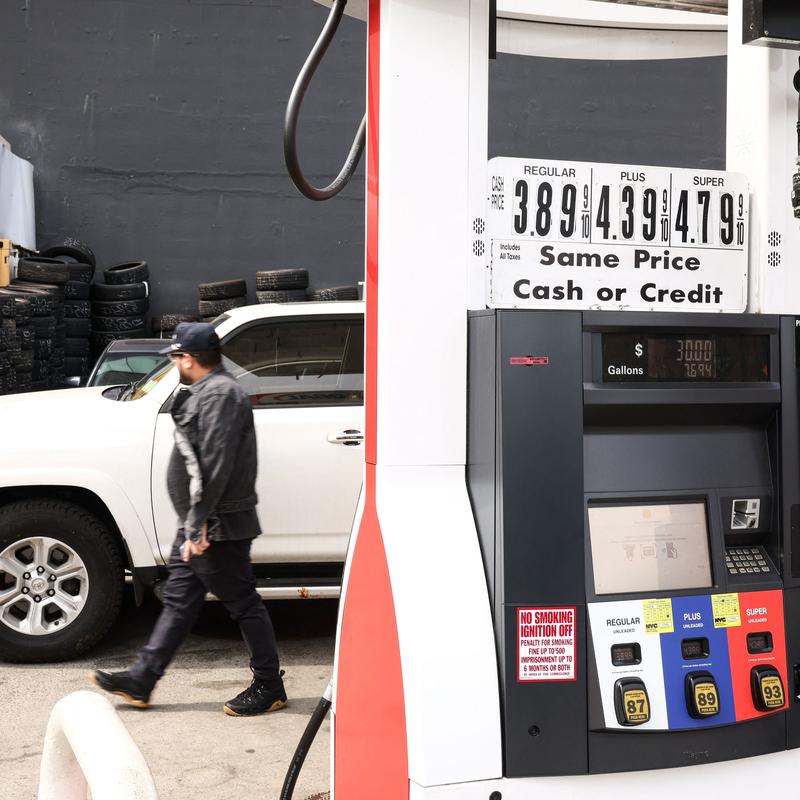
For their part, Iran's response to this move, addressing the American people, "Soon you'll be nostalgic for $4 to $5 gas." That's a direct quote. "Soon you'll be nostalgic for $4 to $5 gas." About that $4 to $5 a gallon gas? This Monday morning US blockade comes after the Friday morning inflation report for the month of March. The Washington Post headline, for example, 'Trump Faces Surging Inflation Report, Fueled by Iran Conflict.'
Instead of speaking to a military analyst as the naval blockade begins, we've invited a world-renowned economist. We'll also get his take on the economics of autocracy, how economic failure for the people of Hungary helped bring down the MAGA role model, Viktor Orbán, in this weekend's historic election there that also has implications here.
Our guest is Mohamed El-Erian, the Rene M Kern professor of practice at the Wharton School of the University of Pennsylvania. He's also the chief economic advisor at the company Allianz, and among other things, a contributing editor at the Financial Times. He writes a Substack newsletter about the economy and is the author of books, including his most recent from 2023, still very relevant today, called Permacrisis: A Plan to Fix a Fractured World.
Some of you may remember we played a one-minute clip of our guest from our program Marketplace on Thursday's show, and we decided to invite him to go deeper. Professor El-Erian, thanks for some time today. Welcome to WNYC.
Mohamed El-Erian: Thank you, and thanks so much for inviting me.
Brian Lehrer: Let's start with Friday's inflation report for the month of March. Do you agree with that Washington Post headline, 'Trump Faces Surging Inflation Report, Fueled by Iran Conflict'?
Mohamed El-Erian: I do. The numbers were very clear. We had a full percentage point increase in the headline inflation, and that's really unusual to get such a jump in one month. Moreover, if you look forward, we will get another jump in the headline inflation.
The other interesting thing is there's a second measure, as you know, called core inflation, that tries to exclude the very volatile energy and food prices, and that did not move very much. I don't think that's going to last. I think what you're going to see going forward is not just headline inflation being driven by energy prices, but we're going to start seeing a broader inflationary process take hold.
Brian Lehrer: Why?
Mohamed El-Erian: Because, first, it's way beyond energy. The prices that are being disrupted, the supply lines that are being disrupted, speak to a number of other things, fertilizers, which will speak to food prices, aluminum. There's a set of other products that are being disrupted in terms of supply.
Second, energy has a way of encouraging what economists call cost push inflation. Put simply, your costs go up as a producer, as a restaurant, and you decide, "You know what? I'm going to pass that on to my consumers. I'm not going to take the hit on my own." If oil prices and gas prices stay high for a while, more and more companies will pass on that hit to households in different ways.
Brian Lehrer: How much do you think this is inevitable, what you were just describing, or already baked in, even if, let's say, they were to come to a peace agreement tomorrow?
Mohamed El-Erian: Brian, there's an economic logic that is very, very clear. When you get the sorts of supply disruptions associated with the war, the first thing that moves are energy prices and interest rates. The average person pays more at the pump. If you're trying to get a mortgage, the cost of your mortgage has gone up. That's phase one. That's done.
Phase two, which we are in the midst of, and it is a done deal, is that you start seeing the increase in very selective things, energy and mortgages, starting to spread through the economy. You have a broader hit that takes longer to overcome. Stage three, which thankfully the US is not in, but Asia and Europe are staring at the face of it--
Brian Lehrer: Hold that for just a second, because this relates to the clip that I mentioned in the intro of your appearance on Marketplace that we aired last week, citing four stages of economic harm from the war. You've just touched on the first two as they pertain to the United States. I want to replay numbers three and four now, which sound more global and much more scary, and then I'll invite you to expound on them. This is you from last week.
Mohamed El-Erian: Parts of Asia, unfortunately, have moved to phase three, which is not only do you get phase one and phase two, but you also get demand destruction. You start worrying about economic growth. Of course, phase four, which I hope we never get to, would be financial instability undermining the economy.
Brian Lehrer: That's part of what made me think, "Okay, I got to talk to this guy in more depth in a longer segment on the show." Take us further into that. What's happening in Asia or elsewhere that you're referring to there?
Mohamed El-Erian: In Asia, no ships practically have come out of the Strait for about six weeks. What they are looking at is not just high energy prices, but a potential disruption in actual availability of fuel. Think a little bit of how you would react, Brian, if suddenly someone tells you, "You know what? It's not that you're going to pay more at the pump, but it's not clear that the gas station will be open." That changes behavior.
We found that when you go from a price shock to a quantity shock, the risk of tipping points increases, meaning that you start seeing damage to economic growth, to economic activity, and that is a much bigger hit to the economy. The minute that happens, then you start worrying about the fourth phase, which is financial instability. There is an economic logic that I suspect 99.9% of economists would tell you, "Yes, that's absolutely the case." The question is, "How quickly do you go through it? What are the tipping points, and what are the circuit breakers?"
That goes back to your question, "What if the war ended tomorrow?" It would take us some time to restore production of energy in the Middle East. It would take us some time to get the ships in the right place. It's not like a light switch. You don't switch it back on and everything comes on. It takes some time. We would be stuck with the phase one and phase two, but we would avoid phase three and phase four.
Brian Lehrer: On this phase three that you said some countries in Asia have already moved into, I've heard a theory that that's why Pakistan was eager to broker these peace talks because their economy is being hit so hard by the war. Does that sound right to you?
Mohamed El-Erian: That may be a reason. It certainly also explains the reporting why China pushed Iran to agree to the two-week ceasefire, fearing that there are worse things ahead. The rest of the world is really concerned. I think here in the US, we're lucky because we have energy independence. We are an exporter of energy. The rest of the world is mostly an importer of energy, and I can tell you the extent of economic concern is a magnitude higher than it is here.
Brian Lehrer: What are the impacts on China that would have led them to pressure Iran to get involved in the talks?
Mohamed El-Erian: They are worried that they're going to lose their second supplier of cheap oil. The first one was Venezuela. Because both Venezuela and Iran are subject to sanctions, China has been able to buy oil from them at a significant discount, estimated to be about 30% of the international price. India also has taken advantage of that. They risk losing their second supplier, not just of oil, but of cheap oil relative to their alternative.
Now, as you know, the Chinese tend to plan, so they have one of the highest storage levels in the world. They've been accelerating not only the transition to green tech, but they've also restarted coal mines. They have taken some steps to protect themselves, but they are looking at disrupted supply of oil and higher prices of oil, and significantly higher, and that's where their economic concern comes in over what's been going on between the US, Israel, and Iran.
Brian Lehrer: This is just me being stupid, but why would it be that China could get oil cheaper because of the blockades or the sanctions on Venezuela and Iran rather than China being blocked from buying oil from Venezuela or Iran, or from the price being higher because the supply is limited?
Mohamed El-Erian: The reason why they were willing to do that is because the US has mostly refrained from what's called secondary sanctions. Primary sanction is I sanction you. Secondary sanction is I sanction anybody who interacts with you. The US has refrained from secondary sanction on China. Whether it's Russian oil, Venezuelan oil, or Iranian oil, all of them have been sanctioned. China has been able and willing to buy oil from there, but in return it asks for a lower price.
Now, if you're Venezuela, Iran, or Russia, you don't have many countries to export to. What we've seen is China being able to take advantage of the sanctions by buying at a lower price. That is coming to an end.
Brian Lehrer: Interesting. Especially if oil can't get out of Iran. Listeners, your stories, comments, or questions about the economic impact of the war in Iran so far, or the implications of the US naval blockade just beginning at this hour on ships that would have used Iranian ports in or around the Strait of Hormuz. 212-433-WNYC. Call or text with your stories if you're personally affected in some way and want to relate something about this to help us report the story, or your comments and opinions, or your questions for Mohamed El-Erian from the Wharton School at UPenn. 212-433-WNYC. 212-433-9692.
Before we get more into the blockade, Professor El-Erian, let's just stay on the Friday inflation report a little bit more. You wrote that, "Consumer confidence has dropped to a record low, further illustrating the widening gap between Main Street and Wall Street." How would you describe that gap?
Mohamed El-Erian: If you just start with Wall Street, stock prices are basically unchanged for the year, and they are back very near their level at the beginning of the war. If you had just gone to sleep at the beginning of the year and woken up, you wouldn't have thought that there's a major war going on that's disrupting oil, energy, that is pushing energy prices higher, that is risking what's called stagflation, higher inflation, lower growth. You don't see it in the stock market.
Go to Main Street and you see a few things. You see, of course, people worried about higher gas prices, which hits the most vulnerable households particularly hard. You see young people now staring at higher mortgage rates than they had before. You see a significant loss in confidence. The University of Michigan issues every month surveys of households, and they ask them two questions. The first has to do, how confident are you about the current economic situation and the outlook? Second, what are your expectations for inflation?
What we saw in the report issued last week is the fall to a record low in terms of people's confidence, driven both by how they feel about the current situation and how they feel about the future. On the inflation side, we've seen a big jump as to what people expect inflation will be in the next year. Now, I have to add two qualifiers. One, there's nothing automatic about the link between the surveys and how people act. Normally, you would expect if you are that worried about the future, you would stop spending, but that link is pretty weak.
The second qualification you will hear, like any other survey, is impacted by the politics and the polarized politics that we're in right now. When you break down between Republicans and Democrats, you get very different results.
Brian Lehrer: Presumably, Republicans are more optimistic about the economy than Democrats?
Mohamed El-Erian: I would put it slightly differently, Brian. They're less pessimistic about the economy than Democrats. The worry about the economy is clearly there, it's the extent of the worry.
Brian Lehrer: Are you saying, though, that when we hear these reports in the news about consumer confidence levels, and we get them every month, that they're really just a measure of people's feelings and they are economically meaningless?
Mohamed El-Erian: Meaningless is a strong word. I would say they provide you some insight, but no one should act on them alone. They have to be combined by actual indicators, not of what I say, but what I do, because the translation between what I say and what I do is not perfect. We've seen this historically over and over again.
Brian Lehrer: You mentioned stagflation, which is slow growth coupled with high inflation. Usually, inflation is something that's produced by rapid growth, a bad side effect of rapid growth, though growth is good generally. When the economy isn't growing and inflation is ballooning anyway, that's stagflation. Our first caller has a stagflation question. George in Riverdale on line one on stagflation. George, you're on WNYC with economist Mohamed El-Erian. Hi.
George: Good morning, gentlemen. Mr. El-Erian, I've been following your career ever since you ran one of the world's great bond funds before you went on present career, and always been storied and I've always enjoyed listening to you. My concern is, of course, the possibility that the Fed will face its worst horror, which we know is stagflation. Last time we had it was in the late '70s, where you had a stagnant economy and a high inflation, and the Fed's supposed cures worked against one another.
What is the chance of our running into the same kind of stagflation again? Obviously, we don't know what ultimate decisions are going to happen or what's going to happen with the current war in Iran, but what would you assess are the chances that such things could happen to create a stagflation?
Brian Lehrer: Thank you, George.
Mohamed El-Erian: Thank you, George. Thank you for your kind words. You're absolutely right. You called it "the worst horror," and it is the worst horror for central banks. As George hinted, the Federal Reserve has what's called a dual mandate. It is designed to deliver price stability, so low inflation and maximum employment. When you get stagflation, both your mandates are threatened, and yet the solution is very different depending on which mandate you want to respond to, as George pointed out.
If you want to respond to high inflation, you raise interest rates. If you want to respond to a threat to employment, you lower interest rates. You can get stuck in these competing claims on your policy tools and end up either paralyzed or making one or other mistake. Right now, if we continue, if the war continues and its economic effects start multiplying, George is absolutely right, it will be the worst horror for the Fed.
We get indications of what the Fed is thinking because they publish the minutes of the deliberation. Right now, while they're worried about the uncertainty, while they would completely agree with George that both mandates are threatened, they are more inclined right now, and this may change, but they are more inclined, if they have to respond, to respond the employment side than to respond to the inflation side.
Because of that, the market is pricing one rate cut this year, not a rate hike, but a rate cut. As George says, if we continue down this road of disruptions to energy prices, broader inflation, growth starting to get threatened, then it is going to be a really tough situation for the Federal Reserve, all this in the midst of a major leadership change to make life even more complicated.
Brian Lehrer: At the Fed, and maybe we'll get into that later with the nominee that the president wants to replace Jay Powell. Here's a question that implies price gouging from a listener in a text message. It says, "If we have energy independence, then why have gas prices gotten so high?" Listener writes, "I've heard that it's because domestic producers are taking advantage of the lack of competition." "Is that true?" writes the listener. Again, I think they're suggesting price gouging here.
Mohamed El-Erian: Yes. That's one of the biggest puzzles for the person in the street. How can we both pride ourselves of having energy independence and yet get hit at the pump? The best way to think about this is, think if you're an oil company. You have a choice. You can either sell domestically, or you can export. As President Trump said last week, our exports to Asia in particular have gone up significantly because they're not able to import from anywhere else. You're the oil company. Do you export at a much higher price, or do you sell domestically at a much lower price?
The way you reconcile this is "in the international price rules," meaning that you end up by adjusting your domestic price higher so that you are indifferent between exporting or selling domestically. Imagine all the oil companies making this decision. What you get is you get higher prices domestically, even though we're energy independent. That tends to happen in virtually all markets, that it is the international price that rules rather than domestic.
What makes people even angrier, I'll put it right there, Brian, and here, the energy companies have less of an excuse. When international prices go up, they adjust domestic prices very quickly up, but when international prices come down, they tend to take their time in bringing down domestic prices. We've seen that in country after country. I think that is a more legitimate complaint than whether the international price and the domestic price should completely decouple from each other.
Brian Lehrer: That might become salient after the war ends, and presumably prices globally would start coming down. That's something to keep our eye on and whether consumer activism can help mitigate that. Before we turn the page a little bit and go more explicitly into the naval blockade that is just beginning at this hour, you said earlier, you mentioned the widening gap between Main Street and Wall Street.
Why do you think Wall Street has been so resilient if people on Main Street are beginning to take these hits that we feel in our lives, Wall Street hanging near its record highs, is that unrealistic optimism or a calculation that even if consumers' pockets get hit, corporate profits won't, or something else?
Mohamed El-Erian: Brian, there's a number of things in play here. One is, yes, the stock market is inherently optimistic. Compare the stock market to the bond market, you'd think that their biases would be similar, they're not. The bond market is not back to where it was at the beginning of the war, but the equity market is virtually there. There is some inherent optimism, some inherent biases, and it's, of course, helped by the fact that if you're optimistic and you sound optimistic, you attract more investment dollars, that you get paid a fee on this. There's a whole structure that supports that optimism.
Brian Lehrer: Until a bubble bursts, right?
Mohamed El-Erian: Correct. You have the classic, classic quote by the, who was it then, the CEO of Citigroup in August of 2008, just before the global financial crisis, and he gave the following image. He said, "At some point, the music will stop and it will be problematic, but as long as the music is playing, we're dancing." Of course, he lost his job a month later when the music stopped.
The second argument is that what normally mitigates risks in a portfolio, the bond prices, gold, the risk mitigators have not worked. The typical manager says, "If the risk mitigator isn't working, I might as well stay in equities because I get the upside." Then the third argument that you see is this notion that investors are paid to take risk. If you had done that, every single dip in the last 10 years has been a buying opportunity.
What we've seen is we've seen this conditioning become so deep that the dips are less frequent and smaller in magnitude because people see it not as it's signaling a yellow light, be careful, they see it as signaling a buying opportunity. That's why you get this incredible decoupling of the financial markets, the equity markets in particular, from the rest of the economy.
Brian Lehrer: One more text before we turn the page, and you don't even have to respond to this, it's a comment, and it starts with a compliment to you.
It says, "Thanks for inviting one of the economic gods of our generation to the conversation. To borrow from an old ed, 'When Professor Mo El-Erian speaks, people listen.' As for the US feeling less pain because of its energy independence, people need to remember the recent experience of COVID. It's just a matter of time before possible pains of stage two from China and other Asian countries hit Americans smack in the face since those countries produce almost everything we 'need,' including generic drugs from India, et cetera." A comment from that listener.
When we come back from a break, we'll get explicitly to the US naval blockade on Iranian ports just beginning this hour, and its economic implications, with economist Mohamed El-Erian from the Wharton School. You at 212-433-WNYC.
[music]
Brian Lehrer: Brian Lehrer on WNYC. Now we'll get explicitly to the US naval blockade on Iranian ports just beginning this hour, President Trump had said 10:00 AM Eastern Time, and its economic implications, with economist Mohamed El-Erian from the Wharton School, and he writes a Substack newsletter and contributes to the Financial Times, among other things. You at 212-433-WNYC, call or text if you have questions or comments.
Professor El-Erian, I know you're not a military strategist, but do you understand the difference, I guess from an economic standpoint, between blockading the Strait that President Trump first announced yesterday and blockading ships from using Iranian ports?
Mohamed El-Erian: I think of it as trying to choke the Iranian economy. This is a blockade of a virtually complete blockade. The virtually complete blockade was, of course, what Iran was imposing as retaliation to the attacks on it. It allowed Iranian ships and certain ships from friendly countries, think Pakistan, think China, to go through, as well as reportedly some ships willing to pay a toll. It was a virtually complete blockade, but not a complete blockade.
What President Trump has announced is the blockade of the blockade. It is to stop even the few ships that were getting through in order to starve the Iranian economy of foreign exchange. What does that do? It pushes the currency, which is already in a total mess, even weaker, it pushes inflation even higher. For those hoping, I'm not making a judgment here, for those hoping that you get some sort of internal uprising, it increases that probability. That's the logic of it.
Of course, it comes with risks to the US military, and it only works, and this is the history of blockades, it only works if you maintain it for a length of time. This is not something that works in a week, in two weeks. It normally takes much, much longer. You've seen it with Cuba recently. This is where the issues come in. This is where the economic consequences start piling up, what we talked about before, the risk of going from stages one and two to three and four. This is why you don't see our allies, France, UK, showing any enthusiasm about it at all because they're worried about the economic effects of it.
Then finally, it's what economists call an unstable equilibrium. Think of a ball on top of an upside-down cup. It looks stable, but you can tip it either way. The question is, does it tip towards a breakdown in the ceasefire and renewed hostilities, or does it tip the other way towards both sides being willing to negotiate much more cooperatively, if you like? We don't know, but that's clearly a tipping point that will be reached at some point.
Brian Lehrer: What this is, is an additional closure of the Strait of Hormuz on top of what Iran had already imposed, this one being applied by the United States to those countries that Iran was still allowing ships to go to. Would you put it that way?
Mohamed El-Erian: I would, absolutely. You put it much better than I could have.
Brian Lehrer: I hope that was a little bit clear anyway. To that, I want to play a clip of President Trump as the peace talks with Iran were beginning in Pakistan, he said this.
President Trump: Regardless of what happens, we win. We've totally defeated that country. Let's see what happens. Maybe they make a deal, maybe they don't. From the standpoint of America, we win.
Brian Lehrer: Economically speaking, did the US already win this war?
Mohamed El-Erian: No. I think if you want to define how the US has won this war, you would need to talk about the destruction of Iran's military capabilities. That is how you do it. The irony here, and it's something that people find very difficult to comprehend, is that all three main warring parties think they're winning. The US thinks it's winning, Israel thinks it's winning, and Iran thinks it's winning. When all three parties think they're winning, it's very hard to actually end the war.
Add to that is what's called an asymmetrical conflict. We know from experience elsewhere that asymmetrical conflicts can last a lot longer than conventional wars. Then, of course, you have the third issue, that it's not clear that the US can impose its will on Israel, which has its own objectives. You know this is a very complex situation, and all three parties will say they're winning right now.
Brian Lehrer: Here's one more clip from that statement by Trump. I'll get your reaction on the other side.
President Trump: One other thing that's happening is that boats are sailing up and heading out to our country, big, beautiful tankers, and we're loading them up with oil and gas and everything else. It's a pretty beautiful thing to see.
Brian Lehrer: Do you know if that's actually happening to ease the energy crunch elsewhere, or if it's enriching the US in any meaningful way, more exporting of oil from this country?
Mohamed El-Erian: What we do have evidence for is first that we've increased our exports of energy products to Asia. That, of course, means because we're selling them at a higher price, means higher profits for oil companies. It comes on the back of the consumer paying for higher gas prices and higher energy prices more generally. There is a transfer going on right now internally from households to energy companies.
There's been a lot of debate as to whether the US should impose restrictions on its exports of energy in order to protect the domestic economy. We've seen Korea do that, but the US hasn't. Yes, we absolutely have seen more exports of energy from the US to Asia. Yes, it's enriching the energy companies, but at the cost of households. Three, the longer this goes on, the more there's going to be a debate as to whether we should limit those exports to protect the domestic economy.
Brian Lehrer: Hassan, in Queens, you're on WNYC with economist Mohamed El-Erian. Hi, Hassan.
Hassan: Brian, thank you very much for the honorable guest that you have. I have to compliment him, he's from the Middle East, and I'm from the Middle East. Obviously, he's from Egypt. Egypt is North Africa, it's not Middle East, to just clear that for your-- I'm from Iran originally. I'm from Iran originally, and I'm going to tell you today, I don't know what is going on with all the media.
Iran has the fifth largest army in the world. The Iranians built bunkers, tunnels for past 50 years. They made a swear to themselves, and I know some of these people because I went to school with them, I went to university with them in '70s and early '80s before I come to United States, these people promised themselves it will never happen what happened during Iran and Iraq war. Trump can say whatever he wants to say.
North Korea has been supporting ballistic system. Their ballistic system is number one in the world. I want all your listeners, including the honorable professor, listen to the Shah's interview with Chris Wallace in 1973. He said, "My number one enemy is not the Arab world, it's Israelis." The Israelis, they do not want Iran have the bomb because they know they cannot go with the Zionist fact that they have.
Now, I leave it to the professor, because I have dearest respect for him, to explain to you what is going on. The Zionists want to expand themselves by completely destroying the Middle East. Shah of Iran knew about it. I believe, as a person that was involved in revolution, that the Israelis had their hand to get mullahs in power. Now, besides that, mullahs are not idiots, they're educated.
JD Vance telling the foreign minister doesn't speak English? He's a graduate of Harvard. This is why I have a problem with you guys in the media. You're underestimating Iranians. They're number five army in the world. They have everything. They have F-16, F-15, they have airports and the ground, three miles full of grounds.
Brian Lehrer: Hang on, Hassan. I'll let Professor El-Erian respond in a minute, although he's not a military expert. Remember, he's an economist. Is your theory, no matter what you may think about Israel, did you say that you thought Israel would have had a hand in getting the mullahs into power because it's in Israel's interest? Did I hear you correctly?
Hassan: Yes, Brian. Yes, because if you remember, nobody talks about George Bush met with mullahs in Spain. Max Miller's father was involved in it, and he got lost in seas? Obviously the professor knows about this because he spoke about this 10, 15 years ago in one of his speech. The guy had a yacht, $200,000, I'm talking about the 1980s, and his yacht got lost? He was a British citizen. He's the father of the Epstein partner. He was the one that arranged the meeting between mullahs and Bush, and he's a Jewish man, and you're telling me there was nothing involved?
I'm not going to the conspiracy. What I'm trying to tell Americans is you're out of your mind to go in war with Iran. I want everybody to listen to Chris Wallace's interview with Shah in 1973.
Brian Lehrer: The Shah in 1973. All right. Hassan, I'm going to leave it there. Leaving aside that Israel would say that it's certainly not interested in taking over the Middle East, what it wants to do is stop people from attacking it from elsewhere. Yes, it wants to take over the West Bank, but as far as further in the Middle East, all they want to do is have a Jewish state. They don't really want to own Lebanon, and they don't want to own Egypt and go on from there.
Nevertheless, any reaction to that, Professor, to his core point, that Iran is stronger than we may be thinking at this point, even with the military destruction that we know has taken place?
Mohamed El-Erian: Brian, the reporting that I've seen out of Washington points to three things. One, that there was an underestimation of Iran's pain threshold. Going in, the US and Israel expected this to be a short war. They didn't expect it to be where we are today, especially after the initial destruction of the Navy, the Air Force, and especially after the decapitation of the regime. The first thing is this has proven to be a much longer war because it turns out that Iran's capabilities, including its tolerance for pain and human suffering, is much higher than what was expected.
The second reporting that came out of this is that Israel has used this to also expand Lebanon, to create what they call a security zone. Then the third thing that has come out of this is that there was a complete underestimation of the regional impact. That even though a lot of experts were warning about the Strait and were warning that the minute you put the Strait, then you expand the spillovers, the fallout of this war significantly, this wasn't factored in. What was also not factored in is that Iran would go after other countries in the region, UAE, Qatar, Saudi Arabia, Kuwait in particular.
There have been a number of underestimations, including, as Hassan points out, the capabilities, and I would add the tolerance of Iran. That's why we're in a situation right now that most people cannot define a realistic off-ramp. That's really an interesting issue. There's always this notion that if you start a war, make sure you know how you're going to end it. We are now seven weeks in, and it's not clear what the off-ramp is.
Brian Lehrer: One scenario I heard for how this economic front could become more of a shooting war is that China is one of the countries that uses those Iranian ports to get oil. You were talking about that before. They may not just quietly stand by for this US closure. Is that something that's occurred to you or that you have an opinion or concern about? Again, recognizing that you're an economy expert, not a military one, but that China will not take this lying down from a military standpoint?
Mohamed El-Erian: I tend to read widely, and there's one person that I respect for his opinion. I don't necessarily agree with them, but I respect for his opinion. That's the historian Neil Ferguson. If you go to his writing, they take you one step further, Brian. He feels that we may very well be in the early stages of something much bigger, a much bigger global war. He feels, and others feel, that China will be empowered with vis-à-vis the Straits of Taiwan because of what's been happening in the Middle East, and at some point will also respond to the fact that its own economic interest is now at risk. I don't go there, but I must tell you, the view is out there, Brian.
Brian Lehrer: If you agree with the premise that I stated in the intro, that rather than bomb all the bridges and power plants as Trump had threatened last week, he has opened this specifically economic front in the war with this blockade in the Strait of Hormuz. Do you think that economic solutions or compromises could be the way out? You were saying a minute ago that you think it's hard to see a way out right now.
For example, for all the devastation that Israel is causing in southern Lebanon to the civilian population there, and Iran is saying that has to stop as part of their conditions for ending the war, but they also have economic conditions, like they want reparations for some of the economic damage that the US and Israel have already done to it. President Trump wants an off-ramp before the midterm elections, presumably because the war is unpopular, at least so far in the United States.
Do you think the economy itself, all these varying, competing economic interests, could be the key to the war, at least between the US and Iran, ending, and maybe even including the Lebanon front?
Mohamed El-Erian: The answer is I don't know. I do know the analytics of it. As I cited earlier, it's an unstable equilibrium. It can be tipped. For it to work, it has to be in place for a long time. That's number one. Two, you've got to hold other conditions as they are. Two, in particular, you need to hold as they are. The ceasefire needs to hold in Iran. Second, Iran needs not to carry its threat of blocking the Red Sea shipping lanes, which we haven't talked about, but there is the possibility of Iran engaging the Houthis in Yemen to say, "Okay, if you block our Strait, we'll block something else." That, of course, multiplies the potential for economic damage.
Let's also not forget that in all this, Israel is continuing to attack Lebanon, which is an issue for Iran. That also adds to the instability. In answer to your question, could it work? Yes. The most critical assumption is that you hold everything constant during the journey to that destination you specified, and holding everything constant during that journey is far from straightforward.
Brian Lehrer: I said in the intro I was going to ask you about one other topic, so if I may, very briefly, and that topic is how economic failure for the people of Hungary helped bring down the MAGA role model, Viktor Orbán, in this week's historic election there. Just before you came on, we were airing a BBC report in which the guest was saying very much this had less to do with his MAGA-style culture war politics than with economic failure in Hungary under his leadership.
I guess I want to ask you if you think there's any connection. Is there a connection between autocracy, or illiberal democracy, as some people have characterized Orbán's Hungary, and economic failure?
Mohamed El-Erian: First, on the economics of Hungary, the last few years have been extremely low growth. The economy contracted in 2023, it expanded only by 0.5% in 2024, only 0.4% in 2025. You haven't had an increase in income. Add to that that they hit an inflation high. We complain about inflation that got to 9%, their inflation got to 25%. They also had a huge hit to affordability. That, I think, has contributed in a significant way to the outcome.
There's something else that has contributed. If you're going to be part of the European Union, you've got to be somewhat liked by the European Union because the benefits come from you being a good-standing member of the club. Increasingly, Hungary was not a good-standing member of the club. I think people in Hungary realize this, that their potential to get out of low growth and high inflation was being undermined by what the Prime Minister was doing day in and day out.
I think it was a contributing factor that was amplified very much by the belief, and I think it's the correct belief, that closer economic integration with the European Union is the way out of low growth.
Brian Lehrer: Mohamed El-Erian, the Rene M Kern professor of practice at the Wharton School of the University of Pennsylvania. He's also the chief economic advisor at the company Allianz, and among other things, a contributing editor at the Financial Times. He writes a Substack newsletter about the economy and is author of books, including his most recent, still very relevant today though it's from a few years ago, called Permacrisis: A Plan to Fix a Fractured World.
Thank you so much for giving us this time this morning. I could tell our listeners really, really appreciated it.
Mohamed El-Erian: My great pleasure and honor. Thank you.
Copyright © 2026 New York Public Radio. All rights reserved. Visit our website terms of use at www.wnyc.org for further information.
New York Public Radio transcripts are created on a rush deadline, often by contractors. This text may not be in its final form and may be updated or revised in the future. Accuracy and availability may vary. The authoritative record of New York Public Radio’s programming is the audio record.
