
MLK Day: The Civil Rights Movement's Unfinished Business
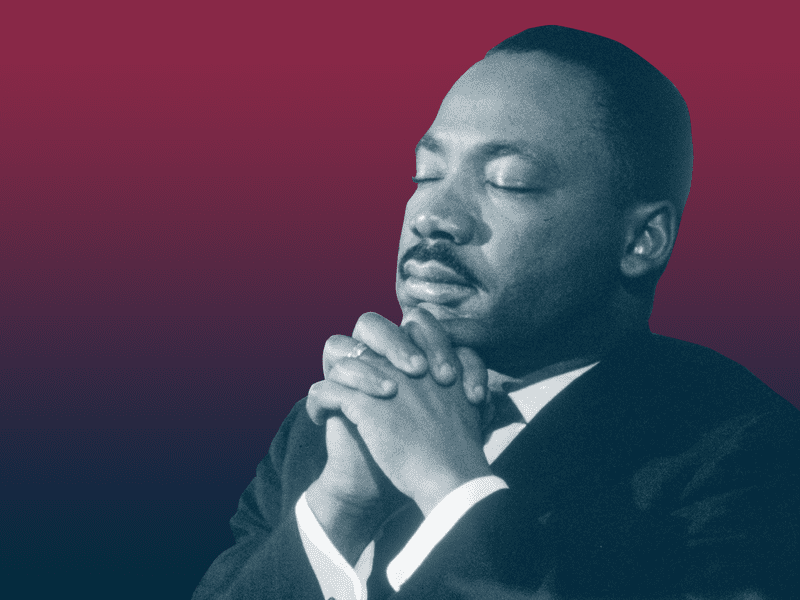
Title: MLK Day: The Civil Rights Movement's Unfinished Business [music]
Tiffany Hanssen: This is The Brian Lehrer Show on WNYC. I'm Tiffany Hanssen filling in for Brian on this Martin Luther King Jr. Day, but since this is a special one for Brian, we wanted to include him, and we're going to end the show today with an interview he did with Peniel Joseph on MLK Day in 2023. We were taking oral history calls from people who participated in the civil rights movement inspired by Dr. King. Professor Peniel Joseph is the founding director of the Center for the Study of Race and Democracy at the University of Texas at Austin, where he is the Barbara Jordan Chair in Ethics and Political Values and a professor of History.
He's authored several books, including his most recent Freedom Season: How 1963 Transformed America's Civil Rights Revolution, The Third Reconstruction, and most relevant to this discussion, his book The Sword and the Shield: The Revolutionary Lives of Malcolm X and Martin Luther King Jr. Brian and the professor start with a discussion of a CNN commentary that he wrote called Why Martin Luther King Jr's Sharpest Questions Remain Unanswered, which, of course, we'll link to on the show page. Here's Brian.
Brian Lehrer: Peniel, always good to have you on. Welcome back to WNYC.
Professor Peniel Joseph: Hey, great to be on, Brian.
Brian Lehrer: You recall in your article King's political activism from 60 years ago, 1963, and say, "He reimagined American democracy on both an intimate and expansive scale, introducing a new lexicon for citizenship." That goes way beyond, conceptually, what people might think of, "Oh, 60 years ago, he gave the I Have a Dream speech." What did you mean "a new lexicon for citizenship"?
Professor Peniel Joseph: Well, King is the person who really provides us the context to think about racial justice as the beating heart of American democracy. Alongside with Malcolm X, King thinks about radical Black citizenship and then, later, dignity as key concepts of transforming the American nation-state, really, for all people. He makes the argument that dignity is more than just voting rights and civil rights. It's really decent housing, a guaranteed income, health care, environmental justice, freedom from violence and food hunger, and freedom from, really, hatred.
The intimacy is proximity. King thought that we should all be in proximity with one another, which is why he was against segregation, but he was interested in being in proximity even with people who were ideological opponents and adversaries. He pushed back against the idea that we should hate people who were opposed to our own political philosophies. When we think about King, he's the person who's going to introduce this idea of the beloved community and really change the lexicon and the vernacular of American democracy.
By beloved community, he meant a few things. He meant a society that was free of what he called militarism, materialism, and racism, but also a society that invested in what he called the least of these, invested in people who are poor, homeless, who are incarcerated, folks who are dispossessed within the United States but also globally. The visit to India in 1959 teaches him about racial caste. His visit to Ghana in 1957 teaches him about political self-determination.
There's a reason why King becomes a Nobel Peace Prize winner, is because he's really thinking about human rights for all people, but he makes the claim that it's going to start right here in the United States because, famously, in the Letter from Birmingham Jail, King says that the movement will overcome because the goal of America is freedom, so King even redefines what we mean by freedom.
Brian Lehrer: We've been taking calls from people who lived through the civil rights era with a memory of the movement and something they think has or hasn't changed as a result of the civil rights laws. Let's take one of those calls. Catherine in Wilmington, Delaware, you're on WNYC. Hi, Catherine.
Catherine: Hi, how are you?
Brian Lehrer: Good, thank you.
Catherine: First of all, I'm an 83-year-old woman, and I grew up in Wilmington, Delaware. I had no exposure or explanation of segregation. I never knew any Black people. How I was first exposed to it is going to the University of Delaware, where I met a young Black man, who was in some of my classes. We would walk back and forth to our classes. He started telling me how he was being treated at the school, that the room they gave to him was next to the boiler, and I was shocked.
Then he started telling me about what he was allowed to do or he was afraid to do. Then I started looking around, and I became aware that there was deep segregation in our city. There was colored fountains and bathrooms for colored people, certain theaters they were not allowed. Then I took a trip down South. I think it was in '63. I noticed the signs all over the place. Before that, I got involved in civil rights marches in the city and sitting in front of real estate offices that were literally redlining neighborhoods. The more I became aware, the more indignant I became.
Brian Lehrer: Catherine, thank you very much for your call. I really appreciate it. Peniel, there's the story of a white woman from a Northern state, who had no awareness of segregation, as she tells it, until she met a Black man who was describing what he was going through even in a not-officially segregated part of the country.
It makes me think about how your books are both about King, who is remembered in part for his politics of love and unity and non-violence, even as he was fierce and a radical in the context of his time in so many ways, but also about those fighters for racial justice who white Americans saw as more hostile perhaps than King. Stokely Carmichael and Malcolm X and others. How does the passage of time bind those leaders to King or separate them from him?
Professor Peniel Joseph: Well, I think they were always bound. I think when we look at the civil rights period and the Black Power period, we should really think of it as a second American Reconstruction. I think we're in a third Reconstruction now, Brian. Reconstructionists are supporters of multi-racial democracy versus redemptionists, who are advocators and supporters of racial caste and white supremacy.
There's a whole group that is lifting King up. People like the Ella Bakers and the Fannie Lou Hamers and certainly people like Malcolm X and Stokely Carmichael. We need to see these folks as dual sides of the same revolutionary coin who are, in The Sword and the Shield, I argue that Malcolm and Martin are both sword and shield. We think about Malcolm X and his call for radical political self-determination and his critique of racism, his critique of anti-Black violence as a sword, and King as the shield because of non-violence, but King is also a political sword.
When we think about Letter from Birmingham Jail, Brian, in 1963, he says that he's come to the regrettable conclusion that the Negroes' greatest stumbling block in its stride toward freedom, it's not the White Citizens' Council or the Ku Klux Klan. It's the white moderate, right? When we think about that, King says it was the white moderate who's more devoted to order than to justice, who prefers a negative peace, which is the absence of tension to a positive peace, which is the presence of justice.
Then there's going to be folks like Malcolm and Stokely, Angela Davis, others, who really take that idea and further amplify it as King did in the late 1960s. The King of '66, '67, '68 is not the same King of '60, '61, '62. Once he sees that civil rights legislation is not enough to transform power relations and the actual living conditions of people in Los Angeles and people in Selma and people in Chicago and people in New York City, King starts to call for redistributive justice.
He starts to call for the redistribution of wealth from the top to the bottom rungs of American society. That's what the Poor People's Campaign is about. He's joined by other civil rights demonstrators and activists. It's Black women who are part of the National Welfare Rights Organization who teach King about welfare policy and why a guaranteed income is necessary.
It's going to be Hispanic farm workers who teach King about what's happening in terms of agricultural policy and the unfair labor practices for folks picking oranges in Florida and folks picking grapes in California. It's poor Black folks in Marks, Mississippi who teach King about what's happening there, where they have no food or blankets, and there's a food desert, and they're in Quitman County, Mississippi, the poorest ZIP code in the United States at the time.
King is really somebody who's constantly a student, and he's humble enough to admit that he's a student. He does so many different meetings with so many different advocacy groups on the run-up to doing the Poor People's Campaign. The reason he's assassinated in Memphis, Tennessee on April 4th, 1968 is because he's helping 1,100 sanitation workers who are on strike for a living wage. King is really this extraordinary figure who is an activist but who's really buoyed by these other activists in that second period of Reconstruction.
Brian Lehrer: Robert in Queens, you're on WNYC. Hi, Robert.
Robert: Hi, Brian. Let's see if I can get through this. In 1963, my father, who was a New York City police officer, a strict adherence to the law, went to the march on Washington. When he returned, I overheard him speaking to my mother in the kitchen in private. He said that if Dr. King had said the only way to solve this problem was to burn down Wall Street, that he would be out there with his matches.
I thought to myself, "Who is Martin Luther King? Who is this man that could make my father say such a thing?" A month later, I was on a school bus, the oldest of nine kids, part of the open enrollment program to integrate the schools in Queens in Douglaston Manor. I got on that bus and I went off to Douglaston Manor. I guess I made it through telling you that. [laughs]
Brian Lehrer: Yes, right. Wow. Is the moral of the story how powerful an influence Dr. King was, how powerful a speaker that even your father, a law and order cop, might have been moved to violence if King had said it was okay, or would you put it a different way?
Robert: Yes, I was totally blown away because my father was such a cop, such a New York City cop. He spoke about having to guard Malcolm X in Harlem and he was not happy with Malcolm at all, but this man had gone to Washington DC and was totally moved by Dr. King.
Brian Lehrer: Thank you so much for your call. Peniel, was that part of Dr. King's genius, sort of knowing just how much to turn up the heat and how much not to for actual results in Congress?
Professor Peniel Joseph: Yes, absolutely, especially during the '63, '64, '65 period. He's definitely interested in a kind of radical reform, which is eventually going to lead to the demonstrations in Selma, what's happening in Birmingham, and the passage of those really important pieces of legislation. I think, however, when we think about '66, '67, '68, a great example of this is the '67 Vietnam speech where silence is betrayal, where he really pushes back--
Brian Lehrer: Here in New York. Is that the New York speech?
Professor Peniel Joseph: The Riverside Church speech, yes, April 4th, 1967. At that point, he's really not trying to push for just congressional legislation. He breaks with the President of the United States and he's really pushing for this kind of political and moral transformation. When we think about the Latter-day King, he's really thinking-- he's got speeches like "Remaining Awake Through a Great Revolution," "The Drum Major," and then "A Time to Break the Silence."
In that speech, he says the United States is the greatest purveyor of violence in the world, but he also says that he loves the country, which is why he is going to criticize the country. He says, "We have a country where Black and white soldiers can destroy and murder people in Vietnam, but they can't live on the same block in Detroit, and there's something wrong with that," saying this April 4th, 1967.
There's a point where he realizes we have to go beyond legislation. Legislation is actually needed, but we need to rethink the entire American project. That's very, very important for us because the King that we celebrate annually, we don't celebrate him as a critic of American imperialism and capitalism and violence. We celebrate him as this martyr to a dream that remains unfulfilled.
Really, he's both those things at the same time, which is why he had so many different people in his coalition. We have to understand that in order to achieve the country that King wanted, we have to be able to do both those things. He said it was going to be a bitter but beautiful struggle. We can love the United States of America while criticizing the country and its injustices at the same time, and that's what King did.
Brian Lehrer: Dr. Peniel Joseph, founding director of the Center for the Study of Race and Democracy at the University of Texas at Austin and author of books, including The Sword and the Shield: The Revolutionary Lives of Malcolm X and Martin Luther King Jr. Always good to have you on and with your deep knowledge of history and such a broad emotional perspective that you brought to today as well. Thank you very, very much.
Professor Peniel Joseph: Thank you, Brian.
Tiffany Hanssen: That is going to do it for The Brian Lehrer Show today here on this Martin Luther King Jr. Day. I'm Tiffany Hanssen. I've been in for Brian today. Coming up tomorrow, it will be producer Amina Srna in for Brian, Amina talking about Mayor Mamdani's campaign pledges. One of them was to pilot city-run grocery stores, which he said would bring down prices. Coming up tomorrow, we'll hear a different idea about how to tackle those sky-high grocery prices, making it easier to open more grocery stores. That's the conversation tomorrow on The Brian Lehrer Show. You'll hear Amina Srna with that.
Amina is one of the producers of The Brian Lehrer Show along with Lisa Allison, Mary Croke, Carl Boisrond, Esperanza Rosenbaum. Sasha Linden Cohen is our interim producer. Meg Ryan is the head of Live Radio. Amber Bruce at the controls today. Milton Ruiz also at the controls. I am Tiffany Hanssen. I've been in for The Brian Lehrer Show today-- in for Brian, I should say. You're listening to WNYC. Stick around for All Of It.
[music]
Copyright © 2026 New York Public Radio. All rights reserved. Visit our website terms of use at www.wnyc.org for further information.
New York Public Radio transcripts are created on a rush deadline, often by contractors. This text may not be in its final form and may be updated or revised in the future. Accuracy and availability may vary. The authoritative record of New York Public Radio’s programming is the audio record.
