
MLK Day and the History of American Protests
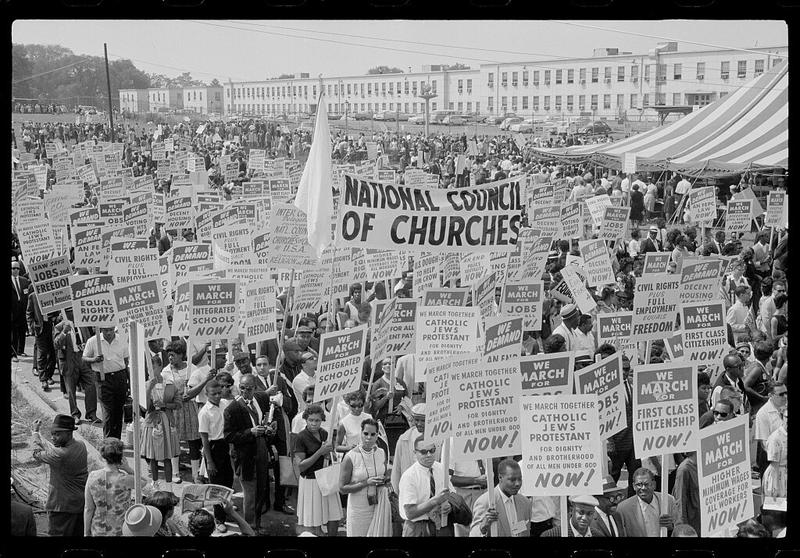
( Trikosko, Marion S., photographer, Public domain, via / Wikimedia Commons )
Tiffany Hansen: It's The Brian Lehrer Show here on WNYC. I'm Tiffany Hansen, filling in for Brian today. Good morning again, everybody. Today is Martin Luther King Jr. Day. It's a federal holiday as designated by Congress and signed into law by President Reagan in 1983, depending on how you count the holidays. It's not the only one to celebrate our right to protest. We have Labor Day, Independence Day, that could also be seen that way.
Reverend King was an activist leading nonviolent protests up until his assassination in 1968. Given the protests that are underway here in this country and around the world, we thought it would be a good time to talk about the history and the tradition that Dr. King was a part of. We are joined by Emmy award-winning writer, Gloria J. Browne-Marshall, a civil rights attorney, a professor of constitutional law at John Jay College, and an author of the book A Protest History of the United States. Welcome back to the show, Professor.
Gloria J. Browne-Marshall: Thank you.
Tiffany Hansen: Listeners, of course, we want you in this conversation as well. You can text us, and call us, by the way, it is Martin Luther King Jr. Day. Do you have a story you'd like to share about how Dr. King's life and legacy inspired you to protest? Do you draw inspiration from the civil rights protests that he led? What forms of protest do your protests take? Call us, text us 212-433-9692. Gloria, I think we should probably start with Dr. King on this day.
We have a clip here, it's a passage from his final speech that you reference in the introduction to your book. He's speaking on April 3rd, 1968. It's the speech that's known as I've Been to the Mountaintop. We're not going to hear those famous last heartbreaking lines, but this is a minute from the middle of the speech.
Martin Luther King Jr.: All we say to America is be true to what you said on paper.
[crowd shouts]
Martin Luther King Jr.: If I lived in China or even Russia or any totalitarian country, maybe I could understand some of these illegal injunctions. Maybe I could understand the denial of certain basic First Amendment privileges because they haven't committed themselves to that over there. Somewhere I read of the freedom of assembly, somewhere I read of the freedom of speech, somewhere I read of the freedom of press, somewhere I read that the greatness of America is the right to protest for rights.
[crowd shouts]
Tiffany Hansen: The voice of Dr. Martin Luther King, of course, on this Dr. Martin Luther King, Jr. Day. He was speaking there April 3rd, 1968, at the Mason Temple in Memphis, Tennessee, in support of a sanitation workers' strike. On the following day, he was assassinated. I want to talk about his words, though, here, Gloria, because as a legal scholar, from your perspective, the right to protest, as he says, for right, I'm putting up my air quotes, is it recognized as such, even though it's not in the Bill of Rights to protest for right?
Gloria J. Browne-Marshall: Those are such powerful words from Dr. King. It moves me every time I hear them. He was also, in his own way, a legal scholar. He understood that the First Amendment, yes, freedom of speech, freedom of press, right to peaceably assemble, but the last line of the First Amendment says that we have the right to petition the government for a redress of grievances. People rarely get to that last line.
We do have the right to ask the government to fix our complaints. Even though the word protest is not in the Constitution, it's the assembly of those rights in the First Amendment that give us the right to protest, and he understood that from the very beginning. It was understood by the framers that the people had that right.
Tiffany Hansen: Do you see protest as an outgrowth of petitioning the government for something that is not going well, not going on, as you would like it to? Is protest an outgrowth of that petition?
Gloria J. Browne-Marshall: The protest is stating to the government that they're either on the wrong path, there's something else that's needed. There's a dissatisfaction, however, that is stated by the group dissatisfied that as though we look at protests as if all of us are always supposed to be happy with our government. It was understood with James Madison, in creation of the Bill of Rights, in particular the First Amendment, that the people would become dissatisfied, that the people would need this power because the government they feared when they created it.
That's why James Madison, considered the father of the US Constitution, promised the framers in 1787, when the Constitution was drafted we will give protections to the people against the government we just created. One of those protections would be the right to protest, because that right was undermined under King George. If you look at the Constitution, a lot of it is like post-traumatic stress disorder. What did we go through under King George that we want to not have to go through again? What powers do we need that the people possess just in case our government becomes a monarchy?
Tiffany Hansen: In the author's note of your book, you write that protest is an investment. What does that mean?
Gloria J. Browne-Marshall: It means that it's not just for the rights of the people who are living and protesting, but for those future generations as well. The fact that we are two women in this studio right now, and I've seen women throughout WNYC today, look here in our control room.
Tiffany Hansen: Yes, in the control room.
Gloria J. Browne-Marshall: This didn't happen by accident. All of this is something we take for granted. We wake up with an eight-hour workday, taking for granted that we always had this. It had to be people who didn't possess it at the time, hoping that in the future, not only they would have it, but it would be part of generational progress. That's why it's an investment not just in the current time period, but the future.
Tiffany Hansen: When we're talking about protest, we're not just saying you and me in the street with a sign. There are other forms of protest. When we talk about that, what's the breadth of action that you mean when you say protest?
Gloria J. Browne-Marshall: When I started writing a protest history in the United States, actually, it was going to be a legal argument on behalf of protests in response to people telling me that protest didn't matter anymore, it was ineffective. I was going to write this legal argument, but then I realized that protest was not confined to legal cases. It involved so much more than that. Therefore, I had to expand it to storytelling, but history-based storytelling.
I had to look at it from what other ways in which do we benefit today from measures that were protests in the past, from the economic boycotts, for example. Not all of those resulted in legal cases. Protesting as part of a teach in the sit in the protest for cultural basis. I think about indigenous people who resisted forced assimilation as a form of protest, that they wanted to maintain their culture. When you think about the different ways in which people during the great migration protesting what was happening in the south or other places, I'm a very proud exoduster.
We were part of the first great migration in the 1870s, protesting the rabid racism that was taking place in the South by moving those people leaving their countries, and coming here is an act of protest. It has to be more than marching in the street with bullhorns, even though I give those marchers all due respect. The protest is more expansive than that for us to have what we have today.
Tiffany Hansen: We're talking with Emmy award-winning writer Gloria J. Browne-Marshall, who is also a civil rights attorney and an author of the book A Protest History of the United States about protest history here on this Martin Luther King Jr. Day. Listeners, we would love for you to enjoy the conversation. Of course, we would. We'd also love you to join in the conversation. Share with us how Dr. King's last legacy inspired you to protest.
What inspiration do you draw from the civil rights protests that he led? What other protest leaders have you learned from? What forms of protest do your protests take? As Gloria was saying, is it a walkout? Is it a sit-in? It's not just bullhorns in the street. Call us, text us 212-433-9692. Gloria, you mentioned making this book a history. There's a personal element to this because you talk about a thread from your own family here. Just share with us a little bit about how your personal family history inspired you in this book.
Gloria J. Browne-Marshall: I was so uncomfortable writing about myself because I'm a legal historian and legal historian, any historian, you're not supposed to put yourself in the book.
Tiffany Hansen: Like a journalist, you take yourself out of it, right?
Gloria J. Browne-Marshall: Yes. I realized that so many of our families also include protests that we don't see as protests. I decided to begin the book with my great-great-grandmother Eliza, who was enslaved in Kentucky, and her act of protest against her slave masters as her ability to leave after slavery ended, and they burned down the schools that they had spent their time and money to invest in as free Black people in America, thinking that they had constitutional rights and to leave Kentucky, pick up and move to Kansas as part of the first great migration as an act of protest.
I started thinking about all the ways in which my family, great cousins who attended Spelman in the 1920s, during the time period of horrific lynching in Georgia and Mississippi. Georgia was only second to Mississippi when it came to lynching. These are two women who left Kansas, traveled by themselves to Atlanta to attend Spelman College to become teachers. Then when they went back to Kansas, no woman could be a teacher and be married. Their act of protest was to not tell their employers they had married. You have these simple acts that may seem very unlike the protests, in-your-face, bullhorn-type protests, but they're important nonetheless.
Tiffany Hansen: Did I imagine this, or did you write this just existing is a form of protest?
Gloria J. Browne-Marshall: If the existence is in what has come to be with African Americans in this country, a systematic undermining of progress, health, ability to enjoy one's life, then enjoyment is protest. Black girl magic is protest against the undermining of Black female achievement. If you think about the person who survives domestic violence, that's a protest against that inhumanity they were suffering and deciding they're going to live anyway.
I recall in the book how my dream to be a writer was undermined by the postman who threw away all my applications. For me to stay with that dream, even though it was years later, it's very hurtful even to this day to think about that someone would be this cruel. To face that and move forward, we have to think about how we stand up, and in that standing up is an act of protest, the act of resistance. When we think about direct action, we decide we're not going to go to restaurants that don't treat us fairly, don't respect us. We're not going to give our money to corporations that don't share our value systems, places where workers are treated poorly, that don't allow labor to actually sit and negotiate contracts.
We have to figure out how we as individuals can take our own individual stand. We may not be the ones in the street, or we may be doing that in addition to our individual stands, but in our families, we probably, for us to be here today, had someone like my great-great-grandmother Eliza. We had those people, and we have to tap into that, especially when it looks as though all is lost and the opposition is so much stronger, more resourced. That's always been the case because the status quo is going to have society at their back. Then this individual is going to say, "Despite what I see, there's more that I should have. It's not fair, and I'm going to stand up for it even though it looks like I'm not going to win."
Tiffany Hansen: This is the individual protest we're thinking on this day about leaders of protesters, Dr. Martin Luther King, Jr. There are many in your book, though, many protest leaders that people might not know about that are lesser figures in terms of who we hear about in our high school history class. Who are a few that we should focus on?
Gloria J. Browne-Marshall: I like to mention Daisy Bates in Little Rock, Arkansas, who was secretary of the NAACP there. She was also someone who helped The Little Rock Nine desegregate Central High School. She was a classy dresser. She was somebody who was articulate, even though she barely had an education. She found out as a young person that her mother had been killed by those who had attempted to rape her and thrown her body into a pond.
She learned this, and she was furious and so filled with pain and bitterness that no one told her how her mother had died. She took that pain, and it became fuel. I admire her so much because many of us have been wronged, and sometimes we allow that feeling of wrong to eat us up. I say use it as fuel. This is my seventh book, all of them written using rage as fuel. I am not blind to racism, I am not blind to sexism, I am not blind to people's inhumanity to other people, but if you allow that to take you over and make you depressed and weighed down, then you're not going to be able to function. I say use it as fuel to go forward.
When you look at Dr. King, he knew when he was in his teens what the Constitution promised. What he's saying in 1968 is something he knew when he was 14 years old. He had to deal with that duality of our country that I talk about, the fact that the United States boasts these rights, privileges, and liberties while it's denouncing and oppressing its own people, murdering its own people. What do you do with that knowledge during the time period of legal segregation? He didn't take it in and just have it weigh it down on his heart. He decided to use it as fuel to fuel his creativity, to fuel his activism, his passion, and his need. Not just to make his life better, but to make other people's lives better.
Tiffany Hansen: Nine books, you said. Another product of female rage.
[laughter]
Gloria J. Browne-Marshall: Use it. I tell people all the time. They say, "Oh, you're just such a positive person." I say, "Well, I try to be." That's the other thing. Here's the other thing. To love despite having been hurt is a protest against someone who would put you in a corner and try to take away your humanity. That's why I'm saying there are so many ways that we are pushing back all the time, and we can. There are opportunities to push back and to share with others in making more expansive life, a progressive life, a life of social justice.
There's always going to be the other side that says, "That's not the life I want. That's not the value system I want." People say, "Why is it that we're re-fighting the same fights? I thought this was done." Is never going to be just done. There's always going to be another side pushing against whatever progress is being made. It's when we sit back and say, we think the game is won and there's nothing else we can do, that we're going to lose ground.
We always have to realize the other side has an opposite idea of what the country should be, where women should be, where people of color should be, where education should be, and they are going to fight for their vision. If we don't have a vision, then their vision is going to take over, and that's what we're seeing right now. What is the vision that the social progressives have? It is not really being discussed, and that's something that people need to do. That's what the leaders did in the past. They actually had discussion of their vision, and then they started to put together concrete steps to make that vision a reality. That's necessary as far as protest as well.
Tiffany Hansen: I do want to talk about that dual personality, the Americans dual personality, with you here. On one hand, we have our ideals. On the other hand, we have our reality, but I want to bring a listener into our conversation here, Gloria. We have Sarah in Chappaqua. Hi, good morning, Sarah.
Sarah: Hi. Thank you for having me on. This is a really inspirational piece. I was a professional campaigner for 20 years, working in the environmental movement, but now I'm in my late 50s, and with three other amazing women, we've actually, about a year ago, came up with the idea of setting up a group opposing and exposing book bans. There's been an ever-increasing epidemic of book bans across the country on many, many subjects.
We're called Move the Margin, and we're starting small. We obviously have social media out there. Today, to honor Dr. King, we're having a read-aloud at a local bookshop, Scattered Books in Chappaqua, and we're inviting people to read inspirational passages from books that have been banned. We want to demonstrate how stories about everyday life are relevant to all of us, and they do not belong on a banned list. Again, as Dr. King himself argued, free speech is not an American privilege, but a universal human rights. Speaking collectively about our experiences, it's critical for our democracy to thrive.
Tiffany Hansen: Sorry to cut you off there, Sarah, but I do want to get Gloria's reaction to this notion of inspiration. That's what I heard there.
Gloria J. Browne-Marshall: Inspiration, but also, reading banned books is protest. That's another act of protest that people may not think of as protest. We can do that in the privacy of our own home, or as she pointed out, you can form a group. You can give banned books to young people or make them accessible to young people. There are ways in which we can take a stand and enjoying with others in doing that and in joining with others.
There's something about that human connectiveness that is inspirational, that you don't feel like you're out there, by yourself, even though you protest. I know people protest by themselves one sign on the corner. I've seen it.
Tiffany Hansen: I've seen it.
Gloria J. Browne-Marshall: It's also something about coming together. Somebody brings the food, somebody else brings the music. That sense of, you're not in this alone, even if it's a small group, and it builds, and that's how you build a movement.
Tiffany Hansen: I want to talk here because we only have a few minutes left, and I promised we'd talk about this dual personality that you mentioned. We have our ideals on one hand, we have our reality on the other, in that clip that we played at the beginning of this segment from the Reverend Dr., be true to what you said on paper. Talk to us about that duality.
Gloria J. Browne-Marshall: The duality is that the 250th anniversary of the Declaration of Independence is this year, and the Declaration of Independence is a protest document. We have, at the one point, empire building, and it's always been empire building. At the other side, we say we're about liberty and justice for all. That's at loggerheads right there. This sense that on the one hand, the country wants to be this empire builder, crusher of souls, money changer, and then it wants to boast about liberty.
These two things, as I say in my book, A Protest History of the United States, that the empire building gives the reason why people protest, because the empire builder is a crusher of spirits. Those people whose spirits, as King said, fall to the ground, rise, and they're going to rise up against the crusher of spirits and say, "No, my humanity means more than your dollar." This humanity versus the dollar is going to be an ongoing battle that takes place in this country.
If I can just quickly, we went through Thanksgiving. This idea of Thanksgiving, people think the country began with the Pilgrims. It did not. It began in 1607 as a business enterprise with English businesspeople getting a charter from King James to have a colony in the New World.
Tiffany Hansen: On land that was already occupied by the way.
Gloria J. Browne-Marshall: Yes, the land already occupied. Here we now have the people rowing the boat are seeking liberty. The people at the top are looking for a business enterprise. Even in the ship, we have this conflict between the liberty and the enterprise that continues to be the conflict we're working with. As we go through our country with this dual split personality, we go through this history, it's always going to be on the one side, we're about money and empire building. On the other side, the people who want liberty and justice are going to keep rising up. That is given the impetus for the protests that we will continue to have as people seek the liberty, as Dr. King said, that was promised.
Tiffany Hansen: We have 30 seconds. You're here today commemorating the Reverend Dr. What else are you doing today?
Gloria J. Browne-Marshall: Today I'm in deep prayer and meditation, and focused on mental physical health because we're in a battle, and you have to make sure you're ready. I think reading, and that's another thing I'm doing today. I'm reading. I was going to be in a protest that's taking place in Newark, New Jersey, that was in last year. I've led many protests. I've been part of protests. I've been protesting since the third grade. I believe in it and all this different facets. I think today is necessary for me to understand how deeply troubled this nation is and how I can be of assistance and continue on what I consider a spiritual journey.
Tiffany Hansen: What are you reading?
Gloria J. Browne-Marshall: I'm actually reading a book about Huey Long.
Tiffany Hansen: All right.
[laughter]
Tiffany Hansen: I'm also writing a novel.
Tiffany Hansen: Oh, good.
Gloria J. Browne-Marshall: I'm working on that as well.
Tiffany Hansen: We'll talk about that. We've been hearing from Gloria J. Browne-Marshall. She is a civil rights attorney, an Emmy award-winning writer, and an author, by the way of a book that might be good to read today. It's called A Protest History of the United States. Gloria J. Browne-Marshall, what an absolute pleasure. We appreciate it so much.
Gloria J. Browne-Marshall: Thank you so much.
Copyright © 2026 New York Public Radio. All rights reserved. Visit our website terms of use at www.wnyc.org for further information.
New York Public Radio transcripts are created on a rush deadline, often by contractors. This text may not be in its final form and may be updated or revised in the future. Accuracy and availability may vary. The authoritative record of New York Public Radio’s programming is the audio record.
