
Minneapolis vs. ICE
( Octavio Jones/AFP / Getty Images )
Brian Lehrer: It's The Brian Lehrer Show on WNYC. Good morning again, everyone. Here's how The Wall Street Journal editorial page has reacted to the killing of Alex Pretti by ICE agents in Minneapolis. The Wall Street Journal owned by Rupert Murdoch, who also owns Fox News. The journal editorial headline is "Time for ICE to Pause in Minneapolis." It says, in part: "There isn't much heart in Immigration and Customs Enforcement (ICE). The Saturday shooting of Alex Pretti as he lay on the ground surrounded by ICE agents is the worst incident to date in what is becoming a moral and political debacle for the Trump presidency."
This is how it looks to us, writes the journal editorial board, "Pretti attempted foolishly to assist a woman who had been pepper-sprayed by agents. Multiple agents then tackled Pretti, and he had a phone in one hand as he lay on the ground. An agent discovered a concealed gun on Pretti and disarmed him. An agent then shot Pretti, and multiple shots followed." It says the Trump administration spin on this simply isn't believable. Stephen Miller, the political architect of the mass deportation policy, called Pretti a "domestic terrorist." He was a nurse without a criminal record.
Kristi Noem, the Homeland Security Secretary, said the fact that he carried a gun, and she said two magazines, meant he "arrived at the scene to inflict maximum damage on individuals and to kill law enforcement." He had a license to carry a gun, adds the journal, which was legally concealed, not carried in his hand, as some claimed. He was carrying his phone. To hear the ardent gun rights advocates of the Trump administration claim he had malicious intentions because he carried a concealed weapon is bizarre. It says Pretti made a tragic mistake by interfering with ICE agents, but that warranted arrest, not a death sentence. Either many ICE agents aren't properly trained, or they are so on edge as they face opposition in the streets that they are on a hair trigger.
Either way, this calls for rethinking how ICE conducts itself, especially in Minneapolis, as tensions build. Again, the headline of that Wall Street Journal editorial was "Time for ICE to Pause in Minneapolis." That's Rupert Murdoch's Wall Street Journal editorial page. That's how broad the consensus is becoming that ICE and Donald Trump and Stephen Miller, and Kristi Noem are inflicting unnecessary violence on the people of the United States, Minneapolis in particular, and then lying about it. That's how the Wall Street Journal editorial board put it in the paper and on their website. Here's how Democratic Congressman Seth Moulton of Massachusetts, a former Marine, put it on X.
Congressman Seth Moulton: What we just saw this morning on the streets of Minneapolis is another outright murder by federal officials. Let me just be clear. Those federal ICE officers are absolute cowards. I'm a Marine veteran standing here telling you to your face. They are unprofessional, pathetic cowards, because if an 18-year-old Marine did that in Iraq in the middle of a war zone, he would be court-martialed because it is murder. You pathetic little cowards, who have to wear face masks because you're so damn scared, couldn't even effectively wrestle a guy to the ground, so you needed to shoot him.
This is why ICE needs to be prosecuted. Yes, I voted to defund it, but ICE, you need to be prosecuted. Director Lyons, who's running ICE right now, I hope you're hearing this from this Marine to you. You guys are criminal thugs. You need to be held accountable to the law if you think you can enforce it, and you need to be prosecuted right now.
Brian Lehrer: Seth Moulton, Democratic Congressman from Massachusetts. Here to help us make sense of what's unfolding on the ground is Reid Forgrave, a state and regional reporter for the Minnesota Star Tribune. Reid, thank you so much for giving us some time today for our listeners around the country. Obviously, you have your hands full just reporting on Minneapolis. Thank you for some time. Welcome to WNYC.
Reid Forgrave: Oh, yes, thank you, of course, for having me. Thank you for paying attention to what's going on on our streets right now.
Brian Lehrer: Listeners, we can hear from you as well. If you live in Minneapolis or elsewhere in Minnesota, how has ICE's presence been showing up in your community? How has this shooting, as well as the shooting of Renée Good and everything else that's going on, changed the way you're thinking about it? 212-433-WNYC. Call or text 212-433-9692. Let's just start in the present, Reid. How are things today so far?
Reid Forgrave: Really cold. This is all happening during one of the coldest stretches that we have here in Minnesota. I wrote a story over the weekend after this latest fatal shooting about this entire city. To a bigger extent, the state, and to some extent the country, is on edge right now. We have been permanently on edge here in Minnesota since the January 7th killing of Renée Good, so we're going on three weeks. You talk to white people in my neighborhood who are going about the city with their head on a swivel. You have average citizens guarding elementary schools at pickup and drop-off. It is very tense. Everything is very tense.
As you saw on Saturday, there are certainly pockets of deep, deep anger right after Alex Pretti's shooting. Just on Friday, a couple of days ago, there were a peaceful demonstration in downtown Minneapolis. We've heard estimates of 50,000, 75,000 people outside in this weather. This is not weather you go outside in. They were all downtown protesting ICE's presence here.
Brian Lehrer: Who was Alex Pretti in the context of what you just described?
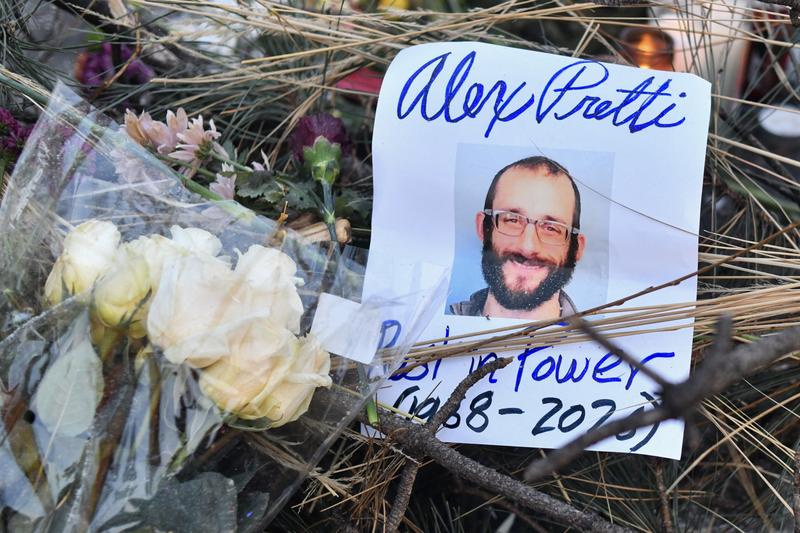
Reid Forgrave: He was a VA nurse. He was an ICU nurse who worked with veterans. He graduated from University of Minnesota, I think in 2011, from nursing school there. He was an avid outdoorsman and mountain biker. There's been a video of him that's been circulating that I saw yesterday, of him reading, I believe it's called The Final Salute. It's for a veteran who just died at the VA in Minneapolis, a very well-regarded federal VA hospital. He is reading this final salute, very solemn. The veteran who passed away, this was a little bit more than a year ago. He released this video yesterday. It's a very deeply personal video, and he shared, saying, "This is the man that has been dubbed by the administration as committing domestic terrorism."
I'm glad that you read that Wall Street Journal editorial coming in. That's a take from the right on this, Rupert Murdoch-owned Wall Street Journal. It's important to note Alex Pretti, yes, he came to a protest with a loaded handgun, and he has no criminal record. He was licensed to carry that weapon. I think this is where you're starting to see some fissures on the right about this, because this is very much a Second Amendment concern. You've seen people over the past 48 hours on the right speaking out about that.
Brian Lehrer: Let's take a phone call from somebody in New York City, but who says she has a connection to somebody there. This is Tracy on Staten Island. Tracy, you're on WNYC. Thank you for calling in.
Tracy: Hi. I am a Staten Island native, and my son is a freshman at the University of Minnesota in Minneapolis. We have family there. My sisters lived there for 30 years. I just wanted him to have the most magical time at a Big Ten University. Sending him back after Christmas, the vibes were very different than when we dropped him off in August. Last night, my sister dropped off snacks and a gas mask to his dorm. I have been calling my congresswoman, Nicole Malliotakis's office, asking for the resignation of Kristi Noem and ICE out of Minneapolis, in Minnesota.
I have not gotten any responses from her office whatsoever. I'm just a mom who wants her kid to have a great time in a magical city. I'm absolutely heartbroken at what is going on there.
Brian Lehrer: Your college student son was given a gas mask. Are those now being distributed to many of the students at the University of Minnesota?
Tracy: No, no. My sister gave it to him. One of her friends got it from a third-tier suburb because they're very hard to find in Minneapolis now. She felt compelled to give it to him because one of her best friends was tear-gassed on Saturday after Alex Pretti was murdered.
Brian Lehrer: Tracy, thank you for your call. That is something, Reid. Can you add any reporting context to that?
Reid Forgrave: Yes. You can hear the emotions in her voice. It's devastating to hear. You want a college freshman to go not have a care in the world. I have two young kids, a middle schooler and an elementary school kid. We're having very serious conversations with them every day. There is that fear that you can hear in her voice that is going on all over the Twin Cities right now. Even in parts of greater Minnesota, out in more rural areas of small towns. There's something else going on, too, and I do think there is a resilience happening in the face of this. Just a lot of human kindness, the way that people have connected as neighbors.
On Saturday, I spent my whole day calling people all around the state. Basically, the main question I was asking is, "What is the feeling in your gut right now?" Republicans, Democrats, average people, officials. Then that night, I walked down the street to our elementary school, and out front in the negative 10-degree weather, there's probably 200 people at a vigil singing songs for a half hour. You're seeing people on these Signal chats, on encrypted apps, who are delivering groceries to people who can't go out, who are housing people in their house. I don't want to cast that as, "Oh boy, this is heartwarming," because none of this is heartwarming.
Being able to see human resilience in a really dark time, there is that flip side of that. I would imagine her son at the University of Minnesota is experiencing plenty of that as well.
Brian Lehrer: John in Brooklyn, you're on WNYC with Reid Forgrave from the Minnesota Star Tribune. John, hello.
John: Hi, Brian. Hi, Reid. I just wanted to express that, obviously, I'm sickened by the killings. What is sticking with me, aside from that at the moment, is the outright lie that we're seeing from the administration about these people, that I feel is a logical conclusion of the empowerment of an administration that's willing to lie about everything, big and small. They are totally immoral and power-hungry, and I wanted to express that. I thought that the General Strike in Minneapolis was the right path, and that New Yorkers should begin to organize a sympathy strike.
Brian Lehrer: John, thank you very much. Reid, tell everybody else about the General Strike. I think they were calling it a General Strike that had been called for Minneapolis for Friday. What happened? How general was it? How broadly was it participated in?
Reid Forgrave: The protest that I mentioned earlier on Friday downtown, this march of 50,000, 75,000 tons of people. I've been downtown for Minnesota Vikings games. It was at least that many or more that went on in conjunction with that. The General Strike was basically, "Don't buy things." People were talking about on Thursday, "Well, I got to get tomorrow night's dinner purchase because we're not going to go shopping." Not anywhere. Restaurants closed down. Businesses closed down. Schools closed down on Friday. It was sort of a symbol of resistance. We've heard some people question, "What does that have to do with anything?"
I think what it had to do with anything is it was the lead headline on The New York Times all day long, "General Strike in Minnesota." I saw something saying it was the first General Strike in America in 80-some years. I can't confirm that exactly. I do think what your caller brought up, one other point that he brought up. This idea of the administration lying in the face of what seems like relatively clear video evidence. I've never heard the word gaslighting more in my life than I've heard it over the past three weeks. I think no matter what people think of immigration policy, of ICE's role in Minnesota and Minneapolis, people can look at the video, especially of Alex Pretti's shooting.
When they hear Kristi Noem say that he approached US Border Patrol agents with a 9mm semi-automatic handgun, well, yes, he had a concealed handgun. If you look at the idea of approaching them, he's holding a phone. Did he put himself in a dangerous situation? Yes. I don't think anyone would deny that. The idea of Stephen Miller saying he tried to assassinate federal law enforcement, or Greg Bovino saying he wanted to do maximum damage and massacre law enforcement. If someone having a concealed carry permit and carrying a gun to a protest is illegal, as FBI Director Kash Patel has asserted, then I guess what these people are saying is true.
If you look at this video and to think that he is some terrorist who's coming in there to shoot law enforcement, he's directing traffic in a really volatile situation. He's taking video in a really volatile situation. Should he have been there? I don't know. I think people on the left would say it is the righteous thing to be there. I think people who are in favor of ICE say, "Why are you getting in the way of a federal law enforcement situation?" The idea of him going in there with the explicit desire to shoot and kill federal law enforcement, I think, is the gaslighting that everyone sees. That really lays bare this moment.
Brian Lehrer: The first call of reference writing to, but not getting a response from, the Republican member of Congress who represents her district on Staten Island, Nicole Malliotakis. There is another New York Republican, Andrew Garbarino, Republican from the South Shore of Long Island, who happens to be the chairman of the House Committee on Homeland Security. He has requested testimony from the leaders of the relevant agencies, ICE, also US Customs and Border Protection, also US Citizenship and Immigration Services, USCIS, the director of that, Joseph Edlow.
He requested that they all appear at a full committee hearing, and Garbarino is getting some attention for that because he's a Republican, seeming to be pushing for these leaders in the Trump administration, relevant to what's going on in Minnesota, to come and be questioned by Congress. I'm just curious. You're in, I guess you could call Minnesota, kind of a purple state. I know your statewide elected officials now are all Democrats. Tim Walz is the governor. Smith and Klobuchar, the Senators. Minnesota's kind of a purple state. How do you see Republicans reacting there, if you're reporting on that?
Reid Forgrave: Just this morning, a prominent candidate for governor on the GOP side, a guy who was getting quite a bit of buzz, ended his bid for governor, saying that "He can't support federal retribution against Minnesota." This is a guy who represented a state trooper who, a few years ago, was put on trial for shooting and killing a guy who was resisting arrest. This is not some RINO. This is a guy who I talked to just after the Renée Good shooting and seemed to pretty much support ICE in that scenario, who seemed to say, "Look, I don't trust the Minnesota--" After Alex Pretti's shooting, there was a spat between federal and state law enforcement on who would investigate this.
This gubernatorial candidate, when I talked to him a few days after Renée Good's shooting, said, "Well, I don't trust the Minnesota BCA, the Bureau of Criminal Apprehension, to investigate this shooting properly." Here he is after this newest fatal shooting, taking a different tactic, saying, "Hey, I'm not running for governor. I can't even be in this party right now if they are taking retribution against the state of Minnesota."
I do think the fissures in the Republican Party, statewide and nationally, that you did not see after Renée Good shooting, I think you're seeing them more. It's not like the entire Republican Party is changing their tune, but you're seeing them more in Minnesota and nationally after this one. I think because of the Second Amendment concerns that are brought up. It seems pretty black and white when you look, like these are videos. The whole story cannot be told from videos. When you look at these videos, you can very clearly see there's five or six law enforcement officers, federal agents, Border Patrol agents who are fumbling him, arresting him.
You can see in a video a Border Patrol agent pulling the gun out of his holster. The gun was not ever in Alex Pretti's hands, and then you can see another Border Patrol officer unload. Whether it is just bad policing, as I've heard from lots of people about the Renée Good shooting or about this shooting, or if it's something worse than that, something more nefarious than that, I think you're starting to see those cracks in the GOP line about ICE tactics.
Brian Lehrer: Someone asks, "Is the ICE agent's name out there? Is that information available to the public? If not, why?"
Reid Forgrave: No. We do not know his name. The administration said that the agents involved in that shooting have been reassigned to a different place. Where that place is, we don't know. Again, there were, I believe, two agents that likely shot off their guns. Then, the third agent, who took the gun out of the holster, from Alex Pretti. We did get, I believe, the day after the Renée Good shooting, the Star Tribune was able to publish the name of Jonathan Good. His name is out there. He's someone who lives in the community.
One other thing about the agents that has rankled a lot of people, the governor spoke about this either today or yesterday, is that in both the Renée Good shooting and Alex Pretti shooting, the agents who were involved left the scene shortly after the shooting. To anyone who works in law enforcement, that is not a thing that happens. The evidence must be preserved. You don't leave two minutes after shooting and killing someone, whether it was justified or not.
Brian Lehrer: That's another whole aspect of what appears to be a cover-up here, in addition to those statements that were false, that appear to be lies, that even the Wall Street Journal editorial that I read from was pointing out very specifically, were inconsistent with the evidence. I see there are multiple court hearings scheduled for today. As these legal battles over who's responsible for investigating a shooting like this unfold, the federal government seems to think it can take on full responsibility to investigate itself. It's trying to marginalize state and local officials.
I see one hearing was set for 9:00 AM Central Time, oral arguments before a judge on the state's lawsuit seeking to stop the surge of federal immigration agents in the first place. Then, at 2 o'clock this afternoon, Central Time, another hearing scheduled on a temporary restraining order aimed at blocking the Trump administration from "destroying or altering evidence." To your point a minute ago in the Alex Pretti shooting, can you explain what each of these hearings is about in a little more detail, and what could come from them?
Reid Forgrave: Yes. The second one, about not destroying evidence, it boggles my mind that we are having a court hearing about not destroying evidence. This seems like common sense, but here we are.
Brian Lehrer: It's about law enforcement not destroying evidence.
Reid Forgrave: Exactly. Right now, I'm keeping track of it on our blog at Startribune.com. Shameless plug. That first hearing is going on right now in court. Basically, there are plenty of things that the state is arguing. Among them is that this ICE surge is interfering with first responders. They're also saying they referred to the Attorney General Pam Bondi's letter to Governor Walz that was published, I believe, yesterday. The assistant attorney general from Minnesota argued that that letter is a "ransom note, an attempt to extort the state to get agents to leave." That letter was asking the state to turn over voter information, Medicaid, and food stamp recipients.
Really, what all this stuff boils down to is who's in charge. Is this the state? Is this state's rights, or is this federal government taking over everything? I think that's what a lot of this really boils down to.
Brian Lehrer: Before you go, I see that your reporting in the Minnesota Star Tribune indicates that this isn't just a Minneapolis or a Twin Cities story. The federal immigration surge is happening all around the state, including in smaller immigrant-heavy towns like Willmar, where you wrote about ICE agents eating lunch at a local Mexican restaurant and then returning after closing time to detain three workers. How have residents in greater Minnesota communities reacted to ICE's presence there, and what did you learn about the ways that these tactics are affecting everyday life, fear, and community, not just trust, but behavior outside the urban centers?
Reid Forgrave: I'm really glad you asked that. I come from Pennsylvania. I didn't know the Midwest until I went to school here, and I've lived here 20-plus years. When people think of small-town Midwest, they think of 99% white towns. Sure, that is the case in plenty of places, but there are so many towns in Greater Minnesota, meatpacking towns, farming towns, ag towns, that have a huge amount of immigrants. You see Hmong people. You see all sorts of Latino people. Somali people. It's complicated. It's a lot more complicated in small-town Minnesota, where it tends to be Trump territory, than it is here in the Twin Cities.
I spent some time in Willmar, Minnesota. It's a town that is, I believe, 40% non-white now. A generation ago, it was virtually 100% white. It is one of the most diverse towns of 21,000 people you'll ever see. It is in a county that voted 65% for Donald Trump back in 2024. You see this political split in America in a very small space, where you go to a diner, and you see Hispanic immigrant sitting right next to a fervent MAGA supporter who's talking about, "Hey, Somalis have ruined this town. There's all this immigrant-related crime." Whether that's true or not, that's a perception that people have. When you see this happen in these small towns, I do think it hits people differently.
These are a lot of towns that had some really dying downtowns that have been reinvigorated by immigrant businesses over the past generation. Things get a lot more complex. This is all over the state. We're talking, the Twin Cities. We're talking Rochester and Mankato and Duluth, and these towns that are far smaller than that.
Brian Lehrer: One little correction that I didn't even catch, but some other people did. When you were talking about the agent who killed Renée Good, you said the name was Jonathan Good. It's actually Jonathan Ross.
Reid Forgrave: Oh, thank you.
Brian Lehrer: I know that can happen when you're saying so many names, so densely in a segment like this. Here's a text message exchange that somebody forwarded to us with the listener's daughter, who the listener says is a Minneapolis nurse who was near the intersection where Alex Pretti was shot. Listener writes, "She was there to protest, but also to assist anyone who needed medical care should something happen."
Here is her answer: "Things have been intense by the intersection. I was helping direct traffic away two blocks up by my friend's house. I was helping an ambulance get through, and all the ICE vehicles start speeding out. I was almost hit. They set off so much tear gas, loud booms of gas bombs, too. I thought a car exploded. I had goggles and a mask on, thankfully, but was stuck for a bit and couldn't get back across to my friends. It was really scary. I can't believe this is all real."
That from a listener in Kingston, New York, relaying a text message from their daughter. With that, we thank Reid Forgrave, reporter on Minnesota and the region for the Minnesota Star Tribune. Again, thank you for taking some time out for us when there's obviously so much that you need to report on locally. We really appreciate your time.
Reid Forgrave: Thanks for having me.
Copyright © 2026 New York Public Radio. All rights reserved. Visit our website terms of use at www.wnyc.org for further information.
New York Public Radio transcripts are created on a rush deadline, often by contractors. This text may not be in its final form and may be updated or revised in the future. Accuracy and availability may vary. The authoritative record of New York Public Radio’s programming is the audio record.
