
Meet the Likely New Speaker
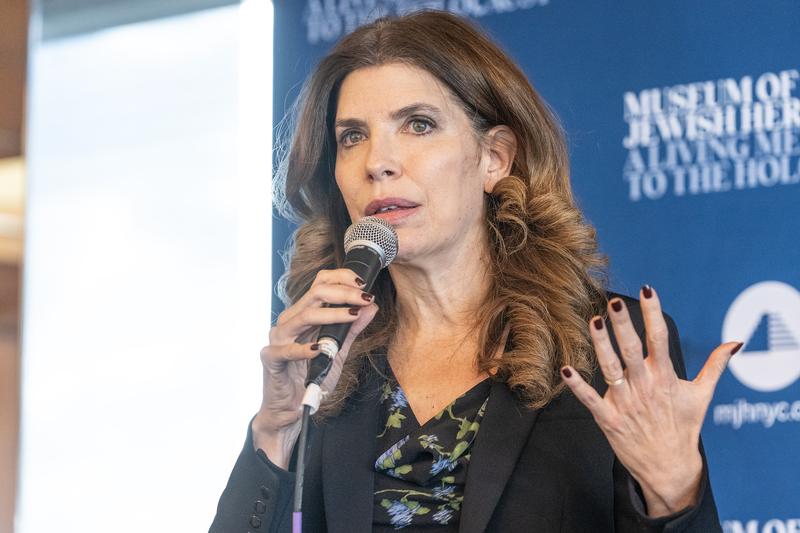
( Lev Radin/Pacific Press/LightRocket via / Getty Images )
Brian Lehrer: Brian Lehrer on WNYC with us now, the apparent incoming speaker of the New York City Council, Julie Menin. Council Member Menin was already scheduled to come on with us in this slot to talk about her plans for leading the legislative branch of government in the Mayor Mamdani era. Yes, we will talk broadly about that, their shared interest in affordability, including universal childcare and more.
Some of the media reports that label her a moderate who might be a check on Mayor Mamdani, the socialist, in some ways, and other things, but the horrific events of this weekend, the mass shootings in Australia and in Brooklyn, also the one at Brown University in Rhode Island and the stabbing of a tourist at Macy's on Friday as she was changing her baby's diaper. Each of those things is not only a tragedy and a crime, but also raise security and policy questions for the city. We will try to cover some of that ground in good faith as well.
By way of background, for those of you who don't know, Julie Menin had been a lawyer and a restaurant owner and became a community leader in Lower Manhattan after the 9/11 terrorist attack in 2001. She first became known citywide in that role through her efforts at helping the area recover and rebuild. She went on to be elected chair of Community Board 1 downtown and then to hold three roles in the de Blasio administration: Consumer Affairs Commissioner, Director of the Mayor's Office of Media and Entertainment, and then head of the city's US census effort in 2020.
She got elected to council from District 5 on the Upper East Side in 2022. She's been on the show in each of those past roles, everything I just enumerated, and now apparently has the support to become speaker when that vote officially takes place in council next month. Julie Menin will also be the first Jewish speaker of the City Council, even as Zohran Mamdani becomes the first Muslim mayor, so the city is making history now in both of those ways. Council Member Menin, congratulations on your apparent path to becoming speaker, and always good to have you. Welcome back to WNYC.
Julie Menin: Thanks, Brian. Great to be back with you again.
Brian Lehrer: Listeners, it can be my questions and yours for presumed incoming council speaker Julie Menin at 212-433-WNYC. Call or text 212-433-9692. Council Member, let's let our listeners know a little bit more about you first, then we'll get into the awful events of this weekend and your larger vision for the city. Anything you want to add to my thumbnail bio or correct of your history in government and public life?
Julie Menin: Thanks, Brian. I really appreciate it. I have been involved in public life for over 20 years. I began my career first as a regulatory attorney working at a large law firm and then as in-house counsel at Colgate-Palmolive, where I did regulatory law. Then, I left the practice of law to open up, as you said, my business, which was a restaurant and catering business and market. This was in 1999, so before 9/11. I was living down there at the time. My business was located two blocks from Ground Zero. My business was absolutely devastated on 9/11.
My husband was supposed to be in the World Trade Center for a meeting that morning, and thankfully, he was okay, but obviously, I became very involved after 9/11 in the rebuilding of the community that I lived in. I started a not-for-profit focused on helping small business and residents, and ended up chairing Community Board 1 in Lower Manhattan for seven years post-9/11. That's really how I got involved in public service, and I have been honored to be able to serve in public life since that time.
Brian Lehrer: What motivates you in politics and public service today? Any central organizing values or goals?
Julie Menin: It's really about trying to get things done, trying to move the needle. All the roles that I've had-- I served as commissioner of the Department of Consumer Affairs, where we launched a paid sick leave law, the Living Wage law, where I presided over the agency and made it consumer and worker protection, where we, for the first time, were able to pass laws and implement laws that protected workers because at the end of the day, the city cannot have a Department of Labor; we're preempted by the state, but we can build out the Department of Consumer and Worker Protection, which is what we did when I was commissioner.
In terms of guiding principles, I have focused really my life's work on consumer protection, on worker protection. There are things that I'm very deeply passionate about. I'm passionate about making sure that city government is really working for New Yorkers, and that we are protecting vulnerable New Yorkers, that we are protecting small businesses, that we're attracting new businesses to our great cities so that we're making sure that we're always creating jobs and really supporting new revenues so that we can build more affordable housing, have the funds that we need to build great schools for our children, build more parks, and all the things that New Yorkers depend on.
Brian Lehrer: Many people were surprised by how quickly council members came to support your bid to be speaker, especially versus Crystal Hudson, who, for example, the New York Times describes as more aligned on policy with the mayor-elect. The article notes she is a member of the council's Progressive Caucus. Should I take it from that that you are not in the Progressive Caucus?
Julie Menin: I joined the Progressive Caucus, Brian, when I was first elected in 2022. 15 members, including myself, left the Progressive Caucus because at the time, there was a pledge that you needed to sign. Embedded in that pledge said that we would work to reduce the size and scope of the NYPD budget. That was not something that I felt comfortable signing or that the other 14 members who also left the Progressive Caucus felt comfortable. At the end of the day, I've done a lot of progressive things in my career. I launched a paid sick leave law, the Living Wage Law. I was the 2020 Census director, where I was honored to run the census for New York City.
We finished Number 1 of all cities across the country. I also served in a senior role at the New York City Law Department at that time, where we were a plaintiff on the citizenship case along with the New York Attorney General, and we successfully sued the Trump administration got the citizenship question off of the census. Again, I think ideological boxes really don't always make sense.
I think what I've really tried to focus my time on are, again, on substantive issues that protect vulnerable New Yorkers, that protect immigrant communities-- I'm the daughter of an immigrant, and really move New York City forward. I'm also a small business owner. For example, when I served as Commissioner of Consumer Affairs, I lowered fines on small businesses. Small businesses were getting socked with thousands of dollars in fines because one word in the sign was incorrect. That is something that I've also been incredibly focused on, and I've also been focused on lowering skyrocketing healthcare prices.
The council passed my bill two years ago that created the nation's first Office of Healthcare Accountability. That office is now up and running at the Department of Health. That office is charged with lowering skyrocketing healthcare prices and lists the price of every medical procedure at every single New York City hospital. It really brings transparency to an opaque process because oftentimes, Brian, when you're at the hospital, it's your most vulnerable time, and yet you come home and you get an enormous bill. For example, a woman giving birth by C-section who goes to one New York City hospital is charged $55,000 for that C-section, yet at another New York City hospital, that same C-section is $17,000.
That's absurd. By bringing transparency to this opaque process, it will allow New York City to harness its purchasing power as the second-largest purchaser of healthcare in the state and drive down costs.
Brian Lehrer: I see that you're aligned with the mayor-elect on aiming for a universal childcare program. What kind of system do you envision, and how much is that the same as the mayor-elect?
Julie Menin: In 2022, the New York City Council passed a package of bills on childcare. I had five bills in that package, and the key bill in my package was a bill that would've required New York City to implement universal childcare within five years of the bill's passage, which again was 2022. The Adams administration largely did not implement those packages of bills beyond really rudimentary basics, so I'm deeply committed to universal childcare. Childcare, on average is costing families $21,000 a year. It's simply unaffordable and not accessible for the vast majority of New Yorkers.
We must move towards universal childcare, and there's also, Brian, an economic cost to this as well. We've had about 300,000 parents in recent years leave the New York City workforce because they couldn't find affordable childcare. The cost to New York City of those parents leaving the New York City workforce was about $2.2 billion economically. Not only is universal childcare normatively the right thing to do, but it's also economically and fiscally the right thing to do. I'm deeply committed to universal childcare. I've been committed to it for years, as evidenced by the fact that I worked so hard on this legislative package.
I'm very excited to work with the mayor-elect on implementing universal childcare. In terms of your question, well, what is the right way to do it? First of all, we obviously have 3-K and Pre-K, although we do need to work harder to make sure that every single 3-K student has a seat that is near their home, so that's something we're going to focus on, but really, we need to do more for zero to two, because if you're a parent of a child that is zero to two, there's very little available to you. We absolutely need to do more on that. If we were to do universal childcare, for example, for all two-year-olds in New York City, that would cost us about $1.3 billion a year.
I know the mayor-elect has focused on zero to five. We need to really look at all of these ages because, for example, if your child is in 3-K or Pre-K, but your workday obviously is not ending in the afternoon, it is very difficult. We need to make sure that we're also working on extended-day opportunities for those families as well. I'm very excited about universal childcare and deeply committed to making it happen.
Brian Lehrer: Governor Hochul also says yes in principle to universal childcare, but she hasn't committed to the tax hike on the wealthiest New Yorkers and on corporations that the mayor-elect thinks might be necessary to pay for it. Do you think those tax hikes are needed to make your vision a reality?
Julie Menin: I think what we need to do as a city council-- and what we will obviously plan to do, is go up to Albany and not just on Tin Cup Day, but really go up there early and often to talk not only with the governor but with legislative leaders about the importance of universal childcare. As I said before, there's an economic issue as well at play here, and that is the lost economic output, the $2.2 billion in lost economic output by not providing universal childcare. What I would like the city council for us to focus on is where we can be value-added at identifying savings at the city level.
I'll give you two examples of that. One example is no-bid contracts. During the Adams administration, as well as the de Blasio administration, there was a prolific use of no-bid contracts. I had a bill in the council that I introduced over a year ago that would ban the use of no-bid contracts beyond the true impact of an emergency, which should be no more than 30 days. For example, in the Adams administration, why did it cost $4 billion a year to house asylum seekers, and why did the Adams administration constantly engage in no-bid contracts with companies like DocGo or even the New York Hotel Association, which received two $1.1 billion contracts?
The problem with no-bid contracts, Brian, is that there's no competitive bidding. As someone who used to own a small business, no small business owner would go with just one bid, the highest bid; that's nonsensical, and it's not the way to run city government. If we could eradicate the use of no-bid contracts beyond the use of 30 days, we could potentially save billions of dollars a year. By the way, those no-bid contracts were used in the de Blasio administration as well because the no-bid contracts were extended over a hundred times to the tune of $7 billion, which is why the city administration spent quite a lot of money on PPE, because they were using no-bid contracts.
That is one potential area of savings that I am very excited to talk to the mayor-elect about. The second area of savings that I think we absolutely must utilize is this healthcare issue that I mentioned before. The new Office of Healthcare Accountability that was created under my bill is estimated to save the City of New York potentially $2 billion a year. How? Because we are spending $11 billion a year currently, or 10% of our New York City budget, on public sector and retiree healthcare, $11 billion. That number, Brian, just five years ago was $6 billion. It's almost doubled in five years.
The reason why is because the hospitals are charging so much money for various procedures. Before my bill came into law, we as a city didn't even know what the hospitals were charging frequently, so we couldn't harness our purchasing power to drive down costs. I'm excited about this area. I strongly believe, and studies have shown, we could save $2 billion a year if we utilize this office correctly, which is what I absolutely plan to do. By identifying those city savings that will help us to be a real player in the affordability agenda and, finally, once and for all, implementing universal childcare.
Brian Lehrer: With the presumed incoming speaker of the New York City Council, Julie Menin, I want to ask you about this especially awful weekend of mass shootings in the city and outside of it. You, of course, know these things. The apparent anti-Jewish massacre of 15 people plus 38 injured is the last number I saw at the Hanukkah celebration on Bondi Beach in Sydney, Australia. Antisemitic hate crimes have also been rising in New York in recent years. As you know, Mayor Adams announced increased security at synagogues and public menorah candlelightings.
Mayor-elect Mamdani released a statement that I want to read a little bit for our listeners. It says, "This attack is merely the latest, most horrifying iteration in a growing pattern of violence targeted at Jewish people across the world." The mayor-elect said, "Too many no longer feel safe to be themselves, to express their faith publicly, to worship in their synagogues without armed security stationed outside. What happened at Bondi is what many Jewish people fear will happen in their communities too."
He said, "When I am mayor, I will work every day to keep Jewish New Yorkers safe on our streets or subways, at shul, in every moment of every day. Let this be a purpose shared by every New Yorker, and let us banish this horrific violence to the past." All of that, unquote, from Mayor-elect Mamdani. As the presumed incoming city council speaker, are there things at the security or policy level that you think the city needs to do to prevent these kinds of hate crimes? How much do you see eye to eye with the incoming mayor, from what you could tell?
Julie Menin: First of all, what happened in Sydney is horrific. I am the daughter of a Holocaust survivor. My mother and grandmother survived the Holocaust in Hungary. My grandfather did not survive. He was killed simply because he was born Jewish. When my mother and grandmother made it through the Holocaust, they stayed in Hungary and stayed for a number of years under Soviet occupation. They then escaped in the middle of the night to Czechoslovakia, and the only country, Brian, that would let them in was Australia. They ended up settling in Sydney, where the Jewish community in Sydney, Australia, welcomed my mother and grandmother with open arms.
They stayed there for six years during my mother's childhood. There had been reports from religious leaders in Sydney and community leaders who warned of the growing tide of antisemitism in Sydney. Unfortunately, those cries were largely not heeded. Now we have the horrific terrorist attack from yesterday. It's absolutely abhorrent, and it's unacceptable. It's not only in Sydney; it's happening really all over the world right now with the rise of antisemitism. To me, the best way to fight antisemitism is through education. There was an article that I read about a year ago that said that 34% of young people in the United States believe the Holocaust is a myth or was exaggerated, 34%.
As a result of reading that statistic, I created a program about a year ago at the Museum of Jewish Heritage here in New York that brings every eighth-grade public school student in New York City to the museum, to the Permanent Holocaust Exhibition, to walk through the museum to learn about the Holocaust. Then there's a curriculum that teachers can utilize to teach about the Holocaust. This is a time where we need to double down on fighting antisemitism. We need to obviously make sure that hate crimes divisions at the NYPD are properly resourced. We need to make sure that the Human Rights Commission at the city government is properly resourced.
It oftentimes takes them over a year to close out investigations, and not just on antisemitism, on all forms of hate. That's simply unacceptable. Obviously, the election of the first Muslim mayor, and if, assuming the vote on January 7th, I would be the first Jewish speaker, that is very exciting, and this is a time to come together. When I chaired Community Board 1 in Lower Manhattan for seven years after 9/11, I stood up for the Islamic Cultural Center and mosque. I actually wrote the resolution for my community board and got that resolution through the community board supporting that project.
This is a historic time where the Muslim and Jewish communities can come together. An example I like to give, Brian, is that after October 7th, a young student in my district in high school who is Muslim came to me and said that her best friend is Jewish. At their high school, they created a club, a joint club for Muslim and Jewish students to discuss issues to come together. That is more of what we need in this city.
Brian Lehrer: We have a caller on that note, I think, Aaron and Astoria. You're on WNYC with a presumed incoming city council speaker, Julie Menin, from District 5 on the Upper East Side. Hi, Aaron.
Aaron: Good morning, Brian. Good morning, Council Member. Thank you for being on, taking calls, and thank you for your words today about coming together in that way. I wanted to ask about your colleague, Vickie Paladino, on the city council. I'm sure you're aware she has a long history of antisemitic, racist, white supremacist comments, as well as threatening violence and murdering her political opponents. This morning, I don't know if you saw, I guess last night, she took the step of saying that we should expel all Muslims from the United States and denaturalize all Muslim US citizens.
You have proudly touted her support when you ran for speaker, and she helped you secure the nomination for speaker along with the entire MAGA Republican faction of the city council. I just wanted to ask your thoughts on her comments and if you would support expelling her from the city council. If not, why do you think her conduct is tolerable? Thank you.
Julie Menin: First of all, blaming Muslims for the attack in Sydney is dangerous. It's inflammatory rhetoric, and it's unacceptable. We saw this type of rhetoric certainly after 9/11, the same type of Islamophobia, which is why, as chair of Community Board 1 in Lower Manhattan post-9/11, as I mentioned, I stood up for the Islamic Cultural Center and mosque. I wrote the resolution that got it through my community board. I got it passed through the community board, and we proudly stood up for that project. I ended up having death threats as a result of that.
This is a time to come together. I will obviously be talking to Council Member Paladino about these comments. We cannot allow this kind of rhetoric to stand, and it's obviously not the time for it, and it's never the time for it. This is a time for us to all come together and not to have this incendiary, inflammatory rhetoric.
Brian Lehrer: Should council take action to censure or expel her, as the caller suggests?
Julie Menin: We have very strong rules in the council. We have an ethics committee. The process is that matters are referred to the ethics committee for a vote, and that is how the censure process works, so that is absolutely up to the vote of the ethics committee. In January, we will be naming all the committees. We'll be naming the chairs of all the committees, including the chair of the ethics committee. That will be a matter for them to take up. To be clear, I do not support those comments. I denounce those comments, and they are extremely troubling.
Brian Lehrer: You don't want to take a position, it sounds like, on whether a censure or expulsion is warranted. Why not?
Julie Menin: It's not up to the speaker. Under our council rules, it's up to the ethics committee. Basically, how the process works is a complaint is filed, the ethics committee meets. Then the ethics committee makes a decision on whether they're going to censure. Under our council rules, it's not up to the speaker; it's up to the ethics committee. We have to follow those rules, but to be clear, I completely disavow those comments and find them absolutely derogatory.
Brian Lehrer: Another listener question on affordable housing, which you brought up earlier. Listener writes: "If your guest is serious in addressing the urgent need for affordable housing, would she support a moratorium on all forms of housing development other than affordable housing for the duration of Mamdani's first term? Piecemeal approaches of setting aside 10% or 15% of development projects will never approach what is needed," writes that listener. Your response.
Julie Menin: One of the things that I'm very interested in the council doing is a proactive, affordable housing plan. That involves looking, for example, at the over 1,000 sites, some of which are vacant land, some of which are underutilized or under-purposed buildings owned by the City of New York. We need to look at those 1,000 sites and see where we can build more affordable housing. That is a historic opportunity. I'm also interested in looking at the public library branches. There are 215 of them; many of them we can build on top of. That's another area of real opportunity to build more affordable housing.
The council has largely been reactive, in my opinion, on some of these issues because we wait till ULURP comes to us, or that's our land use process. Then the council member who's districted in negotiates as opposed to putting out a proactive plan. We have a golden opportunity to look at these sites that the city owns, look at the public library branches, and see which sites are suitable for affordable housing. That, I think, is a golden and historic opportunity and one that I really look forward for the council to dig in on that level of work.
Brian Lehrer: I know you got to go in a minute. I know there are two recent pieces of legislation of yours that are really interesting and that you would love to talk about. I want to give you that opportunity. One is to set up a local census office two years before each census. You got a lot of praise for directing the 2020 census effort, which, from what I've read, did a good count of New Yorkers, and the other one to require two EpiPens per child who might need one in every school. You want to shout out those bills?
Julie Menin: Thanks, Brian. I do. On the census, I served as the 2020 Census director for New York City, where we were under immense pressure on the census. We were able to fund 150 community organizations on the ground that were their trusted voice in their neighborhood. We launched 36 media campaigns in 27 different languages. We funded the 215 public library branches, which again were trusted voices within their respective communities. We obviously were a plaintiff on the citizenship question case, which we, along with the New York Attorney General, won that case at the US Supreme Court and bounced that question off the census.
House Republicans have now tried to put the citizenship question back on the radar. There's legislation in Congress to add the citizenship question back on the census, which would have disastrous implications for blue cities like New York City that have large immigrant communities, and so that is unacceptable. The bill that the council passed, my bill last week, will create a permanent office of the census, so we can start that work now. It's estimated that we could lose potentially three congressional seats in New York State. Let me be clear, we have lost a minimum of two congressional seats every decade since 1950, except for 2020, when we lost one seat, and we came within 89 people of losing zero seats.
That is why it is imperative that we begin the work on the census now because we've got over 300 programs, SNAP, Head Start, hundreds of programs, Title I funds for schools that vulnerable New Yorkers depend on. We cannot lose out on that federal funding, and we cannot lose out on the congressional representation. Finally, by having a permanent office of the census that begins that work two and a half years prior to the beginning of the census, we will ensure that New York City receives its fair share of funding and representation. Then, lastly, on the EpiPen bill, my son had food allergies. We almost lost him when he was two and a half years of age due to a very severe anaphylactic reaction.
It was only two EpiPens, not one, but two EpiPens that saved his life. The bill that the council passed, my bill that mandates that every school and childcare facility across New York City must carry life-saving EpiPens. This is mission-critical because so many children have food allergies, and yet the parents are not aware that their child has life-threatening food allergies. I'm very proud that last week the council passed both of these pieces of legislation.
Brian Lehrer: Very good. Well, the time went so fast. There are so many other things we could talk about. Assuming the official vote goes as expected in January, best of luck as speaker the next four years, and we look forward to speaking with you many times.
Julie Menin: Thank you so much, Brian, for having me. I appreciate it.
Brian Lehrer: Julie Menin, the presumed incoming speaker of the New York City Council.
Copyright © 2025 New York Public Radio. All rights reserved. Visit our website terms of use at www.wnyc.org for further information.
New York Public Radio transcripts are created on a rush deadline, often by contractors. This text may not be in its final form and may be updated or revised in the future. Accuracy and availability may vary. The authoritative record of New York Public Radio’s programming is the audio record.
