Mayor-Elect Mamdani Preps for Office
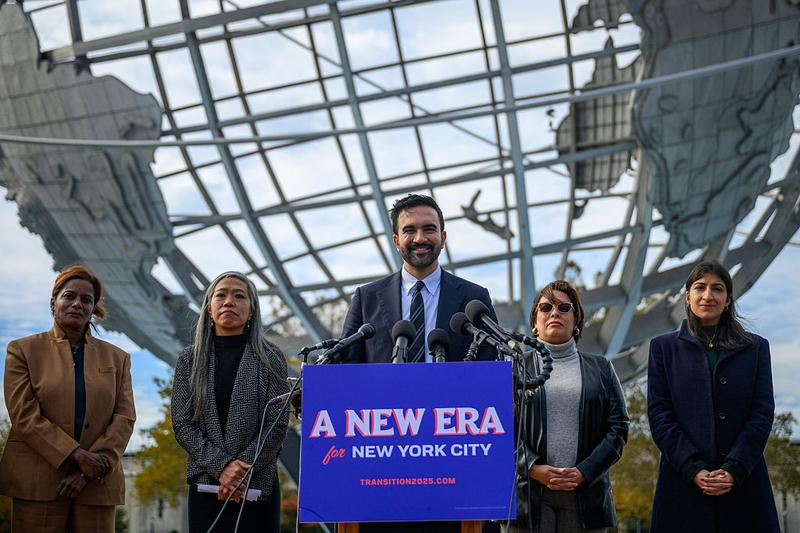
( Alexi J. Rosenfeld / Getty Images )
Brian Lehrer: It's the Brian Lehrer Show on WNYC. Good morning, everyone. Here we are a week and a day after the election and at least two things have happened, one on the national level and one locally. Nationally, seven centrist Democrats in the Senate, as you no doubt know by now, decided it was time to end the government shutdown with the best deal they thought the Democrats would get, no matter how long they held out. Many other Democrats are furious.
We'll cover this in depth later in the show as it is continuing to develop this morning with perhaps an answer to the big unknown here whether they'll get the Obamacare subsidies vote in the House that the Democrats want. That's the big national post election story. Locally, the Governor Mikie Sherrill era and the mayor's Zohran Mamdani era are about to take shape. Sherrill came out angry at those fellow Democrats for ending the shutdown. She called it malpractice.
Mayor elect Mamdani, meanwhile, is beginning to build his governing team with an overture to the establishment he ran against with his first deputy mayor appointee and one to his Democratic socialist base with his incoming chief of staff. How big a tent can he build? How big a tent does he need to accomplish his affordability goals? Mamdani also observed Veterans Day yesterday in his own way to make a point. We'll explain. Also, the outgoing mayor, Eric Adams, remember him? Adams is reportedly planning to make some lame duck moves to what Newsday calls Mamdani-proof city government. We'll discuss what kinds of political sabotage, if we can call it that, he might have in mind.
Listen to this. Fortune magazine reports that some of the New York City billionaires who spent all kinds of money and used all kinds of language to try to defeat Mamdani are now reaching out. For example, the article says Jamie Dimon, CEO of JPMorgan Chase, previously told Fortune Mamdani was, "More Marxist than socialist." He added, "If he becomes mayor, I will call him and offer my help. We'll talk about the significance of things like that today.
WNYC and Gothamist political reporter Elizabeth Kim came on with us every Wednesday during the campaign, as many of you know. She's now being generous enough to sign up for a new Wednesday miniseries on the Mamdani transition on these Wednesdays through the end of the year. The inauguration will be on New Year's Day. Hi, Liz, welcome back to the show. Once again, happy Wednesday.
Elizabeth Kim: Happy Wednesday, Brian. We have less than 50 days until Mamdani takes office.
Brian Lehrer: There we go. The era begins. Your article on these top appointments carries the headline Mayor-elect Zoran Mamdani picks Bill de Blasio veteran for top deputy. Who is this Bill de Blasio veteran?
Elizabeth Kim: This is Dean Fuleihan. He worked under de Blasio both as a first deputy but also as a budget director. Prior to that, he worked for the state assembly for over 30 years. He started out as a policy analyst for the late former assembly speaker Sheldon Silver. Now, the takeaway here is he's a very seasoned state and city government veteran. He's widely respected. I think the most important thing about Dean Fuleihan is he is someone who knows his way around a budget.
Not just the city budget, but also the state budget. Mamdani will have very little time to release a preliminary budget. It's typically due in January. For a first-time mayor, there's a little bit of an unspoken grace period. For example, I looked back and I saw when Eric Adams first took office in 2022, he released his in right around early February. He definitely needs someone who knows the budget, who can hit the ground running. That is what Dean Fuleihan brings.
Brian Lehrer: You brought a clip of Dean Fuleihan. Want to set this up?
Elizabeth Kim: Sure. I thought this was interesting because, of course, you expect someone like Dean Fuleihan to talk a little bit about his experience, what he did under de Blasio, helping rollout-- negotiate the rollout of universal pre-K. He did a lot to spearhead the city through the pandemic. I thought this was interesting. He talks a little bit about his personal biography.
Dean Fuleihan: Like so many in our city, and Marlik mentioned it, I come from an immigrant family. My father, an immigrant from Lebanon, my mother, whose parents immigrated from Lebanon, and her first language, Arabic. They struggled and succeeded and instilled in my brothers and me a deep sense of public service.
Brian Lehrer: Very nice.
Elizabeth Kim: I think it's important because it lends a personal tie to the mayor himself, who is an immigrant. He came to the country as a child after being born and raised in Uganda.
Brian Lehrer: This, besides that little piece of identity commonality, is a reassure-the-cautious pick of a government insider, or just a he-knows-the-ropes pick to tap Fuleihan's connections, or maybe some of each?
Elizabeth Kim: I think it's some of each. It's an interesting pick because Fuleihan during the transition had been advising Mamdani's team on transition. How do you assemble, who to look for in building an administration. I think it was a little bit of a surprise, at least to me, that he turned out to be the pick. There were several other people that were named. Since leaving the de Blasio administration, he's been at CUNY, he's been teaching. It wasn't clear to me that at 74 years old that he wanted to come back to City Hall. I think in the end, I think Mamdani decided on using someone that had this deep knowledge, deep management skills, both as you said because he needs that well of experience, but also because he himself is only 34 years old. He will be the youngest mayor in over a century. I think the knock on him or one of his perceived vulnerabilities during the election was that, can someone with no experience in city government come and be the mayor of the biggest city in the country? This lends him a right hand person who does have that experience.
Brian Lehrer: From Fuleihan's perspective, I would speculate that even if he didn't previously plan to go back into government at age 74, he finds the prospect of the Mamdani era exciting enough that he will want to have at least this one more chapter and be a part of it. The other top appointee aged 34 like Mamdani himself is Elle Bisgaard-Church, who your article reminds us managed Mamdani's primary campaign and is considered one of the mayor elect's closest confidants. She has been his chief of staff in Mamdani State assembly office. Give us some more background on her.
Elizabeth Kim: Like Mamdani, she is a member of the Democratic Socialists of America. I would say that short of perhaps his family, Elle Bisgaard-Church is probably the closest advisor, confidant, you name it, that he has. The two are very ideologically and politically aligned. On Monday, when he announced her as his chief of staff, I believe he called her his moral compass, but she has no city experience. At the same time, this pic was not a surprise because she has been with Mamdani in the trenches since the very beginning when he was in the Assembly.
Brian Lehrer: You brought a clip of Elle Bisgaard-Church. Want to set this one up?
Elizabeth Kim: Sure. This, to me, is interesting because, unlike a Dean Fuleihan, per se, because he was someone who was prominent in de Blasio's administration, this is really the public first look, close look at Elle Bisgaard-Church. I think she's very familiar to people in DSA circles, but not to the broader public. It was very interesting to see how she would talk about how she would approach government.
Elle Bisgaard-Church: During my tenure, I promise that this administration will be open minded, strategically oriented, and pragmatically focused. We will be open to new ideas because we know the old ones aren't working. Anyone who wants to contribute to our shared project of building a better New York for all its citizens has our ear.
Elizabeth Kim: Now, one of the criticisms, or maybe concerns about the DSA, I would say, is some critics feel that they are very ideologically rigid. If you hear Bisgaard-Church talking there, she's saying--
Brian Lehrer: Pragmatism.
Elizabeth Kim: Yes, pragmatism, open minded. I think that that is meant to alleviate some fears of people who are outside the DSA or maybe perhaps more centrist in the party, that their ideas and their concerns will be heard by Bisgaard-Church.
Brian Lehrer: She is named in some stories as the architect of Mamdani's proposal for a Department of Community Safety, that unarmed response team for certain kinds of mental health crises. The department would also fight hate and bias crimes against Jews and Muslims and others, according to Mamdani. Know anything yet about how that might take shape if she's the architect of that?
Elizabeth Kim: My colleague Charles Lane has done a lot of deep reporting on this, and there is intense interest from criminal justice advocates on who would helm this department, how it would be carried out, what is its relationship to the NYPD and the commissioner. At this point, these are all still open questions. What I've learned from my reporting is that when it comes to this particular issue, the Department of Community Safety, but also the issue of policing and criminal justice at large, Bisgaard-Church and Mamdani are the principal architects, and they will have the final say.
Brian Lehrer: Where does the Jessica Tisch story stand now that you mentioned the NYPD? The current police commissioner under Mayor Adams, Jessica Tisch, who Mamdani announced that he would invite to stay on, I guess as a reassurance to people nervous about public safety and his past statements about policing. You have another clip from the mayor's news conference yesterday with his new appointees, who we were sampling from. The mayor-elect was asked about Jessica Tisch, where that stands, and said this.
Zoran Mamdani: I continue to retain my interest in keeping Commissioner Jessica Tisch. I'll be sure to inform you when I have any update.
Brian Lehrer: No news is no news. Are there tea leaves?
Elizabeth Kim: I thought his answer there was interesting. He doesn't spend much time on it. You can tell [laughs] he didn't really want to say too much, but as you remember, Brian, he made that very splashy. Really, it's a little bit of an unorthodox thing to do, which is to announce a pick as big as police commissioner before the election. He announces that hours before the final debate. I think the way most of us read that was that there must have been some conversation between the two of them, because it would seem very strange to come out in front of and say, "This is who I want to be my police commissioner," without giving that person a heads up.
What I've learned is that his campaign did approach and have a conversation with the police commissioner, but she's been very mum as to the roles she sees for herself in the future. She has said-- This is not she herself, but people around her have said that she's very interested in remaining police commissioner. In the past, she has referred to this role as her dream job, essentially. Other than that, we haven't learned much since that story that was broken by the New York Times came out. He did later confirm it during the debate and in other subsequent press conferences.
I do find it curious because I had thought that immediately after he won the election that the announcement of Tisch would have to be fairly soon. Perhaps it does make sense. You do want to maybe announce your first deputy mayor, make that the first formal announcement. The fact that we are now-- It's now Wednesday. There's no appointments press conference planned for today. We'll see it. I think the longer we wait, I think the more questions will arise as to what is the holdup. Is there any kind of hesitancy on Tisch's part from accepting the job? Does Mamdani have any demands of her?
Brian Lehrer: Are there any anti-Mamdani people urging Tisch not to take the job?
Elizabeth Kim: That I don't know, Brian. I imagine that, yes. The governor has come out and said that she wants Mamdani to keep Tisch. That was, in fact, reported as one of the reasons why Mamdani did, in effect, announce that he would try to do so.
Brian Lehrer: Interesting. Listeners, any questions or comments for Liz Kim on any of these appointments named so far, or anything else about the Mamdani transition? 212-433-WNYC. 212-433-9692. You can call or you can text. By the way, Comptroller Brad Lander, who ran against but then endorsed Mamdani in the primary, gets named in several articles as having been interested in first deputy mayor, but spurned by the Mamdani team. Now he's considering running for Congress. What's the Brad Lander story as far as you know?
Elizabeth Kim: In September, my colleague Brigid Bergin and I did report that the relationship between Mamdani and Lander had become strained. It had become strained, in part, because Lander was going around and telling people that he expected or that he wanted to be the first deputy mayor. Someone described it to me as this was the worst political secret in New York City, was that Brad Lander was hoping that this would happen.
My reporting was that Mamdani had felt that he was getting a little ahead of himself, and he had told him that this was not something we had agreed to, and basically, you need to knock it off. I think after that story came out, there was more reporting that showed that Mamdani wasn't really on board with the idea of Brad Lander being his first deputy mayor. He was looking at a lot of candidates. I think, ultimately, as we saw what happened was he decided not to go with Lander. Lander has since signaled his interest in primarying Dan Goldman in the 10th congressional district.
That's interesting, because I think at the time, and it seems like so long ago, but if we think back to when Brad Lander decided to come out and basically endorse Mamdani together, and this was the first time that this was happening in a ranked choice election where these two candidates were coming out and showing this alliance. I think at the time, a lot of people thought, "Wow, this is great. This makes a lot of sense. They are two progressives." Brad Lander, having been on the City Council for many years, he balances out the lack of city experience that Mamdani-- He balances out the ticket in a way. I think it was viewed as a ticket. It's turning out that Brad Lander may very well not be part of the Mamdani administration.
Brian Lehrer: Yes. Of course, Lander himself was a citywide elected official, as there are only three of those posts. Mayor, comptroller, which he was or is for another few weeks, and public advocate. Let's stay on that Lander challenging Dan Goldman, perhaps, in a Democratic primary for Congress. He's not the only one. It looks like this might be a very crowded primary against a Democrat who is considered centrist enough that the progressive wing might want to primary him on Israel, Palestine and things like that.
Elizabeth Kim: That's right, Brian. I think all of these races are still-- We're going to see the field get more crowded as time goes on. The advantage that Lander has is that he is very much well supported by the Working Families Party. Alexa Avilés, who is a City Council member, has announced her interest in running in that primary as well. That's a question. What happens there? Does she step down if Brad does, in fact, signal his-- announces a formal interest in running for that seat? Unclear. I think there might be some strategizing there by the left as to who would be the best candidate that could defeat Goldman.
Brian Lehrer: I saw a report that progressive City Council member Chi Ossé, my primary, Hakeem Jeffries. Is the DSA leadership, if you know, or is the Working Families Party leadership down with more challenges even to Hakeem Jeffries from the left after the victory of Mamdani, which obviously showed some electoral power?
Elizabeth Kim: The challenge that Chi Ossé faces is that Mamdani's people had privately discouraged him from trying to challenge challenge Jeffries in a primary. It puts him in a very awkward position. Jeffries didn't, of course, as we know, immediately endorse him, but ultimately, he did. I believe it was just hours before early voting began, but he did do it. I think there will be some questions. Chi Ossé is a member of the DSA, but he is not a longtime member of the DSA. As to whether or not he gets strong support from the left to go ahead and challenge Jeffries, I think that's an open question.
Brian Lehrer: Here's a Brad Lander-related call. Marvin in Brooklyn. You're on WNYC. Hi, Marvin.
Marvin: Hi. Thank you. I hope people are contributing to NYC even though there's no fundraiser. I was a very strong supporter of Brad Lander's [unintelligible 00:20:43] run for mayor during the primary and all his other elections. I live in his district. It would be a terrible thing for him to primary Goldman. It would divert millions of dollars and lots of energy that needs to be spent on flipping Republican seats and protecting vulnerable Democrats. Rather than having a contest where the difference between the two candidates would take a Talmudic scholar or are a Jesuit to understand the differences.
Brian Lehrer: Marvin, thank you.
Marvin: The Democrats want people-- Can I add one other quick point?
Brian Lehrer: Yes.
Marvin: Democrats are looking eagerly for somebody to stand up to Trump. Goldman actually led the prosecution that impeached Trump. There's no stronger person to stand up to Trump and to defend democracy then Goldman. Brad shouldn't take this race, and I hope he'll reconsider.
Brian Lehrer: Marvin, thank you very much. Yes, probably the Working Families Party, the DSA, if they get involved would think there's enough money and enough energy to challenge Republicans in general elections and challenge Democrats in primaries where they think it's worth doing. You're right to remind about Goldman's leading role in the impeachment hearings. I think his strong and pretty unwavering support for Israel is one of the things that's probably drawing interest in a primary. Liz, in fact, you brought a clip of the mayor-elect on a boycott Israel question he was asked. Do you want to set this up?
Elizabeth Kim: Sure. This has been something that would rear its head occasionally during the election, which is there is a campus on Roosevelt Island. It's called, for shorthand, the Cornell Tech campus. It's in process, but I think it's only phase 1 and is probably at least 10 years away from being completed. It involves a partnership between Cornell University and an Israeli university. When Mamdani was an assembly member, he had called for a boycott of that campus because he had maintained that the Israeli university had some relationship to the Israeli military. During the primary and also during the general election, he would be asked about this issue and whether he still stood firm on that boycott.
I think that this is-- and this has come up on your show as well, Brian, when you've interviewed him, is how does his stance on BDS, how would that shape city policy? In one way, this is an example of that. The other way is, you had asked him about contracts. Would he decide to cancel or not go forward with any contracts with certain Israeli companies that he found objectionable? The other way is this university, because the mayor does control some board regarding this university on Roosevelt Island. That's why he has been asked again and again, what is your position on this university?
Zoran Mamdani: What I've said time and again is wherever the Adams administration, previous administrations, have taken us out of compliance with international law, we'll return this city back into that compliance. I think that New Yorkers, by and large are looking forward to that politics of consistency. That's what we'll deliver on.
Brian Lehrer: That's the same answer he gave on the show, as you know, Liz, when I was pressing him on, what, if any, policies are you going to enact as mayor that are intended to affect the situation in the Middle East? He gave that same answer about bringing the city back in compliance with international law. Is it clear to you what that refers to, whether it's the Cornell Technical Campus or contracting or anything else?
Elizabeth Kim: No. His answer is a little puzzling. I think the reporter did try to follow it up and said, "Is this an instance where you feel that the Adams administration is violating international law?" I think he says no, that this is not. He doesn't come out and give a straight answer on whether he would still stand by his original position, which would be to boycott the campus. Also, what would he do with this board? Like I said, that's the way in which he does have influence. There is a Roosevelt island operating corporation where he is empowered to nominate members to that board.
Brian Lehrer: One other thing related, on Friday's show, we had the incoming comptroller just elected, Mark Levine, the current Manhattan borough president who's moving up, on the city pension fund's investment in Israel bonds. Here's Levine on Friday.
Mark Levine: Israel bonds have been an extremely solid investment, a part of a diverse global portfolio for New York City's pension funds, paying good returns, never missing a payment. They've been part of our portfolio since the 1970s. What you want in a pension fund as big as ours is a truly diverse portfolio. We have thousands of investments, literally thousands in other parts of the world, in almost every country of the world. As I said, this should be part of a diverse global portfolio.
Brian Lehrer: That's a solid yes on Israel bonds from the incoming controller. Does it appear the new mayor, new comptroller, and it is the comptroller who generally controls pension fund investments, are heading for a public dispute on that?
Elizabeth Kim: Yes, they do have a difference of opinion on this issue. Under Brad Lander, Lander had decided to not repurchase State of Israel bonds after they had matured. One of the reasons that he gave was he felt like the city was making an exception because the city does not hold other types of sovereign debt. He just thought, as a practice, that it didn't make sense that the returns are not very good on these kinds of foreign government bonds. He would continue to instead invest in Israeli companies directly. The city, in fact, invests around $300 million in Israeli companies and also real estate.
It's not that the city-- It's been misreported that Lander had somehow taken all of the investment and was no longer investing in Israel. That was not true. He was just trying to bring it in line with how the city treats other foreign countries and government bonds. Mamdani has supported what Lander has done, but you heard there on your show the incoming city comptroller, Levine, has signaled that he would want to go back and repurchase Israeli bonds.
Brian Lehrer: We'll see what happens with that after the break, how Mayor Adams may use his remaining power to intentionally make certain things harder from Mamdani, and more. Stay with us.
[MUSIC - Marden Hill: Hijack]
Brian Lehrer: Brian Lehrer on WNYC. Few more minutes with our political reporter Elizabeth Kim, who is being good enough to do an addendum to her Wednesday campaign appearances on the mayoral race. Now it's going to be a Wednesday transition era series of appearances until Inauguration Day. Inauguration day is Thursday, January 1st. They do it on New Year's Day for mayor of New York. They do it later in January for governor of New Jersey, a few weeks later. Look for the inauguration. We'll have inauguration coverage here on WNYC, and Liz on Wednesdays before that.
Yesterday, Liz, was Veterans Day, as, of course, you know. We had a veterans group leader on the show who said he hoped that the mayor-elect would march in the Veterans Day parade. The mayor elect did not, but he did observe Veterans Day in a way that might make a point about how he feels he will best serve the needs of veterans. He literally served veterans yesterday. He served them hot meals at a Volunteers for American Veterans residence in the Bronx. Here's a clip of him there.
Zoran Mamdani: I wanted to ensure that on Veterans Day, I actually got the time to sit down with veterans and hear from them. Some of the stories that I heard from men who have served this country and given everything they could to protect this nation is that they have often been left behind and forgotten by the same nation, by this same city.
Brian Lehrer: The mayor-elect said he chose that as his Veterans Day event to, "Thank you for your service and also to say the days of thanking you today and forgetting you tomorrow have come to an end." He leaned into a performative aspect of the Veterans Day parade that may leave veterans forgotten the next day. He was trying to make a different point, I guess, huh?
Elizabeth Kim: That's right, Brian. On the debate that you moderated, I think that was the one in which he said that-- He was asked about whether he would participate in any parades. I believe he said no, that his focus would be on running the city. He got some flack for that from his opponents, as to why won't you. Why won't you participate in any parades?
This, if he does follow through with it, it would be a departure from prior mayors. That's not just Adams, but also de Blasio who did participate in multiple kinds of cultural parades, Veterans Day, you name it. It seems as if he's making a statement, beginning with the Veterans Day parade, that he will not be a mayor who participates in these kinds of parades, and he'll find a different way to engage these constituencies and stakeholders.
Brian Lehrer: That parade's question was actually in the previous debate, the Channel 4 debate. Did he say, I would have to go back and listen, but maybe you did, bid he say he will not participate in any parades or just that his focus will be on policy as opposed to parades?
Elizabeth Kim: I think it was the latter, Brian. I think it was likely the latter. I think he tried to sidestep the question and he wouldn't directly say yes. You can't help but wonder whether-- One of the questions, I think, on people's mind is, would you participate in the Israeli Day Parade? Because that has been so much of his political identity as being an ardent critic of Israel. That's a thorny situation for him.
If he doesn't participate in that particular parade, what does it say for the others that he does elect to participate in? Perhaps it makes more sense for him to just not participate in any of these parades. We'll see going forward as the parades-- There's so many parades. Just think of the St. Patrick's parade, and what a tradition. How many photographs, archival photographs, do we have of New York City mayors marching in that parade?
Brian Lehrer: By the way, a listener texts. A little correction, as they see it, of me calling Governor Murphy a lame duck now that the election is over. In the promo for tomorrow's show, listener writes, "Murphy was a lame duck from the moment he was reelected," [laughter] which technically is true since there are term limits in New Jersey. Before you go, Liz, Newsday has an article about Mayor Adams trying to make things harder for Mamdani.
The article starts like this, "Call it Mamdani proofing. Potentially packing New York City's Rent Guidelines Board with landlord-friendly appointees to delay the freeze Zoran Mamdani promised for roughly two million apartment tenants, offering to rehire public employees fired during the pandemic for refusing the mandatory COVID-19 vaccine." I don't know how that sabotages Mamdani.
Continuing, "Budgeting an NYPD headcount boost to 40,000 cops, even though Mamdani campaigned to keep the force at the current 35,000." It's been for years. It continues, "In the 110th Mayoralties waning weeks before Mamdani is inaugurated January 1st, Eric Adams is looking to extend his reach into the 111th. He appears to be considering how to embed people and policies to stymie his successor."
It notes, "As lame-duck politicians have done since the beginning of American history, and mucking up that successor's ability to quickly deliver on some of the campaign pledges, that one last week's election." You've been reporting on the Adams administration all this time. Do you see Adams actually taking any of those steps that would be a Mamdani proofing, as Newsday calls it, or some kind of political sabotage?
Elizabeth Kim: I think of those that that Newsday story mentions. I think the first one, which is packing the New York City's Rent Guidelines Board, would be the most problematic one. It is one that has been talked about. There was a report not long ago that Adams had asked this Netflix reality star, her name is Elena Srugo. She is a real estate agent on this show called Selling the City. She has been seen with the mayor at public events. The mayor often appears on in her social media. They are close. He had asked her if she would consider sitting on the Rent Guidelines Board. She ultimately declined. That then started feeding the fodder. "Oh, is he really trying to do this?"
The Rent Guidelines Board, it's a nine-member board, and the terms are either two or four years, and there are six members who are currently serving on expired terms. This certainly gives the mayor the opportunity to do something like that that the Newsday story references. I will say, and I talked to my colleague David Brand about this. It's not that easy to just appoint someone to this board. There's a lot of work involved in being on the Rent Guidelines Board. I don't know that it's that easy for the mayor to find willing appointees for this board.
That is certainly something that could significantly stall one of Mamdani's key promises, which is to freeze the rent. The idea behind that is that he would pack the board with appointees who are willing to do so and vote in that manner. The other thing that was mentioned, which was the budgeting and NYPD headcount boost. That was something that he did do. I would say simply by budgeting for an additional 5,000 officers, he wants to bring it from 35,000$ to $40,000, does not immediately mean that those officers materialize, as has been talked about on your show and has been reported.
There has been a lot of difficulty in the NYPD to both retain and also recruit officers. I would say maybe the optics of that, though, is by budgeting, by raising the budget to reach that 40,000 mark. It could put the new mayor in a difficult position if he wants to bring that number down. Then the other thing that was mentioned, trying to basically plant his current administration officials in other parts of the city to insulate them from perhaps being fired. As the article says, it does happen all the time. I think a lot of that, though, is just trying to help keep his staff employed less than this nefarious suggestion that they're there to somehow stymie Mamdani's agenda.
Brian Lehrer: Is he being cooperative? We talk about this when the presidency changes hands. Some presidents do more than others to reach out to their successors and help with the transitions. "Hey, anything I can do to help?" Some others more turn their backs. It is an expectation, I think, in all of these executive offices that the outgoing person be gracious and lend a helping hand in the transition. We have this story from Newsday that we've been discussing in ways Adams wants to make it harder for Mamdani. Is he helping him at all?
Elizabeth Kim: In his public comments, the mayor has said that-- Even before the election took place, the mayor said that he was already working on the transition. He has already said that, as is the custom, he is going to sit down with Mamdani and help him with the transition. I know the mayor's prone to exaggeration, but I do believe he said something. This is going to be the best and smoothest transition we've ever had. We'll see. I think the thing to watch is the Rent Guidelines Board.
Brian Lehrer: Last thing, you brought a clip of Mamdani from his news conference yesterday where he was introducing some of his top appointees. He used a word, I think this is what you keyed on in this clip, that I've heard him use several times now since the election. The word is excellence.
Elizabeth Kim: Yes.
Brian Lehrer: Should I just play this or do you want to set it up further?
Elizabeth Kim: No, you can play it.
Zoran Mamdani: Nothing has been more unwavering within this movement than our commitment to excellence. Excellence was the rubric around which we built our campaign team, and it will be the framework through which we approach every governing decision. Excellence is not abstract. It will be reflected in the highest levels of City Hall and the advisors who most shape my decision making.
Brian Lehrer: It's funny, Liz, because I heard that one as boilerplate, "I'm going to do a good job," like anybody would say, coming into office. Why did that perk up your ears?
Elizabeth Kim: For many reasons. For one, the context is we are coming out of a mayoralty that has been scarred or shaped by scandal, and some would say incompetence. Then on the other hand, we're bringing in a new mayor, a young mayor who some are worried that is perhaps too ideologically driven. He has, in the closing weeks toward the general election, has repeated this idea, if not the word itself, of excellence, that his administration would be one that is focused on competency. I think a lot of that is to draw a contrast both between himself and Adams, but also to reassure people who are worried about his age and worried about his connection to the DSA.
Brian Lehrer: Liz Kim, who has graciously agreed to this coda to her Wednesday campaign series on the show, Wednesday transition series until the inauguration. Keep your calendar clear for next Wednesday, Liz.
Elizabeth Kim: Thanks so much, Brian.
Copyright © 2025 New York Public Radio. All rights reserved. Visit our website terms of use at www.wnyc.org for further information.
New York Public Radio transcripts are created on a rush deadline, often by contractors. This text may not be in its final form and may be updated or revised in the future. Accuracy and availability may vary. The authoritative record of New York Public Radio’s programming is the audio record.