
Mayor Mamdani's Lessons From Mayor La Guardia
[music]
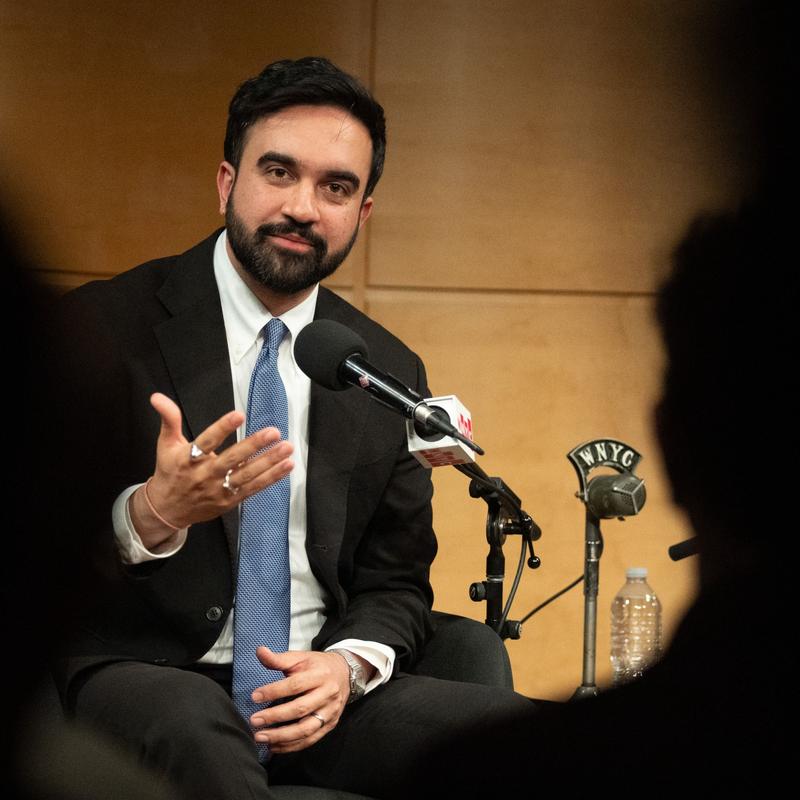
Brian Lehrer: It's The Brian Lehrer Show on WNYC. Good morning, everyone. Last night, our senior political reporter, Brigid Bergin, hosted a really interesting event in our theater, The Greene Space. Maybe some of you were there. Maybe some of you watched it. It was an interview and audience Q&A with Mayor Mamdani, built around the history of perhaps the most famous and universally respected past mayor of New York City, Fiorello La Guardia, who served from 1934 to 1945.
He was revered enough to have both an airport and a Broadway play named after him. Anybody ever see or listen to the original cast album or anything from Fiorello? Both Mamdani and Cuomo said during the campaign that they would want to be like him. The event was part-history, part-newsmaker interview with the mayor, part Q&A with students and faculty from community colleges in all five boroughs. That was most of the audience. Brigid will join me in a minute after these two clips. First is this clip that they used of Mayor La Guardia, extolling the virtues of and waxing optimistic about the city of New York.
Mayor Fiorello La Guardia: This great city, unique in its kind, nothing like it in the whole world. This great city of huge spaces that are too small, of millions of little people who are really big, of people coming from every climbing country of the world, living in peace and happiness here.
Brian Lehrer: Now, here's this from Mayor Mamdani's victory speech. This was on election night, where he mentions Mayor La Guardia by name.
Mayor Zohran Mamdani: This will be an age where New Yorkers expect from their leaders a bold vision of what we will achieve, rather than a list of excuses for what we are too timid to attempt.
[crowd cheers]
Mayor Zohran Mamdani: Central to that vision will be the most ambitious agenda to tackle the cost-of-living crisis that this city has seen since the days of Fiorello La Guardia.
[crowd cheers]
Brian Lehrer: Yes, since the days of Fiorello La Guardia. All right, those are both archive clips to set it up. We'll hear a few from last night's actual event as we go. Hi, Brigid. I did get to watch a lot of it on the livestream last night. Great job. Did you have fun?
Brigid Bergin: Yes, I had such a great time, Brian. The energy in the room, I have to say, was really something special. You mentioned that we had a lot of students from local community colleges there. I think part of the reason we did that, we also had some WNYC listeners, listeners to your show, readers of our Politics Brief newsletter. We wanted to have that room filled with people who were really thinking about the future. We thought, what better way? Particularly, since we were going to be holding up the legacy of Mayor La Guardia, why not start with students who are at LaGuardia Community College?
Then from there, we were very fortunate. Thanks to your senior producer, Mary Croke, who connected us with the head of their public history program, Stephen Petraeus, who is a professor there. We were able to connect with community colleges across all five boroughs. To have those students represented in the room, people who are so committed to the future of New York City and also have a deep understanding of the affordability crisis, we thought that is a real way to have a different kind of conversation with the mayor than he's probably had in these many 100 days conversations he's been having.
Brian Lehrer: By the way, all praise to our senior producer, Mary Croke, senior producer of the show.
Brigid Bergin: Absolutely.
Brian Lehrer: She manages it. She manages other people on the staff. She directs the show. She's in my ear during 10:00 AM to noon. Mary is a real manager. What did she do last night? She was a microphone runner. She was running up and down the aisles holding the microphone to the people who were going to talk next. You had every facet of Mary Croke for the people last night, right?
Brigid Bergin: Absolutely. Here, here. All praise for Mary Croke.
Brian Lehrer: Why do you think Mamdani cited La Guardia in his victory speech?
Brigid Bergin: Well, I think it is part of how he thinks about the city. He looks at how La Guardia came into office as a transformative mayor, frankly, who was cleaning up after an era of corruption through Tammany Hall, and trying to make the city a place that working people could survive and working people could build their families in, and to really return city government to something that people could expect something from and built a legacy, granted, over 12 years, served for three terms of really changing the landscape of New York city.
You mentioned LaGuardia Airport, the East River Drive, NYCHA. He established the New York City Public Housing Authority on the 20th day in office on January 20th, 1934. I think Mamdani, his ambition, and his agenda, match what La Guardia delivered. Now, it will be up to him and his team to see if they can live up to this very high bar that they've set for themselves.
Brian Lehrer: You know what struck me listening to that La Guardia clip, how optimistic he was about the city. Whether that was just politician speak or whether it really reflected the different mindset that people had, the different feeling that people had about life and life in the city. Of course, the 1930s was the Great Depression.
Brigid Bergin: Yes.
Brian Lehrer: The early '40s, the end of his term, was World War II. Those were tough times, but he talked about millions of little people who are really big, which is a good populist note right there, and people coming from every climbing country of the world, oh, he was pro-immigration, living in peace and happiness here. Then, the last part that really struck me in this respect, people knowing that their children will have the opportunity of an education in the most hospitable city in the world, very different from, oh, my gosh, will the next generation be able to live at all like their grandparents and their parents, like we talk about so much now?
Brigid Bergin: Yes, absolutely, Brian. Even as you were describing that, it made me think of these parallels between-- When La Guardia was elected, they talk about how he put together this new coalition of voters, and that there was a tremendous spike in voter registration, in voter turnout.
You and I have spoken many times about the Mamdani campaign, and what they were able to do in this most recent election to activate new voters, particularly young voters, South Asian voters, Muslim voters, people who maybe have not, in the past, seen themselves represented in the city's politics and had a candidate who was both speaking to them, but also listening to them.
I think that is something that in covering the mayor in his first 100-plus days, 111 days so far, that is something that you do hear him talking about, trying to make sure that he is still listening to New Yorkers as they did during the campaign. I think people are not used to hearing that from politicians.
Brian Lehrer: It may be a footnote to history at this point, but wasn't La Guardia the first Italian mayor?
Brigid Bergin: Yes, indeed.
Brian Lehrer: Italian American mayor of New York. Now, Italian Americans once discriminated against and largely despised by people who were here before. Minority group of immigrants. Now, of course, so mainstream as white Americans that we don't even think about that first as being a first that raised up an emerging group, but that's another parallel. He was the first Italian mayor, and that meant a lot. That was a big deal at the time, as the population of the city was changing.
Brigid Bergin: Absolutely.
Brian Lehrer: Now, of course, Mamdani is the first Muslim mayor with all the questions that come around that from people who are from groups who've been more numerous in the past.
Brigid Bergin: Sure, absolutely. La Guardia came and saw Tammany Hall. Tammany Hall, dominated at the time by many Irish people who were Irish immigrants or the descendants of Irish immigrants, did mark this new era in New York City politics. It's just that reminder that as much as New York City is the story of America, that evolution and how immigration is so key to how both the city and the country evolves.
Brian Lehrer: Listeners, anybody out there right now attend or watch on the YouTube stream, the Brigid Bergin, Mayor Mamdani, and a panel, we'll talk about the panel that followed the mayor, too, a little bit, and invoking the history of Fiorello La Guardia, event last night? Was anybody there and want to follow up in any way, or anybody else with a question or comment for Brigid about the event and other themes and news that was made at the event that we'll discuss, or just things for her as senior political reporter in the Mamdani era now here at WNYC? 212-433-WNYC, 212-433-9692. You can call or you can text, 212-433-WNYC, 433-9692. To my eye, if the mayor made news last night, maybe it was in his comments on an incident involving the police in Gowanus. We'll play that clip of the mayor, but do you want to set it up for us, Brigid?
Brigid Bergin: Yes, so there was a very troubling incident last week where officers were attempting to make an arrest of someone that they thought was a suspect connected to what had been a drug sale or associate of someone who had been selling drugs. They were in a liquor store near the Gowanus Houses. There's video of this particularly violent arrest where the individual was assaulted. It is something that many people saw on social media. The police commissioner condemned. The mayor had condemned. Much of that particular unit has now been reassigned.
My question to the mayor was connected to some reporting that my colleagues here in the WNYC and Gothamist newsroom had done, going to Gowanus Houses and talking to the residents there about their experience, their impressions. What their takeaway was, as awful as this particular incident had been, that this was not a one-off, that that was more reflective of their experience with the police. I asked the mayor, what did he think needed to be done? What would he do to repair that relationship with the residents there and the police.
Mayor Zohran Mamdani: First and foremost, we have to understand that New Yorkers expect us to deliver safety and justice hand in hand. For a long time, they've been told, as if they have to choose between the two. What we saw, as you said, in that video was not only incredibly disturbing, but also unacceptable. There are the immediate actions that we took to reassign these officers to investigate this.
Yet, as you've also said, this is what we've heard from a number of constituents, part of something that is larger, something that troubles them. That also means that we as city government have to look deeper than just this as one case, one incident. As we reflect on that, we will share with New Yorkers the kinds of steps that we're going to take to ensure that not only does this not happen again to this New Yorker, but that it does not happen again, period.
Brian Lehrer: Mayor Mamdani last night. Brigid, interesting that he started that answer with, "First and foremost, we have to understand that New Yorkers expect us to deliver safety and justice hand in hand." Considering some of his past activism, he's been very careful as a candidate and now as mayor. Of course, he reappointed Jessica Tisch as police commissioner to position himself, at least as a public safety measure, as well as a police accountability mayor, right?
Brigid Bergin: [clears throat] Excuse me, Brian. Absolutely. I think that was something that he was trying to underscore in his response. I appreciated the fact that he said that they will communicate back to us and to New Yorkers about the steps that they plan to take, because I think that gives us, as reporters and as journalists, an opportunity to then follow up over time and ask, "Okay, so what are the next steps here?" We know that there is an ongoing investigation, and there are some disciplinary proceedings that have started, but it sounds like there's more that they plan to do. I think that he has now given us an opening to ask further questions about what is coming next from that.
Brian Lehrer: Right, and he suggested there that this shouldn't just be looked at as an isolated incident involving the individual officers who've been reassigned, is that the word he used, while the investigation continues? Also, I guess what he was suggesting there was, "Hey, police brutality is a systemic problem, and we're going to look at it structurally as well," correct?
Brigid Bergin: Absolutely. At this point, we know that he has hired a deputy mayor for community safety, and that is something that his administration is trying to build up. What ultimately, I think, they wanted was an agency that would be part of his criminal justice plan. That's another place that we will have to see what comes next. Is that something that evolves? Do they get the support that they need from the city council in order to do that? Lots of threads to watch coming out of both what happened in that particular incident, but also the larger criminal justice agenda of this administration.
Brian Lehrer: We should say crime, if you look at the stats, has stayed quite low in Mamdani's first 100 days, but you also pressed him last night on a horrible incident from the past week, the shooting death of 15-year-old Jaden Pierre at Roy Wilkins Park in Southeast Queens. What happened, and how did you press the mayor on that?
Brigid Bergin: Yes, this is just such a troubling, troubling story. This is the story of a young man who was at a park, as you mentioned, Roy Wilkins Park. He was surrounded by some other kids. He was ostensibly there, had gotten permission to go play basketball. It was actually going to be a water balloon fight that he had heard about on social media, according to reports there.
The reports are that several other kids there proceeded to start beating this kid up, and kids were filming it. It escalated to the point where he was shot and killed. Video of his death was then shared on social media, including by former Mayor Eric Adams, who was, I think, rightfully outraged, but then asked the question, "Where is Mayor Mamdani on this?" I posed that question to the mayor to see if he wanted to respond to the former mayor.
Brian Lehrer: Wait, you mean Eric Adams? Because I didn't know this. Eric Adams trolled. Would that be a fair word? Trolled Mamdani by going to the scene?
Brigid Bergin: No, he didn't go there, but he shared this piece of video that had been shared of the incident.
Brian Lehrer: I see, and criticized Mamdani for not personally going to the site.
Brigid Bergin: Yes, this is something that I think we have seen mayors in the past. It, I think, is both a reflection of style, perhaps over substance. Mayor La Guardia, in fact, was known for showing up at fires and incidents, just was everywhere when things happened. Mayor Adams, similarly. Mayor Mamdani has had a different style than that. I wanted to know if he wanted to respond to both Mayor Adams' criticism, but also to comment on the broader tragedy of what had happened in this park.
Brian Lehrer: What did he say? We don't have that clip.
Brigid Bergin: He did not want to respond to Mayor Adams by any means. He just said very, very quickly, "No," but he did talk about, ultimately, how tragic the incident was, and that it was something that his administration needed to pull together the resources to combat gun violence, and that that was something that they were very much committed to doing. I think, to me, his response reflected an awareness of this problem that is frightening and thorny and very difficult, but that they are committed to focusing on, and that will be part of the purview of this new deputy mayor of community safety.
Brian Lehrer: Well, if you're just joining us, my guest is WNYC senior political reporter Brigid Bergin, who hosted an event in The Greene Space last night with Mayor Mamdani and questions from the audience, which was largely community college students and faculty members from all five boroughs. There was also a panel discussion afterwards. The theme was built around knowing some history of Mayor Fiorello La Guardia, who Mamdani considers a role model. You know what? We probably don't have many listeners in our audience right now who actually were alive to remember Mayor Fiorello La Guardia, but we have at least one. Jerry in Paramus, you're on WNYC. Hi, Jerry.
Jerry: Oh, I appreciate you taking my call, Brian. I am 101 years old, and I lived through the Great Depression and World War II. I always remember. I was 10 years old when Mayor La Guardia was elected. I always remember the enthusiasm in the Jewish community that he was their mayor. He reached out to everyone and actually ran under the Fusion ticket. He wanted to cover everyone. He wanted to appeal to the entire community.
There was a great sharing of joy, and I would say happiness at that time, even though the Great Depression was a terrible situation, and we all shared in it. La Guardia brought a different character. He was an individual, I think, that wanted to touch everyone. I think he was very effective in it. My experience was very positive. I think that everyone should see the show, Fiorello! I thought it was a magnificent portrayal of him, and it should be revived. I thank you for having me on, Brian.
Brian Lehrer: Jerry, can I ask you one follow-up question?
Jerry: Of course.
Brian Lehrer: You mentioned the Jewish community being happy with La Guardia being their mayor. Earlier, I mentioned that he was the first Italian American mayor, and I guess I should have thrown in that he was half-Italian, half-Jewish, so he was actually the first Jewish--
Jerry: Absolutely. Absolutely. He came to the Jewish communities, and I remember that he was speaking Yiddish at the sub time. He was a remarkable individual, a tremendous politician, but a warm human being.
Brigid Bergin: Wow.
Brian Lehrer: I don't know if this is an insult to even bring it up, but I'm sure listeners are thinking, "Man, that Jerry sounds great for 101," so whatever you're doing--
[laughter]
Jerry: Brian, let me tell you this, that you are helping me live longer because I listen to your program every day, and I'm thrilled to be able to just listen to what you say. Your listeners are marvelous, so keep it up. As long as you keep it up, I'm going to be around.
Brian Lehrer: Oh, Jerry. Okay. Well, now, you just gave me reason to keep going for decades more. Jerry in Paramus, thank you so much for calling. Wow, Brigid, I think that he is the oldest caller that we've ever had on the show. We had somebody a couple of years ago, just after they turned 100, like, days after they turned 100. Not everybody identifies their age. I know we've had callers in their 90s, but there you go, Jerry at 101.
Brigid Bergin: Remarkable.
Brian Lehrer: Pretty incredible.
Brigid Bergin: That was so, so remarkable. [clears throat] Excuse me. Jerry sounded amazing, but Jerry also reminded me of the fact that La Guardia was this transformative, amazing mayor. That is what we focus on. He had this amazing career and life and spoke five languages, had been in Congress, fought in the war. Just an absolutely tremendous individual. Then to hear Jerry say that he was 10 years old when La Guardia was elected, Jerry is a tremendous individual. That was such a fun call. The only question I would have asked him is if he is-- He's in Paramus, so he's not a New York City voter, but is he following Mayor Mamdani at all? That was very cool. [laughs]
Brian Lehrer: Yes. All right, Jerry, you can call us back and tell us if you're following Mayor Mamdani, and how you think he's doing. Yes, I guess I should have had it top of mind that not only was La Guardia the first Italian American mayor, he was the first Jewish American mayor of New York City. I generally think of Abe Beame as the first Jewish mayor, but I guess he was the first fully Jewish mayor, so happy to be corrected.
Brigid Bergin: Yes, because I think that La Guardia was a practicing Episcopalian, but his parents were Jewish and Italian.
Brian Lehrer: He had one Jewish parent. All right, we're going to continue with Brigid. More clips from her event last night. More calls from you. I don't care if you're 101 or if you're 1. 212-433-WNYC, call or text, as The Brian Lehrer Show continues.
[music]
Brian Lehrer: Brian Lehrer on WNYC as we continue with our senior political reporter, Brigid Bergin, who hosted an event at our theater, The Greene Space, last night. A Mayor La Guardia-themed interview with Mayor Mamdani. Also, just on current news, a panel discussion followed, and questions from the audience. We'll play at least one of those as we go.
The audience made up largely of community college students, students from community colleges in all five boroughs, and a few faculty members as well. 212-433-WNYC, if you were there, or you just want to react to anything you're hearing now, or if you watched it on the livestream last night, 212-433-9692. One big difference is who was president for each of these mayors. FDR for La Guardia. Trump, obviously, for Mamdani. Here's an archive clip you had of La Guardia speaking about FDR.
Mayor Fiorello La Guardia: He's a great president. Even those who are politically opposed to him concede his greatness and admire his qualities. Our President Roosevelt will live in history as long as history is written and read.
Brian Lehrer: Mayor La Guardia at the time on President Franklin D. Roosevelt. Brigid did ask Mamdani about this, apparently, at least on the surface, friendly relationship with Trump. She asked, "Is Trump your FDR?" The mayor said this.
Mayor Zohran Mamdani: The first time that I met with President Trump, it was November of last year, and he showed me a portrait of FDR. I told the President that my favorite mayor in the history of New York City was Fiorello La Guardia, and that so much of what he was able to achieve, as you said, was because of his partnership with FDR, because of how the New Deal infused this city with a real sense of possibility.
In the second meeting, as you have in the photo here, my proposal to the President was to build the greatest amount of housing we'd seen in a single housing development since the early 1970s. Sunnyside Yard would yield 12,000 homes, 30,000 jobs, and is impossible to complete without the work and the assistance and the approval of the federal administration. I shared with the President directly what my hopes would be. I think the President and I have many more disagreements than Mayor La Guardia had with FDR.
Brigid Bergin: Sure.
Mayor Zohran Mamdani: However, what we do have in common is the fact that like La Guardia and FDR, we are also both from New York City. This city holds an outsized sense of not just importance, but also love for all of us. After that first meeting, the President shared with the press that the better New York City does, the happier he is. That is one thing that I do have in common with the President. I think that's one thing that La Guardia and FDR also felt.
Brian Lehrer: Mayor Mamdani on his relationship with President Trump after Brigid asked him about comparisons between La Guardia's relationship with FDR. What'd you make of that answer, Brigid?
Brigid Bergin: I had heard some of the story before about how President Trump had showed Mayor Mamdani the portrait of FDR when he visited the White House the first time. I think that there is something to this idea that because President Trump is a creature of New York City, that it has thus far been good for the Mamdani administration and for his relationship with the mayor. I think he also appreciates the charisma, frankly, of Mayor Mamdani and had a connection with him when they met.
We have seen in the recent weeks, some more critical messaging from President Trump about some of Mayor Mamdani's policies. I think we're still far from seeing shovels in the ground at a place like Sunnyside Yards. Part of my follow-up to Mayor Mamdani on that line of questioning was to see if there was any news that he wanted to share with us about the status of that particular project.
That was part of the mocked-up Daily News front page that he had brought with him to meet with the President for that second meeting in February. That became the photo that many of us have seen. There was no press conference like after their first meeting, but there was this image of Mayor Mamdani standing next to President Trump in the Oval Office with these mocked-up front pages.
The classic, old Ford to City: Drop Dead, and then the contrast being Trump to City: Let’s Build, talking about Mayor Mamdani's proposal for building over the Sunnyside Yard rail yard in Queens. That was something that happened in February. We wanted to press him a bit on that. Ultimately, he said, when there was more to share on the status of that project, he would be sure to let the public know.
Brian Lehrer: Right.
Brigid Bergin: Interesting that that is an area of common ground that even when you hear the mayor talk to national outlets, like he was on Meet the Press on Sunday, and he talked about how he has conversations with President Trump about Midtown Zoning, because President Trump is both running the country, but also is familiar with ULURP because he is from New York City real estate. That kind of conversation, I think, is probably not something that most mayors and presidents have had, but perhaps there is a parallel to someone like a Mayor La Guardia and President Roosevelt, who was, although not in New York City real estate, also a New Yorker and understood what happened and what needed to be done to build in New York.
Brian Lehrer: Right. ULURP, by the way, folks, since most of you probably don't know, is an acronym for the Universal Land Use Review Process, ULURP, in New York City. I wonder how many presidents before Trump could have said what that acronym was for. Yes, this is just an agreement in principle to build. What is it? It's over 10,000 units, I think.
Brigid Bergin: 12,000, yes.
Brian Lehrer: 12,000 at Sunnyside Yards. I guess we should say that that was one of FDR's main legacies for New York City. Maybe his main legacy for New York City was putting so much money into the building of public housing, right?
Brigid Bergin: Absolutely. That is something that we didn't get to talk as much about last night. There's many topics, of course, as you well know, Brian. When you prepare for these conversations, sometimes there are things that you want to hit, and you don't get to hit them. A deeper conversation about the future of public housing in the city was something that we didn't get to, but is very much a part of La Guardia's legacy, and controversial in some respects because the housing that he helped build at the time was segregated housing.
It did still build this foundation of public housing in a public housing infrastructure that changed the city's landscape. Now, we're at a point where we've seen decades of disinvestment in that infrastructure. I think there are some real questions about, what is the future of public housing under this current administration? Will we see more teardowns like we're seeing at the Chelsea-Elliott Houses? Is that what the future holds? Will there be public investment in public housing, or are we shifting to some new model? It's definitely fertile ground for a lot of follow-up conversation with the mayor and other members of his administration.
Brian Lehrer: Right. I know you prep talking about not getting to public housing, which is one of the things you would have liked to get to. I know you prep like I do. It's like we write 20 questions so that in the live improv conversation, when the actual show is on, we can use from our menu the best 10.
Brigid Bergin: Yes, exactly.
Brian Lehrer: Depending on the situation. Of course, make up others as we go along, depending on the situation. Yes, a little behind-the-scenes, folks. We almost always leave some questions on the table because that's actually part of how you get to the best segments. All right, we're going to talk about and play a clip about one of the big differences that Mamdani obviously has with the Trump administration. First, I want to take a call from Melissa in Long Island City, who, it looks like, hosted a watch party for your event last night, Brigid. Hi, Melissa, you're on WNYC.
Melissa: Hi there. Yes, I run a voter guide called Soft Power Vote. We hosted a watch party at a bar in the Lower East Side called Beverly's. It's an artist-run bar. I hope she doesn't mind me mentioning this, but one of La Guardia's descendants joined us. We were just talking about his legacy, and also his impact on the arts, and just public access to services like housing. I live over by LaGuardia Community College. Then some other people that were there, some other friends, were also wondering why we're talking about La Guardia.
I thought that was a fun parallel to keep the conversation alive, especially about his legacy and about his impact. Of course, we all know LaGuardia, the airport, and we see his name around town, but it's nice to know and reflect on the legacy. I think as you guys were talking about how he collaborated with the President at the time, FDR, and then also La Guardia was-- I don't want to say forced to, but the legacy of his collaboration with Robert Moses, I know there's a lot of criticism with the mayor of collaborating and taking meetings with these people.
Because of that, New York City was able to capitalize on, I think, a quarter of the CWA funds at the time during the New Deal and was able to champion all of these public infrastructure projects that kept New Yorkers working during the Great Depression. Definitely interested to see how the current mayor champions the arts. I know housing is a big deal. It's nice to provide that space for people who are still wondering about why La Guardia is important and the parallels between him and the current mayor.
Brigid Bergin: That's so cool. [chuckles]
Brian Lehrer: Brigid, talk to Melissa.
Brigid Bergin: Melissa, that's so cool. I'm so glad you guys did that. I hope you enjoyed it. As Brian and I were just saying, in the many topics that you prepare for but end up having to leave on the table, La Guardia's investment in the arts, you think of a place like City Center and restoring it to its full glory, and making it a place where working people could go and see theater on their schedule, so timed at a different time. It wasn't the late-night after-dinner.
When they got out of work, they could go and see theater. That is part of his legacy. In the early days of the Mamdani administration, among some of his first announcements were partnerships with arts organizations that were trying to make tickets available to New Yorkers at discounted prices and to make the arts something that are accessible, that it shouldn't be a luxury. It's part of why so many of us live in this city, to be able to experience that creativity, and to make sure that everyone can experience it.
That was a parallel that I wanted to get to. We didn't get a chance to get to. There's just this wonderful photo of Mayor La Guardia, who used to love to conduct the New York Philharmonic. Just for the visual, Mayor La Guardia was about 5'2", kind of a squat guy. This image of him conducting the Philharmonic is such a fun image. When you look at it, I wonder, what is the kind of version of that we might see from a Mayor Mamdani over the next few years?
Will he conduct the Philharmonic, or will he do something else on social media, or, similarly, like the image of Mayor La Guardia smashing slot machines as he's cracking down on vices? Is there some version of that? Certainly, Mayor Adams, we saw some of that. I remember images of him seeing those dirt bikes being crushed, but will Mayor Mamdani have a version of that? It's something that's so interesting. I'm glad that there was a group of people who were having that conversation. It just makes me so happy. [laughs]
Brian Lehrer: Thank you, Melissa. Thank you so much. By the way, the listeners always keeping me on my toes. A correction to my description of the acronym ULURP. I said Universal Land Use Review Procedure. It's not Universal. It's Uniform.
Brigid Bergin: Oh, yes.
Brian Lehrer: The Uniform Land Use Review Procedure, so I stand corrected once again by a Brian Lehrer Show listener. I thought one of the most striking moments of the night, as I watched the livestream, came from a student question. We're going to play the student's question, and then the mayor's answer. This is Christina, a student at Bronx Community College, followed by the mayor's response. You'll hear what the issue is.
Christina: Seriously, I wanted to talk about ICE on our campuses. I'm not sure if it's a CUNY-wide standard of how we should be attacking this situation, but at least on BCC, this is the protocol. If ICE comes to campus, the CUNY guards will make sure that they have all the proper documentation. Thank you. Make sure they have all the proper documentation. If they don't strong-arm their way onto campus, they will be taken to an office, in which CUNY officers will then retrieve the student and deliver them to the ICE agents.
This is a problem. It will just erode the trust between institution and student. We need your help. We did mention this to the Senate meeting that we have. We were told, "Is this the right setting for you to mention this?" I believe any time to mention such a thing is the right setting. Please, can we just get across-the-board no ICE on CUNY? What can we do as an institution to support each other, that we keep each other safe on our campuses?
Mayor Zohran Mamdani: Do share your opinion that it's always the right time to ask that, no matter what setting you're in. First and foremost, I'm going to follow up with my team around what CUNY policies are and what they need to be. I think we've seen a number of times where we are proud of the sanctuary city policies we have in New York City. We also want to be clear that, and I'll say this, as the mayor, I do not want a future of the city where we learn how to deal with ICE. I believe that ICE should be abolished. I've said this both publicly and privately.
I've even told the President directly that I believe that ICE raids are cruel and inhumane. I think that they don't do anything to serve in the stated public interest of public safety. On the specific policies, I'm going to look into that. I really appreciate you raising it. On the broader level, I think we need to ensure that as we know what it is that we're fighting against in a political sense, we also have to know what it is that we're fighting for. I believe that when it comes to immigration at a national level, we have to be fighting for a vision that has much more humanity at the heart of it than what it has become.
Brian Lehrer: All right. Christina, a student at Bronx Community College, asking the mayor a question, and his response. Brigid, she laid out a protocol where CUNY officers will hand students over to ICE if ICE's paperwork is in order. Did that seem to be news to the mayor, or did you confirm that that's actually a thing?
Brigid Bergin: I have not fully reported this out yet since the event last night. I did receive a notice from a source at CUNY who pushed back on that and said that, in fact, CUNY works very hard to make sure students are safe on their campuses. I think the fact that Christina raised it raises questions to me and is something that I want to make sure that we follow up on to understand if there is a protocol and if it is not being followed, or if there are students who are aware of things that are breaking from what is supposed to be the protocol, that would be news.
It certainly seemed to be news to the mayor at the time, which is why, obviously, he said his team was going to follow up on it. There was something, I think, that was hard for that student to do. It was hard for Christina. You can hear that she was nervous as she was asking that question, but this is something that is, I think, very much is real for these students. If this is something that they're witnessing and seeing, then it's something that we need to report out.
Brian Lehrer: He did say plainly in that answer. I took note of this as it was going by. I wonder if you did, that he believes ICE should be abolished and that he's told the President so directly. Was that the first time you'd heard him say it that flatly as mayor?
Brigid Bergin: It's interesting. I think he has said it before, but I do think the fact that he underscored the fact that both he thinks it should be abolished and this is something that he's made very clear is notable and striking. It will be interesting to see what the days and months ahead are in terms of what this federal administration's policy is on ICE crackdowns, which seem to be slowing somewhat compared to what we had seen earlier in the year
Brian Lehrer: Well, actually, a follow-up to that. Does the mayor say, as a matter of policy, what would happen to legitimate immigration enforcement? Because there is some legitimate immigration enforcement, I think, he would say. Some legitimate deportation. If ICE was abolished, how would that happen? Do you know what his response to that would be?
Brigid Bergin: I think what I have heard from the mayor, when you go there on certain questions, because it is not something that is necessarily within the purview of his role as the mayor of New York City, he will pivot back to saying that, right now, he is focused on what he can do as the mayor of New York City. I don't think that he has necessarily articulated what he thinks that type of federal immigration policy should be beyond saying that it shouldn't be what he would describe as the cruel version that we have right now.
Brian Lehrer: We're way over time. Note to our other guests, you're just going to have to wait a few more minutes because this has been so interesting and fun with Brigid Bergin on her event last night in The Greene Space with the mayor and about La Guardia as well. After we played that Christina from the Bronx Community College clip, I'll read this text.
Listener wrote, "It was really inspiring and uplifting to see all of those CUNY students in the audience last night. Way to go, WNYC and Brigid B." On La Guardia, listener writes, "Don't forget the life-size statue of La Guardia on LaGuardia Place, a block below Washington Square Park. You can see him walking while expounding," [chuckles] which is a great way to describe that statue and La Guardia walking while expounding. All right, one more clip.
In the event, you had a panel discussion after the mayor left. I'm just going to play one clip from one of the panelists because it was so striking to me anyway, putting Mamdani in the context of history with respect to a different mayor of New York from the past. This is Dennis Walcott, who's currently in charge of the Queens Public Library system, but he was the school's chancellor, one of the people who served as school's chancellor under Mayor Michael Bloomberg. He notes here similarities between Mamdani and Bloomberg.
Dennis Walcott: I see direct connection between the two, even though they may not agree on various policies at the same time, both in their vision of transforming a city and how to go about doing that. I saw another very interesting connection between Mayor Bloomberg and Mayor Mamdani as far as the reliance on team as well, the delegation of responsibility, the understanding that you have others who are part of your team who are strong in a particular area. I know Mayor Bloomberg was like that, and Mayor Mamdani seems to be like that.
Brian Lehrer: That might have surprised people. He did say, "Yes, they may not agree on all policies," but in a way, de Blasio was elected as a backlash to some of Bloomberg's centrism, if you want to call it that. Adams was elected somewhat as a backlash to de Blasio. Of course, it was the pandemic and everything, so that was a unique moment. Maybe Mamdani was elected to some degree as a backlash to Adams swinging in his direction, but the Mamdani-Bloomberg connection would be counterintuitive to a lot of people.
Brigid Bergin: Yes, and I loved that Dennis Walcott said that. He was part of the reason why we wanted to have him on that panel discussion, which just also featured former speaker Melissa Mark-Viverito and the historian Kim Phillips-Fein from Columbia University. They all had some unique perspective to bring to that conversation. Having Dennis think about the connection between Bloomberg and Mamdani, which, as you said, Brian, is counterintuitive, and yet they both have assembled teams who have deep expertise in their field and have relied on those teams.
One of the things that we had talked about ahead of the panel was the ability to put together a team that then is in place over time, as opposed to a team where you see tremendous amounts of turnover. The wheels of city government continue moving because of so many of those individuals, those people who are leading agencies and then, even below that, doing the work over time, regardless of who's been elected, people who are making the city run.
One of the things that he saw was this ability to find people who could have tasks delegated to them, but also an idea that these are people who may be around for the long term that can really build something that is sustainable. We'll see because we're 110, 111 days in. That was something that Dennis Walcott thought was a parallel between Mamdani and Bloomberg, or could be going forward.
Brian Lehrer: 110 days in, out of 365 x 4 + 1 for a leap year.
Brigid Bergin: [laughs]
Brian Lehrer: We are just getting going. That building a team of experts in their fields, and then relying on their expertise to help make policy, just like President Trump. Well, maybe not, but that's another show. Brigid, great job last night.
Brigid Bergin: Thank you.
Brian Lehrer: It was awesome to watch as an audience member watching the livestream. Really excellent. Thanks for getting up right away and coming on with us and breaking so much of it down. Thanks, Brigid.
Brigid Bergin: Thank you so much. It was a real pleasure. I can't believe Jerry called in. That's still going to be my takeaway. Wow.
Brian Lehrer: So many texts saying Jerry was an inspiration. We should have him as a regular guest. Jerry, thank you one more time. All right, Brigid, thanks.
Brigid Bergin: Thanks, Brian.
Copyright © 2026 New York Public Radio. All rights reserved. Visit our website terms of use at www.wnyc.org for further information.
New York Public Radio transcripts are created on a rush deadline, often by contractors. This text may not be in its final form and may be updated or revised in the future. Accuracy and availability may vary. The authoritative record of New York Public Radio’s programming is the audio record.
