Mayor Mamdani's First Week
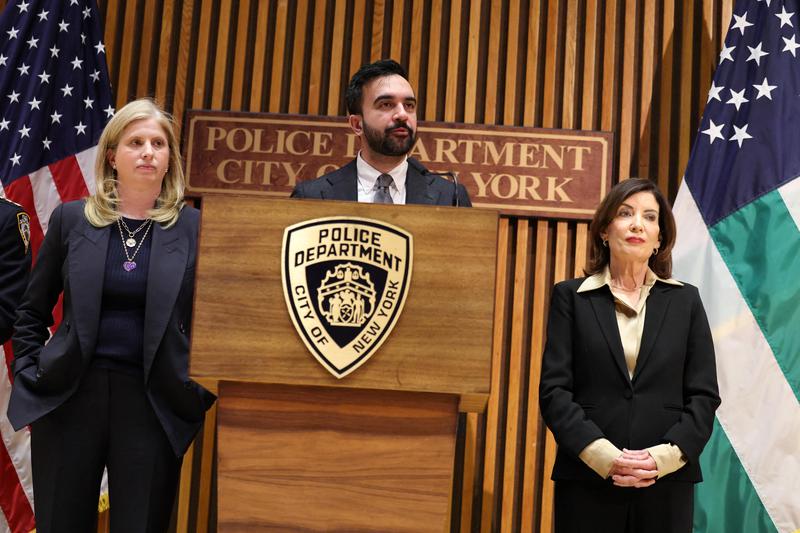
( CHARLY TRIBALLEAU / AFP / Getty Images )
[music]
Brian Lehrer: It's The Brian Lehrer Show on WNYC. Good morning, everyone. It's day seven of the Mayor Mamdani era, right? We've been discussing his early moves daily on the show so far. We'll do that again today as he completes his first week. Among our topics today, what the mayor said yesterday with Police Commissioner Tisch as they announced record-low crime stats that came on Mayor Adams' watch. Does it mean keeping some approaches to fighting crime that you might not associate with Mamdani, even as he implements some of his own? He canceled as a group every executive order that Mayor Adams made after Adams was indicted on corruption charges in September 2024 and allegedly began to tilt policy in hopes of a pardon from Donald Trump. Mayor Mamdani is restoring those executive orders he agrees with. Two of those not being restored have gotten the most backlash. Those were specifically supportive of Israel in ways Mamdani believes harm Palestinian rights or purposely conflate certain criticism of Israel with antisemitism. He did renew Adams' creation of an office of antisemitism or to fight antisemitism in the city.
The mayor changed a top position from deputy mayor for economic development to deputy mayor for economic justice. WNYC's Elizabeth Kim asked the mayor about the difference. She will join us with a clip of his response and discuss Mandani's campaign promise to appoint a "Mom-and-Pop czar" to support small businesses in the city, even as he cracks down on businesses acting in bad faith against workers and consumers.
He affirmed that he is still for mayoral control of the public schools, something he had opposed during the campaign, but he will have his own approach to more community input. What happens locally after the mayor called President Trump to object to the military action in Venezuela, and after the acting city health commissioner yesterday rejected Trump's reduced childhood vaccine recommendations? We'll get to as much of that as we can now with WNYC and Gothamist political reporters Brigid Bergin and Elizabeth Kim. Hi, Brigid. Hi, Liz. This is January 7th, so probably the last time I will say Happy New Year, but Happy New Year, and thanks for coming on the show again in 2026.
Brigid Bergin: Thanks, Brian. Happy New Year.
Elizabeth Kim: Happy New Year, Brian.
Brian Lehrer: Listeners, your questions or comments about the Mamdani era on day seven, 212-433-WNYC. Call or text. 212-433-9692. Liz, let's start with renaming a top job from deputy mayor for economic development to deputy mayor for economic justice. Does it seem like more than a symbolic name change?
Elizabeth Kim: I'll be honest, in the beginning, when he rolled out this appointment, I didn't think that it precluded him naming a deputy mayor for economic development. I had even heard some candidates who were in the running for that job. Then what happens is after his inauguration, he comes out with an executive order, and he basically says, these are the five deputy mayors that I'm sticking with.
I look at it, and I notice, huh, that's kind of interesting. He's not going to name a deputy mayor for economic development. It's interesting because I've spoken to a lot of city government veterans, and they have told me that, going back, until at least the Koch administration, there has been a deputy mayor for economic development. There has been that word attached to a deputy mayor.
I'll give you an example. It's not always just strictly the deputy mayor for economic development. For instance, under de Blasio, he had Alicia Glen as his deputy mayor for housing and economic development. This was interesting. I really wanted to know why he decided not to have that particular naming. I think it is more than symbolic. I think that that has traditionally been something that mayors have wanted to do, which is foster a conversation and foster a relationship with the city's business community, because at the end of the day, they are employers that contribute to job growth and also tax revenue.
Brian Lehrer: Here's an exchange between Liz and the mayor.
Elizabeth Kim: You don't have a deputy mayor for economic development. I was wondering if you can explain your thinking on that. How do you balance regulating bad actors in the business community while encouraging the good employers to invest and grow in the city? Who is their point person in the administration if they have questions?
Mayor Mamdani: Their point person will continue to be our deputy mayor for economic justice, Julie Su. We, as an administration, are focused on not only generating prosperity and continuing to do so here in our city but also in ensuring that that prosperity reaches the lives of each and every New Yorker who calls the city home. I am excited by this action, not just for what it does to protect consumers and workers, but also, frankly, businesses that are law-abiding.
We see so many businesses who are following the regulations as they are, and then they look at someone across the street who's violating them, and then they ask themselves, "What am I doing? Why am I the chump at the end of the day?" What this does is actually show that that is the correct way to approach business in New York City. That is the kind of business that deserves our support. This is the business that has to get into compliance. This is not about punishment. It's about compliance. We want people to follow the law as it is so that New Yorkers can thrive in this city.
Brian Lehrer: Mayor Mamdani answering Liz Kim's question about why no deputy mayor for economic development. Listeners, if you own a small business or any business, how do you hear that answer? How do you see, let's say, Mayors de Blasio and Adams as having been different in terms of economics? What do you expect in good or bad, or mixed, from Mayor Mamdani with respect to your business and its success or potential success? What can he do that you would like to see? 212-433-WNYC. Call or text. 212-433-9692. Small business owners, among others, a general invitation for people with comments and questions.
Liz, listening to that clip, Mamdani and his supporters say if businesses are serving their workers and customers legally and in good faith, they won't have a problem with his administration. Only those not doing that will have the city on their backs, maybe in some new ways. They ask, why wouldn't clean businesses, Mamdani and his supporters ask, which are most businesses, why would they be skeptical of that? Has anyone in business leadership answered that question?
Elizabeth Kim: This is what one person told me, and I thought this was a very good analogy, is that if you think about up high, what Mamdani is saying is the way that the pie has been divided has historically been unjust. I want to focus on making it more fair. There's another way to look at that is that's true. The city should actively be trying to make the division of the pieces fair. The city also needs to grow the pie. That's where this idea or concept of economic development comes in.
For example, there was no reason that Mamdani could not have said, "Julie Su is appointed as the deputy mayor for economic justice and development." I think it was a conscious decision not to do that. This is very much in keeping with his ideology as a democratic socialist. This is very much in keeping with his rhetoric about governing as a democratic socialist and putting people first before businesses and billionaires.
I would also say this is not just about following the rules. I think the risk of this, and this is when I'm talking to people in the business community, people like Kathy Wylde, is that she worries that this comes off as being a little bit antagonistic. For her, the concern, and she told me that she has told the mayor that she just wants him to make sure that he has an open door to businesses, that they have a way to talk to him about their views. I'm sure they have plenty of views in terms of why they think traditionally they'll always say that it's too expensive to do business in this city.
One example I thought of last night was with Eric Adams; he came into office very much trying to put out the welcome mat for businesses. He felt like he was going to try to make a real shift from Bill de Blasio, whom some people viewed as anti-business. One thing that he immediately tried to tackle was this idea, we were coming out of COVID, was how do we get people back to work? I remember him having several meetings with the Partnership for New York City and their members and asking employers, "What can the city do to help get your employees to come back to work?"
A lot of the answers was rooted in quality of life and public safety. Then you saw the mayor bringing more police onto the subways, et cetera. That is just one example. That's not about setting rules about deceptive pricing practices, but it's one example in which there was a mayor, he regularly met with the business community, they had a line to him, they had a line to his deputy mayor for economic development, who was Maria Torres-Springer, by the way, who was also advising Mamdani on his transition.
That's one example. There are others who make the other argument that this is something that is long overdue and welcomed in this city, is that we are finally putting consumers and workers first.
Brian Lehrer: Brigid, anything to add so far on economic development versus economic justice or development plus justice?
Brigid Bergin: [clears throat] Excuse me, Brian. I think what's interesting is we're having this conversation, as you noted, very early in the year. It's day seven of the Mamdani administration. Part of any new administration, what they're thinking about is what can we do in the first hundred days? How can we show that we know how we got here, we know who sent us into this office, and how can we start delivering for those people who supported us?
Mamdani said it in his inaugural speech, "I am a democratic socialist. I was elected as a democratic socialist. I will govern as a democratic socialist." I think he had been hinting and showing us in the transition that he was going to use the tools of city government to take some swift action in ways that he knew he could, so using these executive orders.
The piece of tape we just listened to was at a press conference talking about junk fees and how the Mamdani administration wants to empower its Department of Consumer and Worker Protection to go after companies that they think are making it too hard to quit the gym or assigning fees to certain products, services, and tickets that are making it harder to live in New York City.
There was a very stark warning from this commissioner, Samuel Levine, who is worth noting, worked for Lina Khan at the FTC before joining the Mamdani administration, that don't make us subpoena you, be a good actor, cut these junk fees before we have to come after you. I think the Maidani administration is trying to send some messages, particularly to the bad actors, however they define them, that this administration is taking a different approach.
I think that message doubles for the people who supported him, that we've heard you, we are making some of our initial efforts in these first hundred days, focused on what we can deliver to make this a more affordable city.
Brian Lehrer: Brigid, I want to put his approach to economic development and economic justice in perhaps an even larger frame. Here's a clip from Mamdani's inaugural address that actually is not one of those that's gotten the most attention, but it's one of those that stood out to me. I think it was a candid statement of how he sees the stakes for New York and beyond and is taking them on.
Mayor Mamdani: What we achieve together will reach across the five boroughs, and it will resonate far beyond. There are many who will be watching. They want to know if the left can govern. They want to know if the struggles that afflict them can be solved. They want to know if it is right to hope again.
Brian Lehrer: There are many who will be watching. They want to know if the left can govern. That was the middle of that clip. Do you find him, in general, combining his beliefs about democratic socialist economics with a pragmatic determination to have New Yorkers broadly experience his policies as a success? Because he knows, as somebody who, of course, is interested in running New York City, but had a global interest in seeing an improvement of quality of life for people around the country, maybe even around the world, through democratic socialism, he knows whether this spreads or not is going to be determined to some degree on whether he gets results.
Brigid Bergin: Absolutely. Brian, it's so interesting to hear that clip and think about the context of it. Here, you have an inauguration where the two leaders of the national progressive movement are holding up Mamdani as the new face of their movement. Bernie Sanders is swearing him in. Alexandria Ocasio-Cortez is giving the introductory remarks. Here is Zohran Mamdani, mayor of New York City, in a leadership position in the largest city in the nation, to essentially prove that what they have been advocating for can actually deliver for people.
At the same time, who else has Mamdani's ear? There are people like Dean Fuleihan, who has been working in Albany and working in City Hall for decades. He knows the reality of politics, the reality of policy, and what it takes to actually get things done. One of the things that ultimately I think a lot of people know, we've seen it in prior administrations, services have to be delivered.
I was talking with Ester Fuchs at Columbia University at the School of International and Public Affairs. One of the things she said to me that she was really struck by was she thought that there was a real maturity in some of his early appointments. One of the examples she held up was that he didn't suddenly introduce a new sanitation commissioner. Why wouldn't he do that? Because it's the middle of the winter and you need the streets to be plowed. The worst thing that can happen for a mayor if you just start office, just ask Bill de Blasio, is to be socked with a snowstorm in your first few days and not be able to get people around.
That balance of understanding that your obligation is to deliver services consistently while also trying to put forward policies that make the city fairer, in your view, I think, is something that will be a real tension, but also a real expectation for this administration.
Brian Lehrer: Let's take a phone call on this topic. David in Brooklyn, you're on WNYC. Hi, David. Thank you for calling in.
David: Hi. Thanks for taking the call. I'm a New Yorker. I've been here my whole life. I've done a lot of work in working-class communities that don't listen to WNYC or read The New York Times. I feel that there was something your guest mentioned regarding taking another perspective on the fact that the new mayor, remind me, did not appoint an economic development something leader or something like that.
Brian Lehrer: Deputy mayor.
David: Yes. Your guest said that, "Well, another perspective is businesses in the city do need to grow." That that's another perspective. For some reason, when the guest said that, it made me think about how big and a small amount of growth. There are so many people who have micro businesses and who are just starting a little business, and then there are these huge businesses that, as we know, are amoral. I'm so excited myself, obviously, about Mamdani, but even friends of mine are like, "Well, we'll see what he's able to do."
I just feel like there's things against it, particularly when your guest said about that other perspective, "The businesses need to grow." How big, is my question, do they need to grow? So far, it seems to me he's so clear, articulate, and literally caring. That's why I'm excited. I guess it was just about that gross question.
Brian Lehrer: You can speak for yourself, but, David, I don't think Liz was intending to say small businesses need to grow bigger and become mega corporations. I think she was referring to the generally accepted belief that there's always a reason to add more jobs. We've done a segment on this recently. New York City, toward the end of the Adams administration, had a higher unemployment rate than most of the rest of the country and had not recovered from the pandemic as well as a lot of other cities around the country, except in certain job categories like healthcare.
I think, and Liz, now you can speak for yourself, that what she was referring to, that maybe you misunderstood David, was not grow businesses into corporations, but grow the job pool. Liz, you hear what David's saying, and you know what you said.
Elizabeth Kim: Yes. What I was going to say is, to Brigid's point, the point she was saying that Ester Fuchs said that he's made some very pragmatic decisions. To people who are looking at this economic justice and economic growth issue, what's pragmatic for him is to promote economic growth because their view is, "You want universal pre-K? You want free buses? You have to grow the pie. You have to grow revenue. You have to try to grow jobs."
To David's point, it's not growing small businesses into mega businesses, but it is this idea that you need the economy to grow. You need the economy to do well. People are trying to make the argument that you can hold two thoughts at the same time. Remember how Mayor Adams used to always say we need to have public safety, but we can also have justice at the same time? This is another argument. We can have economic justice, and we also need economic growth. The two are not opposed.
Now, I think a lot of this is, like Brigid said, he's trying to send a message. I think for the time being, it does serve him politically because this is-- To many people in this city, it will be a refreshing shift. I think to the caller, David, it probably is a refreshing shift because they see government as so often being on the side of big businesses. Finally, we have a mayor looking out for the little guy.
Brian Lehrer: David, thank you for raising that issue and that distinction. Brigid, go ahead.
Brigid Bergin: I just wanted to add, in terms of sending the message and the vital importance of that, one of the things that this administration is also relying on is maintaining engagement among some of those people that helped him get elected through this outside group called Our Time, through the Mayor's Office of Mass Engagement, which I think we're going to learn more about.
There is this idea that in order to advocate for some of his most banner policies, universal childcare, this rent freeze, that it's going to require boots on the ground beyond just Mamdani himself and members of his administration. There's this idea that to get these things across the finish line, people are going to go up to Albany. They're going to lobby their state lawmakers. They're going to make the case that this is not just something coming from him, this is coming from them.
Brian Lehrer: One more thing on this, and then, Brigid, you mentioned public safety. We're going to go on to some Mamdani and Jessica Tisch news on that. Liz, as a candidate, Mamdani said he would appoint a "Mom-and-Pop czar" to help support small businesses. Do we have one?
Elizabeth Kim: No, we don't. I was reminded of this promise when I spoke to Andrew Rigie. He represents the restaurant and hospitality industry. I called Rigie because I was trying to ask different members of the business community whether they felt they had a point person in City Hall, to the point of the criticism that if you don't have a deputy mayor for economic development, a lot of business leaders are going to feel like they don't have an ear.
He's mostly dealing with restaurants that are small businesses. He's waiting for this "Mom-and-Pop czar." Speaking to the point of not having this deputy mayor for economic development, he told me that he has really urged Mamdani that when he does appoint a "Mom-and-Pop czar," that he would really prefer the "Mom-and-Pop czar" report directly to the mayor, because I think there is some concern that the deputy mayor for economic justice is going to be--
Right now, the way it's currently structured, the head of the Economic Development Commission is going to report to the deputy mayor for economic justice. The Small Business Services commissioner is also going to report to the deputy mayor for economic justice. I think there's a little bit of concern about how that role, because it's new, how it's going to work and what its focus is going to be. I think it's very telling to have someone like Rigie just out of the gate saying, "I need someone who I can talk to, and I want that person to report directly to Mamdani."
Brian Lehrer: All right, public safety. If you're just joining us, Brian Lehrer on WNYC with our political reporters Elizabeth Kim and Brigid Bergin on day seven of the Mamdani administration, as he does a lot in week one. On public safety, there was maybe the unexpected spectacle of Police Commissioner Tisch held over from Mayor Adams, of course, with Governor Hochul and the mayor as the commissioner announced big drops in crime, including record-low shootings and record-low murders that occurred last year on Adams' watch.
Police Commissioner Tisch: We see the headlines, and we hear the pundits talk about crime being out of control in our city. These numbers tell a very different story.
Brian Lehrer: Mayor Mamdani was asked at this news conference if Adam's policing policies, which Mamdani campaigned as critical of in various ways, were working based on those numbers.
Mayor Mamdani: I think these numbers showcase a police commissioner, an executive team, and a department that are delivering for New Yorkers. Also, as the commissioner has said, as well as the governor has said, we cannot rest on these results. We have to build on these results. I appreciate the commissioner and I's shared focus on doing so and the fact that the creation of the Department of Community Safety is one that will also help to alleviate some of the immense, ever-growing burdens we are putting on this department.
Brian Lehrer: Brigid, pretty interesting. He, of course, as we've known through the campaign, is no longer the defund the police mayor. There, he's supporting, he's endorsing, praising the work of the NYPD, while at the same time saying he's going to do some new things, like initiate his Department of Community Safety. How did you hear that response?
Brigid Bergin: It's interesting, Brian. There's another clip at another point in the press conference that I think goes to the point of what we were just listening to, but really was striking to me. It was Mamdani repeatedly thanking the members of the department for their hard work and acknowledging how hard it was for them to do what they needed to do. I think part of what we saw there is this effort on his part to make sure that he comes into his administration with as much of a reset with this department, which included members who were, certainly, the outgoing ones, much more critical of his candidacy, with an opportunity to work hand in hand.
Appearing at that press conference with Police Commissioner Tisch standing at her side while letting her deliver those statistics, which, as you noted, included some really striking numbers, some huge declines in a whole series of crime categories, the safest city in history, is very striking. The safest year on subway since 2009. These are statistics that I'm sure Mayor Adams is feeling a certain way about.
It's a good thing for Mamdani to be starting with, at the same time, to be noting what he wants to do. This idea of this new Department of Community Safety, there is already City Council legislation that's been introduced to establish this department. He's not backing away from that, but he continues to stress that this will allow members of the NYPD to focus on the serious crimes they signed up to fight. That is very important to his ability to deliver for all New Yorkers.
I think that there were moments that we'll come back to in future briefings. This was the first crime stat briefing. One happens every month. Commissioner Tisch made the point that this was being done through their deliberate data-driven strategy. She did get a question about the gang database, which is something that has been more controversial in the past. She pivoted around it, talked about how it was useful, but it never was a question that ended up going directly to Mamdani. I think that'll be something that'll be interesting to watch, but I think this was really a way for the two of them to show a certain amount of mutual respect, partnership, and send a message to the NYPD that he has their back.
Brian Lehrer: Nick in Manhasset has a Tisch-Mamdani question, I think. Nick, you're on WNYC. Hello.
Nick: I've heard conflicting reports. Does Jessica Tisch report directly to Mamdani, or does she report to his first deputy instead? What about the security for synagogues? I heard that he rescinded the order to have more police security outside of synagogues to protect against acts of antisemitic vandalism.
Brian Lehrer: Nick, thank you. We'll take on each of those. Brigid, on the reporting structure, she addressed it in the news conference yesterday. I saw it. She said, "I report directly to Mayor Mamdani," right?
Brigid Bergin: That's right. Quite explicitly. I think that there was some confusion. Under Mayor Adams, there was a deputy mayor of public safety. There are some operational issues that the police commissioner will work with on the first deputy mayor. Ultimately, the police commissioner reports to the mayor. As you said, Brian, Commissioner Tisch made that very clear yesterday during the press conference, before anyone could even ask that she reports directly to the mayor, so there is no question there.
Brian Lehrer: Can you answer his question about police protection around synagogues?
Brigid Bergin: I can answer the question in so much as we know that the Mamdani administration did rescind several executive orders. They were executive orders that had been signed by the previous administration, starting from the date when Mayor Adams had been indicted. That batch of executive orders did include two that were signed relatively late in Mayor Adams' term that related to the definition of antisemitism that the city adopted. There was another one related to antisemitism--
Brian Lehrer: Relating to Israel. Actually, after a break, we're going to talk about those in some more detail.
Brigid Bergin: He did not rescind the executive order related to the office of-
Elizabeth Kim: Combating.
Brigid Bergin: -combating hate crimes and combating antisemitism. In terms of the decision around funding, I would presume that a lot of that will continue to be at the discretion of the police commissioner. When things need to have heightened security that she will dictate that.
Elizabeth Kim: That order that the caller was referring to it was an executive order requiring the police commissioner to evaluate the rules about protests outside houses of worship. This came after there were protests at a synagogue in Manhattan, in which the protesters were protesting an organization that leased space or was holding some kind of event that tries to assist and give information to Jewish New Yorkers who might want to relocate to Israel, including some contested areas in Israel, like the West Bank.
That's what they were protesting, but in the course of that protest, there was some ugly rhetoric that was used, and a lot of the people who were trying to go to synagogue felt that they were being harassed. That became a story. As a result of that, that's why Adams came out with that EO.
Brian Lehrer: We'll continue in a minute with WNYC political reporters Brigid Bergin and Liz Kim, and you, 212-433-WNYC. Call or text. We'll get more into the rescission of those two Israel-related and other executive orders from Adams right after this.
[music]
Brian Lehrer on WNYC on the Mamdani era, day seven, with WNYC's Brigid Bergin and Elizabeth Kim. Liz, let's go over this a little bit for people who haven't followed the TikTok of this. On day one, Mayor Mamdani canceled as a group every executive order that Mayor Adams made after Adams was indicted on corruption charges in September 2024 and allegedly began to tilt policy in hopes of a pardon from Donald Trump.
Mayor Mamdani is restoring those executive orders he agrees with. Two of those not being restored have gotten the most backlash. Those were specifically supportive of Israel in ways Mamdani believes harm Palestinian rights or purposely conflate certain criticism of Israel with antisemitism. Can you give us the big picture first of what was canceled en masse beyond what I just said?
Elizabeth Kim: You're right, Brian. Basically, the way Mamdani has described it, because he was asked this question and he's been asked it multiple times, actually, since he revoked the orders, was as a new mayor, he basically had two choices. He could either extend the prior mayor's executive orders or he could amend them.
He said what he elected to do was he elected to basically set up a kind of demarcation line that you talked about, which was the date in which Eric Adams was indicted because he sees that as the line in which the public could no longer trust the mayor, in which they felt that the mayor was compromised and every decision he made was somehow tainted or like I said, compromised in some way.
That is how he has chosen to frame it. Of course, because Mamdani has been, not just critical, but this has been part of his identity as an anti-Israel activist, there is a lot of attention. Anything he does with relation to Israel, with relation to antisemitism, is going to get a lot of heightened scrutiny. Of course, he was asked about what about these orders involving Mayor Adams. Early December, one of his executive orders was that he prohibited mayoral appointees and agency staff from boycotting and divesting from Israel, essentially meaning that in things such as contracting, that they could not decide not to withhold a contract from a company because of its ties to Israel and the military or things like that.
In many ways, it was very much, I think, symbolic. I don't know that there are agencies that are faced with these decisions, that have these decisions coming on their desks every day, and that are somehow using a BDS rubric to decide them. It was something that the mayor was doing. We should recognize the context of these executive orders. These executive orders were in concert with other policy decisions and other rhetoric that he was making at the time to undermine Mamdani, knowing that Mamdani was coming in, knowing that Mamdani would have to face this decision of whether or not to continue his orders, and knowing that Mamdani was going to get a lot of heat for undoing them.
Brian Lehrer: Among the Adams executive orders that Mamdani has restored, as he restores some of them one by one that he agrees with, is the one that created an office to combat antisemitism in the city. That goes on. We talked about that before the break. The two Israel-focused ones, just to explain this further, folks, if you haven't been following this, the two Israel-focused ones from Adams that he canceled were one that accepted a certain definition of antisemitism that Mamdani and others believe conflate certain criticisms of Israel with antisemitism.
As The New York Times reports it, this includes defining as antisemitic saying Israel is racist. Zionism is racism is an opinion some people hold, or comparing Israeli policy to the Nazis, as The Times cites that as an example from that definition. Israel, of course, has been accused of genocide, which would seem to compare it to the Nazis. Accused of that by many. The word is controversial. I always say that here when people use it. The definitions Adams had in place would seem to suggest that even having the debate is antisemitic.
Now, the other Adams order that Mamdani revoked is the one that Liz just described, prohibiting city agencies from boycotting Israel. Mamdani has supported the Boycott, Divest, and Sanction, or BDS movement.
I guess on that one, Liz, you said you didn't know if there was actually a history of any city agencies using a BDS gauge in order to approve city contracts or anything else. Is there any reason to think that Mamdani is signaling to city agencies, "Yes, let's do this"? You know what I mean? Let's look at whether companies we're going to do business with are doing business with Israel or the Israeli military, and that that's going to be something that we see, or does that one really just live in the realm of symbolism that, as you say, Adams was trying to invoke to force Mamdani into a position of doing something controversial?
Elizabeth Kim: Brian, that's a question that journalists, including yourself, have put to Mamdani. I think prior to the November election, you asked him whether his stance on BDS was going to shape local policy in any way, particularly with the way the city contracts. He didn't really answer it. I think one of the first tests and something--
Brian Lehrer: What he said to me was he will run city policy consistent with international law.
Elizabeth Kim: Yes, yes. That's right, Brian. I'm always confused when he uses that kind of term. I think he needs to elaborate exactly what he means by that. I think the first test for him is going to be what does he do with the Cornell Tech campus on Roosevelt Island? It's an ongoing development. Maybe phase one is complete, but it's ongoing, and it involves a partnership between Cornell and an Israeli university that has some kind of ties or relationship with the Israeli military. As an assembly member, Mamdani was very critical about it, and he urged a boycott.
Now, he's been asked repeatedly during the campaign trail, "What do you think about that?" Because now he kind of owns that project. It's a very big development project. As mayor, what does he do? I think it will be a real test because, as always with these things, there are bound to be ribbon cuttings. There might be decisions that the city has to make in the course of the development. I don't know what kind of stance he chooses to take on it. I don't know that he's given a clear answer either on how he feels about it as mayor.
Brian Lehrer: I guess we'll see over time. I did not interpret his answer about international law as requiring BDS in any way. There's nothing in any interpretation of international law, as I understand it, or that the mayor subscribes to, that would require BDS in any particular way. Here's a clip from the mayor's news conference of reporter Jacob Kornbluh from the Jewish newspaper The Forward asking about the day-one timing of the rescission of all the executive orders from Adams.
Jacob Kornbluh: You say it wasn't intentional that this was on day one?
Mayor Mamdani: In the first executive order, you, as the new mayor of a city, have to sign a continuation of all prior executive orders or a revocation or an amendment of all of them. What we did was to sign an executive order that continued every executive order that predated the moment when our former mayor was indicted, a moment when many New Yorkers lost even more faith in New York City politics and the ability of city government to actually prioritize the needs of the public as opposed to the needs of the person.
What we will now do is showcase that new era to protect each and every New Yorker and to deliver for those same New Yorkers in a manner that they have not seen under prior administrations.
Brian Lehrer: There's that. Before we run out of time, two big Trump stories this week are obviously Venezuela and the cancellation of universal recommendations for 6 of the 17 common childhood vaccines. Mamdani called Trump personally to object to the Venezuela military action. The acting New York City health commissioner, Dr. Michelle Morse, said yesterday the city will maintain its recommendation for all 17 childhood vaccines. Brigid, do you know if that affects availability or insurance coverage in the city?
Brigid Bergin: It's a really good question, Brian. Certainly, as a mom, it's something that I'm interested in, but it's not something that I've dug into yet. I think my colleague Caroline Lewis has been doing a lot of writing on that and, of course, on this unfortunate flu epidemic, but it will be interesting. I think it in some ways dovetails with this idea of mayoral control of city schools, because if the city is saying that it has a higher vaccine requirement, I'd be curious to know if that will then also extend to what they require for kids attending New York City public schools.
Very interestingly, just the day before the mayor was inaugurated, he made a pretty significant 180 on his language around mayoral control and stating very explicitly that he will ask the legislature to extend mayoral control of schools, something that I think gives a lot of comfort to certainly some educators, some people who are hopeful that he will be able to achieve universal child care and see mayoral controls a key tool in being able to do that.
Going back to your original question, Brian, I think we'll have to get a little bit more information from our healthcare team about what it's going to mean about the availability of those vaccines going forward.
Brian Lehrer: All right. We're going to have to leave it there for today. On Venezuela and New York City, we're going to have a Venezuelan American journalist for The Atlantic coming up later in the show, specifically on the local angle: what does the military action and the follow-up to it in Venezuela mean for New York, the Venezuelan community, and others here? That'll be coming up a little later. For now, we thank our political reporters Brigid Bergin and Elizabeth Kim. Thank you both.
Brigid Bergin: Thanks, Brian.
Elizabeth Kim: Thank you, Brian
Copyright © 2026 New York Public Radio. All rights reserved. Visit our website terms of use at www.wnyc.org for further information.
New York Public Radio transcripts are created on a rush deadline, often by contractors. This text may not be in its final form and may be updated or revised in the future. Accuracy and availability may vary. The authoritative record of New York Public Radio’s programming is the audio record.