
Mayor Mamdani's First Moves on Housing
( Dave Sanders - Pool / Getty Images )
[music]
Brian Lehrer: It's The Brian Lehrer Show on WNYC. Good morning again, everyone. Now, Mayor Mamdani and the quest for affordable housing, day six, with WNYC and Gothamist housing reporter David Brand. The mayor has already made it clear in his first days in office that housing will be a major focus of his administration. Of course, we knew that. All the candidates ran on housing as a major focus. So far, though, he's held two press conferences already. One in Flatbush, another at the famous address of 1520 Sedgwick Avenue in the Bronx, also known as the birthplace of hip-hop. Here's a bit of the mayor's opening words in the Bronx on Sunday.
Mayor Mamdani: When New Yorkers can afford a home, New Yorkers can afford to make great art. When New Yorkers can afford a home, New Yorkers can afford to be themselves. As many working people know, it is increasingly impossible to find an affordable home in New York City, to build a dignified life without earning hundreds of thousands of dollars each year. Those same New Yorkers know that too often, if they can find a home that they can afford, there is likely a reason they can afford it. Roaches and rats. Heat that never turns on. Elevators that are always out of order. Bad landlords who take their money and yet never respond to requests for repairs. A dignified life does not just mean having a roof over your head. It means that you don't feel uncomfortable or unsafe in your own home. It means that your money buys you what you paid for. It means that a bad landlord is not allowed to rip you off with impunity.
Brian Lehrer: Mayor Mamdani on Sunday. Now that we've heard some of the description of the problems and some of the description of the goals, let's talk about the policy. So far, the mayor has signed four executive orders already, aimed at protecting tenants and building new housing. He also appointed a commissioner for the city's Department of Housing and Preservation, as well as a director for the renewed Mayor's Office to Protect Tenants.
Some more news. The city's top lawyer will be representing tenants' interests in a bankruptcy case. Yes. Plus, it seems that Adams' plan to block Mamdani, that is outgoing, the former mayor Eric Adams plan to block Mamdani from enacting his campaign promise of delivering a rent freeze, that Adams plan to block Mamdani has been foiled. We'll explain. With me now to cover as much of this as we can is WNYC and Gothamist housing reporter David Brand. Hey, David. Happy New Year.
David Brand: Hey, Brian. Happy New Year.
Brian Lehrer: Let's dive right in and start with some of the people, the new appointees. You had the scoop that Dina Levy was set to join the administration as commissioner of HPD. Who is Dina Levy, and what does her appointment seem to represent?
David Brand: Sure. Dina Levy is going to be the commissioner of the Department of Housing Preservation and Development, HPD. That's the city's affordable housing financing agency. It also employs hundreds of inspectors who enforce the city's housing code, issue fines and violations to landlords. They run a federal rental assistance program. The agency also has an over $2 billion budget to finance new affordable housing construction. It's a really important city agency, especially at this time when the city's facing a housing crisis.
Levy is coming into this role after having a top position in the state's housing agency. It's called Homes and Community Renewal. Prior to that, she was at the state attorney general's office and actually negotiated settlements with lenders and banks that were involved in the mortgage and foreclosure crises of maybe 15, 17 years ago, around 2008. Before that, she worked at the nonprofit UHAB, which does a lot of work with tenant organizing and helping tenants and nonprofit groups take over apartment buildings and preserve them as affordable housing.
Brian Lehrer: I want to get into, just a minute. Maybe the most interesting news out of all of this, which is that at his Flatbush news conference, the mayor announced that the city would be representing the tenants of a particular building in a legal battle against their landlord, Pinnacle Realty. The city's going to get involved legally, but let's do one more appointee first. This is a significant person in housing advocacy. He signed an executive order, the mayor did, renewing the Mayor's Office to Protect Tenants, and appointed as its executive director housing advocate Cea Weaver. Tell us about Cea C-E-A Weaver.
David Brand: Cea Weaver has been a prominent tenant organizer for a number of years. She ran the organization Housing Justice for All as a statewide coalition of tenants. They were pretty instrumental in getting these 2019 tenant protection laws passed in the state legislature, that ended a lot of the rules that allowed landlords to deregulate rent-stabilized buildings or to raise rents on rent-stabilized units once they became vacant.
A couple years ago, she was also pretty key in another big tenant protection law called the Good Cause eviction law, which gives tenants in most apartments, not just rent-stabilized apartments, a chance to challenge "egregious" rent increases. She's been involved in a lot of tenant organizing and a lot of tenant-focused policy. It's also made her a reviled figure among landlords.
She's been a pretty prominent advocate for a while, but now she will be on the inside, in power, and tasked with leading this City Hall office that's supposed to hold bad landlords accountable or to identify distressed properties where landlords owe more in expenses than they're making in rent and try to take over those buildings and turn them over to nonprofits or tenant groups.
Brian Lehrer: On Cea Weaver as-- What did you call her? A lightning rod or--
David Brand: That's a good word for it.
Brian Lehrer: A lightning rod, reviled by landlords. Here's a headline about her in the New York Post from Sunday. Says, "Zohran Mamdani's new New York City tenant advocate called to 'seize private property' and blasted home ownership as white supremacy. What are they referring to?
David Brand: Last night, a journalist, a writer, who's pretty prominent on Twitter, named Michelle Tandler, had posted a number of screenshots of Cea Weaver's past tweets. These date back to I think 2016 to about 2022. She's since deleted her Twitter account. Some of them are very radical positions on private property and on rent regulations, how she thinks there should be rent regulations for all apartments. That was the focus of the Good Cause eviction law: that all tenants should be subject to smaller rent increases and that they should be able to challenge larger rent increases.
She talked about wanting more government-controlled housing to make a baseline habitability for New York renters. Some of these other tweets that were posted last night have been generating a lot of attention and controversy were riffs on white supremacy. Here's one. "This country built wealth for white people through genocide, slavery, stolen land, and labor. White supremacy built the North and the South." That's from 2017.
Another from 2018, she said, "There is no such thing as a 'good' gentrifier, only people who are actively working on projects dismantle white supremacy and capitalism and people who aren't." Not just housing-related, but some of these are clunky, some clumsy, and some I think she would probably continue to stand by.
Brian Lehrer: How might we see some of those values to the extent that there are ongoing values for her reflected in policy, if she and Mamdani see the world the same way?
David Brand: I did A story last month, a couple weeks before Mamdani's inauguration, focused on his goal for what we just talked about the Mayor's Office to Protect Tenants, which he had campaigned on and said he wanted this office to identify these bad buildings and come up with ways for the city to acquire them, either seizing them because the owners owed a lot of back taxes or unpaid fines or negotiating sales if it seemed the owner wasn't able to keep the buildings up to code and then either transfer them to tenant groups, to nonprofits, and in some cases even keep public ownership.
That's what I was really interested in in that story, because that's not something the city has done in decades, which is to take buildings and keep ownership of them. I wanted to find out more about that. When people hear that idea, they think back to the 1970s and 1980s, when New York City was really at its nadir, and a lot of landlords were just walking away from properties and just not paying property taxes, so the city acquired them through in rem foreclosure.
I talked to Cea Weaver about this. I talked to some other people who are interested in this idea. I look back at this article that she had written in October, just before Mamdani's inauguration, and she did talk about the goal of city ownership, but in this case, it would be the city owning the land under buildings and then leasing the buildings to private developers and nonprofit groups, who would then handle operations in management and rent collection.
The idea was that if the city did this at scale, without that big profit motive and instead just investing back in the buildings, that they would be able to get economies of scale through that and get savings. It would make them the owner. Similar to how NYCHA, the New York City Housing Authority, owns public housing campuses, but leases many of the buildings and operations now to developers and private managers through what's called a RAD/PACT program.
Brian Lehrer: Brian Lehrer on WNYC with our housing reporter, David Brand, going over some housing policies and appointments announced by Mayor Mamdani in his first days in office. We can take your questions or comments on any of them. 212-433-WNYC. Call or text. 212-433-9692. We talked on yesterday's show about the mayor announcing a plan for a series of what he calls "Rental Ripoff" hearings. I guess we can always have our own ongoing "rental ripoff" hearing here. On that or any other aspect, 212-433-WNYC, 433-9692.
I guess to that point, I do want to ask you about the announcement at the news conference in Flatbush that the city would be representing the tenants of a number of buildings in a legal battle against their landlord, Pinnacle Realty. According to The New York Times, more than 5,000 rent-stabilized units are set for auction this Thursday. Can you tell us about Pinnacle and the dispute between the company and its tenants?
David Brand: Pinnacle owns, I think, 93 apartment buildings across the city with about 5,500 units. Most of those are rent-stabilized apartments. They were foreclosed on by their lender last year, and then they filed for bankruptcy to try to halt the foreclosure process. That is leading to a bankruptcy sale, which you mentioned is scheduled for this week. Tenants across the city in Pinnacle Buildings have been organizing to try to halt that sale. They want to come up with an alternative way to either get financing from the city, find nonprofits, or maybe private developers that could take over these buildings instead.
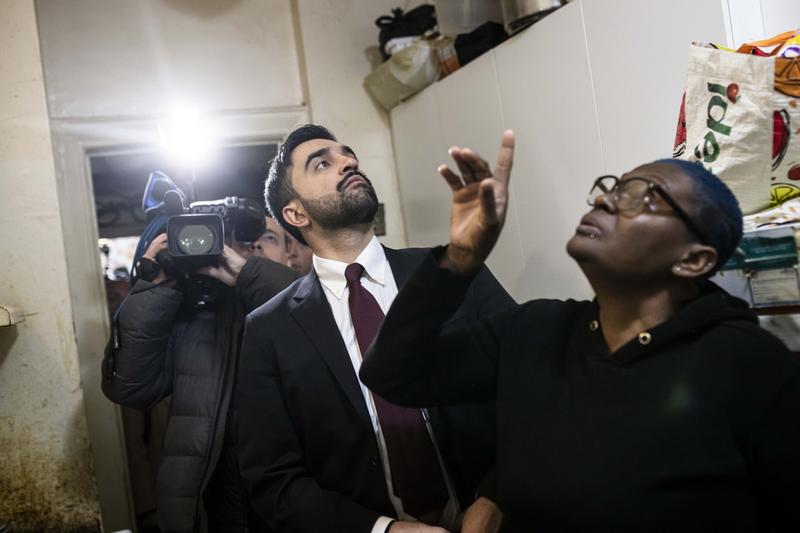
They say they need more time to do that. They don't want a buyer to come in, buy low, and continue some of the bad practices that they're experiencing. That building that Mamdani made this announcement at the other day, he went into an apartment and was picking at broken floor tiling. There was mold growing on walls. Tenants across the city in buildings owned by Pinnacle are making similar complaints.
He made this announcement that the city is going to intervene in the bankruptcy sale. Last night, they actually did file paperwork to do that. They say, "Hey, we're a creditor here too," because Pinnacle owes the city unpaid property taxes as well as unpaid fines for hundreds of violations that they've accumulated. They're saying, "We have an interest here," and they're asking for a 30-day delay to start. That might give them more time to finance other buyers or for the tenants themselves to come up with some type of solution.
Brian Lehrer: Looks like we have a Pinnacle tenant calling in. Let's hear Sean in Manhattan's experience and point of view. Sean, you're on WNYC. Hello.
Sean: Hi. Thank you so much for taking my call. I'm a Pinnacle tenant. I am also the president of my building tenants' association. We've been working with the Union of Pinnacle Tenants to combat the auction of the bankruptcy building. Also, one thing that the person you're interviewing didn't mention is that there's also 45 Pinnacle buildings that are being submitted for condo conversion. These are rent-stabilized apartments.
Most of the tenants are not interested in buying, certainly not at the prices that Pinnacle is asking, especially because the buildings that are undergoing conversion, just like the bankruptcy buildings, they're in terrible states of disrepair. There's moisture issues. There's mold issues. There's fire safety issues. We just had a fire in our building on New Year's Eve. It brought to light just numerous code violations, that it just could have been a lot worse because there's just serious violations. For example, when the fire happened, the smoke went and filled the fire stairwell because the fire doors don't close or latch. It just could have been terrible. The smoke spread throughout the entire building.
We really are really happy in the union that Mayor Mamdani has made this a priority because we agree. We think that people who work for a living deserve to have decent housing. We deserve to control our housing. Even though it might be owned by a landlord, that landlord has a responsibility to tenants. Pinnacle has shown through the 23 years that I've lived in this building that they're just not concerned about the lives of tenants. This is just a way for them to extract value from us and extract profits, not just value.
Brian Lehrer: That's an allegation. We have responsibility to note that that's an allegation and it's this caller's side of the story. What's the outcome that you would like to see?
Sean: What we're looking for is for the bankruptcy buildings that we don't get another slumlord who's going to own the buildings. If there's going to be another landlord that it's someone who actually cares about the tenants and is going to take care of the buildings and take care of the tenants. With condo conversions, it's really the same thing. We don't want other landlords that are just as bad as Pinnacle.
Brian Lehrer: Sean, thank you. I'm going to leave it there. I'm going to take one more Pinnacle tenant. Calling in, Dara in Crown Heights, as we go from Manhattan to Brooklyn on this landlord multiborough issue, obviously. Dara, you're on WNYC with our housing reporter, David Brand.
Zara: Hey, all. This is actually Zara with a Z. Thanks for taking my call.
Brian Lehrer: Oh, I apologize.
Zara: Oh, no problem. I just wanted to chime in with all of the important reporting you're doing just about the really, really long-term effects of displacement on Black and brown communities. I'm a member of the Crown Heights Tenant Union. We have been organizing against Pinnacle for all 13 years that we've existed. We started this campaign that ended up turning into the Union of Pinnacle Tenants. The motivation is to stop displacement and make sure that working-class communities can stay in New York.
We're really, really excited that the mayor announced he was going to intervene, that there was this objection filing. We are excited to collaborate with them, partner with them, to try to figure out how we actually save rent stabilization in New York City.
Brian Lehrer: What outcome would you like to see from this?
Zara: I would really like to see the city step in to actually take over these buildings. From there, if they're able to put the buildings in a land bank, there's a lot of different options that we can pursue, from nonprofit preservation partners to potentially having different forms of tenant ownership. I know that many, many members of the union, many of whom are legacy tenants, meaning that they're second or third generation in these apartments, that this is home. We want to make sure that these homes are treated as homes moving forward, no matter what.
Brian Lehrer: Zara, thank you so much for your call. One call of pushback on this. Billy in Astoria, you're on WNYC. Hello, Billy.
Billy: Brian, how are you doing? Hey, I'm not really pushing back. I just would like your listeners to understand that these buildings are a lose-lose proposition. These laws that were passed in 2019 now make empty apartments rent-stabilized forever. Somebody living there for 25 years, they move out, the apartment's still $900. It still needs $3-400,000 worth of work; nothing can be done, so the building as a whole basically falls apart, becomes uninhabitable.
I hope these nonprofits can do well, take these things over, and run these buildings properly. If you want to compare things to how NYCHA is run, you might want to think twice. Maybe the city can offer some kind of property tax discounts or some kind of other incentives to really make these things above water again.
Brian Lehrer: Billy, thank you very much. I don't know that there's ever been a rent-stabilized apartment that got a $300-400,000 renovation. David, you hear his larger point and those of the last two callers who were Pinnacle tenants. Between the three of them, do they represent some of the political tension here, or what were you thinking as you heard that set?
David Brand: Definitely represents some of the political tension here. They all make really valid points. The last caller's point about some of these rents are going to be very low, so that makes it harder to keep up with expenses, Pinnacle would make that argument. A lot of property owners. A lot of economists would say that as well.
What the city would do here is something that they do somewhat often, but never at such a large scale across 90 some buildings and in such a constrained time frame here of asking for a month extension to come up with some other solutions to halt this sale is a deal where they could get a nonprofit or a private developer or a partnership between the two to come in and they could provide low interest loans, and yes to that last caller's point, property tax breaks to keep expenses down.
In exchange, they would agree to clear all the housing code violations and do renovations and repairs, and then keep rents regulated, stabilized in perpetuity. That's called a preservation deal, something that the city does relatively regularly, but I don't think at this scale across four different boroughs that Pinnacle owns buildings in all at the same time like that. That's the challenge and why they're asking for more time.
Brian Lehrer: Almost as a follow-up to the last call, our listener writes, "David, what is the new mayor's plan for subsidizing maintenance and renovations of rent-stabilized units that are sitting vacant?" I guess that listener is hoping if the city intervenes with some subsidy that the apartments can get renovated, but affordably enough that the landlords keep renting them out, keep using them.
David Brand: That's bringing up the famous question about all of these vacant rent-stabilized apartments that the landlords say the rents are too low to make it economical for them to renovate them and put them back on the market and accept rents. That's something we've talked about on this show quite a bit, and always really gets people going. There's some number of apartments out there in that condition.
Under the previous administration, Mayor Adams they offered programs where they would give grants to landlords who agreed to renovate those low-cost apartments. In an exchange for doing that, they'd have to rent them to people who use rental assistance vouchers, usually people coming out of city homeless shelters. No one took them up on that offer.
Mamdani, I don't think has a specific plan for getting those units back online. What he has focused on during his campaign and right up until his inauguration was trying to drive down other costs so that rent is not as important to landlords. That would be the cost of property taxes through systematic property tax reform, to bring down the property tax rate for apartment building ownership and then also bringing down the cost of insurance, is something that he's talked a lot about on the campaign trail.
Both of those are complicated. They're state issues. In the case of insurance, involve private industry. Those are the two things that he has really said about driving down costs for property owners.
Brian Lehrer: As we're running out of time, I just want to make sure to touch on this one other thing that I mentioned in the intro, because you reported that Mayor Mamdani has gotten closer to achieving his goal of a rent freeze in rent-stabilized apartments after Mayor Adams attempted to foil this campaign promise with some action in his last days in office. Since it was the holidays and other things were going on, people probably missed what Adams did. What did Adams try to do to foil the rent freeze plan, and how did it fall apart?
David Brand: This was a mess. This was a lot going on. About two weeks before leaving office, we were the first to report that Adams appointed two new members to the nine-member Rent Guidelines Board and reappointed two others. Those four, combined with another person whose term will end at the end of this year, would have meant that Mayor Adams had appointed the majority of the nine members. His goal there was to appoint people who wouldn't just rubber-stamp a rent freeze. He said they would consider the data, and they might be more landlord-friendly and approve a rent increase despite the wishes of Mamdani and his viral campaign slogan, "Freeze the Rent."
One of those new appointees actually dropped out December 30th. On December 31st, Adams' last day in office, he did try to appoint another new member that would preserve his majority on the board. That person then decided not to take the role, which means Mayor Mamdani will have the opportunity to appoint five members, the majority of the board, including the chair.
Brian Lehrer: In other words, you got a couple of people, as Adams tried to subvert some of the incoming mayor's agenda, who basically said, "I don't want that job. I don't want that to be my legacy in public life." Am I over-interpreting it?
David Brand: No, I think that's the way to interpret it. One person was all set to go and then decided to back out. Then another person who they scrambled to get at the last minute, she was like, "You know what? I don't think I'm going to do this." It's a tough job. We said it on this show before that if you're on the Rent Guidelines Board, nobody really likes you. Tenants are angry because you're considering raising their rents. Landlords are angry because you're not going to raise their rents high enough to satisfy property owners. It's a lot of work. It's dry. It all culminates in getting screamed at at a public hearing in June, where you either vote on an increase or, on a few rare occasions, on a freeze.
Brian Lehrer: WNYC and Gothamist housing reporter David Brand. I have a feeling we'll be speaking just a few times in 2026.
David Brand: I think you're right. Housing is a pretty big issue right now, Brian. Thanks for having me.
Copyright © 2026 New York Public Radio. All rights reserved. Visit our website terms of use at www.wnyc.org for further information.
New York Public Radio transcripts are created on a rush deadline, often by contractors. This text may not be in its final form and may be updated or revised in the future. Accuracy and availability may vary. The authoritative record of New York Public Radio’s programming is the audio record.
