
Mayor Mamdani's First 100 Days
Title: Mayor Mamdani's First 100 Days
[MUSIC]
Brian Lehrer: It's The Brian Lehrer Show on WNYC. Good morning again, everyone. Well, it's been 98 days since Zohran Kwame Mamdani was sworn in as New York City's 112th mayor. As his administration approaches that 100-day milestone, what does Mamdani's New York actually look like so far? What, if anything, has changed? He ran on three big promises: freeze the rent, free childcare, and fast and free buses. Campaign promises are one thing. What's he actually been able to deliver? Here's how he described his governing philosophy as a reminder and a starting point at his inauguration on New Year's Day.
Mayor Zohran Kwame Mamdani: I was elected as a democratic socialist, and I will govern as a democratic socialist. [applause] I will not abandon my principles for fear of being deemed radical. As the great senator from Vermont once said, "What's radical is a system which gives so much to so few and denies so many people the basic necessities of life."
Brian Lehrer: That from the inaugural. Now, as Mayor Mamdani gets ready to celebrate the occasion of the 100 days with a rally this Sunday at the Knockdown Center in Maspeth in Queens, let's see what 100 days of governance as a democratic socialist has meant for New York City. With me now are Errol Louis, political anchor at Spectrum News NY1, host of Inside City Hall there, and The Big Deal with Errol Louis. He's also a New York Magazine columnist and host of the podcast You Decide, and our Brigid Bergin, WNYC and Gothamist senior political correspondent. Hi, Brigid and Errol. Welcome back to WNYC.
Brigid Bergin: Hey, Brian.
Errol Louis: Good morning. Great to be with you.
Brian Lehrer: All right, Errol. You often end the debates you moderate, and that we sometimes moderate together, with a lightning round of short questions, short answers. I want to begin with one for you and Brigid on Mayor Mamdani's first 100 days. You ready?
Errol Louis: All right.
Brigid Bergin: Sounds good
Brian Lehrer: Is there a biggest thing or two that have obviously changed from the Adams administration, Errol?
Errol Louis: Oh, sure. Much better communications. The mayor now talks regularly with the press and, therefore, with the public. Minus the bluster, the whining, playing music, and all kinds of other strange gimmicks, we get a lot more direct communication that shows the mayor doing his job and trying to convey sometimes difficult information to the public.
Brigid Bergin: I would add to that the circle that is around him. Obvious, it's a transition. These are Mamdani's people. These are not Eric Adams' people. It also changes the feeling within City Hall, and as you're dealing with agencies and as you're trying to reach out to commissioners and staff, there is just, forgive me for using the word, a different vibe when you're dealing with City Hall now than at the end of the Adams administration.
Brian Lehrer: Different meaning, more open to journalists like you asking questions, or what do you mean?
Brigid Bergin: I think more open and more of a recognition that they are embarking on something new and that it's important and it's essential for them to share some of where they think that they are headed.
Brian Lehrer: All right. Next lightning round question, Brigid. Is there a biggest success or two and biggest failure or two, or is 100 days just too few days to put things in either column?
Brigid Bergin: You can put them in the column of the first 100 days. Within his first 100 days, I think undoubtedly coming out on day 8 with an announcement with Governor Kathy Hochul that his universal childcare initiative was getting a jolt of state funding over the course of multiple years is a significant win, really undeniably. Even though it is not the full universal childcare program that he is aiming to deliver at the end of his term, it's a concrete step towards something that I spent a lot of time during the campaign talking to parents and voters on the campaign trail about. You did hear repeatedly this need for some relief. Paying $20,000 for childcare is just not sustainable, given all the other expenses people are trying to navigate here in New York City.
Brian Lehrer: Errol, biggest success or a biggest failure in 100 days?
Errol Louis: One of each. I would agree. The biggest success is that billion dollars plus that he got for childcare just in basically the first week. That's a huge amount of money. It's an important issue. It's a campaign promise that was going to be difficult to achieve otherwise. He did it essentially without firing a shot, so to speak. The biggest failure, I think, was his proposed property tax hike. If it was a bluff as part of a negotiation, it did not work. It was roundly rejected even by his allies in the City Council right off the bat. It made one wonder why it was ever proposed in the first place if they didn't know that they were going to get that reaction.
It was just a misstep. It's not going to happen. Substantively, it may or may not be a good idea. To propose something that everyone from Albany to the Council Speaker's office says is a non-starter, that it's not even going to be seriously considered or discussed, I think, was a misstep.
Brian Lehrer: All right. Two more in this first set that are the opposite of each other. Errol, the most socialist thing that he's done or proposed. Think of anything?
Errol Louis: [laughs] The rental rip-off hearings, that was just a struggle session in public. It didn't change a thing as far as policy. It didn't tell us anything we didn't know. It was a feel-good session. It's part of the style of socialist governance and campaigning.
Brian Lehrer: Brigid, same question.
Brigid Bergin: The most socialist thing that he's done, I think, part of what we've seen a lot from this administration is the focus on some of the little things with this idea that by addressing some of these smaller issues that affect everyone, you make everyone's lives better. Maybe celebrating the filling in of the 100,000th pothole might fit into that category.
Brian Lehrer: We're going to get into that in a little more detail in just a minute after the final lightning round question. The biggest compromise or nod to reality away from his socialist values in the first 100 days, Brigid?
Brigid Bergin: Well, I think one of the things that we are continuing to see is this pressure to tax the wealthy and keeping up this campaign, and yet there has been reporting from The New York Times that there is an expectation that maybe this will not happen. We continue to see the supporters of the mayor actively pushing for it. I think that there may be an awareness that they need to find another way to close this budget gap. I agree with Errol that floating this property tax hike as the solution, or as the last-ditch solution, was very much a misstep. I heard that repeatedly, particularly from voters in Southeast Queens, who he already was not doing as well with. I think that tax-the-rich concession may be still on the table.
Brian Lehrer: Listeners, we invite your comments and questions about Mayor Mamdani's first 100 days with Errol Louis from NY1 and our Brigid Bergin. 212-433-WNYC. Call or text 212-433-9692. Mamdani came into office talking about a concept called "sewer socialism" as a part of his democratic socialism, governing by delivering for working people on the most basic everyday level. This, Brigid, is what you were indicating when you brought up the pothole-filling campaign. Here's what he said about it back in October 2024, Mamdani on sewer socialism.
Mayor Zohran Kwame Mamdani: One of the things that comes to mind for me is the concept of "sewer socialism," which was a term that was coined by a delegate to the Milwaukee Convention of the Socialist Party of America to describe the project of municipal government that transformed that city, where you had socialist mayors who went on to build public health infrastructure, publicly owned power systems, improving workplace conditions, expanding education, truly putting the needs of the working class at the center of city government.
Brian Lehrer: Brigid, I think you wanted to talk about that kind of thing, and that clip was a year before he got elected. What besides potholes?
Brigid Bergin: Well, just this morning, Marist College released a new poll about the mayor's favorability that includes questions around things like his handling of the snowstorm, which I think also would fall under this category of sewer socialism. It is really striking when you look at overall his favorability in this poll. 48% of New Yorkers that they surveyed approve of the job that the mayor is doing. 30% disapprove. 23% are not sure. When you then look at how New Yorkers rate his handling of something like the snowstorm, 65% of city residents approve of how the mayor handled the snowstorm.
That, I think, is an indicator that taking care of those basic functionings of government are things that New Yorkers are really paying attention to and that matter for the overall success of the administration. I think this administration is acutely aware because of who Mayor Mamdani is, the youngest mayor in more than a century, the first Muslim mayor, a democratic socialist. There are so many eyes on his administration and their ability to deliver not just their big promises, but the daily functioning of government. People want the trash picked up. People want the potholes filled. People want the streets plowed when it snows. It's important for the success and their ability to deliver the big things to show that they can deliver on these small things as well.
Brian Lehrer: Yes, or the other way around. Errol, to put it in a global context, even critics of socialism point to the failures of, say, Venezuela or Cuba as proof that that system doesn't work. Maybe the mayor's answer to that, trying to govern as a democratic socialist at the municipal level, is something like the announcement this week that they just filled the 100,000th pothole of the year on Staten Island.
Errol Louis: Well, that's right. In fact, I was watching one of the press conferences just a little over a week ago, where he was literally talking about putting $100 million into sewers. He started off with a little riff during the press conference about sewer socialism. It's exactly that. If you can run the government well and deliver services to people, and look in some corners of the city, Southeast Queens comes to mind. Getting the sewers right is actually a very big deal as far as people's day-to-day quality of life, and even the value of their homes if they're homeowners. These things matter. I think what the mayor will find, however, is that picking up the garbage and making sure we're investing money in sewers doesn't necessarily get everybody excited.
Ribbon-cuttings are what people like. Big, splashy, innovative projects are what really tend to attract voters and attract good press and so forth. We're not going to be leading my broadcast anytime soon, and neither will you, Brian, with "Gee, $100 million is going into new sewers." I think that's going to be one of his challenges to do the workaday business of government, try and make it seem appealing, try and relate it back to his socialist values, and try and make people care about it all at the same time.
Brian Lehrer: Right. Well, maybe we should lead a segment with sewer renovation. If you've ever been--
Errol Louis: I can hear the snoring from here, Brian. Don't do it.
Brian Lehrer: [chuckles] If you've ever been in a house where the sewage backed up into the basement, I don't know. It didn't happen to me. I live in an apartment building. I know these things happen. Just on the competency of fulfilling these kinds of tasks, Brigid, during the cold snap, 19 New Yorkers were found dead outside. You all at Gothamist reported that some unsheltered New Yorkers weren't even aware of the warming buses that the city had deployed. They were there, but people didn't know about them, and Mamdani ultimately reversed his no-sweeps policy, a promise he had made on the campaign trail, after those deaths. How do you assess that response?
Brigid Bergin: It is tragic. I don't think you could say anything else. Losing the lives of 19 New Yorkers is a tragedy. We did see the administration, however, adjust their response, which I think is important. This first 100 days, is also a period of transition. You're bringing in new staff. You're bringing in new commissioners. You're learning how the city functions while also running it. While I think those deaths are a stain on the first 100 days, it's also, I think, a good sign that they changed how they responded to the storms, and they did more in storms that were to follow to try and make sure that people were inside.
Brian Lehrer: One text on this, a listener writes, "Errol, he hired New Yorkers to shovel the snow instead of contracting it out." Was there something different there?
Errol Louis: I'm not so sure about that. There's always a point for more serious storms at which they make payment available to whoever wants to show up. They go to people who just want to, almost on the fly, grab a shovel, put on a vest, go clear some of the catch basins and some of the bus stops, and get what can be a tidy little sum depending on how much snow is out there and how long it all lasts. I think they were a little slow in getting that together. There were some complaints that they didn't get to quite enough bus stops quickly enough.
They came back, as I recall, with a much larger number and pretty good pay. I think it's like $30 an hour or something like that. If you've got a strong back and warm enough clothes and don't mind shoveling a lot of snow, they do it gang style. If 10 people all attack the same bus stop at the same time, you can actually clear it without a lot of effort by any one person. I think they'll probably be better prepared for the next snowstorm.
Brian Lehrer: Listeners, we're assessing Mayor Mamdani's first 100 days, today is day 98, with Errol Louis from NY1 and our Brigid Bergin, and with you at 212-433-WNYC. More texts and calls, 212-433-9692. What has stood out? What questions do you have? Critiques, praise. 212-433-9692. On the campaign trail, Brigid, the mayor, proposed a Department of Community Safety, as we all know. We got the Office of Community Safety with only two staff members instead.
I guess that's what he can do without a new law being passed. According to reporting in Gothamist yesterday, Mamdani has also signaled openness to reforming NYPD's gang database. What do you call this? Is it strategic incrementalism or a sign of the gap between campaigning and being able to deliver? What is this as it relates to the Department of Community Safety?
Brigid Bergin: I think it's a little bit of both of what you just said there, strategic incrementalism, pragmatism, and the reality of governing. I was at that announcement when he appointed the new deputy mayor. I will say, while the office only has two staff members at this point, it was hard to think of a criminal justice advocate that was not there for that announcement. They had completely filled the rotunda of City Hall, which I think, for people who are invested in seeing this Office of Community Safety stood up and really reflective of some of the work some of these different groups are already doing on the ground, is a promising sign.
On the issue of the gang database, I think that is something that his Police Commissioner Jessica Tisch has repeatedly pointed to as an important tool for crime fighting here in the city. As we know, there have been some truly tragic incidents in recent weeks that officials have connected to what they say are gang-related crimes. The shooting death of a seven-month-old baby in broad daylight is a stunning event.
For the police commissioner to say that they are then going to use this gang database as a way to prevent retaliatory incidents is something that I think at this stage of the administration, given the experience of the mayor and his team versus that of Police Commissioner Tisch, who was in this role before the mayor was in office and also has experience working in other parts of the NYPD, I think it's a point of perhaps taking a pause. He's said he's given some feedback in terms of how it is used and what it contains. I wouldn't say that this statement and this signal that he gave most recently is the final statement on that.
Brian Lehrer: Is the issue there, Errol, that people who've not been charged with any kind of crime are on the database as suspected gang members and that subjects them to whatever governmental action that might disadvantage them unfairly in their lives?
Errol Louis: Yes, exactly right. There have been stories for years about this. You'll see, Brian, there'll be a big splashy "gang takedown," and they'll show 20 people were arrested, 30 people were arrested out of this housing development. What we've seen reported is that many of the families would say, "Look, my kid was just coming home." Just because he associates with the people who live in the same building with him doesn't make him a gang member. It's terribly unfair, terribly damaging, and can have real serious legal consequences if you just get listed with everybody who happens to go to school with you and lives in the same building complex.
There have been a lot of questions asked, and that's why there were members of the City Council that have said this is being misused. Again, the big gang takedown one of the stories that you'll occasionally see. It doesn't happen very often. Once in a while, people will go back and say, "Hey, whatever happened to that big gang takedown where they were supposed to have busted up some crew that was terrorizing a housing complex and they made 20 arrests?" You go back a year and a half later, and there's maybe three people who are actually being prosecuted. What happened to everybody else? There was no evidence that showed that they were involved in a crime. Now their names are in some database. That's not okay.
Brian Lehrer: By the way, Errol, a listener writes, "Sewers aren't boring. For example, look at the social media of the Northeast Ohio Sewer District." I don't know that that's a great example, but that's the one they gave. To follow up on what you were just saying on crime more broadly, the NYPD recorded low murders in the first quarter of the year and a 5.3% drop in major crime citywide. Obviously, any mayor, and with even more scrutiny, I think, for a progressive mayor, they have to be effective on crime. Hate crimes are up 11% or 12%, according to the city's stats. Commissioner Tisch is claiming credit for crime reductions. The hate-crime figures are complicated, I think, by a change in reporting methodology that Tisch also takes credit for.
We also know, coming in, there was a lot of concern in the Jewish community, for example, that because of Mayor Mamdani's politics on Israel-Palestine, Jews might be more subject to hate crimes in the city because people think they can get away with them. I don't know that that's happened. What do you say about crime generally, hate crimes in particular?
Errol Louis: Well, crime generally is down. I am old school, as you know, Brian, because methodology can change quite a lot. What might be a misdemeanor becomes a felony if what was stolen has a different value, that kind of thing. It gets loosey-goosey. It's hard to compare across years. That's not true for shootings, and that's not true for homicides. If shootings and homicides are at all-time lows, which by some measures they are, that's a good thing. We should all celebrate that. I'd also caution that we should make sure that we apportion the praise properly and not simply ascribe it to the NYPD.
There are lots of different strategies. There are lots of community organizations. There are a lot of people who have put their shoulder to the wheel, and we'll never get this stuff right if we don't understand that. It really is all of us working together, including vigilant citizens who pick up the phone or who otherwise intervene in their community at the right time, in the right ways, who have made this possible, and we should celebrate it. I don't know what comes next. There are always political discussions that follow, and there are always those who say, "Whatever the question is, the answer is to hire more cops."
There are others who think that there are different ways of going about it, and one of those people happens to be the mayor. It'll be interesting to see how he plans to both continue and build on the success that we're seeing in the statistics right now.
Brian Lehrer: Do you have anything on hate crime so far? Maybe Muslims would be more targeted because Mamdani is the mayor, and people's perceptions of him and people in that religion, or maybe Jews would've been targeted more frequently because of what I said before. Is any of it actually happening?
Errol Louis: Well, there's a rising tide of antisemitism that predates this administration, and it's really quite alarming, to tell you the truth. I don't know where it came from. As a Crown Heights resident, I am very aware of how my neighbors are feeling. It's not something I've heard of, what I would consider a straightforward or convincing explanation for why it's happening, because it seems to be happening worldwide. Of course, we're the global city, and so we're going to feel it as well. I think we need one of those all-out efforts, the same way we do with street crime, to try and deal with it.
There were some promising things under the Adams administration, where they introduced a new curriculum to help people understand both their own history and the history of others. I will say at NY1, we have a great reporter, Noorulain Khawaja, who's been doing some reporting on just the basics of the Muslim community, who's in it, where do they cluster, what are the different denominations within Islam, how do they celebrate their festivals, and so forth. We need a lot more of that, a lot. I don't know of a more straightforward way to try and attack at least the roots of some of these hate crimes.
Brian Lehrer: We'll continue in a minute with Errol Louis from NY1 and New York Magazine, and our Brigid Bergin on Mayor Mamdani's first 100 days, and more from you. Stay with us.
[MUSIC]
Brian Lehrer: Brian Lehrer on WNYC. We're talking about Mayor Mamdani's first 100 days with Errol Louis, political anchor at NY1. Inside City Hall is his show, seven o'clock on weeknights. Plus, he's got his podcast, and he is a New York Magazine columnist and Brigid Bergin, WNYC senior political correspondent. I'm going to let you know right now, reveal, unveil, that Brigid is going to be hosting a 100-day-related event. Do you want to tell everybody about it?
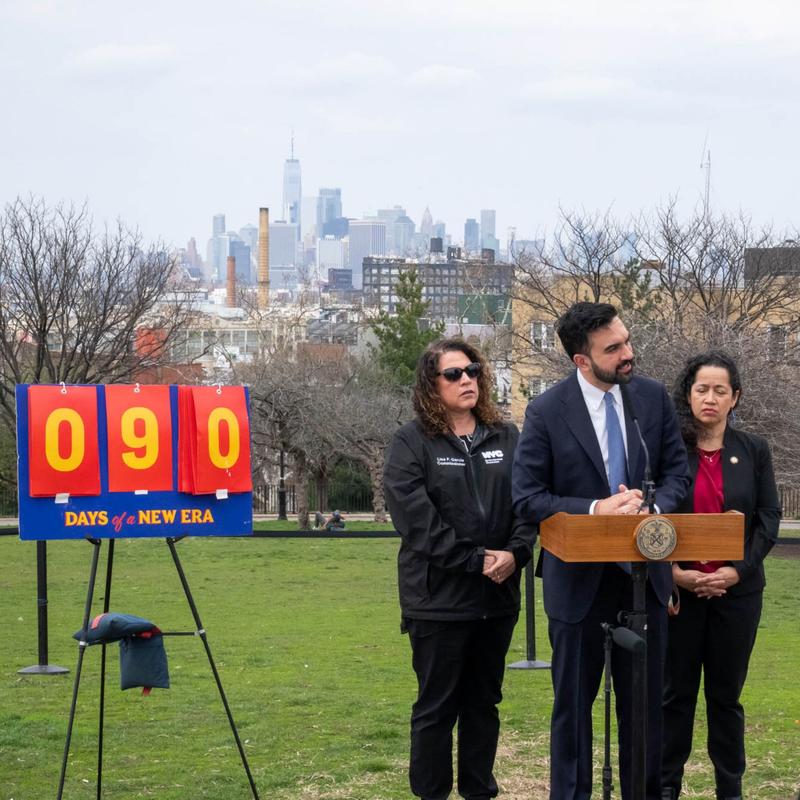
Brigid Bergin: Yes, we are so excited. As we were approaching this 100 days of the Mamdani administration, I knew there would be a lot of coverage assessing the mayor's performance so far. We've seen him really lean into this timeframe. He displays the number day at each of his press conferences ever since the inauguration. He set a really high bar for himself during his victory speech on election night. This is one of the things he said.
Mayor Zohran Kwame Mamdani: For decades, our city's approach to mental health has leaned heavily on criminalization. For many in the throes of crisis, Rikers has been their holding cell. As such, it has become a de facto mental health facility, now standing as the second largest in the country, forcing staff and corrections officers to shoulder a burden they were never supposed to bear.
Brigid Bergin: Actually, that wasn't the clip that we were going to throw to. We will throw to it now. Let's try again.
Mayor Zohran Kwame Mamdani: This will be an age where New Yorkers expect from their leaders a bold vision of what we will achieve rather than a list of excuses for what we are too timid to attempt. [applause] Essential to that vision will be the most ambitious agenda to tackle the cost-of-living crisis that this city has seen since the days of Fiorello LaGuardia.
Brigid Bergin: Brian, we had to get that mention of Mayor Fiorello LaGuardia in there because the frame for our conversation, which I think is going to be a little bit different than the other 100-day conversations you're going to hear, is going to be what are some of the lessons that Mayor Mamdani has drawn from the LaGuardia administration, and how can we compare in just his first 100 days, what can you do in the first 100 days, to the legacy of the LaGuardia administration? Of course, that was a-
Brian Lehrer: Wow.
Brigid Bergin: -12-year timeframe, a lot of major changes to the city's skyline, to what government does for New Yorkers. We're going to have a great panel of experts who will also be joining us, and I will interview Mayor Mamdani live in The WNYC Greene Space on Monday, April 20th, at 7:00 PM. Listeners can sign up for a livestream link. You just need to head over to wnyc.org/mayor, and you can sign up to watch that event, submit your own question.
I think it's going to be a really exciting moment. I brought one more little piece of tape if we have time. It's just a teaser. We're going to play some of this archival tape at the event itself. Since we talked so much about those snowstorms before, here's a little bit of Mayor Fiorello LaGuardia. This is from December 12, 1943. I think it's something Mayor Mamdani might be able to relate to.
Mayor Fiorello LaGuardia: All right, now that brings us up to snow. I dread snow. I don't know. I just dread snow, and I pray every night to please keep snow away. We haven't got the equipment, and we can't get the personnel.
Brigid Bergin: I think Mayor Mamdani, as he made that call to New Yorkers to help with shoveling and just lamenting the snow itself, may have some feelings about the snow that has then become an issue for every New York City mayor.
Brian Lehrer: Sign up for Brigid's Greene Space event, the livestream for it at wnyc.org. Say it again?
Brigid Bergin: wnyc.org/mayor.
Brian Lehrer: I'll note, though, we won't have time to talk about it in depth, that the other clip that we played by mistake, sorry, about trying to make it so that Rikers isn't the biggest mental health facility in the city anymore, which was just from yesterday, is an indication of where the mayor is trying to head to. We're not obviously going to be able to get to every one of the big issues facing the city or even every one of his top priorities. Housing, of course, is a huge one. Al in Summit is calling about that. Al, you're on WNYC. Hi.
Al: Hi. Hi, Brian. Thanks so much. I love the show.
Brian Lehrer: Thank you.
Al: There's been a movement to take over rundown public housing, particularly in Chelsea, I'm thinking about, replace that with high towers, which are really high-end towers. People are fighting that and arguing about what's going to happen to the people who've been living there in this subsidized public housing.
Brian Lehrer: Al, thank you very much. Errol, there's that controversy that I think he accurately framed around the public-housing buildings in Chelsea. There's also the mayor trying to block the bankruptcy sale of Pinnacle Group's rent-stabilized apartments, but was blocked by a federal judge. He's trying to do different things. It's complicated with almost anything that comes to housing.
Errol Louis: That's exactly right, the Fulton Houses and the Elliott-Chelsea Houses. Our station actually is right across the street from the Fulton Houses. I go by there every day. What really happened was they were planning to do renovations to the very much rundown facilities. It turned out, because this is Chelsea, this is one of the most expensive parts of the city as far as land values, they realized that it would actually be cheaper to demolish it and rebuild it than to continuously try to patch the roof and the heating systems and the elevators and all that.
Of course, because this is New York City, even after they had a vote and the tenants voted to do exactly that, to demolish the old housing, build new housing, and put them back in it, there's been a controversy. There's lawsuits and there's at least one political campaign that really turns on this, an Assembly race in the area. It's a little unfortunate, in my opinion, just because I've watched this develop over the last 15 years. I've been in the buildings. I've walked through the campus. It really is rundown. Asking people to stay there really amounts to demolition by neglect, except people are living in the building.
Again, they had a plebiscite. They put it to a vote. The vote was to build more buildings, and there will be some that are not public housing. To pay for the whole thing, basically, they're going to use part of the campus and put some housing there where people will be paying market rent, and that will help pay for the entire project. Again, it's New York. You could literally build the Garden of Eden, and there'd be people who would complain, you know what I mean?
Brian Lehrer: It is only the first 100 days, technically 98 today. Obviously, a lot more coverage of the mayor to come here with people like WNYC senior political reporter Brigid Bergin, and NY1 and New York Magazine's Errol Louis. Thanks for coming on today, both of you.
Brigid Bergin: Thanks, Brian.
Errol Louis: Thank you, Brian.
Brian Lehrer: Listeners, stay tuned for Alison.
Copyright © 2026 New York Public Radio. All rights reserved. Visit our website terms of use at www.wnyc.org for further information.
New York Public Radio transcripts are created on a rush deadline, often by contractors. This text may not be in its final form and may be updated or revised in the future. Accuracy and availability may vary. The authoritative record of New York Public Radio’s programming is the audio record.
