
Mayor Mamdani on the Cold, Budget and More
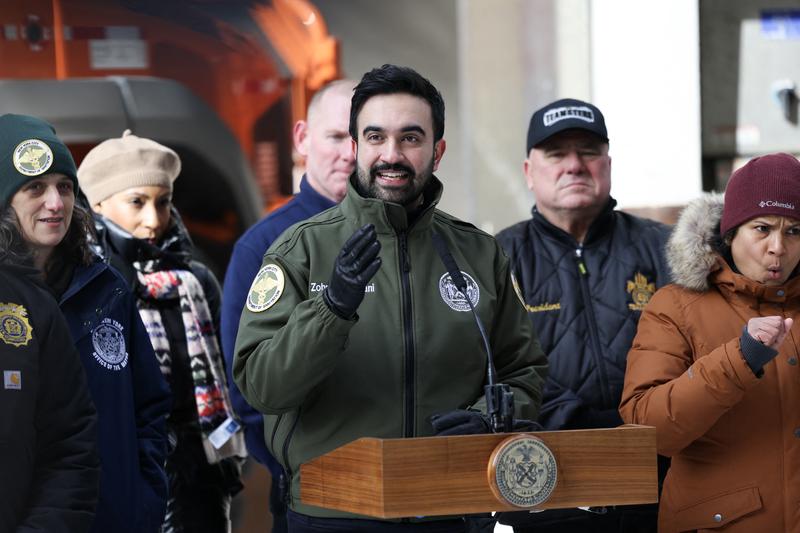
( Angela Weiss/AFP / Getty Images )
Brian Lehrer: Brian Lehrer on WNYC. Mayor Mamdani joins us now. We have 15 minutes with him today. There are things I want to bring up. I know there's some news that he's breaking this morning, including his endorsement in the Democratic primary for governor. Mr. Mayor, thanks for coming on today, the first time since the inauguration. Rather than Assemblyman Mamdani, as I've called you in the past, it's the first time I say, Mr. Mayor, welcome back to WNYC.
Mayor Mamdani: It is a real pleasure to be back. Brian, thank you so much for having me.
Brian Lehrer: I said this to the new controller in his first appearance, Mark Levine, and I'll say it to you. You think you're running for a job like mayor, for lofty goals like universal childcare and equal justice under the law, and then you realize you have to take out the garbage and clean up the snow. Yes, you will be judged by that. How does it feel to be suddenly the executive for the first time with the realities of running this complicated city?
Mayor Mamdani: Well, I think it's only right to be judged on what you do on a daily basis. I think what we see time and again is that New Yorkers care far less about how you describe your politics and far more about whether your politics actually includes them and their struggles. As it comes to the snow, just to give you an update, what we are looking at is some of the coldest weather we've seen in recorded history in New York City, where typically snowfall would be followed by an increase in temperatures and the assistance of the sun in melting that snow.
What we've instead seen is a cold front the likes of which we have not seen in many years. The hard-working men and women of DSNY have been doing everything that they can. What they've done thus far is melt more than 200 million pounds of snow, lay out more than 230 million pounds of salt. In doing so, they have split their shifts between snow removal and response, and garbage and recycling collection. Now that's back on its scheduled day that we have here in New York City.
Brian Lehrer: About the cold, 17 deaths is the last number I saw, most from hypothermia, which means literally dying of cold. You're getting criticized from the right and from some civic groups like the Partnership for New York City business lobby for your policy of no longer sweeping homeless encampments. I saw you quoted saying you're continuing the Adams policy of involuntary removal of people unable to care for themselves. Do I have that part right, no change on the standards you are using to determine when involuntary removal is warranted in the person's interest?
Mayor Mamdani: Yes, that is correct. Just to be clear to New Yorkers, that's when there's been a clinical determination that a New Yorker is a danger either to themselves or to those around them. The city has, over the course of the time since we've put our city into a code blue, which was on January 19, we have made 20 involuntary transfers. This is only one part of what we are doing to do everything in our power to reach out directly to homeless New Yorkers, to bring them inside.
Thus far, outreach workers have made over 1,100 placements to transitional housing, safe havens, and shelters. With a cold front coming once again this weekend, the focus continues to be everything we can do to get them off the streets and get them inside. In addition to the outreach workers, it's also ensuring that we are building on the 20 mobile warming units that we have with resources, clinicians and connections that folks can have to shelter the 15 warming vehicles, the 15 warming spaces, the addition of 50 SRO style shelter units in upper Manhattan, as well as the expedited opening just yesterday of 106 bed safe haven shelter in lower Manhattan.
I say all this to say, Brian, that I went out one evening with some of our outreach workers, and they are doing such difficult and important work at all hours of the day to reach out to homeless New Yorkers and try to get them inside. For many homeless New Yorkers, their prior experiences with the shelter system, their prior experiences with the services they've been provided, are also what color their decision-making of whether or not they should be inside or outside.
We don't want to go to them and say, "There's only one option you have, take it or leave it." Our goal is to go to these homeless New Yorkers and say, "Here are the many different ways that you could come indoors, be warm, be safe," and ensure that we are actually meeting that moment and meeting their needs.
Brian Lehrer: On the Lower Manhattan shelter, which I think is the one that you've described as having fewer restrictions than typical at a shelter. What is fewer restrictions mean? I have to tell you, there seems to be a concerted campaign to get me to ask you a version of this question. A lot of people have written in. I'll read you one that's representative of the group. "Regarding the low-barrier shelter on Pearl Street, please highlight that this is attached to an elementary school, and ask Mamdani, does it make sense to put hundreds of children at risk?" Like I say, there's an organized campaign. We're getting a lot of texts and phone calls to that effect. Reply to that group and also talk about less restrictive shelters.
Mayor Mamdani: The point when I speak about less restrictive shelters is a lower barrier to ensure that, too often, if a homeless New Yorker is looking to find shelter, they will have to then go through an intake process. They will have to then go through a process that is more drawn out and more likely that someone will actually not be able to get shelter in that immediate moment. In this level of cold, what we are doing is to ensure that we are expediting all of these processes to bring people inside.
This safe haven shelter that I toured in lower Manhattan, it is one that-- I know that there was a lawsuit that was a part of this. The city ended up prevailing in the lawsuit about establishing this safe haven shelter and is taking every precaution necessary to ensure that safety, like is always the case, is a critical part of what we are delivering in that. That includes things such as the installation of privacy screening material and all interior windows facing the adjacent school. That includes the procedures that breaking ground, which is the organization that is running the safe haven, are instituting here.
All of it is to both be responsive to the concerns of the community around them, but also responsive to a crisis of cold weather, the likes of which we have not seen in the city in a long time, and the likes of which need to be responded to by the utilization of every possible resource.
Brian Lehrer: Mr. Mayor, I think you've heard that our reporter, Liz Kim, found warming buses deployed by the city near the Staten Island ferry that were empty because nobody knew they were there. You've talked about there being an all-of-government approach in this homeless outreach in the cold, but apparently the NYPD, transportation department, and ferry officials all had no idea the city sent warming buses to a well-known homeless hub. Who's responsible for that communications failure?
Mayor Mamdani: I think at the end of the day, that is a responsibility that I have as the mayor of the city. It's never a moment to pass the buck to anyone else. What we are doing is ensuring that the focus of our work, which is outreach workers directly reaching out to homeless New Yorkers to bring them to those warming buses, is supplemented by clear and additional signage to those buses to ensure that everyone understands that they are there. That is critical, and those are some of the changes that we're making.
Brian Lehrer: We'll change topics now. Here's one of the things I know you want to announce. Pre-K and 3K applications are due at the end of this month, and you want to get the word out. Are these central education and child care programs under-enrolled?
Mayor Mamdani: [laughs] No. This is just an opportunity to tell New Yorkers about the fact that it is their right to enroll their child, whether they're turning three or four years old this year into 3K and pre-K. We actually recently celebrated 50,000 signups from New Yorkers across the five boroughs. New Yorkers and families listening right now, you have until February 27th. For those of you who might be anxious about you haven't already applied, it is not a first-come first-serve basis. If you apply anytime before the 27th, your application will be treated the same.
You can do so by visiting myschools.nyc. You could call 718-935-2009, or you could visit one of the city's more than 10 family welcome centers. What this all is making the case New York is about is the way in which city government can address what is one of the most expensive parts of living in the city, which is to raise a family. We know that it is a sad reality that in New York City, it's considered a good deal if you can get childcare for one child for the course of a year for about $23,000. It's time to make it that little bit easier to raise that family here and not have to choose between the city you love and the family you want to raise.
Brian Lehrer: Are you doing anything more aggressively than the Adams administration did on 3K and pre-K outreach? They got criticized for doing less outreach than under de Blasio.
Mayor Mamdani: I'm here on Brian Lehrer, and we're looking to be on everywhere, frankly, to make the case directly to New Yorkers. I think part of this is you got to be on the radio, you got to be on television, you have to be using digital media. You also have the opportunities of visiting childcare centers yourself.
I think that I may be the first mayor to have visited a home-based center. Home-based centers are a critical part of our childcare infrastructure. They provide the kind of linguistic and cultural flexibility that meets the needs of, as Mayor Dinkins would say, the gorgeous mosaic of our city. It is up to me to make sure that we're making the case in every possible way. That even includes our link NYC terminals across the five boroughs.
Brian Lehrer: Another announcement that you have. I see you've just announced your appointee to lead the mayor's office to combat anti-Semitism. It's Phylisa Wisdom, Executive Director of New York Jewish Agenda, generally described as a progressive Jewish group. This comes a day after the NYPD reported a big spike in all hate crimes, but led by anti-Jewish hate crimes over the last year. Why Phylisa Wisdom, and do you and she have plans yet on how to reverse the trend, and any differently from under the Adams administration?
Mayor Mamdani: I've had the pleasure of working with Phylisa prior to this moment as the mayor of our city, and I've always been impressed and truly appreciated the sincerity and the depth of her commitment to combating anti-Semitism. As you've said, we saw in the prior month 31 anti-Semitic hate crimes here in our city. And any single anti-Semitic hate crime is an anti-Semitic hate crime to many in this city.
We are seeing the need to not just sustain the mayor's office to combat anti-Semitism, but to strengthen it, and the appointment of Phylisa is one that is critical in doing so because it won't just ensure that there is close coordination with the NYPD's Hate Crimes Task Force and community leaders and city agency to respond to these hate crimes, but frankly, it will also do the work to ensure that we prevent these hate crimes.
The work that she has done with the New York Jewish Agenda, the work that she has done in making sure that this is a city where Jewish New Yorkers can live free of violence, intimidation, and harassment, that is the kind of work that we need to build on here in city government. I'm frankly so excited by her appointment and the work that she will do.
Brian Lehrer: I gather you and Ms. Wisdom have differences on at least two issues. I read that she does support Israel's right to exist as a Jewish state, and I gather you've promised more of a hands-off approach to how yeshivas are regulated than she would like to see. She'd like to see more regulation regarding secular education standards on Jewish state. That's a point of contention, of course, on how anti-Semitism is defined. Will that difference inform how you fight hate and actual hate crimes?
Mayor Mamdani: No. The differences of opinion that we may have on the question of Israel and Palestine do not an impact on the importance and the urgency with which we treat the fight against anti-Semitism here in New York City. I need not have every appointee align with every single view that I hold. What I need them to have, however, is a dedication and a commitment to the job that they're being hired for. I can tell you that what I have heard from far too many Jewish New Yorkers is that this crisis of anti-Semitism is one that is too often thought about after the fact and not enough in advance of it.
What I'm most excited about with Phylisa, with her leadership and the office that she will be leading, is building out a team which will be tasked with ensuring that we have a city where every Jewish New Yorker is not only able to live, work and worship, but also thrive without fear of violence or harassment or intimidation, because it is unacceptable. This is a moment where we have to meet that challenge, and she is just the person to do so.
Brian Lehrer: Last thing, the breaking news. This morning, you published your endorsement for governor in a column in the Nation. It is, drumroll, Governor Hochul, rather than her Lieutenant Governor, Antonio Delgado, who is primary ing her from the left and has prominent Democratic Socialist India Walton as his running mate. Why Governor Hochul, and what do you say to those of the people in the movement to elect you who are now out there on the other side of that primary?
Mayor Mamdani: On day eight of our administration, Brian, I stood with Governor Hochul on stage in our city to announce more than a billion dollars in funding from the state to deliver universal childcare. As I was sharing with you earlier, this is the kind of cost that pushes working families out of the city. That was a commitment that not only fixes the childcare we provide for three year old to ensure that it can meet the demand of every three-year-old, but also delivers, for the first time in New York City history, childcare for every two-year-old.
As Governor Hochul was on that stage, she said that the era of empty promises is over. To me, what that is an indication of is exactly what New Yorkers want to see. They want to see a government that can deliver real material improvements in their lives. You can already see the results of the partnership between the two of us in that historic agreement on childcare and in the potential of a new relationship between City Hall and Albany that is characterized more by productivity as opposed to the pettiness that has often been the case.
I am proud to support her reelection. In this moment, this is a governor who has chosen to govern with the needs of working people in mind. That is exactly what we have to deliver in what has now become the most expensive city in the United States. States of America.
Brian Lehrer: I know you got to go. Any quick thing you want to say to India Walton, who is the you of the mayor's race in Buffalo?
Mayor Mamdani: I have nothing but respect for India, and I think that there's the ability to both appreciate one's work and be on the other side of a race.
Brian Lehrer: I know we're out of time. Thanks for this. I look forward to full-fledged Ask the Mayor segments, which I know you're going to do going forward. Thank you, and good luck as you continue to hit the ground running, as certainly you've had to do.
Mayor Mamdani: Thank you very much, Brian. I appreciate it. I look forward to seeing you soon. Bye-bye.
Brian Lehrer: Brian Lehrer on WNYC. We will talk about that conversation with the mayor with WNYC and Gothamist political reporter Elizabeth Kim when we come back from a break. Listeners, we can take some of your reactions at 212-433-WNYC, 433-9692, call or text. We continue after this.
[MUSIC - Marden Hill: Hijack]
Brian Lehrer: Brian Lehrer on WNYC. Now we'll talk about some of what we just heard from Mayor Mamdani with WNYC and Gothamist political reporter Elizabeth Kim. Listeners, our lines are open. Look at that, surprise. They're already full. 212-433-WNYC, but our text message thread is never closed or full, like sometimes my voicemail on my phone is. 212-433-9692. Liz, let's start on the mayor's reaction to your story about the warming buses that nobody out in the cold knew were there. I asked him who was responsible for that failure, and he said, "Me." What do you make of his response?
Elizabeth Kim: Brian, I was really happy that you asked him that, and I was really actually gratified to hear him own it. That's not a response you often hear from mayors, but he did. He said, "That's a responsibility that I have, and it's never a moment to pass the buck." I was also happy to see him say that his solution was going to be to give more clear and additional signage in that particular location. What's important to know about the Staten Island terminal, both-- Actually, there are two terminals. There's one in Staten island and there's also one on the Manhattan side in Battery Park.
The one in Battery Park has, for decades been a resting place for homeless people. It's not any secret that if you go there on a given night, you will see plenty of homeless people, especially in the waiting room, but also outside. On the night that I went out with a group of volunteer outreach workers, and it's important to acknowledge that these were volunteers, they're not contractors, they're certainly not city officials.
Their confusion about why is there not better signage? It just seemed like it was a very logical question to ask because, yes, the city says that they have outreach workers working around the clock. I was told that they are going out in every two hours, but there are bound to be periods where there's no one there. In the absence of having-- We asked the NYPD officer who was there, ferry employees, a DOT official, none of them knew about these warming buses that were just steps away from the terminal. It was a real tragedy of miscommunication.
All of us looked at one another, and we thought, granted, you can't have someone here 24 hours a day, but you can have signage. That just seemed like such a practical solution. I was really happy to see the mayor say that the city's going to do that, and we are going to follow up on that.
Brian Lehrer: Few people are calling in on his announcement this morning of his endorsement of Governor Hochul over her primary challenger from the left, her own Lieutenant Governor, Antonio Delgado. Jen in Brooklyn is one of those callers. Jen, you're on WNYC. Hi there.
Jen: Good morning, Brian. It was so great to hear the mayor back on your show and here to listen to the needs of the people of New York. I'm the first vice president of the PSC-CUJNY. This is a great day for the City University of New York on your show, representing with the labor union, representing the faculty and staff of cuny. I'm calling in to support the mayor and his agenda.
What that means for us on a day when he is endorsing the governor, is that we also need all of New Yorkers to be raising their voices up in the streets and on the phone lines to be telling the governor that we need more revenue, that we need to be taxing the rich, and that everyone, I hope listening, is who really supports the mayor is also here to keep the pressure on Governor Hochul because if we're going to enact his agenda, if we're going to fund things like CUNY and parks and warming centers and schools, then we need to take back the money that's ours.
We need to tax the rich and raise revenue in order to stand up to Trump, who is giving the money of the people of New York to the ultra-wealthy. We have to take back what's ours.
Brian Lehrer: You're praising the mayor a lot in this phone call, but his endorsement of Hochul, who is not for taxing the rich in the state budget is raising eyebrows among some of his allies because that seems like a sellout to them compared to the possibility of Delgado becoming mayor. Why aren't you more angry at him for this endorsement?
Jen: I know that my role is to continue to pressure the governor, and that I know that it is really significant. I know what it meant in my life when my child went into 4K, and I stopped paying $2,000 a month for childcare. That was a life-changing thing. I know that the governor and the mayor are working together in order to bring more money into the people of New York. I know that if I want to support his work, I need to continue to raise my voice in frustration with Governor Hochul, even as the mayor is endorsing her, in order to tell her it is time to have fair taxation in New York, and that means an adjustment of our taxes.
Brian Lehrer: Jen, thank you very much for your call. Liz, what do you make of the endorsement of Hochul and why now?
Elizabeth Kim: I think it's a very fair question to ask whether the mayor, in endorsing her so early, has given up some of his leverage to raise taxes on the rich. It's important to remember that, yes, what the mayor said, that this is a historic agreement. I think that that's fair to say, but the money that she has agreed to give the city-- We should preface this by saying that the budget still has to be passed, but the money that she has pledged to give the city really funds a two-year pilot, we're nowhere near universal.
What the mayor has to think about is within those two years, Hochul could very well win reelection. The mayor has to start thinking about his reelection, too. I don't know, what he does after those two years? His whole argument for raising taxes on the rich was so that he could establish a lasting stream of revenue that could fund not only universal pre-K but a lot of other things that he promised and were very popular with voters, like free buses, like city subsidized grocery stores. I think it's a very fair question to ask the mayor, was this too early? Are you undermining yourself here?
Brian Lehrer: Lauren in Manhattan wants to call in on the cleanup from the snow. Lauren, you're on WNYC. Hello.
Lauren: Hi, Brian. Thank you for taking my call. Hi, Liz. I'm calling because, as we know, there's a slowdown with picking up the garbage, but I feel like at this point, it should be up and running. I live on the Upper East Side, and there are just mountains of garbage double the height of cars. There's dog poop bags in my garbage bin that the garbage trucks won't pick up, so I don't even know who's going to be picking those up. There's literal pieces of spaghetti that have been ripped out of the garbage bag strewn across the sidewalk, and now it's frozen. There's a huge couch that's just in the garbage.
While Mr. Mandani has great ideas, and he is very aspirational, I feel like there's a huge disconnect between what he wants to do and what is really happening on the ground. In this city, I was born and raised here, there has to be at least a perception of safety. Right now, with the way the garbage is, it feels disgusting. There's a-- It's a health hazard. It feels unlivable. If the city looks like a trash can and if it feels like a trash can, then people are going to act like that. They act like how they feel they're being treated.
At this point, nothing matters unless the garbage is picked up, because it will become a place that people will just disrespect. I cannot understand why it is taking this long to pick up the garbage.
Brian Lehrer: Lauren, thank you. I will tell you that we are already planning to reach out today to the sanitation commissioner and hear directly from the commissioner about how this has gone. Liz, have you reported on this at all? I guess a question I have, because I don't really know the history, even though I've lived here all my life, is, is this any different in terms of the difficulty in clearing the snow enough and using the sanitation trucks to clear the snow and then getting back into the game of actually picking up garbage different from when we've had similar snowfalls?
Elizabeth Kim: Here's the difference, Brian. We have not had so much snowfall in years. That's just been an aspect of climate change. That's one difference. Then there's the other difference that the mayor repeatedly points out, which is this may be the longest cold stretch in New York City in recorded history. What that means is that after that snowstorm, the temperatures remain low and the snow hasn't melted. That also complicates the situation with sanitation workers, because they have been trying to melt the snow.
While they're trying to do things like melt the snow, clear crosswalks, it means that-- I should say the Department of Transportation is responsible for clearing the crosswalks, but what it means is a lot of this energy has been diverted to trying to make the city passable. And as a result, yes, the city has acknowledged that they've fallen behind on garbage collection. The caller, these are all fair points, and this is why it's very difficult to be the mayor.
It was very interesting in that immediately, the day after the snowstorm, I think a lot of people praised the mayor's performance because he was so good at the communications aspect of it. Now in light of this, and then-- This has complicated things and raised questions about can the city be doing more. More than that, it's also the deaths. The deaths of-- It's now up to 17 New Yorkers who have died in the cold since that snowstorm. That has also complicated our assessment of his performance. I thought it was instructive in knowing, perhaps maybe it was a little premature to start giving the mayor a grade on his first snowstorm.
Brian Lehrer: I did ask him about the deaths, because 17 is a lot, but he confirmed what I've read, which is that he has not changed from the Adams approach on involuntary removal. He has ended the sweeps of homeless encampments, and that's gotten criticized as, at least in theory, putting people more at risk in the name of compassion. Not forcing them to move from where they want to be, but maybe that's too risky for them. When it comes down to assessing each individual, he says no change from Adams. Does that look to you like what's actually happening?
Elizabeth Kim: There was a policy change, and it was reported, which was basically City Hall asked police to let the Department of Social Services and sanitation take the lead in homeless outreach. That's not saying we don't want you involved, but it's telling them that they would like these other city workers to take the lead. I think that that's consistent with the mayor's idea or belief that he doesn't want to criminalize homelessness.
It did raise the question, which is, are police somehow being less proactive, perhaps, in their homeless outreach? Has that affected the number of New Yorkers who are being brought in? I think that that's a fair question. The mayor was asked about that this week, and his response was no. His response is no, the police are involved, just like social services and sanitation. He says it's an all-of-government approach. That was it. I think that that slight shift in policy does open the window to asking, are there less eyes on the ground who are paying attention to this?
Brian Lehrer: WNYC and Gothamist political reporter Elizabeth Kim. Liz, thanks a lot.
Elizabeth Kim: Thank you, Brian.
Copyright © 2026 New York Public Radio. All rights reserved. Visit our website terms of use at www.wnyc.org for further information.
New York Public Radio transcripts are created on a rush deadline, often by contractors. This text may not be in its final form and may be updated or revised in the future. Accuracy and availability may vary. The authoritative record of New York Public Radio’s programming is the audio record.
