
Mayor Mamdani in Albany
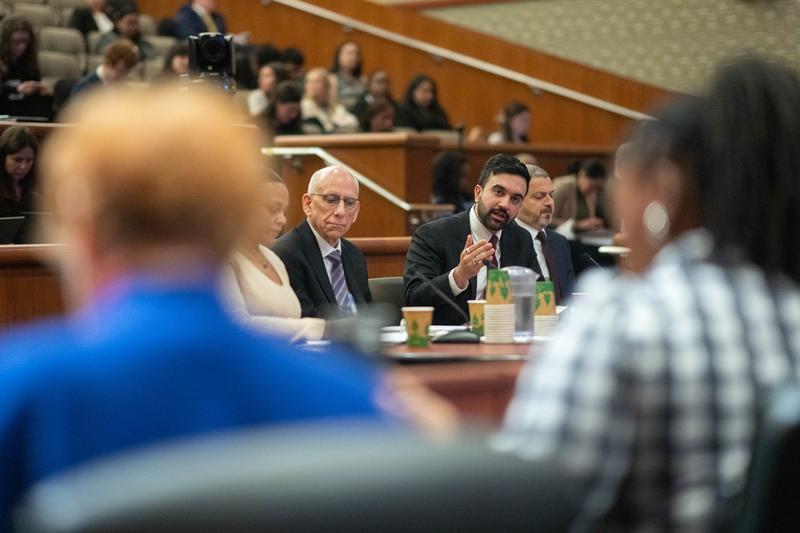
( Michael Appleton / Mayoral Photo Office )
Brigid Bergin: It's The Brian Lehrer Show on WNYC. Good morning again, everyone. I'm Brigid Bergin, sitting in for Brian today. Yesterday was what's known as Tin Cup Day in Albany, when local leaders make their cases to the state legislature for more money. Mayor Mamdani, a former member of the state assembly, was among them. It turns out the mayor needs a little less money than originally estimated.
Mayor Zohran Mamdani: By assuming an aggressive posture on savings without compromising city services, incorporating updated revenue and bonus estimates and using in-year reserves, we have lowered that $12 billion gap to $7 billion.
Brigid Bergin: My colleague, Jimmy Vielkind, is a New York State issues reporter for WNYC and Gothamist, and he was there. He joins me now to talk about what the mayor wants from Albany and how the governor and legislature are responding. Hey, Jimmy.
Jimmy Vielkind: Good morning, Brigid.
Brigid Bergin: Listeners, we can take your calls on this. What are the promises you are counting on Mayor Mamdani getting Albany to go along with? Do you think New York City gets its fair share of state funding and services? Call or text us. The number, 212-433-WNYC. That's 212-433-9692. Jimmy, $5 billion seems like a lot of adjusting. I hope I can find that in my couch cushions. Do you know a little bit more about the mayor's deficit calculations?
Jimmy Vielkind: Well, it's really a combination of a few things, Brigid. The mayor was joined by Sherif Soliman, the director of the Office of Management and Budget, as well as Dean Fuleihan, the first deputy mayor, who some listeners might know has basically been doing fiscal stuff in city and state government, basically, since they invented math.
Brigid Bergin: [laughs]
Jimmy Vielkind: Dean is really well-known in Albany, pretty well-respected. The three men really presented this improvement as the product of three things. One is better-than-expected performances on Wall Street. That means bonuses to Wall Street bankers. Thanks to New York's nation-leading income taxes. That means a glut of money coming into both the city and the state coffers.
Governor Hochul, when she unveiled the state budget, she really pointed to this bolus of funds coming in from the Wall Street bonuses as a reason to not raise taxes. Mamdani and his team say that that counts for about $3 billion of the $5 billion that they are lopping off the deficit calculation. They say that another billion dollars is coming from savings, operational savings, which was not really specified, and then another billion is coming from reserves or the use of reserves in the middle of the year.
Brigid Bergin: Of course, the mayor is set to deliver his preliminary budget next week. I'm sure there'll be a lot of questions about those savings and the use of the reserve funding. Still, $5 billion is a sizable amount. The mayor blamed his predecessor, Mayor Adams, and the way he says the state treats the city as "a resource to be drained," meaning, essentially, the city taxes subsidized upstate programs.
Jimmy Vielkind: Yes. The short answer to that is yes. New York City is the hottest economy in New York State right now. It has been for quite some time. Since the preponderance of the wealthiest people in the state of New York live in the five boroughs and in its surrounding areas, there is more money that flows north to Albany, then comes back south in terms of social services. Now, it hasn't always been this way. Some listeners might remember in the 1970s, there was a fiscal crisis for New York City. The state really stepped up to bail it out.
According to Mamdani, the city accounts for about 50% of state revenues, but only gets about 40%, 41% back. To really go back in history, Brigid, people might remember state Senator George Washington Plunkitt in his famous 1905 book saying that "the city is pie for the hayseeds." We see some of the structural imbalances there where New York State controls the affairs of New York City. These are things that were set up at the end of the 19th century, but that we're still living with and are still major parts of the power structure here in the state of New York.
Brigid Bergin: Wow, Jimmy, sneaking in a Plunkitt quote. Leave it to you. The publication, New York Focus, took a look at that claim, noting it was odd for a socialist to argue against redistributing wealth, but they did point out that not only does the city send Albany more than it gets back, that it's actually a bigger percentage difference now than it has been recently. Mamdani has blamed former Governor Cuomo for this. How's that landing?
Jimmy Vielkind: Well, Governor Cuomo's very happy to be a punching bag up here among the current crop of state legislators. I think many people are happy to smirk or smile when he gets blamed for something. The biggest thing that Cuomo did that's really tangible, and this is something that Mamdani, Fuleihan, and Soliman brought up in their testimony, was the end of AIM funding. AIM is Aid and Incentives to Municipalities. This is actually something that started in 2010, I believe, under Governor David Paterson. The state was facing a big, big hole during the Great Recession.
Part of the way the state dealt with that was to eliminate $300 million a year that New York City received as part of this AIM program. The state distributes money to all kinds of municipalities, towns, villages, cities upstate, and in the Hudson Valley, and even on Long Island, but New York City doesn't get anything. As I recall reporting on that at the time, it was basically a notion of, "Well, Mike Bloomberg is the mayor of New York City. He's a Republican, we're Democrats. He seems to be good with fiscal management, so we're going to take this money, and he'll have to deal with it." No one has bothered to bring it back ever since.
Brigid Bergin: It's not just AIM funding, right, Jimmy? Isn't it? There's also funding to support Raise the Age juvenile justice programs. Why is the city excluded from that?
Jimmy Vielkind: That is something that has come up. It's been a problem in various counties around the state, not just New York City. It's really interesting to quantify these various revenue streams, right? The state sends out education aid to school districts around the state. I think there are around 700 of them. Of course, New York City's school district is the largest.
How you tweak the formula to direct money in school aid has a big amount of influence about how much state money is going to New York City. Medicaid is the other largest area of state spending. Medicaid is, of course, a program that provides health coverage for poor and disabled people. Depending on how you track reimbursements or tweak reimbursement levels, that funnels an enormous amount of money into New York City. It just doesn't necessarily fall into New York City's budget.
It's a little hard to play this balance-of-payment game when you look at so many of the programs that the state of New York operates are not necessarily based on geography, but they're based on need. Where the need is the greatest, the funding is going to flow the most. I don't know how well this argument about balance of payments is going to land in Albany. We already heard from some legislators that represent other areas that, like, "Hey, we send money where we need to."
Brigid Bergin: We have, I think, pretty clearly established that the city is a creature of the state. Something that Governor Cuomo liked to point out, Plunkitt pointed out. That's why the mayor ultimately needs the state to let him fulfill many of his campaign promises. How did free buses, if at all, come up yesterday?
Jimmy Vielkind: It came up only obliquely. It's not something that Mamdani focused on in his testimony. He was asked about it by some legislators and, of course, by some journalists in his post-testimony press conference. Specifically, people asked whether he was going to move forward with a pilot program during the World Cup, which is something that was reported in a few other newspapers. Mamdani said he's having conversations with state officials. The Metropolitan Transportation Authority is actually not a city agency. It's an authority that's effectively controlled by the state. This is something that I feel like the details are ongoing, but nothing necessary, and nothing that he really pushed or emphasized too strongly.
Brigid Bergin: If you're just joining us, you're listening to The Brian Lehrer Show on WNYC. I'm Brigid Bergin, senior reporter in the WNYC and Gothamist newsroom. I'm talking with my colleague, Jimmy Vielkind, about Mayor Mamdani's trip to Albany for Tin Cup Day. Let's go to Allan in Brooklyn. Allan, you're on WNYC.
Allan: Good morning. I appreciate a chance to talk about this on a very germane segment. If it's ever a time to ask Albany for further authority when climate change is urgent, but being denied by the Feds, and the Feds are cutting back on aid to transit, and everything else the city needs, and wealth disparities are greater than ever. We need to grow the subway system, not just maintain it. The system has always been the goose that laid the golden egg for landowners near downtown transit stations.
Without those stations, the buildings would be giant, empty, useless sculptures. The landowners know that. It's time to have a benefit zone assessment akin to a business improvement district assessment, but something that's quasi-mandatory that just asks landowners there to pay some fraction of the windfall of land value they get by having thousands of people delivered to fill their rentable floors. It's only fair, but it's not been discussed because it's political poison for most people in politics. The necessity has reached the point where we need to talk about it.
Brigid Bergin: Allan, thanks. I know this is an issue that is close to you, Jimmy. What Allan is talking about there in terms of-- he's talking very specifically about raising taxes on landowners near subways, but the idea of raising taxes in general has certainly been a theme of Mamdani's pitch around the budget. He endorsed Governor Hochul's reelection bid last week despite her opposition to one of his key proposals, which is increasing taxes, but in this case, on millionaires. How did he make the case for that to the legislature?
Jimmy Vielkind: Well, you're exactly right, Brigid. He's in this point where even though his fiscal condition is improving, he's still saying, "I want to raise taxes." He's, of course, a Democratic socialist. He campaigned on raising taxes. He believes in, as you said, the redistribution of wealth from the people at the top, more to the people at the bottom. He says that now that he's faced with a $7 billion deficit instead of a $12 billion deficit, recurring revenue is really the only way to plug that.
For Mamdani, that means he's asking for the ability to levy an additional 2% tax on people's income over a million dollars. The way he sells this is that a millionaire would pay another $20,000 in taxes if their income was a million dollars, and also an increase to the corporate tax in this state. That is something that we're going to be hearing a lot of discussion about. I want to also go quickly back to what Allan said. Allan, there actually has been some talk about what is often called by urban planning geeks is "tax increment financing."
Basically, this idea that when you extend mass transit, you improve, as you said, the value of the land around those new transit stops, and that the increase in value and the resulting increase in property taxation should be directed to pay for some of the cost of the improvement. Governor Cuomo called that value capture. It was implemented in some limited forms for new service, but I haven't heard anyone really talk about doing it retroactively, saying that the Woolworth Building, which we opened in 1911 after the subway opened in 1904, should have to pay a special assessment because it's surrounded by all these subway stations.
Brigid Bergin: Thanks for weighing in on that as well, Jimmy. You have mentioned that we're hearing Mamdani continue to make the case for his personal income tax and increase on corporate taxes. You and I both know that the governor has said it's a non-starter. What is the basis of her objection?
Jimmy Vielkind: Governor Hochul has really forged by Buffalo, forged by Upstate New York. She said quite clearly that she is concerned that if you raise taxes too high, it will hurt the business climate. It will drive away the wealthiest New Yorkers, who already disproportionately pay a very large share of state revenue. I think that the latest statistic is that the top 2% of taxpayers account for roughly half of what New York State collects in personal income tax.
It's a tax base that's very top-heavy, and that's skewed very heavily toward the people who are at the very top of it. The big question is, if you raise those levies more, will there be migration? This is something that I've been hearing debates about for the decade and a half plus that I have covered New York State politics. People on the left who favor tax increases, they note that since New York increased its rates in 2021, the number of millionaires increased. It went up.
People on the right will say that the relative share of millionaires in New York State compared to the rest of the country has actually decreased over time. Dean Fuleihan was asked about this during the hearing. He said that the New York Metropolitan Statistical Area, the MSA, its share of millionaires is holding steady, which is his way of nullifying that argument about the growth. Hochul is sympathetic to this. She's wary of this migration. I also don't think that she wants to raise taxes in an election year. She's facing a Republican opponent who is faulting her for high spending. I don't know that she wants to give him an open line of attack on this issue.
Brigid Bergin: The Democrats in the legislature have supported a millionaire's tax in the past. Do you get the sense of where they're going to land this year?
Jimmy Vielkind: It's a little bit too early to tell. We're in the budget process. Both Speaker Carl Heastie and Senate Majority Leader Andrea Stewart-Cousins, they didn't have equivocal opposition or equivocal support for it when they first received Governor Hochul's budget proposal in January. Heastie said that, "I have to see what my members want. I have to see what our budget priorities are, and then I figure out how to pay for it. If I need more money to pay for it, we put a tax increase on the table."
As she said, we put tax increases on the table multiple times in recent years. They seem to always favor raising taxes, but it hasn't really come together. What's interesting to me, though, Brigid, is that after the budget was revealed, Heastie said something to the effect of, "Well, Governor Hochul is right. We did get a lot of extra money this year. We did get a lot of money from Wall Street. We are spending more money."
The state budget is projected to go up about $6 billion as is, so I don't know that there is a strong will to raise taxes just based on ideology. I think that Albany lawmakers are much more interested in looking at what programs need funding. Where does revenue have to be raised before they come to this calculation? Right now, they don't seem to be incredibly sold.
Brigid Bergin: I want to go to Edith on the Upper West Side, who has some skepticism of whether those taxes would do much. Edith, you're on WNYC.
Edith: Yes, hi. Thanks for taking my call. Interesting conversation. Yes, I was thinking in terms of how much we raise taxes on the very wealthy. The reason I feel like, I wonder how much of a difference it will make is that there are so many loopholes that the wealthy can use. In fact, Trump, I think when he was running for the first time, was asked about that. There was even a year when he paid no taxes. It's because of these loopholes. His answer, his response, was, "Well, because I can, because it's legal." Is there anything we can do? This is a huge issue, though, about dealing with some of those loopholes that the very wealthy get in terms of paying their taxes, especially real estate, but many others.
Jimmy Vielkind: Edith, thank you so much for that question. There's actually a state senator from southern Brooklyn named Andrew Gounardes, who has really been harping on this exact issue. He has a bill that would close what he says are loopholes that favor the wealthy. His favorite example is that, apparently, there's a tax break if you buy more than $1,000 worth of gold bars, which I didn't know. I have not availed myself of that one.
Brigid Bergin: You haven't done that, Jimmy?
Jimmy Vielkind: I haven't done that. He's gone through the tax code and found all kinds of things, and he's harping that point. In a year where lawmakers may be loath to enact a broad-based tax increase, I think that an idea like that might have a little bit more traction in the final budget-making soup when it starts to really get on the stove in the latter part of March.
Brigid Bergin: Jimmy, just to put an end cap on the tax part of the conversation, Mamdani has also talked about raising the corporate tax to New Jersey's level, although there's been some pushback that when you include all the corporate taxes, New York isn't technically really lower. What's been the governor's response to that particular piece of policy?
Jimmy Vielkind: She has been far more equivocal on that note than she has been on income taxes. Her rhetoric really shifted in the latter half of 2025, where she says, "I'm not going to raise income taxes." Income taxes are, of course, the largest portion of New York State's revenue equation. She also will point out exactly what you just said, Brigid, is that if you look at just the base tax rate of New York versus New Jersey, New York's is lower.
If you're in New York City, again, the locus of most economic activity in New York State, there are additional surcharges for the Metropolitan Transportation Authority. There are some other things that jack that rate up, so it's actually higher than New Jersey. It's also a little unclear about how you structure that. Governor Cuomo melded the separate bank tax that existed into the general corporate tax. I think that there might be room to change some definitions to see what's captured and maybe tick the rate up in the corporate tax. That might have more of a chance of passage than the income tax, which I think is a little bit more salient and tangible for New Yorkers.
Brigid Bergin: Jimmy, I mentioned this was Mayor Mamdani's first Tin Cup Day as mayor. How did his former colleagues respond to him in that room, in that position?
Jimmy Vielkind: What struck me, Brigid, having watched different mayors come up and do this for many, many years, is that Zohran Mamdani is a charmer. He is smooth as silk. He started off the hearing by going around, shaking hands, posing for selfies with some of his former colleagues. He continued to make a joke that, as someone testifying, he was allotted 10 minutes to speak, whereas rank-and-file lawmakers, like he was last year, only get three minutes to do their questioning of the person on the dais.
He was talking about what a luxury it was to have that time. At one point, he was facing a grilling from Steve Chan, who's a Republican state senator who represents parts of southern Brooklyn. Before Mamdani engaged with Chan, who had this staccato rat-tat-tat of questions about local issues in his district, Mamdani said, "By the way, Senator, I just have to say. You're really great on TikTok."
Brigid Bergin: [laughs]
Jimmy Vielkind: He wished a happy birthday to State Senator Luis Sepulveda, who wasn't even there.
Brigid Bergin: Wow.
Jimmy Vielkind: Someone prepped him really well. I think that kind of personal charm, it has an impact. It has an impact, and it's a marked difference between people like Mike Bloomberg and Bill de Blasio, less so than Eric Adams. Eric Adams, again, a former lawmaker, someone who had his own kind of-
Brigid Bergin: Charm offensive.
Jimmy Vielkind: -quirky charms, yes, but certainly a marked difference from those Red Sox fans that we've mentioned.
Brigid Bergin: Those Red Sox fans. Jimmy, did you find that that approach was disarming? The way you described it, it seemed like you're taking this hit of question after question. It might interrupt that flow if you were trying to connect with a lawmaker on that level.
Jimmy Vielkind: Yes. Mamdani, in his testimony, emphasized, as he has said publicly before, that he wants to have a more cordial and productive relationship between the city and state. New York City and New York State have been fighting against each other, probably since the days of Peter Stuyvesant. That really came through. The thing that you heard from lawmakers was not necessarily a warm embrace, though there were several lawmakers, including the Democratic Socialists, who Mamdani was part of that cohort when he served as a state legislator, who did speak clearly about their desire to raise taxes in New York City and to give the city the authority to do that.
Yes, I did think it was pretty disarming. Even the most contentious exchange, which involved an assembly member from Long Beach and the southern areas of Nassau County named Ari Brown, who was really a guy accusing Mamdani of being anti-Semitic. Brown is himself an Orthodox Jewish man. Even that, Mamdani just stayed level-headed. He didn't raise his voice. It was left to one of the co-chairs of the hearing to basically cut Brown off and cut off his line of questioning.
Brigid Bergin: That underscores a point, I think, Jimmy, that the Republicans who were there for this line of questioning had to make a choice yesterday, right? They could either be in Albany or be at the state GOP convention, where they were nominating their party's candidate for governor, Bruce Blakeman, that was in Garden City. He'll be running against Governor Hochul in the general election. What did you make of the folks who decided to be in Albany versus those who were in Garden City?
Jimmy Vielkind: Having covered political conventions and covered budget hearings, I think that there's actually probably more of a potential for impact or more of a potential for even a point-scoring moment as a politician to go in that hearing, right? If you're a Republican who doesn't like Zohran Mamdani, this is your chance. You've got three minutes. You can question him. You can ask whatever you want. You can lecture him.
We saw some legislators do that at a party convention. Unless you're one of the featured speakers, it doesn't necessarily lend too much to be there. Maybe cheering and clapping along as somebody else does, as we heard from our colleague, Walter Wuthmann, really denounce Mamdani and Hochul and turn the current New York City mayor, who's not going to be on the ballot this year, into a boogeyman for the Democratic Party, which is what the Republicans are going to try to do in November.
Brigid Bergin: Jimmy, was there a big difference between the New York City Democrats versus those outside of the city in the questioning for Mamdani?
Jimmy Vielkind: One thing that struck me is that Mamdani is requesting to raise taxes in New York City, that he wants to raise the New York City income tax. What we heard from some legislators who represent areas outside of the city is that they want to think about the fiscal needs of the state's municipalities as a whole, not just a one-off, one-off, one-off. The mayor of Buffalo, Sean Ryan, testified about major fiscal problems that he is having in New York's second most populous city.
Other upstate cities have problems that much of their key downtown property is tax-exempt because it's owned by government or eds and meds. That's always been a perennial complaint of officials in Albany because it's the state capital. I think that there was some hesitance among upstate lawmakers to approve just a one-off solution for New York City. Because if you give something to one kid, you're going to have all the other kids asking you for the same thing, if not more. Any parent, present company included, knows this is a fundamental law.
Brigid Bergin: Absolutely. Jimmy Vielkind, New York State issues reporter for WNYC and Gothamist. Lots more budget-haggling to cover. Jimmy, thanks for joining me.
Jimmy Vielkind: Thanks for having me.
Copyright © 2026 New York Public Radio. All rights reserved. Visit our website terms of use at www.wnyc.org for further information.
New York Public Radio transcripts are created on a rush deadline, often by contractors. This text may not be in its final form and may be updated or revised in the future. Accuracy and availability may vary. The authoritative record of New York Public Radio’s programming is the audio record.
