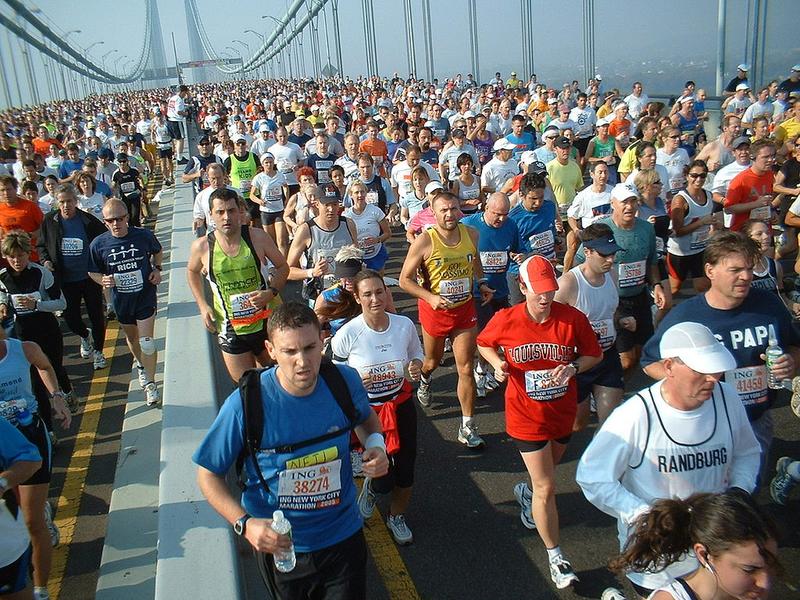
Brian Lehrer: Brian Lehrer on WNYC. Yes, to end the show today, we are turning to the New York City Marathon, 26 miles plus, first Sunday in November. Good probably for all of you who ran that it's the day after you turn the clocks back, so you were able to get an extra hour of sleep before having to get out there early to the Staten Island side of the Verrazano Bridge. We're inviting your calls, 212-433-WNYC. Did you run to support a cause? What kept you going through 26.2 miles? Did you see a familiar face or a great sign that made you laugh?
Was it a song on your playlist or the sound of the crowd cheering you on? Do you have a favorite part of the course? Anything you want to share about your experience running yesterday? Give us a call now. 212-433-WNYC, 212-433-9692, or you can text, as we are also joined by Nicholas Thompson, CEO of The Atlantic and a marathon runner, having run the New York City Marathon several times. In his new memoir, he writes about how much his father inspired him to pick up the sport. The new book is called The Running Ground: A Father, a Son, and the Simplest of Sports. Nicholas, welcome back to WNYC. Hi there.
Nicholas Thompson: Oh, thank you so much. Delighted to be here.
Brian Lehrer: You wrote, "I took up the sport to be like my father. I kept going because he stopped." Tell us a little bit about that relationship.
Nicholas Thompson: Yes, my father introduced me to running. He took me running when I was five or six years old. In fact, when I was seven years old, I came down to New York from my home in Boston and watched him run the New York Marathon and stood on First Avenue just as they came off the Queensboro Bridge. It was a really important and beautiful moment for me. Then my father's later life was very hard. A lot of alcohol, a lot of disarray, a lot of chaos. I felt like he lost his discipline. One of the ways that I've tried to maintain mine is to just keep running every day.
Brian Lehrer: On your 40th birthday, your father posted a pretty private message on your very public Facebook page. He warned, "All men's lives fall apart at this age." Was he referring to age 40?
Nicholas Thompson: Yes, so he posted this amazing note. He said, "Hey, Nick, you're 40 years old, wonderful wife, wonderful children. Your job's going great, but my father's life fell apart at 40. My life fell apart at 40. Hope it doesn't happen to you." His point was just the forces and temptations and the pressures that hit men and women at this age in life, when you're caring for parents, caring for children, their professional expectations. Maybe you haven't lived up to what you desired, gets really hard, and you can let go of things.
I got that note, and it made me want to double down on not letting things get out of control, not have the rest of my life spiral in the way that his life spiraled. There are lots of particular reasons why my father, who had an amazing, interesting life, a lot of reasons why his life got a lot harder at 40. I just figured I would try to keep them at bay. My book is partly about how I've been able to use running to maintain focus in life, but it's also about other runners who have used the sport as a way to understand pain and the things that really matter.
Brian Lehrer: Kathryn on the Upper West Side is calling to celebrate a friend who ran the marathon. There's an incredible number I'm seeing in the notes on this call. Kathryn, you're on WNYC. Hello.
Kathryn: Thank you, Brian, and thank you for Beatrice. Dr. Beatrice Fennimore, BZ. She'd be appalled that I'm making this call, which bespeaks her. She was a 1970 graduate at St. Joseph's College for Women, now St. Joseph's University on Clinton Avenue, Clinton Hill, Brooklyn. She began her beautiful family of two amazing daughters in Bay Ridge while she was getting her doctorate at Teachers College, where she, for two decades, taught a highly esteemed and oversubscribed course on public education, while she was a full-time head of department at one of the state universities in Pennsylvania at Indiana, Pennsylvania. Yes, that is the name of the town. Most importantly, she has, through her writing and through her advocacy and through her brilliancy, advocated always for public education in the United States of America insofar as it often underserves the most important and underserved--
Brian Lehrer: Come back to the marathon.
Kathryn: Her 77th marathon in her life.
Brian Lehrer: Come on.
Kathryn: 77, she does not lie. By the way, three of them were three of the last New York marathons, three of the last four years.
Brian Lehrer: Kathryn, thank you very much. All right. Who else wants to brag on a friend who ran the marathon any number of times? My father-in-law ran till he was 75. He did many, many marathons.
Nicholas Thompson: That's awesome.
Brian Lehrer: 212-433-WNYC, 212-433-9692. Who do you want to shout out, including yourself? I know we have people around the marathon listening at this hour on Monday morning, unless you're still recovering. Brag on yourself. 212-433-9692. Nicholas, I would say, you didn't brag enough on yourself because I see at the age of 44, four years after that post from your father, you ran a marathon in 2 hours and 29 minutes?
Nicholas Thompson: I did. I ran that one very fast. I went through a big change in my mid-40s. I had been running. I had run the New York City Marathon every year for 10 or 11 years in 243, 244, 242. Then, in my mid-40s, I made a psychological and physical breakthrough and really got a lot faster, and then ran the 229. I will say, though, that yesterday, I ran it, and I ran a lot slower, but still finished, did my best.
Brian Lehrer: Yes, but that was just the beginning of your success. You kept setting records for your age group following that race. What did that experience teach you about aging and running?
Nicholas Thompson: Well, it's what inspired the book. What had happened is in 2005, I had run the New York Marathon at 243, and it was my first really fast marathon. Then, immediately afterwards, I had been diagnosed with thyroid cancer a week later. They found a lump in my throat. I went through a lot of really hard treatments, completely wiped out. Two years later, in 2007, I came back and ran it in 243. Then what happened is, for 10 years, I ran it at 243, 244, et cetera, and then I got much faster.
I was trying to think through. If I clearly had the talent to run 229s and to set all the records I've set later, why couldn't I have done that in my 30s? This is what inspired the book. I had a realization. It happened one day when I was running across the Brooklyn Bridge into Manhattan. I had a realization that the reason why I hadn't gone quicker in my 30s was that I had been really deep inside, just focused on being as fast as I'd been before I got sick.
What that realization meant to me is that it was an insight that what makes you fast, what makes you slow, what lets you keep going can be buried really deep inside. For me, my speed was tied up in the way I had dealt with my illness and with my perceived sense of mortality. It made me realize that running is a really powerful force. What controls it is very hard to put your finger on. The process of getting faster taught me a lot about the way we see ourselves and what holds us back or what pushes us forward.
Brian Lehrer: Morgan in New Rochelle, you're on WNYC. Hi, Morgan.
Pat Horgan: Well, I'm guessing it's me, Pat Horgan.
Brian Lehrer: Oh, I'm sorry. You're right. We got that wrong.
Pat Horgan: That's okay.
Brian Lehrer: Hello, Pat.
Pat Horgan: Okay, you were asking for bragging. I'm going to brag about my grandson, Brendan Mulvaney, who did the marathon for the first time and did it in 2 hours, 31 minutes, and 13 seconds.
Brian Lehrer: Neat. Awesome.
Nicholas Thompson: Awesome.
Brian Lehrer: Could have almost won. What was the winning time? Do you have it? It's not that much different from what you just said, right?
Nicholas Thompson: It was like 208.
Brian Lehrer: Yes. Alex in Brooklyn, you're on WNYC. Hi, Alex.
Alex: Hey, can you hear me right?
Brian Lehrer: Yes.
Alex: All right, great. I just want to comment. First of all, I want to say I want to congratulate my friend, Daniel Plench, who ran yesterday. I've had many friends that's done it in the past. I just wanted to say that one of the most amazing things that happens in New York is the marathon. You just see people cheering for people that they completely don't know. I had my dog barking yesterday. My girlfriend was crying. You see people who have amputated legs running, or just the elderly. It's such a beautiful thing and such a wonderful reminder of what it means to be a New Yorker.
Brian Lehrer: Hear, hear. Beautifully said, Alex. Having been on the sidelines myself, never in the race. I've had that same emotional experience that you just described so beautifully. Last thing, Nicholas, because part of your book is tips and tricks. One of them real quick. You write that when you race in a marathon, your goal early on is to spend as little energy as possible thinking about anything extraneous. What does that mean?
Nicholas Thompson: My view is that you begin a race with the equivalent of 100 pennies in your pocket, and you spend them as you go forward. Your goal is when you get to the finish line, to spend the last one sprinting towards the finish line in Central Park. Anytime you let your mind drift or you run off to the side and you high-five someone or you get frustrated by the person in front of you and you move around to the right to get by them, you spend a penny you didn't need to spend. In the beginning of a marathon, you're really trying to relax. You're really trying to stay calm. You're really trying to stay on a steady, even pace. When I talk to people about what they should do in their first marathon, it's, "Go slower than you expect, and stay calm those first 5, 10, 15 miles."
Brian Lehrer: All right, so those of you who saw something on TV yesterday or whatever and said, "I'm going to try it in 2026," there's your first tip from Nicholas Thompson, CEO of The Atlantic, in his day job. His new memoir is called The Running Ground: A Father, a Son, and the Simplest of Sports. Thank you so much for sharing it with us.
Nicholas Thompson: Oh, it's great to be on. Thank you so much.
Brian Lehrer: Thanks for listening, everybody, and for calling and texting. Stay tuned for Alison.