
Mamdani's Historic Win
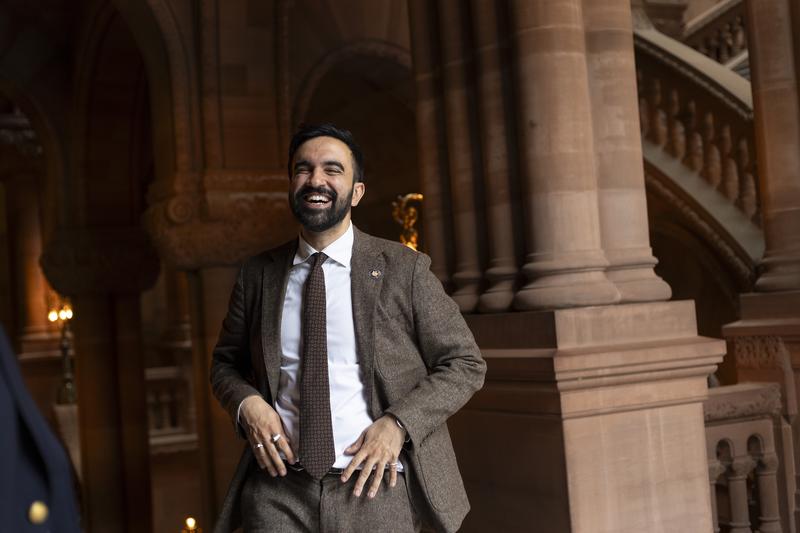
( Patrick Dodson / New York Public News Network )
Title: Mamdani's Historic Win
[MUSIC]
Brian Lehrer: It's The Brian Lehrer Show on WNYC. Good morning, everyone. You know the headlines, unless you just woke up, and you've probably heard very short sound bites of these Zohran Mamdani and Mikie Sherrill victory speeches. With the luxury of time that we have on this show, here's a little more.
Zohran Mamdani: The sun may have set over our city this evening, but as Eugene Debs once said, [applause] I can see the dawn of a better day for humanity.
Mikie Sherrill: The men and women in labor [applause] at union jobs, at a time when our economy is set up to make it harder and harder for working people, you know what? They don't just fight for their brothers and sisters in labor. They fight for all of us, [applause] for working families everywhere, so everyone has a shot. Thank you.
Zohran Mamdani: Thank you to those so often forgotten by the politics of our city, who made this movement their own. I speak of Yemeni bodega owners and Mexican abuelas, [applause] Senegalese taxi drivers and Uzbek nurses, [applause] Trinidadian line cooks and Ethiopian aunties. [applause] Yes, aunties. [applause] To every New Yorker in Kensington and Midwood, and Hunts Point, [applause] know this, this city is your city, and this democracy is yours, too.
Mikie Sherrill: I hear you, Newark. I'm going to work with communities from the ground up so all of our neighbors thrive. [applause] I hear you, Shem, so I'm going to declare a state of emergency on day one to drive down your utility costs. [applause] I hear you, Westfield, so I'm going to make sure our kids are safe online and schools have the resources they need to address the mental health crisis. [applause] I hear you, Jersey City, so I'm going to hold government accountable, balancing individual liberty with collective responsibility, ensuring people are safe, healthy, educated, and free to pursue their dreams. I hear you, New Jersey. Good government doesn't just manage problems, it solves them. [applause]
Zohran Mamdani: Together, we will usher in a generation of change, and if we embrace this brave new course, rather than fleeing from it, we can respond to oligarchy and authoritarianism with the strength it fears, not the appeasement it craves. [applause] After all, if anyone can show a nation betrayed by Donald Trump how to defeat him, it is the city that gave rise to him. [applause] If there is any way to terrify a despot, it is by dismantling the very conditions that allowed him to accumulate power. [applause] This is not only how we stop Trump, it's how we stop the next one. [applause] Donald Trump, since I know you're watching, [applause] I have four words for you. Turn the volume up. [applause].
Mikie Sherrill: I'm going to continue to listen and work with you to move our state forward, because I have learned so much as I've traveled our state. Our innovations, our businesses, our inventors and entrepreneurs have amazed me, but it's the people, the people, that have left the biggest mark, especially those who are fighting for prosperity for their entire communities. I was moved during my block walk in Trenton with Shanique as she spoke so passionately about the promise of her city and her neighbors, despite the challenges. I love the group of young men from Monroe who've been hard at work on this campaign.
They want a seat at the table, and they're ready to fight for their future. The little girls who come up to me to say that they're going to be a governor or they're going to be a president [applause]. It reminds me of my own belief that anything was possible. Akeem's team, who worked their butts off, [applause] knocked over 60,000 doors. [applause] Akeem told me, "These are not the kids who will succeed in Trump's vision of this country," but they will in mine [applause].
Zohran Mamdani: We will build a City Hall that stands steadfast alongside Jewish New Yorkers and does not waver in the fight against the scourge of antisemitism, [applause] where the more than 1 million Muslims know that they belong, [applause]not just in the five boroughs of this city, but in the halls of power. [applause] No more will New York be a city where you can traffic in Islamophobia and win an election.
Mikie Sherrill: Tomorrow begins a new day, and at each new day in New Jersey, the sun rises over the Statue of Liberty, a daily reminder of her promise, "Give me your tired, your poor, your huddled masses yearning to breathe free." [applause] She declares that her lamp lights the path to the golden door. That golden door is New Jersey. [applause] It always has been. That expectation is well deserved, especially after this election where we chose we're going to follow Lady Liberty speaking. We're not going to give in to our darker impulses. Here in New Jersey, we know that this nation has not ever been, nor will it ever be, ruled by kings [applause].
Brian Lehrer: Governor Elect Mikie Sherrill and Mayor Elect Zohran Mamdani. Some extended excerpts of their victory speeches that we thought you might like to hear on this morning, after they both won by bigger margins than any of the polls predicted. Sherrill beat Republican Jack Cittarelli by 13 points. Mamdani, if you haven't heard this yet, got more votes than Cuomo and Sliwa combined. He did win a majority, just barely, but over 50%. 50.4% is what I saw, to Cuomo's 42%, and just 7% for Curtis Sliwa, whose numbers really crashed as President Trump and others encouraged conservatives to consolidate behind Cuomo.
Of course, that is still 49% who voted against Mamdani and, in Sherrill's case, 43% against. As WNYC's Elizabeth Kim wrote about Mamdani on Gothamist this morning, now comes the hard part. Later this hour, Governor Elect Mikie Sherrill will join us live for a short victory lap appearance, and we'll dive deeper into what comes next for New Jersey, but we begin in New York. WNYC's Elizabeth Kim, as many of you know, has been coming on the show every Wednesday throughout the campaign, and today completes the set. Happy Wednesday, Liz. I hope you got some sleep last night, and good morning.
Elizabeth Kim: Good morning, Brian. I think of it as our marathon. We ran through the tape last night.
Brian Lehrer: There you go. Listeners, the phones and text message thread are open for your thoughts and feelings this morning, no matter who you voted for. 212-433-WNYC, 212-433-9692. If you're in any of the groups that Mamdani or Sherrill shouted out by name, are you feeling seen in a new way? What would delivering on the hopes that you voted for actually look like? 212-433-WNYC, 212-433-9692, call or text. Anyone who picked Cuomo over Mamdani in the primary and switched to Mamdani this time, want to call?
The numbers suggest a meaningful number of Black and Latino voters especially did that. Are there any Trump Mamdani voters who want to call in? We'll talk about that group and how it actually does exist, according to data analyst Michael Lange, 212-433-9692, or anyone else? 212-433-WNYC, call or text. Liz, let's first talk about the historic turnout and how Mamdani won, how big and with whom?
Elizabeth Kim: Before I came in here, Brian, I was talking to our colleague Brigid Bergin. She told me it was over 2 million voters, and it's the most since 1969. I just think that that is a stunning statistic, and it really shows you how motivated people were to come out and vote. We saw it even starting in the primary. We saw the surge in turnout, and it continued into the general election. Mamdani, he won the primary with a multiracial coalition. In the general election, he built on that.
We had talked about the concern among some people that he did not win a majority of Black voters in the primary. It turns out that he did really well with Black voters and also Latino voters. He was strong with Latino voters in the primary, but he was courting Black voters in churches. He had made several appearances with Reverend Al Sharpton at the National Action Network, and that seems to have paid off. There was talk at the time, Black voters are loyal Democrats. Would they come out to vote for someone that they admittedly did not know that well? It looks like by Election Day, they felt that they did know him, and they did vote for him.
Brian Lehrer: I mentioned the New York City political data analyst Michael Lange, who, by the way, will be a guest on tomorrow's show, will take a really granular look at the results. He already posted some takeaways, including, "Mamdani improved from the primary among low-income and middle-class Black and Latino voters," as you were just saying, Liz. Also, what he calls the Trump Mamdani voters, he says, are working-class Latinos, South Asians, and Muslims.
Again, listeners, anyone who picked Cuomo over Mamdani in the primary and switched to Mamdani this time, want to call? The numbers suggest a meaningful number of you are out there. Are there any Trump Mamdani voters who want to call in? Do you actually exist? 212-433-WNYC, 212-433-9692. More data here from the New York Times coverage, which says, "Mamdani built his own new Democratic coalition." It says, "For decades, Democrats in New York City have prevailed with a fairly static coalition. White liberals in Manhattan and Brooklyn, Black and Latino voters, ultra Orthodox Jewish communities, and a smattering of other immigrants."
"Early results suggest that Mr. Mamdani reworked the contours of that coalition, stitching together new alliances that could shift the city's political outlook for years to come. It says, "He ran up 40 and 50-point margins in Brooklyn's affluent Brownstone belt, swept Northern Manhattan, and secured slightly more narrow margins in historically Black and Latino areas of Brooklyn and the Bronx." We were just talking about those.
It continues, "Mr. Cuomo pulled away in Orthodox Jewish precincts where he approached 80% of the vote and clearly won large numbers of more liberal Jewish voters in Manhattan and Riverdale, and the Bronx that typically back the Democratic nominee, but Mr. Mamdani, who will be the first Muslim and South Asian mayor, more than made up for those losses with two groups most Democrats have overlooked, the young residents of gentrifying neighborhoods like Bushwick and Williamsburg, and the taxi drivers, bodega owners, and other working class South Asian immigrants in Queens and the Bronx," from the New York Times.
Liz, did you see that coalition gather when you covered Mamdani's victory party last night?
Elizabeth Kim: Absolutely, Brian. Something that stood out to me as I was waiting for Mamdani to come out with his speech was how different this was from 2021 and Eric Adams's victory party. At Adams's victory party, you saw him assemble his coalition on stage with him, and you saw that multiracial coalition that he built on the stage. I remember thinking, "Oh, this is a little interesting. Mamdani is not choosing to do it that way." It's usually very standard in these kinds of election events.
You have your supporters standing around you, so that symbolizes the people who got you there, but instead, you had Mamdani giving that speech by himself on stage. Later on, he brings his family to join him. Then, as he was talking, and I am shoulder to shoulder, Brian, with the crowd, that was also distinctly different is how many people were in the audience. I turn around and I look at the people around me, and they are transfixed. What really is striking is, to use the phrase of David Dinkins, there was a gorgeous mosaic there that night, but it was in the audience. You really saw it in the audience.
Black, white, Latino, Jewish. It was all there in the audience. There was an exuberance there of young people. Young people dancing. That was something that I did not see with Adams. Whereas everything was on stage for the cameras, here it was all in the audience.
Brian Lehrer: Let me ask you to set up a clip that you have of someone named Khan from the party last night.
Elizabeth Kim: Yes. This was a woman who was standing next to me. I was surrounded by many South Asians. She grew up in New York City, but she's actually from Princeton, New Jersey. She told me that she had driven an hour and a half to see Mamdani and to listen to his speech.
Khan: I'm honored to share a similar background as him, being South Asian, being Muslim, being a New Yorker. To have that ray of hope be someone who is so similar to me just gives me goosebumps. I'm just so happy to be here.
Elizabeth Kim: There, you really hear personally, for South Asians, for Muslims, to see themselves now reflected in City Hall, how meaningful that is for this constituency. Muslims make up about 1 million people in New York City.
Brian Lehrer: You brought a clip from a Rabbi Abby Stein at the Mamdani Victory Party. Want to set this one up?
Elizabeth Kim: Sure. Rabbi Abby Stein is an activist, and she's a member of Jews for Racial and Economic Justice. She has been with Mamdani since 2020. I thought she encapsulated really well the shift that his candidacy represents in terms of a mayor's stance toward Israel. This is what she said.
Rabbi Abby Stein: We are in a world where an openly anti-Israel, non-Zionist candidate can run and win in the city that has the largest Jewish population in the world. That is a good thing.
Brian Lehrer: Now, Liz, as the Times noted in the data from their article that I read, Jewish voters divided more and differently from the past in the city, but you had that clip of the pro-Mamdani rabbi, and we heard Mamdani from his speech in one of the clips we played, say he'll fight what he called the scourge of antisemitism as well as anti-Islamic hate. Despite differences with many Jewish voters on Israel, we'll see what kind of unity he can produce against anti-Jewish and anti-Muslim violence and other hate. Did the rabbi speak to that last night in any way?
Elizabeth Kim: I did talk to her about that because, as we know, there were a group of, I think, 100-some odd rabbis across the country who wrote a letter expressing their concern that Mamdani was contributing to, somehow, the "mainstreaming" of antisemitism. Stein, who has a relationship with Mamdani, vigorously or vehemently denied that there was-- I think in her words, she said, "There is not an antisemitic bone in his body," but those concerns were raised.
Up until the last stretch, Brian, you may remember reading about, there was this very prominent rabbi at the Reformed Synagogue, Central Synagogue in New York City, who expressed that same concern. She did not sign on to the letter, but she did make remarks at her synagogue. People in this community are paying attention to that. I think we need to see how it plays out in the coming weeks and in the beginning, first months of his mayoralty, because he didn't win over a lot of these rabbis in New York City.
The question will be how does he build a relationship with them? They've been such important stakeholders in New York City for decades. What happens next?
Brian Lehrer: Austin in Queens, I think, was at the Mamdani watch party last night, or maybe it was a different one. Austin, you're on WNYC. Hello.
Austin: Hello, Brian. Good morning. It's a pleasure to be on your show. Yes, I was at the Bohemian Hall & Beer Garden Astoria watch party from Mamdani last night. Being at the watch party was simply a sea of excitement, seeing smiles, and really an opportunity to see hope realized by many of the marginalized over the past several years, maybe even going on a decade. One big takeaway for me was the type of messaging that Mamdani had offered throughout his entire campaign, which was hopeful and jubilant, and embracing.
Many of us had felt seen by his words and actions, and his messaging was what I feel the antithesis of Cuomo's messaging, which was quite fearful and even laced with Islamophobia towards the end. In turn, people based on Mamdani's messaging felt encouraged during the primaries to canvas, to phone bank throughout the summer as well. I'll end by saying that many of us are galvanized by the fact that Mamdani is sincere about the government wanting to serve the people and wishes for public service to be not only purposeful, but also honorable again.
Brian Lehrer: Austin, thank you very much. Yamile in the Bronx, you're on WNYC. Hello, Yamile.
Yamile: Oh, hi. How are you? Thanks for taking my call. I just want to say something about the speeches. Mandani's speech, his victory speech, was awesome. It was the best speech I have ever heard in my lifetime of candidates' accepting. It had the victory thing, but it had a unity message. It was deep, it had substance. It was embracing of everyone.
It just was really, really nice. Now, I was really, really curious about the Cuomo concession speech. I was just wondering, "Oh, he says he loves us much. I wonder how he's going to work with him for the best of everyone."
I just couldn't believe what he was saying. He was saying stuff like-- You know what he was saying, but it was just so contrary, so evil in a way, bad. Why? You're supposed to be working for all of us. Whether he's a communist or not a communist, that's not the point. I think Trump is more of a communist, but then this morning, I was listening to Lawrence O'Donnell, and he was-- I didn't see it last night, but he was talking about how he was curious about Cuomo's concession speech and how he's going to work so good with-- I was validated. I was like, "I was expecting the same thing."
That's basically what I wanted to say. I'm so happy for the women. They're just so phenomenal. Women are really going to take the power, really.
Brian Lehrer: Yamile, thank you very much for your call. Again, if you didn't hear me mention at the top, we will have a big woman winner in about 20 minutes. The Governor-Elect of New Jersey, Mikie Sherrill, will be on. Excellent woman reporter with us right now, WNYC's Elizabeth Kim. Liz, did you watch the Cuomo concession speech? I saw a clip where he was saying, "Congratulations to Mamdani. We wish him the best. We hope he succeeds." People were booing, and he was tamping down the boos and saying, "No, no, no, don't do that." Anything else from you from the Cuomo speech?
Elizabeth Kim: I will confess, Brian, I did not have a chance to listen to his speech. When I was there, they did put him on the screen, but you couldn't hear anything because everyone was just booing at him.
Brian Lehrer: I want to note before we bring on another guest with you from the news site Documented, which covers immigration, so relevant to this election. Now, as you wrote on Gothamist, comes the hard part, how to deliver on his promises, not just because billionaires and conservatives don't like him, but because affordability is really hard. The city's been getting less affordable, we should probably say, under Bloomberg, under de Blasio, under Adams, under Cuomo, and Hochul as Democratic governors with supermajority Democratic state legislators.
Your article on Gothamist this morning is called Daunting Challenges Await New York City Mayor Elect Zohran Mamdanii after a Historic Win. How would you begin to describe those challenges?
Elizabeth Kim: I just want to shout out my colleague John Campbell, who did a lot of the heavy lifting for that story. I was just contributing quotes and interviews for him, but he was up late at night crafting that. What I would say is there will be immediate expectations with Mamdani. He has promised to do something which is really hard, which is to transform politics from something in the abstract to something that actually touches people's lives. I think, in fact, he talked about that in his speech.
In this particular case, it will be relieving the high cost burden of living in this city. There's the question, what is the breadth of people who will be able to feel this change? Under the proposals that he's made, it should be pretty much everyone, because if you're thinking about something like free buses, that's everyone who takes the bus, of course, universal childhood. That's every family that needs that child care, but that's going to be really, really expensive. He's going to have to find a way to fund it.
Brian Lehrer: Jim in the Bronx, I think, switched from Cuomo in the primary to Mamdani in the general. Jim, you're on WNYC. Hello.
Jim: Hey, thanks for taking my call. I just wanted to say I actually made up my mind yesterday when Cuomo came on your show. You asked him what his number one issue was. I couldn't believe he said it was public safety. As important as public safety is right now, that is not the hot issue. I couldn't believe that somebody as experienced as him-- If I could have advised him, I would have said, "Fight back against Mamdani on why you would be better for affordability, which is the key issue right now."
The fact that he said public safety yesterday just showed how out of touch he was with what's going on right now in our city. Everybody's struggling, and I switched my vote. The other thing I wanted to say also is he did get 40%, which is not insignificant. If you give him Sliwa's 7% if Sliwa had dropped out a couple of months ago, it might have been a much tighter race. I just don't think Cuomo ran a good campaign, which was surprising for somebody as experienced as him. Good luck to Mamdani.
Brian Lehrer: Jim, thank you very much for your call. Yes, Liz, it's worth noting, as I did in the intro, but that was almost a half hour ago now, that though Mamdani got more votes than Cuomo and Sliwa combined, it was just a few tenths of a percent over 50%. About 49% voted against Mamdani. How does that set him up for the politics of his administration?
Elizabeth Kim: What it means is there will clearly be people who look at that and say, "You do not have a mandate." You could already see that he was trying to head off that kind of pushback or criticism in his speech, because in his speech, I think I was rereading it this morning, and I think he said several times, "This is a mandate." He's coming out and proactively saying, "I have a mandate." I think people will look at the numbers, and I think we're still counting all the votes. How far he gets over 50% we'll see.
I think it's fair to say, if it's 51%, is that really a mandate? If it's a strong enough mandate, that would mean there was a good chunk of voters who did not believe in his vision.
Brian Lehrer: Although we see, I don't know if Trump is an example that Mamdani supporters would like being used here, but Trump barely won last year. He won the Electoral College fairly decisively, but a popular vote with not quite 50%. Certainly, a lot of people oppose Trump, but he's got his majority in both houses of Congress, and he has proceeded certainly not to try to be some kind of unifier, trying to take care of everybody's interests, but going hard on the agenda that he believes in and that his most hardcore supporters believed in. Mamdani, too, will have a very progressive city council, and they've got that Democratic supermajority state legislature.
I think politically speaking, it's a question, how much of a mandate over 50% he actually needs to enact a lot of his agenda.
Elizabeth Kim: That's right, Brian. Although if you remember, Eric Adams had the same thing, but he was basically at war with the city council for most of his tenure on a lot of policy issues.
Brian Lehrer: They may not have been as ideal ideologically aligned.
Elizabeth Kim: That's right, but I think what we're going to see play out in the coming days is, how does Mamdani handle the Speaker's race? Does he try to shape that race at all? We have Julie Menin, a council member from Manhattan who is more of a centrist. She's considered really the top candidate in that race. She's also facing a challenge from Crystal Hudson from Brooklyn, who is considered more left-leaning. The test, then, for Mamdani is does he try to weigh in, does he try to whip votes in that race for a speaker who is more progressive? Certainly, I think it would help him to have a more progressive ally leading the council.
Brian Lehrer: We'll continue with our post-election coverage right after this.
[MUSIC - Marden Hill: Hijack]
Zohran Mamdani: I am young, despite my best efforts, to grow older. [applause] I am Muslim. [applause] I am a democratic socialist, [applause] and most damning of all, I refuse to apologize for any of this. [applause].
Brian Lehrer: Brian Lehrer on WNYC. That, of course, from Mamdani's victory speech last night, as we continue with our post-election show this morning. Liz Kim is still with us, and also joining us, Ethar El-Katatneyi, editor in chief of Documented, which describes itself as New York's source for immigration news. Ethar, thanks for some time this morning. Welcome to WNYC.
Ethar El-Katatney: Thanks for having me. Excited to be here.
Brian Lehrer: What's your lead angle on Documented?
Ethar El-Katatney: Documented is a newsroom that is for immigrants and primarily staffed by immigrants, led by an immigrant. We publish in four languages, English, Spanish, Chinese, and Haitian Creole, for immigrants, about the stories that matter to them and on the platforms that they're on. We're on everything from WhatsApp for the Spanish community, WeChat for the Chinese community, and Nextdoor for the Caribbean community. We've been covering this race very closely.
Brian Lehrer: Mamdani often talks about New York City's Muslims, for example, feeling as though they are living in the shadows, a phrase he's used. Are you familiar with the meaning there? What might today, the morning after his victory, feel like for any Muslim New Yorkers or communities of Muslim New Yorkers who you report on?
Ethar El-Katatney: New York, of course, as we've just been discussing, is a city of more than 3 million immigrants. Two-thirds of all families have immigrant members, and about half a million in the city are undocumented. We are the multiracial, multi-religious city where the intersectionalities among these racial lines, faith lines are really what we report on. Along in our Chinese communities, our Latino communities, Indo, Caribbean, South Asian, even Arabs, we've been following very closely.
What we've been seeing over the last few months, again being out in several boroughs, yesterday we were out at everything from the Bronx to Staten Island to Flushing to Chinatown to Jackson Heights, talking to immigrants, which regardless of the faith they identify with, it is the intersectionalities that they see with Mandani as resonating with them his issues and talking about affordability, talking about the issues they care about is really what resonates deeply with them.
The fact that he has been clear on his inclusive message, whether it is on faith, on LGBTQ issues, being Black, being immigrant, being Jewish, only adds a nuance to that. I can speak more to maybe some of the Islamophobic things, some of the messaging, and what we've been seeing on the ground.
Brian Lehrer: Here's a little bit more from the Mamdani victory speech, where he shouts out some of the immigrant communities explicitly. Listen.
Zohran Mamdani: We will hold bad landlords to account because the Donald Trumps of our city have grown far too comfortable taking advantage of their tenants. [applause] We will put an end to the culture of corruption that has allowed billionaires like Trump to evade taxation and exploit tax breaks. [applause] We will stand alongside unions and expand labor protections because we know, [applause] just as Donald Trump does, that when working people have ironclad rights, the bosses who seek to extort them become very small indeed. [applause] New York will remain a city of immigrants, a city built by immigrants, powered by immigrants, and as of tonight, led by an immigrant. [applause] Hear me, President Trump, when I say this, to get to any of us, you will have to get through all of us. [applause].
Brian Lehrer: How about that clip, Ethar? Certainly historic.
Ethar El-Katatney: Definitely. We've been reporting all year on the first year of the Trump presidency, and really, if I were to sum it up for immigrant communities, fear has really been the overarching theme. It has caused immigrants to change their habits, affecting, "Should I go to court? Should I go to my place of worship? Should I go to restaurants? Should I pick up my kids from school?" It's changed the way immigrant New Yorkers live. They've been living this year.
In Mamdani's messaging, it really has been them thinking of how the Trump administration may target the city with aggressive immigration enforcement, how it's been happening. The way Mamdani has been speaking for immigrants, feeling that they have a support in their mayor, especially seeing the way Adams has changed his tone on immigration over the past few years, immigrant communities that we've been seeing, who have been seeing attacks on their communities, attacks in the rhetoric, and the issues that they care about also represented.
We have been hearing very loudly from them that everything Mamdani has been talking about, they have turned up because of his consistent messaging, his representation, seeing that across all of newsrooms, everything from Hindus for Zohran, Africans for Zohran, Desis rising up and moving, street vendors for Zohran, all of them across the board, believing in that messaging and in that representation and joining with a new level of energy, organization, participation, and enthusiasm.
I think what we've seen is the consequential voting bloc that immigrants represent in New York City and the importance of listening not just to their needs, but also accurately reflecting that. To your caller who just mentioned thinking of public safety as the number one issue, when really it is affordability for the vast majority of New Yorkers.
Brian Lehrer: Elizabeth Kim, we certainly heard in that clip and one of the ones we played earlier that Mamdani really got in President Trump's face last night in that speech. Right?
Elizabeth Kim: That's right, Brian. That was what helped him starting in the primary. He had that clip of himself going after Trump's immigration czar in Albany, and that went viral. It's very much his willingness to take on the Trump administration that has distinguished him in both the general and during the primary.
Brian Lehrer: Ernest and Flatbush, you're on WNYC. Hello, Ernest.
Ernest: Thank you, Brian, and an excellent job by Elizabeth Kim. I was at the victory party last night, and I can attest to the varied communities that came together. The one observation I made since I was right up front is that the photographers-- I saw one East Asian photographer, there were no Blacks as far as I could see. That's something that needs to improve. I also want to indicate that Zohran has a mandate from everybody except Schumer, Gillibrand, and Jacob. We are here to support him 100%.
Brian Lehrer: Ernest, thank you very much. I'm going to go right on to Miriam in Brooklyn. You're on WNYC. Hi, Miriam.
Miriam: Hi, Brian. It's such a wonderful day in New York City. We have Mamdani at City Hall. I just wanted to say congratulations to all of us. I wanted to share with you the energy that was in Bushwick. The youth is just magnificent. The wave is taking all of us, and we all have to jump on the wagon. I called to share something with you about the name Mamdani. In Arabic, Al Maidan is the square where the people gather. When you put Al Mamdani, it's grammatically speaking, inclusiveness, and it becomes the gatherer.
I just think that this is such a destiny for him to be the gatherer of all of us and bringing us hope and making us believe that we can turn the wheel. I definitely believe that he will be able to produce all the promises because he is surrounding himself with an amazing team. Thank you, Brian, and congratulations. Yes, go ahead.
Brian Lehrer: I'm so glad you called with something about the name Mamdani other than people's failure to pronounce it.
Miriam: No. Al Mamdani. His name is Mamdani, and he's awesome. Yesterday, we were all gathered outside because we were not inside the Paramount, but we were gathered outside, and we were waiting for him to come out, and we were like, "Please come say hi. Please come say hi." Finally, he sneaked out behind us in the big limousine, and he pulled all his body out of the window with his big smile, cheering to all of us. It was just magnificent. We wish him all the best.
I want to say to you, Brian, and to Ms. Elizabeth Kim, that throughout all this campaign, you actually made me listen back to Radio NYC. You. You brought us the energy that he was also giving to us. Thank you very much.
Brian Lehrer: You're very kind. We have just been trying to be fair to all the candidates and also, honestly, scrutinize all the candidates. Not everybody thinks we were so nice to Mamdani or so nice to Cuomo or so nice to Sliwa, but Miriam, I'm glad you appreciated what you appreciated. Ethar, there's an article on Documented, one of your writers' articles that has the headline, These Mamdani Voters aren't Taking Cuomo's Anti-Hindu Bait. What was the anti-Hindu bait?
Ethar El-Katatney: We've been covering both anti-Asian, anti-Hindu, Islamophobic commentary that's been coming both from mainstream, from news organizations, and from candidates. Specifically, when it comes to anti-Hindu sentiment, we saw there's obviously been groups, Indian Americans for Cuomo, to give you an example, they flew a banner across the skies a few months ago talking about how he promotes division, that Mamdani promotes division, alienates Hindu New Yorkers.
Part of that, that it actually gave rise to a Hindus for Zohran group who actively worked to combat some of this misinformation. A photo of him wearing shoes, saying that he's wearing shoes at a temple, but saying actually, that's not the case. That just because he's in criticism of Indian Prime Minister Modi doesn't mean that that is anti-Hindu. I would really say that across all of these groups, really, these attacks are really below the belt. They are last-ditch attempts to divide. Accusations, I would even bring into that antisemitism, Islamophobia, where they are ways to divide.
We actually talked to Mamdani a while ago, and one of his quotes was that the politics of division that we're here seeing and that his mandate is also to offer the hopeful vision of the future, a campaign that is showing you can build that multiracial, multi-religious coalition that will inspire and bring hope similar to your call ins who are expressing the same. We've been covering very consistently the groups that were working actively to fight against rhetoric that tried to paint Mamdani's identities or unwillingness to speak on specific issues as being anti-whatever identity trait that is.
That article, along with others, we really went deep into these communities that seemed on the surface that then would be anti-Zohran or pro-Cuomo, but actually were actively canvassing for him, making sure that they aren't taking that bait and really doing the deep dive to explain why it was attacks against Mamdani but not actually Hindu-phobic or anti-Hindu.
Brian Lehrer: Ethar El-Katatney, editor in chief of Documented, which describes itself as New York's source for immigration news. Thank you so much for joining us today.
Ethar El-Katatney: Thank you for having me.
Brian Lehrer: WNYC's Elizabeth Kim, we will talk, Liz.
Elizabeth Kim: Thank you, Brian.
Copyright © 2025 New York Public Radio. All rights reserved. Visit our website terms of use at www.wnyc.org for further information.
New York Public Radio transcripts are created on a rush deadline, often by contractors. This text may not be in its final form and may be updated or revised in the future. Accuracy and availability may vary. The authoritative record of New York Public Radio’s programming is the audio record.
