Mamdani's Budget Challenges
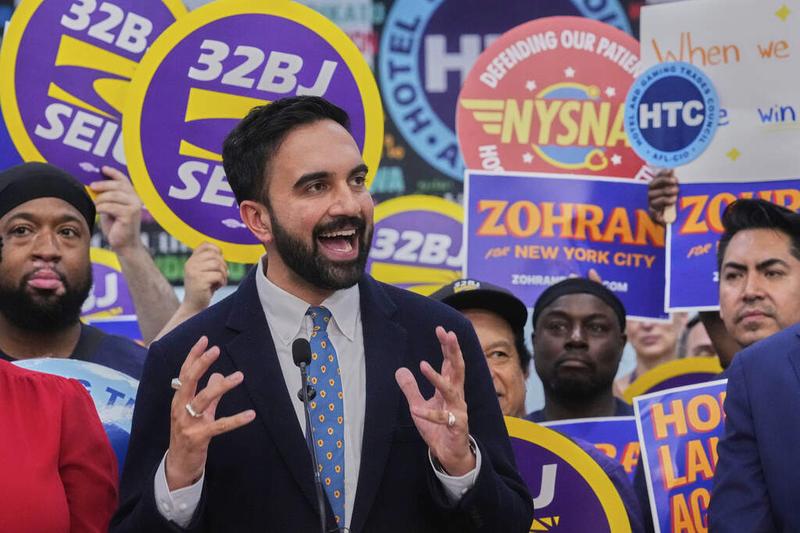
Brian Lehrer: Brian Lehrer on WNYC. With me now is Greg David, contributor to the news organization, THE CITY, covering fiscal and economic issues. He's also the director of the business and economics reporting program and Ravitch Fiscal Reporting Program at the Newmark Graduate School of Journalism at CUNY. He's got a new article out in THE CITY projecting some economic troubles awaiting mayor elect Mamdani called Mamdani's Next Battle: Attacking Inequality While Balancing Budgets. Hey, Greg, always good to have you. Welcome back to WNYC.
Greg David: Always good to be on, Brian.
Brian Lehrer: Is the bottom line, to start out with the bottom line, that the city government and the state government, having nothing to do with Mamdani, are facing likely budget deficits in the coming years?
Greg David: That's true, but there's an important part that we need to get to before we get there, and that's Wall Street is booming, and because it's booming, the state's problems will be a little less. Mamdani's problems with his first budget are going to be a lot less than anyone would have predicted two months ago. I assume that my first story, the one you referred to after the election, was going to be Mamdani faces a huge budget disaster in a budget he must present 30 days after taking office. Well, that's not going to happen and he has Wall Street to thank for it.
Brian Lehrer: Well, how tenuous is that? I follow the economic press to some degree, and there's a lot of speculation that we're in an AI bubble and some kind of correction or crash or big bubble bursting that would affect Wall Street may be coming.
Greg David: Well, Brian, I've just spent two weeks teaching that here at the J-School. Personally, I believe there's a big bubble coming, but it's not going to burst before the end of the year or early next year. You're right. It may not last very long, but at the moment, Wall Street is booming in large part because of AI, maybe mostly because of AI, and that always spells good things for New York. It spells two good things in particular. Comptroller Tom DiNapoli, in his major report last month said that Wall Street's on track to have record profits of more than $60 billion.
Well, when Wall Street has record profits, that means they're going to be record bonuses in February, and that's going to be a big boost to the economy. It's going to mean that Wall Street's going to throw off enough tax revenue to make the first few months of next year really good. Wall Street accounts for more than 20% of all state tax revenue, about 7% of all city tax revenue. For the first six months of the city's fiscal year, tax revenue collections were up 8% over a year ago. No, for last year. For the last fiscal year. Let me correct myself.
I couldn't get the numbers for the first six months of the city's fiscal year, but I think it's going to be really big. People are talking about a six to seven billion dollar budget deficit the new mayor is going to face. It's actually going to be more like two or three, maybe even one or two. That's going to make the first budget he proposes a lot easier.
Brian Lehrer: That's really interesting. As you talk about what Wall Street can do for the Mamdani agenda, I mean, if the mayor elect ran against anyone in the campaign and if anyone circled the wagons against him, it was some high profile Wall Street people, billionaires who poured money into the Andrew Cuomo and Eric Adams campaigns, but now some of those billionaires are also reaching out. Fortune magazine, and I mentioned this earlier in the show, but now we'll go into a little detail. Fortune magazine reports that Jamie Dimon, CEO of JPMorgan Chase, previously told Fortune that Mamdani was, "More Marxist than and socialist."
He added, "If he becomes mayor, I will call him and offer my help." Then we have Bill Ackman, the hedge fund manager who helped fund Mamdani's opponents. He's reached out. More explicitly, a reporter from the news site Zeteo asked Mamdani about a tweet Ackman sent offering to help. Here's the mayor elect's response.
Mamdani: Well, I appreciated Bill Ackman's tweet and the sentiment of it. I will continue to have conversations with anyone who is committed to the welfare of this city, the vitality of the city. Those are the conversations I will have over the next 57 days and beyond.
Brian Lehrer: Greg, what do you make of this stance post election between anti Mamdani billionaires who call him Marxist and all kinds of things, but are now offering to engage?
Greg David: First of all, they were outliers towards the election day. Yes, there were some real estate and Wall Street billionaires still funneling a lot of money, but most of the business leaders I talked to had moved on. They had recognized that Mamdani was going to win, and their job is to work with the new mayor. Their job is to help their companies thrive in New York City. I think that part was inevitable. James Whelan, the head of REBNY, had appeared at a [unintelligible 00:05:26] breakfast in October and made it pretty clear that he expected Mamdani to win, and it was his job to work with the new administration.
The press, particularly, of course, the national press, which understands actually very little about New York and the New York Post, focuses on these few very high profile people and don't really know the business leaders that make the city tick. They've been prepared to work with the new mayor for some time. Also, let's be frank, they need to. JPMorgan just opened a huge new multibillion dollar headquarters.
Dimon has no choice but to try to work with the new mayor. His investments in New York are enormous. He can't go to war with the new mayor. It would be counterproductive for the company he runs, and remember, CEO's number one obligation is to the companies they run. That's how you need to think about not only business and the new mayor, but national leaders and Trump.
Brian Lehrer: That's interesting about JPMorgan Chase opening a big new facility in New York because it cuts against one of the arguments that we've heard against electing Mamdani, and one of the concerns that some people still are articulating, including Democratic Congressman Tom Suozzi on this show on Monday, who would endorse Cuomo in the primary. He's still concerned that a lot of people are going to leave New York and take their potential--
Greg David: Oh, I'm so tired of this, Brian. I am so tired of this. The New York Post is going crazy on this subject. Look, first of all, a lot of the talk comes from real estate brokers, especially real estate brokers in Miami. I'll say publicly what I've always taught my students. On my list of the least reliable sources in the world, real estate brokers are number one. I wouldn't believe any of the talk coming out of Miami about everybody fleeing.
The person who I think knows the most about residential real estate in New York, Jonathan Miller, has been writing some really good blog posts about all the data shows that nobody is fleeing. There is some move to the suburbs, as there always is. Look, people are not going to move important operations, and frankly, they're not going to move themselves because of the election. They will move if economic and public safety and just the whole general tenor of New York changes dramatically. The election by itself does not do that.
Brian Lehrer: I might even go one step further and say the people, from what I read, who really have been leaving the city are the working class and middle class families with children who can't afford to live here, and that's exactly who Mamdani's policies are intended to address. We'll see if he's successful, but that's where the departure wave is, if it's anywhere. Is that consistent with what you see?
Greg David: There's a lot of evidence of that, but there is evidence that some very wealthy people are leaving. The reason that's important, by the way, is that the top 10% of New Yorkers, the top 1% of New Yorkers pay more than I think about half all the income tax New York state collects. A few people leaving from the very highest ranks of wealth in New York can make a big difference. That's why the concern focuses on that group.
Brian Lehrer: Listeners, anyone with a question for Greg David about the New York City economy, in particular, that mayor elect Zohran Mamdani will face once he takes office. 212-433-WNYC or anything related or any students of Greg David at the CUNY Graduate School of Journalism with a question you didn't get to ask in class. 212-433-WNYC, 212-433-9692. You can call, you can text. We're all students of Greg David now. Short term, not so bad. Longer term, tougher for Mamdani, and by extension, Hochul?
Greg David: much tougher. Let's talk about why it's going to be much tougher. For four years, the Adams administration has been proclaiming how great its stewardship of the economy has been. Record job totals, complete recovery from the pandemic. We've heard it over and over and over again. Indeed, my stories in the city are designed, I think, to try to puncture that which has become like a myth. First of all, New York City's recovery from the pandemic has lagged the rest of the country. The rest of the country is about 5% higher than the pre-pandemic record. We're a little more than 3% higher.
For the last two years, job growth in New York has been heavily based on low wage health care jobs, especially home health care. One, while we're glad to have all kinds of jobs, those are not the best jobs. Two, they're jobs paid by tax dollars. To count them as private sector jobs is not good. Three, it's pretty clear that the economy outside health care in New York City has stalled. No job growth, indeed, job losses so far this year. Our data is a little out of date because of the federal government shutdown, but we hope to update that. Yes, we're at a record number of jobs, but that is not the real story.
Secondly, the other thing that we really need to focus in on is the bifurcation of the city's economy. Great report by local economist, James Parrott, from the Center for New York City Affairs at the New School. Wage growth for the top 3% of earners in New York was a multiple of the wage growth elsewhere in the economy. These gains in wages accrued almost exclusively to the top. New York was the only one of the 10 largest cities in the country between 2019 and 2024 to see an increase in inequality.
Poverty in that period went down in the rest of the country or was flat. Poverty in New York City went up, including child poverty, and the cash public assistance rolls are at an all time high. Clearly, this is an economy that no one should be cheering from the rafters about. It's an economy with serious problems. If we have a recession, of course, and if there is an AI bubble or even if the AI spending can't offset the declines elsewhere in the economy, those problems could get worse.
Brian Lehrer: What are the underlying reasons as you see them for this increase in poverty in New York City and income and wealth inequality?
Greg David: What we know is that wages for the middle and low income wages did not keep up with inflation. We also know, I mean it was the central issue of the campaign, right? The affordability crisis, which is primarily for that group focused on housing and on childcare. Those are making matters worse. Look, the New York City economy is now driven by three primary sectors. Wall Street, tech, there are more jobs at tech companies than on Wall Street, and tourism.
Those first two industries wind up accruing gains to the people at the relatively top of the scale. We're seeing a lot of-- It's a long-term trend, decade long trend of middle wage jobs disappearing from New York. One of the sectors that has now recovered, excuse me, from the pandemic, is construction, which is a very important source of middle wage jobs in the city.
Brian Lehrer: A few more minutes with Greg David from the news organization THE CITY, and head of the business and economics reporting program, and Ravitch fiscal reporting program at the Newmark Graduate School of Journalism at CUNY. We're talking mostly about his new article in THE CITY projecting some economic troubles awaiting Mamdani eventually called Mamdani's Next Battle: Attacking Inequality While Balancing Budgets. Let's take a call. I think Joan in Manhattan keyed on what you said about how much of the tax base comes from the top 1%. Joan, you're on WNYC. Hello.
Joan: Yes, hi. I've been wondering this for a while. I'm always hearing that around the country, generally the top 1% pays 40% of the taxes, but nobody ever tells us how much of the income do they have. Do they have 40% or more of the income? That's one question. What percent of income do they have? The other thing is, when we talk about poverty, isn't it about time we recalibrated what we call poverty? As far as I know, we still consider a single person with an income above 11,000 not to be poor. That's less than $1,000 a month. How could you possibly live on that? Because if we looked at the reality of poverty, the rates are much higher than they're reported to be around the country. What do you think about that?
Brian Lehrer: Joan, bringing the data. Greg.
Greg David: I don't have the percent of income off the top of my head. I do know that Wall Street accounts for about-- what was the figure? I think it's in the mid-20s of all the income in the city. In that case, Wall Street is paying state income taxes in line with the amount of income people on Wall Street make, but let's be clear. New York has the highest marginal tax rate. New York City residents pay the highest marginal tax rate in the entire country. That means that a New York City resident making more than $2 million pays more than 65% of all their income in taxes. That's a pretty high number, highest in the country.
She's absolutely right about the poverty number, but we do have alternate statistics that the city publishes yearly about the number of people in poverty. I'm not sure about the $11,000 number, but we do have alternate statistics that track it more broadly. If you're looking at poverty around the whole country, you obviously have to use the same statistic for everywhere.
Brian Lehrer: Thank you for your call, Joan. Here's Paulette in Atlanta, one of those ex-New Yorkers who left the city. Paulette, you're on WNYC. Hi.
Paulette: Hi, good morning. Just wanted to call in to say I wish the mayor elect the best. I hope everything is successful when he becomes the mayor. I left New York because it was unaffordable in terms of rent. I could not afford it. Looking down the line in 10 years, I couldn't see how I would be able to continue to afford as rents went up each year, actually. I would come back to New York in a heartbeat if I could afford it. It is my wish that the new mayor could create a little village for us expatriates of New York to come and live. I would appreciate that. I ought to put that little idea in his head because there are many of us who would love to come back.
Brian Lehrer: Paulette, thank you very much. That was an interesting call, Greg, Paulette, representing the non billionaire exodus from New York over affordability.
Greg David: That's true. A lot of people have written a lot about the great Black exodus from New York, people moving back to the places they or their parents came from in the south, particularly if they were homeowners, because as neighborhoods gentrified, homeowners could really cash in and move back to the south where housing is much cheaper. I do want to introduce a dose of realism here. Nobody is talking about the rents going down. That's not going to happen. What we need to do is greatly slow the increases in rents. What we need to do to do that primarily is build a lot more housing.
The one thing I suggested to my editors that we should write, is that the one great legacy of Eric Adams might be reforms that will result in a lot more housing. That would be really good. There's the city of [unintelligible 00:19:13] there's rezonings. We just did two major rezonings in Queens. That might be the great accomplishment of the Adams administration.
Brian Lehrer: Ronan in Brooklyn, you're on WNYC with Greg David. Hi, Ronan.
Ronan: Hi there, Brian. Thank you so much for taking my call. Greg, I appreciate the point you just made about Adam's legacy on housing. I think you're spot on that [unintelligible 00:19:36] his best legacy. What I wanted to ask about was this article I saw yesterday in Gothamist about the skyrocketing cost of liability insurance for bars in New York City, which I think is relevant in that it impacts the ability of small businesses, which is our remaining source of middle class income for a lot of New Yorkers. I'm wondering if you think that an issue as niche as doubling liability insurance right now for bars in the city is going to attract the attention of the Mamdani administration, and even if it did, if there's anything he would be able to do about it.
Brian Lehrer: By the way, we have an article about this on Gothamist right now, but Greg, go ahead.
Greg David: There's nothing the city can do about it. Let's be clear. Only the state could act on insurance matters because the state is the regulator of insurance. Let me tell you, it's not just liability insurance for bars. I've done one major story about rent regulation. I'm working on another one I hope to publish next week. Insurance costs have soared for rent regulated housing in New York. It is a huge crushing burden on landlords. Uber and others are talking about the huge crushing burden of auto insurance on the cost of getting around.
Insurance costs have gone up dramatically and it's a huge problem. Business groups would tell you it's the fault of the Democrats in the legislature who are beholden to the trial lawyers making lawsuits both reasonable and flaky. They're very successful in New York. Others would counter that that's not true, but insurance across the board is a huge problem for people.
Brian Lehrer: As we start to run out of time, I'll note that there are going to be a lot of people trying to make it hard for Mamdani and hoping that he fails. Politico had a line this week. Moderate Democrats and Republicans across the country will be watching New York City closely for any slip ups they can use to write off the Democratic socialist experiment set to commence in the new year. As a last question for you out of that, looking at the Mamdani agenda, universal free childcare, free buses, building more affordable housing, opening city grocery stores, and then all of the budget constraints coming Mamdani's way from what you and others have been reporting on the structural pressures on the budget that are likely to come pretty quickly, is his plan to increase taxes on corporations and the wealthy, if that goes through, enough to make up for the losses and achieve this bold agenda.
Greg David: I don't think the math works. I just don't think the math works on almost any one of his proposals. I know they don't work on housing, which I've spent a lot of time on. I guess they work possibly on free buses. Universal childcare has got a price tag in the neighborhood of $6 billion. You can't introduce universal childcare in one year, right? You could play it out. Brian, you raised the issue of the statewide elections where Kathy Hochul is going to face a spirited challenge from the Republicans. I would be shocked if she agrees to a tax increase next year. I think it would be a very damaging issue for her reelection campaign, especially outside the city.
I don't think the new mayor wants a Republican governor in Albany, especially one whose vetoes might be able to be sustained in the state Senate. Very tricky politics to play next year and very tricky long-term budget math to make any of those promises come to fruition.
Brian Lehrer: Let me just give you one alternative scenario on the Hochul story. She's also going to face a spirited primary challenge apparently from her own lieutenant governor, Antonio Delgado. We saw how Mamdani just won. I realize that's New York City only, that's not the rest of the state, but there's also a lot of Republican anxiety around the country about things like loss of Medicaid, loss of SNAP benefits under the so-called one big beautiful bill. If this tax hike is only on people making a million dollars a year or more, and in fact, the way I've heard it, it's only on people in the city making a million dollars a year or more and only the wealthiest corporations, why would that be such a political vulnerability for Hochul against a Republican? Maybe it wouldn't.
Greg David: As I understand it, that's not true, Brian. As a matter of fact, the original proposal was a statewide increase with all the money coming to New York City. That is a political non-starter, and clearly what might have been proposed in the campaign, we'll have to see. I think tax increases are anathema outside the city to all kinds of people. I think they are particularly dangerous in the New York suburbs where people pay the highest property taxes in the country. Republican Blakeman won a decisive victory in Nassau County's county executive race. That used to be a Democratic county. You may be right. I may be right. Obviously the election will tell us, right?
Brian Lehrer: We will talk many times between now and then. Greg David, contributor covering fiscal and economic issues for the news organization THE CITY, and director of the Business and Economics Reporting Program, and Ravitch Fiscal Reporting Program at the Newmark Graduate School of Journalism at CUNY. Thank you very much for coming on as always.
Greg David: Thank you, Brian.
Copyright © 2025 New York Public Radio. All rights reserved. Visit our website terms of use at www.wnyc.org for further information.
New York Public Radio transcripts are created on a rush deadline, often by contractors. This text may not be in its final form and may be updated or revised in the future. Accuracy and availability may vary. The authoritative record of New York Public Radio’s programming is the audio record.