
Mamdani's Budget and Tax Hike Proposals
( Ed Reed / Mayoral Photo Office )
Title: Mamdani's Budget and Tax Hike Proposals [music]
Brian Lehrer: Brian Lehrer on WNYC. By the way, that Colbert typical TV ratings number I was looking for, my team looked it up, and he averages about 2.6 million total viewers a night. Nothing against Colbert by any means, but it is an indication of with 330 million Americans, how far network television in general has fallen. If not even 3 million people a night are watching a prime late-night talk show. The 7 million-plus views on YouTube trounces that, doubles it, shows you where the media is going, where the media is. Just for some context on that.
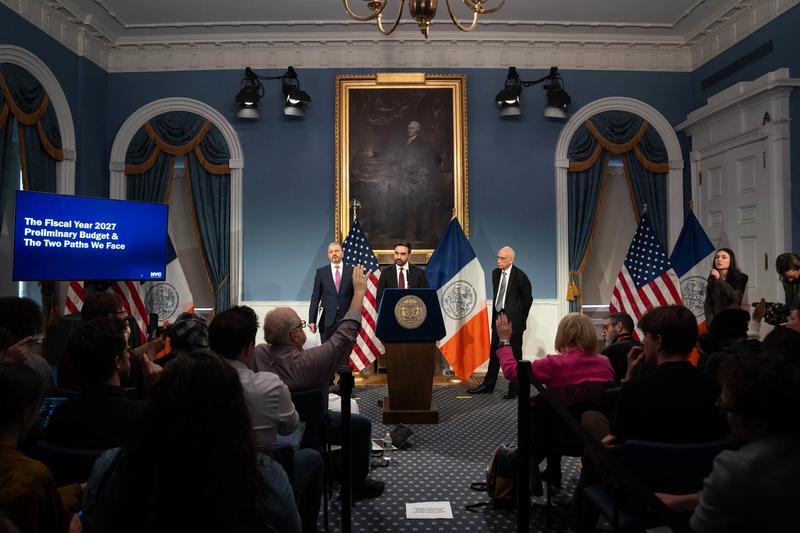
On Tuesday, Mayor Mamdani released his first annual budget proposal. Budget, of course, is policy. How much will New York City or any place spend on education, on housing, on law enforcement, on childcare, and more? Who will pay how much in taxes to fund those spending and policy priorities? In Mamdani's case, you know some of the prelude to this, he campaigned on fostering more equality in the city through universal childcare, free city buses, new housing programs, also on taxing the wealthiest corporations and people with million-dollar-a-year incomes as individuals several percentage points more to help pay for those things.
He inherited a multi-billion dollar budget deficit for the coming fiscal year that by law he will have to close before adding anything new by raising revenue, dipping into the city's reserves, or finding savings in existing programs. Every path comes with a price and political controversies. What does the new mayor prioritize? Is it much different from past mayors in this budget? Why is he suddenly talking about the possibility of a property tax increase? That's not the progressive tax the rich proposal from his campaign.
I should say reactions to this draft are coming in from advocates for education, for bikes and mass transit, for housing the homeless, for the NYPD, and more also from the budget watchdog groups and of course the City Council, which negotiates with the mayor on the budget and gets to vote on it before the new fiscal year actually begins on July 1st. Speaker Julie Menin has already made some skeptical pronouncements.
With us now to go over some of the big items in both the taxing and spending sides of the ledger, and to help hear from some of you is Greg David, contributor covering fiscal and economic issues for the news organization The City and director of the business and economics reporting program and the Ravitch Fiscal Reporting Program at the Newmark Graduate School of Journalism at CUNY. His new article tries to get to the truth on one of the central tax the rich debates. The article is simply called Would Raising Taxes on the Richest New Yorkers Drive Them Away. Hey Greg, always good to have you. Welcome back to WNYC.
Greg David: Always good to be here, especially on such a controversial and hot-button issue.
Brian Lehrer: Listeners, we invite you to help us report this story. 212-433-WNYC. If you work for or benefit from any kind of city spending, make your case as advocates from all the sectors have begun to do. Is the mayor spending or cutting too much or too little, or at least proposing to? 212-433-WNYC. Same with the tax rate questions. What would it mean to you if property taxes go up? That's the big new question since Tuesday's budget address.
Or personal or corporate taxes if you're in that million dollars or more of personal income or corporate profits category, would you leave or not bring new jobs here? 212-433-WNYC, call or text 212-433-9692. Greg, let me start with a very general question and then we'll get to some budget specifics and then your take on the will they leave debate. The very general question is Mamdani campaigned on being a new kind of mayor. Has he proposed a new kind of budget in any big way?
Greg David: Yes, he has. What he's done is he's corrected the great fiscal error of the Adams admin, which was every year, Eric Adams underestimated key spending drivers, NYPD overtime, especially the new housing voucher program. In essence, every year Adams proposed a fake budget. The reason he got away with it is that revenues kept exceeding expectations for most of his tenure. It was really bad budgeting.
People like the Citizens Budget Commission called him out, the IBO. God knows I wrote four or five stories over the last couple years pointing out how ridiculous and harmful such practices were. That's the good part. This is a realistic budget in most ways, and the estimates of spending in the coming year are about what people think makes sense.
Brian Lehrer: The last Adams budget was $116 billion. For the current fiscal year, I'm seeing the number 127 billion for this Mamdani proposal. That would be an increase of around 9%, which is more than inflation. Is that unusual for a year-to-year change?
Greg David: Oh, it's huge. But what they're pointing out is that the increased spending is actually like less than a billion dollars. What he's doing is correcting the errors. He's realistically saying what the city's going to spend, and he's getting praise from that, even from people who are mad about a lot of other things he did, whether it's State Comptroller Tom DiNapoli, City Comptroller Mark Levine, or the Citizens Budget Commission, they've all said this is good.
Brian Lehrer: What's the deficit piece of this? Mamdani didn't create the deficit, we should say he inherited, but why are you laughing?
Greg David: I'm laughing because in part I got it wrong too, in a way. Look, in December, in a major report, then Comptroller Brad Lander issued his big econ and fiscal update. I paid attention to the econ thing and didn't look at the fiscal thing very closely. He had projected a $12 billion gap for the current fiscal year, which ends June 30th, to the next one, but no one picked up on it.
Levine comes into office as the new Comptroller and issues a big press conference saying, "Oh my God, it's a $12 billion gap." The next day, Mamdani says, "Oh God, this is terrible, and it's all Eric Adams fault." There were a lot of questions at the time. Kathy Hochul, at the time, the governor said, "The gap isn't that big." Lo and behold, last week up in Albany or the week before, Mamdani says, "Oh yeah, it's only $7 billion."
The reason is, is that Wall Street is booming, and when Wall Street is booming, so do tax revenues, especially for the state but also for the city. Tax revenues are really robust for the state. Mamdani said, "Oh, we're getting all this new money from Wall Street, so the budget gap is only $7 billion." $7 billion over two years is a problem, but it's not like $12 billion. We routinely close budget gaps in the neighborhood of $3 to $4 billion. Is it a problem? Yes, but there's a lot of posturing going on here, or maybe political maneuvering over it.
Brian Lehrer: As we talk about the Mamdani budget proposal with Greg David from the news organization The City and the Newmark Graduate School of Journalism at CUNY, and with some of you coming up at 212-433-WNYC, call or text. Let's do a couple of specifics, and then we'll get into the will they leave if you raise taxes debate and your analysis of that in your article. The biggest piece of the city budget is the public school system, more than a third of all city spending last time I looked.
I see on the education news site Chalkbeat that the mayor's budget does commit to spending more to meet the state's smaller class size law. That would probably be around $600 million of new spending, they say, to cover thousands more teachers. This has been controversial. I think both other mayoral candidates in the general election wanted to just delay implementation of that mandate. That 600 more that they'll need to find right there, is that a big deal decision, and was it a surprise in any way from Mamdani?
Greg David: No, I don't think it's a surprise, but it's a big deal decision. The class size mandate's going to be very costly. In typical fashion, the legislature imposed it without providing any money to fund it. It's going to be a major burden in the coming years, and the city's going to have to meet it and whatever way possible. I think that it's not a surprise. He doesn't want to anger the teachers union, so he'll start out here.
If we do face a fiscal crisis, which is key to whether the economy and Wall Street falter, I think there will be a lot of pressure to delay the requirements, but it's not here yet. The economy is stalled, but not collapsing. Wall Street's booming. That's why I think he's going to go ahead and try to do what's required at the moment to meet that requirement.
Brian Lehrer: How about law enforcement? I see the right is hitting Mayor Mamdani for canceling an additional 5,000 police officers that Mayor Adams wanted to add. Mamdani is not defunding the police. That budget is about consistent with what Adams had been spending. He's just not extra funding them.
Greg David: That's right. That's what he said in the campaign. He's just doing what he told voters he was going to do. He doesn't see a need for more police, but he wants to keep it at the current levels. By the way, that's not so easy because the city's actually had trouble recruiting enough police to fill the number. Jessica Tisch, the police commissioner, would prefer more cops, but obviously, this is something at least for now she says she can live with.
Brian Lehrer: My colleagues at Gothamist note that funding for the Department of Community Safety, Mamdani's signature proposal to dispatch mental health teams to some 911 calls instead of police or with police, is notably absent from the preliminary plan. Why is that? He campaigned so centrally on Department of Community Safety?
Greg David: I think we'll need to find out. Is it part of a deal with Tish about what's going to happen, or is it that he just have to make choices? The other key choice that he made is he's not expanding the city's housing voucher program, which he said he would do during the campaign. This program's now approaching $2 billion I think. It's become very costly.
People have been raising concerns about it. He said during the campaign he would increase it according to a law passed by the City Council. Now he's pulled back on that. That's another choice he's made. The city is under fiscal constraints. It's not in a disaster, but it is under fiscal constraints and he needs to make choices, and this is a sign of the choices he's making.
Brian Lehrer: Now let's go on to taxes. The biggest storyline in much of the press after Tuesday's budget proposal speech was that the mayor put a 9.5% property tax increase on the table if he doesn't get the tax hike that he wants from the state on the wealthiest corporations and individuals. Property tax is the one that the city can raise on its own. Can you explain how the property tax hike would work and who it would hurt?
Greg David: What I want to tell you, first of all is I was so shocked by him doing this. I've been talking to my budget sources about how Mamdani would play his first budget, and the basic consensus we had was he'd proposed some draconian cuts. None of us thought that he would propose a property tax increase. Why? First of all, the city's property tax system is completely unfair. It's like the worst thing we have.
It taxes homeowners of color more than white homeowners in areas that are gentrifying, and their property values are going up. It taxes rental buildings extraordinarily heavily and condos and co-ops extraordinarily lightly. He's admitted this. He knows this. He says he wants to reform the tax. He's proposing to increase the worst tax we have, which, by the way, is politically very sensitive. He's going to do this, this is what really shocked me, before he proposes reforms which in themselves will be incredibly controversial because any reform will raise taxes on homeowners and co-ops and condos to give relief to rental buildings. I don't know. That's the [crosstalk].
Brian Lehrer: If rental buildings are affected too, the landlords who own those buildings, would the mayor who ran on freezing the rent wind up indirectly causing an increase in the rent for non-stabilized apartments?
Brian Lehrer: Oh, of course he would. I've read a whole story about how the freeze is going to raise market-rate rents anyway. Look, we don't want to get into the rent thing, I think in depth, but there are two areas of rent-regulated buildings that are in financial crisis. Older buildings that are entirely rent-regulated, especially in the Bronx and Upper Manhattan, and all affordable projects built with city subsidies that don't pay property taxes. Both those groups are heading for financial crisis. He wants to freeze their rents, and on the first group, he now wants to raise their taxes? Oh my God.
Brian Lehrer: Now we get to the main event in your article, which is about raising those other kinds of taxes. It's called Would Raising Taxes on the Richest New Yorkers Drive Them Away? We did two segments last week on this very question. First, we had Steve Fulop, the new president of the Partnership for New York City, which represents the biggest businesses in the city, Wall street and real estate and tech companies, and others. Here's a sound bite from his appearance regarding the corporate tax hike proposal.
Steven Fulop: Currently, when you layer on all of the different taxes for corporations in New York, you are at 17%, which is marginally more than New Jersey already. If you replicate the tax rate for New Jersey, you would move New York City to 22%, versus New Jersey staying at 11%. All I said was that, you know, at some point, you hit a tripwire, and people do make a decision to leave. If your taxes are 100% higher than you could have them a mile away, people are going to make that decision. It's not overnight, but some people make that decision, and it will be bad for New York.
Brian Lehrer: Steve Fulop, who represents a lot of those companies who do make $1 million or more a year in profit in the city. The next day, we got the other side from the leaders of the left-leaning Working Families Party. Here's their co-director, Jasmine Gripper.
Jasmine Gripper: You pay New York's corporate tax rate, not because you are based in New York. You pay New York's corporate tax rate if you do business in New York. Businesses like Amazon aren't leaving New York. They're not going to leave our market. It is too big of a sales market for them to go. Amazon can absolutely afford to pay more in corporate taxes to New York State, and they are not going anywhere.
Being really clear that a corporate tax has nothing to do where an organization or business is headquartered, it has all to do with if they produce, if they do business in New York, and they earn a million dollars in profit or more. That's only taxing the ultra-wealthy corporations and the ones who won't leave New York because they know they want to be here, this market is strong, and they want to do business here, and we have no threat of them going anywhere.
Brian Lehrer: There are two competing takes. Does your article answer who's more right?
Greg David: You know what, I got a lot of criticism for the story because people have said to me, but you didn't come down on one side or the other. Let's try to parse this, but it's pretty subtle so the details are really important here. Steve Fulop is absolutely right on the numbers. When Mamdani said he wanted to raise the New York State tax rate to New Jersey, he was ignoring the fact that New York City businesses pay the city and MTA taxes.
The Working Family Parties is actually right that the corporate tax rate is levied only on your sales and revenue in New York. Moving to New Jersey doesn't reduce your taxes on that, but and here's the most important, but it's a signal. It's a signal to corporations about what kind of environment they're in. In addition to that, and this is a more sophisticated point made by the Citizens Budget Commission, when a company decides where to locate, it's not only deciding on its own bottom line, it's deciding on its employees and it's deciding on what they think about taxes, et cetera.
The income tax in New York State is very high and very progressive, especially if you make a lot of money. The "wealthy" are the ones who pay virtually all of New York State's incredible income tax revenue. The bottom 50% of taxpayers pay something like 0.2% of all the income tax collected. That means all the income tax is being paid by the top 50% and the millionaires pay like 40% of all the state income tax.
New York State has the fifth most progressive tax system in the country. Will people leave if Mamdani were to win his tax increase, which would increase the income tax by 2 percentage points and increase the corporate tax rate? No, of course not. A lot of people are not going to pick up tomorrow and leave, but over time, is it a factor? One of the ways that people argue this is that you have to look at these two situations.
New York has more millionaires than it has ever had before, but its share of millionaires in the country continues to decline. On the same token, Wall Street employment in New York City is near at or near a record, but the City's percentage of Wall street jobs in the country has never been lower. Are more millionaires being produced elsewhere because taxes in New York State are so high? Are Wall Street firms clearly expanding elsewhere because of taxes in New York are so high? As a single reason, I don't think so, but as a contributing reason, I think there might be some credence there.
Brian Lehrer: Warren in Manhattan, you're on WNYC. Hello, Warren.
Warren: Hi. I'm a man about town. I'm actually on 79th and the 79th, and I was just on a lighter note, and everything that you're saying, I think it's wonderful much, but I was reading Robert Frost last night and he said that don't think good about communism was that no one ever asks you to mind your own business.
Brian Lehrer: Warren, I'm going to have to get you to the point. I think you told our screener about the million dollar income New Yorkers, if they want to leave, they should leave. Is that what you said? Like good riddance?
Warren: That's the siren.
Brian Lehrer: No, I know. I was just asking you about your comment. All right, Warren in Manhattan proving that he really is on the streets of New York, but what about the comment we thought he was going to make if they want to leave, they should leave, but based on what you just described and the potential threat ultimately to the city's tax base from that, do the rich have everybody else over a barrel because all the other states and cities can have a race to the bottom for taxes?
Greg David: There is a race -- it's not a race to the bottom, but there's states that obviously are thriving that have no income tax. Look, if the rich leave New York and we don't need the-- if the 20 people making 25 to 50 million dollars a year leave, the budget deficits will be enormous, enormous. You just have to look at the stats about the income tax. I got to look. Millionaires paid 41% of all the income taxes in New York State. Who's going to pay them if they leave? To be frank, it's just a ridiculous idea.
Brian Lehrer: Yet many people would say this is a scare tactic, and it's not really that the city is going to wind up with less tax revenue overall, not more, by raising taxes on the wealthiest New Yorkers, and that trickle-down economics going back to the Reagan administration at the national level has never proved to be right.
Greg David: I agree with you about the national level, but that's not necessarily the case about the local level. The reason we know that is because they pay such a huge share of the taxes. Now, I don't think they're leaving either exactly. I don't think 100,000 millionaires are going to leave if the tax increase goes through.
Not to recognize that New York state's tax system is heavily dependent on a relatively small number of wealthy taxpayers is just to close your eyes to the facts. Most of the people on the progressive side who want the income tax agree with that, they just say that New York's attractiveness is so great that they won't leave, and the added tax burden won't make a difference. That's the way the issue needs to be considered.
Brian Lehrer: This budget debate is just getting started. The mayor and city council have until July 1st to work it out for the next fiscal year. Greg David reports on business and economics as a contributor to the news organization The City. He directs the business and economics reporting program and the Ravitch Fiscal Reporting Program at the Newmark Graduate School of Journalism at CUNY. Thanks for joining us, Greg.
Greg David: My pleasure.
Copyright © 2026 New York Public Radio. All rights reserved. Visit our website terms of use at www.wnyc.org for further information.
New York Public Radio transcripts are created on a rush deadline, often by contractors. This text may not be in its final form and may be updated or revised in the future. Accuracy and availability may vary. The authoritative record of New York Public Radio’s programming is the audio record.
