Mamdani, Cuomo and Sliwa Mayoral Debate Recap
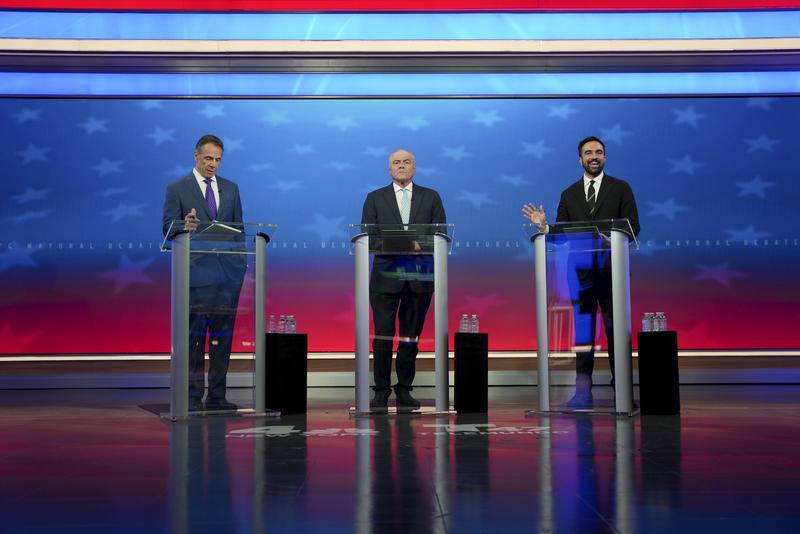
( Angelina Katsanis, Pool / Getty Images )
Title: Mamdani, Cuomo, and Sliwa Mayoral Debate Recap
[MUSIC]
Brian: It's The Brian Lehrer Show on WNYC. Good morning, everyone. We'll begin today with last night's debate. Last night, the three candidates for mayor of New York met on stage in their first televised debate. The second and final debate will be next Wednesday on NY1 and here on WNYC, when I will be one of the moderators. The sponsors last night were WNBC-TV, Channel 4, Telemundo, and Politico. We have Jeff Coltin from Politico to do some analysis with us. He wrote up five takeaways from the debate for Politico New York's morning newsletter. Jeff, thanks for coming on.
Jeff: My pleasure. That was, wow, two hours jam-packed last night. They seem to have covered everything, but I'll do my best to summarize.
Brian: We're going to play a few clips from a few of the topics because I agree with you. They touched on so many things and fairly briefly each time, but we're going to try to focus in on some of these issues. A major topic was how each would deal with President Trump, and one of your five takeaways in your article was on that. Here's how part of that section started with part of Zohran Mamdani's answer to what he would say to Trump in his first phone call with him as mayor.
Zohran Mamdani: What I tell the president is if he ever wants to come for New Yorkers in the way that he has been, he's going to have to get through me as the next mayor of the city.
Brian: Now, here's some of Andrew Cuomo's response about his first call as mayor with Trump.
Andrew Cuomo: I would say to the president in the first conversation, "Look, we have had many, many battles. We fought together every day during COVID. The battles were blood, and I'd like to avoid them. If you come after New York, you know what I'm going to do, you know it's going to be ugly, and you know my chances are almost 50/50, even though you're the president."
Brian: In a way, they were similar, Mamdani and Cuomo there, saying, "Trump, you're going to have to go through me if you want to hurt our city." Then came an interesting exchange between Curtis Sliwa and Mamdani. Sliwa speaks first.
Curtis Sliwa: What I would do is sit and negotiate. I would say, "Look, Mr. President, we need that Gateway tunnel. It moves millions of people from Washington, DC to Boston, but take away the Q train project." We don't need those three stations going from 96th Street to 125th. It's not a necessity. Sit with the president and whoever he delegates, and try to negotiate. If you try to get tough with Trump, the only people who are going to suffer from that are the people of New York.
David Ushery: Mr. Sliwa, thank you. Brief response, Mr. Mamdani.
Zohran Mamdani: Mr. Trump is already suspending infrastructure grants to this city, and he's doing it in a blatant act of political retribution. What it requires is leadership that will stand up to him. I disagree with Mr. Sliwa. We do need to extend the 2nd Avenue subway to 125th Street. It was a promise made to Harlemites decades ago. It's time to actually fulfill it.
David Ushery: Thank you, Mr. Mamdani.
Brian: The candidates on dealing with Trump. Jeff Coltin is with us from Politico, one of the sponsors last night. Politico's Sally Goldenberg was one of the questioners. Jeff, you wrote up that exchange, or at least that exchange was part of one of your topics, "Curtis talks up Trump." Why that?
Jeff: That's right. The Sliwa and Trump relationship is just so interesting because he has to be one of the most prominent Republicans in the entire country, in the way that he is the nominee for mayor of New York City, who has a horrible relationship with Trump. Trump was demeaning to him, saying that he wants to bring cats into Gracie Mansion.
Of course, Sliwa, as the Republican nominee, he knows that he can't dismiss Trump back. He needs those Trump-friendly votes if he has any chance to win. It's kind of a tense relationship. Sliwa is actually, I think he has put it, taking the high road on Trump, and he's not insulting him back. He's saying that he will work with him and he'll work with him in a different and better way than Mamdani or Cuomo would.
Brian: Politically, you wrote that that stance by Sliwa serves multiple purposes, especially because, as you put it, Cuomo is trying to steal his Republican supporters?
Jeff: Yes, that's exactly right. The shift from Cuomo in the Democratic primary, he's only, of course, going for Democratic voters here in the general election. His only path to victory is to win over Republicans and win over independents. We're seeing a new Cuomo, and he's still standing up to Trump. He's still saying very firmly that I will oppose Trump, but this relationship has just changed. Even the subtleties of his answers on Trump, it's a little more respecting Trump, I guess, as a powerful figure than it was in the primary, where it was a little more dismissive, I've noticed.
Brian: Mamdani, he had to defend against the idea that Trump would come down harder on the city if he's the mayor. He also went after Cuomo as having some of the same donors as Trump and being like him in other ways, right?
Jeff: That's right. Mamdani, he can't deny that Trump has specifically singled him out and said, "I will cut off funds to New York if he is the mayor." I think Mamdani has a fair defense, which is, number one, Trump is already cutting off funds to New York, and number two, Trump is often all bark and no bite, or at least maybe some bark and less bite. That is to say, just because Trump says he's going to cut off federal funds doesn't mean he legally can.
Mamdani has thought a lot about how to defend against that charge, and that's what he was saying last night. I think it's actually helpful for Mamdani the more Trump talks about him, because overall, this is an anti-Trump city, Democrats and independents. Trump, he polls very poorly in New York. Anytime Trump is talking about Mamdani, criticizing him, I think that's generally helpful to Zohran Mamdani in this election.
Brian: Of course, don't tell the people of Chicago and LA that Trump is all bark and no bite, but we'll deal with that another day. Let's go next to the topic of management experience. Cuomo hits Mamdani, always with Mamdani's lack of management experience. Mamdani counters that Cuomo messed things up in so many ways as governor, so why credit him with that experience? Again, we're going to play a clip of Sliwa, who was trying again to distinguish himself from Cuomo.
Curtis Sliwa: Thank God I'm not a professional politician. We have the architect and we have the apprentice of no cash bail, which has been a disaster. We have the architect and the apprentice here of raise the age. My own son was almost killed because of that in a gang attack. We have the architect and we have the apprentice of closed Rikers Island, which would just release criminals in the street. Thank God I'm not a professional politician because they have helped create this crime crisis in the city that we face.
Melissa Russo: Thank you, Mr. Sliwa.
Brian: Obviously, trying to distinguish himself from both Mamdani and Cuomo there. If people are rating zingers from a debate, that was one that Sliwa kept coming back to, running to the right by calling Cuomo the architect and Mamdani the apprentice of liberal policies that Sliwa says have increased crime.
Jeff: That's right. He used that a couple of times, the architect and the apprentice, or the father and the apprentice. That's a smart move by Sliwa. There's a decent population here that doesn't like politicians, and saying, "I'm not a politician," that was a winning formula for Donald Trump in his first election, and Sliwa is going to try. It's obviously a longer shot for him, but I can understand that.
It is also notable that Sliwa was going after Andrew Cuomo. There were some people thinking or maybe hoping that Sliwa would only keep his fire on Zohran Mamdani and that Sliwa and Cuomo would team up against the frontrunner. There was some of that. Curtis definitely took shots at Mamdani, but there was a lot of criticism of Andrew Cuomo, too. I know that Cuomo and his supporters were not happy about that. They're really trying to get Sliwa either out of the race or just completely minimize him so he's no longer a factor. Cuomo wants a one-on-one race against Mamdani, and we didn't see that last night. It was not one-on-one. Sliwa was a factor. He was involved.
Brian: That actually helps Mamdani, as we've discussed so many times, at least in theory, if Cuomo and Sliwa are meaningfully splitting the non-Mamdani vote. Another thing about last night's debate was that Cuomo kept coming back to Mamdani's positions about the Middle East. Now, this didn't work in the primary, where Cuomo had made it even more of a central theme, and obviously, he lost by a lot. Almost regardless of the topic, he kept coming back to it one way or another last night. Here are Mamdani's two responses to the two things Cuomo kept accusing him of: not recognizing Israel as a Jewish state and allegedly not saying Hamas should lay down their arms. Here's Mamdani's two responses. First, on the Hamas laying down their arms.
Zohran Mamdani: Of course, I believe that they should lay down their arms. I'm proud to be one of the first elected officials in the state who called for a ceasefire. Calling for a ceasefire means seizing fire. That means all parties have to cease fire and put down their weapons.
Brian: Now, Mamdani on Israel.
Zohran Mamdani: There have been a number of absolutely unfounded lies that have been said by Andrew Cuomo, just like a moment to address them directly. I've had time and again that I recognize Israel's right to exist. I've said that I will not recognize any state where I said that I will not--
Andrew Cuomo: As a Jewish state.
Zohran Mamdani: If I would be allowed to finish. That I would not recognize any state's right to exist with a system of hierarchy on the basis of race or religion. I have made that very clear. Part of that is because I'm an American who believes in the importance of equal rights being enshrined in every single country, whether we're speaking about Israel or whether we're speaking about Saudi Arabia.
Brian: Jeff, that obviously remains a hot button for some Jewish voters on one side, for voters horrified by the war in Gaza on another side. We'll see if it plays any differently in the general election than the primary, but just politically speaking, Cuomo must be hoping that it will, because even though it was an ineffective assault on Mamdani in the primary, he tried to make that topic number one last night, to my ear, no matter what the question was.
Jeff: Absolutely. That's because it's such an emotional topic. Talking about Israel and Palestine, that is something that is the number one issue for a population of New York. There are voters who think that is the biggest, strongest argument against Mamdani. Cuomo was really looking for a big swing last night. He was looking to cost Mamdani support, and apparently, he was thinking that's the issue. As you mentioned, the problem with that is that he's already hammered Mamdani on that. Mamdani absolutely has a portion of voters who care about Israel who will simply never vote for him.
I'm sure it can be helpful to hammer on that and to remind voters of it, but you're right. I just don't know if he's picking up support on that issue. Mamdani, he absolutely was ready for these questions. It was an opportunity to clean up one of his answers on the Fox News interview the night before, or the day before, where he dodged this question about Hamas laying down their arms. He was ready for that one. He had an answer this time. This time around, Republicans couldn't use it against him. I didn't see any headlines. He seemed to have quieted that answer.
Brian: On rent and housing costs, Mamdani was asked how he could propose freezing the rent and rent-stabilized apartments for his full first term when he can't know the tenant and landlord expense data in advance, and he said this.
Zohran Mamdani: I've seen the data year after year of the fact that salaries are stagnating, costs are up. New Yorkers can't actually afford their apartments. I will also take action to actually ensure that the landlords of those buildings can better handle their costs by taking on their insurance, their property taxes, and their water bills.
Brian: Here's part of Cuomo's response.
Andrew Cuomo: Freeze the rent only postpones the rent because then you have to have an increase to cover the costs. Otherwise, the building is going to go bankrupt. It does nothing for the majority of renters who aren't in these rent-stabilized units. There's nothing for NYCHA, there's nothing for homeowners, there's nothing for people in Black, brown communities who are getting priced out. I was the HUD secretary. I built affordable housing all across this nation. I built affordable housing in this city when I was in my 20s.
Brian: Cuomo also proposed what he called "Zohran's Law" so that future rent-stabilized tenants would have a means test for getting one of those apartments. Mamdani had a zinger prepared in response to that.
Zohran Mamdani: You've heard it from Andrew Cuomo that the number one crisis in this city, the housing crisis, the answer is to evict my wife and I. He thinks you address this crisis by unleashing my landlord's ability to raise my rent. If you think that the problem in this city is that my rent is too low, vote for him. If you know the problem in this city is that your rent is too high, vote for me.
Brian: The moderators did clarify after it that Cuomo's proposal would not have Mamdani evicted because of the ratio of his income to his rent. It would apply to future rent-stabilized tenants. Curtis Sliwa also weighed in on housing with a different take, emphasizing some different things.
Curtis Sliwa: First off, we have 6,000 available apartments that a mayor controls in NYCHA, and they've been empty for years. That you address number one. Then we talk about senior citizens who are living here. My whole goal is to improve and not to move. I'm concerned about the seniors, especially those that own homes. If they're 65 and make less than $250,000, no property tax because the property tax is way too high. We need to cut it in half to keep people who are here.
Then in terms of rentals, we have affordable housing that can be built in these huge skyscrapers. You see them all throughout Manhattan and in Northern Brooklyn and in Long Island City, which we have 25 Empire State buildings full of commercial space that will never be occupied for office space. We should be converting them into affordable apartments. They're in dense areas. The infrastructure can support it. I'm the only candidate here who's against the City of Yes that would destroy residential neighborhoods.
Brian: Some clips from last night's debate from Channel 4, Telemundo, and Politico. Politico's Jeff Coltin is with us. He wrote a five-takeaways article this morning. Later in the show, by the way, we'll compare their answers on free buses in particular and have two guests with a debate on that. Jeff, your article is more on the politics, and centrally, you said Cuomo went in looking for a breakout moment, as we discussed a little already, and we'll see if he succeeded.
I don't think there are any memorable debate moments from him jumping on social media, from what I can see this morning. I kind of have a different theory of what Cuomo went in to do last night. If he did well, it was by looking competent and consistent to voters who might be prone to seeing him that way. Your article calls him "clinical." I think he was trying to be the very experienced, moderate kind of, rolling his eyes at Sliwa to his political right and Mamdani to his political left kind of candidate. Maybe that was more his strategy than even the breakout moment.
Jeff: I think you're completely right. That is obviously Cuomo's strength is that he does have decades of experience, and he was leaning into that. Now, the problem is that there was a poll that came out yesterday, a Fox News poll, that showed him down 24 points. I just don't think that Cuomo emphasizing his competence can make up that kind of double-digit gap in the polls unless we also see a Zohran Mamdani collapse or Mamdani huge mistakes. Cuomo simply didn't force anything last night.
I think if he wants to win, he needed to see Mamdani just really make a mistake. Although Cuomo took some swings, I just don't think there were any home runs. I think he got some hits on some of Mamdani's weaknesses, but again, this race has been pretty consistent since the primary with Mamdani, with a really steady and solid lead. There's another chance with another debate next week on Wednesday, but this debate, I would be quite surprised if we saw a lot of movement in the polls.
Brian: We talked about a way that Cuomo's presence might hurt Cuomo because they would split a non-Mamdani vote. There's at least, theoretically, a way that it could help Cuomo because Cuomo would look like the centrist moderate guy oh, that Mamdani, and oh, that's Sliwa, and that would draw a lot of votes. So far, I didn't see that Fox News poll, but it's Fox News poll, and that's pretty stark on how it's going the wrong way. I guess we'll see if the debate changes anything. One more of your takeaways was about Mamdani's visual, that he smiled the whole time.
Jeff: Yes, Mamdani, he was smooth, he was calm and cool and collected, while Cuomo was a little more stern, and then Sliwa had his typical frenetic energy at times. Now, a lot of people don't like that about Mamdani. They feel like he's a used car salesman. I've seen some criticism of that. He was almost too smooth, too smiley. Frankly, I think that's only the people that are already predisposed to not like Mamdani. I think, overall, he just seemed like a cool as a cucumber up on that stage.
I think that's important for him because, again, if one of Cuomo's main attacks on him is youth and inexperience, and up there, he looked sharp, he just seemed calm. He had the straight answers, and that only leaves criticism on policy. Of course, there's definitely room to criticize Mamdani on policy. We saw a lot of that last night, but the problem is that Mamdani's policies are popular. Everything he's proposing polls really well. If he is able to minimize or diminish the criticisms on his demeanor and his youth and inexperience, then he's left with a winning policy message basically.
Brian: His demeanor, the smile could definitely play to his advantage, too, I would think. You say used car salesman to some of his detractors. I was thinking maybe important to voters who might just be starting to pay attention, not the people who listen to the show a lot, but a lot of people who haven't been really tuned in to the political campaign, but might've been watching on mass distribution Channel 4 last night and who have only seen Mamdani portrayed by his critics as some kind of scary radical, and there he is smiling and looking friendly. Again, we'll see how it plays, but I could see it working to his advantage as well as you posit, potentially to his disadvantage.
All right. Debate number one in the books. Credit to the moderators, David Ushery and Melissa Russo from Channel 4, Rosarina Bretón of Telemundo, and Sally Goldenberg of Politico. Errol Louis, Katie Honan, and I will try to pick up the baton in good faith next Wednesday night. Jeff Coltin from Politico, thanks for coming on.
Jeff: We will all be watching and listening next week. Thank you so much for having me on the show.
Copyright © 2025 New York Public Radio. All rights reserved. Visit our website terms of use at www.wnyc.org for further information.
New York Public Radio transcripts are created on a rush deadline, often by contractors. This text may not be in its final form and may be updated or revised in the future. Accuracy and availability may vary. The authoritative record of New York Public Radio’s programming is the audio record.