
Making Sense of the New Nutrition Guidelines
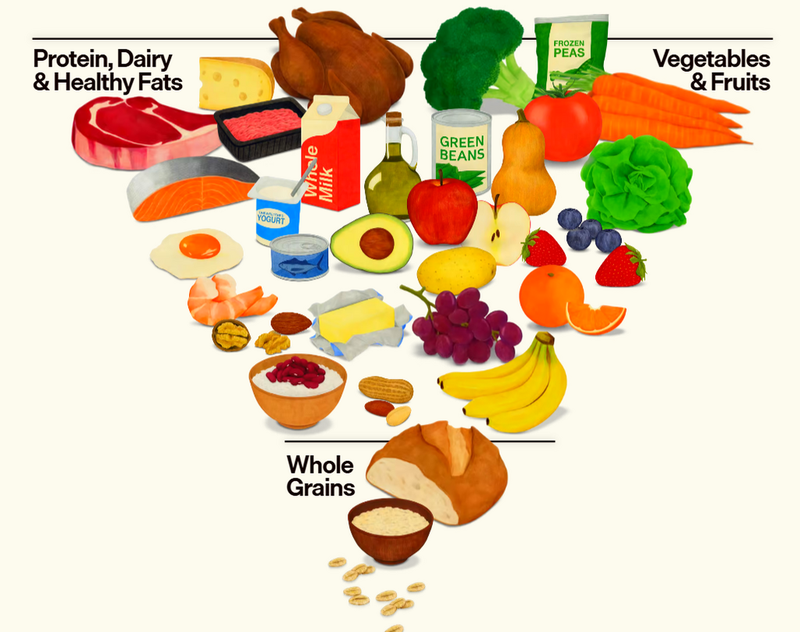
( Department of Health and Human Services, CC0, via / Wikimedia Commons )
[music]
Brian Lehrer: Brian Lehrer on WNYC. We haven't talked here yet about the new dietary guidelines issued last week by Health and Human Services Secretary RFK Jr. with everything else that's been going on. Now we'll try to answer some questions you may have about some of the changes, certainly regarding saturated fats and whole grains. Those have been in the headlines. Also some of these questions, why were the previous recommended limits of alcohol removed? Is butter a special case from a fats and cardiovascular health standpoint? What's really new here regarding highly processed foods? Is the recommendation regarding children and added sugar laughably unrealistic? Maybe you've not heard what's in there. What's the role of of the corporate food industry in these new guidelines? Could it just be that some industries gained an advantage over others and more?
On that corporate food industry question, listen to how RFK Jr. framed that as he announced how dramatic he considers these changes to be.
Robert F. Kennedy Jr.: The most significant reset of federal nutrition policy in history. These guidelines replace corporate driven assumptions with common sense goals and gold standard scientific integrity. These new guidelines will revolutionize our nation's food culture and make America healthier again. For decades, Americans have grown sicker while health care costs have soared. The reason is clear. The hard truth is that our government has been lying to us to protect corporate profit-taking.
Brian Lehrer: That's some of the politics, or at least the politics as Kennedy framed them. With us now to bring the science is Deirdre Tobias, assistant professor and epidemiologist at the Brigham and Women's Hospital in Boston, and assistant professor in the Department of Nutrition at the Harvard T.H. Chan School of Public Health. Dr. Tobias, we appreciate you coming on with us. Welcome to WNYC.
Dr. Deirdre Tobias: Thank you for having me. Good morning.
Brian Lehrer: Can we do some basics first? What do we mean when we use the term food pyramid?
Dr. Deirdre Tobias: Yes, a good question. The original food pyramid was the icon that was used for about a decade back in the '90s to represent an infographic to the public what the dietary guidelines for Americans were at that time, so having enough fruits, vegetables. You'll remember the foundation or base of the pyramid were loaves of bread and shafts of wheat imagery. At the tippy top, there was a little triangle at the top of the pyramid that said use fats and oils sparingly. That's the iconic original pyramid that I think a lot of folks perhaps recall or think of when they hear dietary guidelines.
Brian Lehrer: Yes, and some people don't even like the visual of this new pyramid. The designer Debbie Millman wrote that the new graphic "feels less like a contemporary public health tool and more like a collection of emoji-inspired illustrations or clip art from a 1950s health pamphlet. I don't know if that matters because that's maybe not the way people encounter it generally, but do you have any opinion about that?
Dr. Deirdre Tobias: Trying to distill everything that we've learned about nutrition and health over the last couple of decades into a single graphic, I'm sure is a challenge. Even when it's what to eat and how to think of your shopping basket or your food and dinner plates, I think it's really hard to convey without words and just imagery, but I don't know. Yes, I think to your point, there's probably not a lot of folks who see it on a daily basis or use it as their guide through the grocery aisles. It is what it is.
Brian Lehrer: We'll move beyond that.
Dr. Deirdre Tobias: Yes.
Brian Lehrer: You said in a Harvard website article that you appreciated that the new quantitative recommendations are actually quite consistent with the government's previous dietary guidelines on recommended servings for the foundational groups of fruits, vegetables, whole grains, dairy, and oil. Since we keep hearing about what's changed, maybe it's worth saying first before we dig into the changes, what's remaining the same.
Dr. Deirdre Tobias: Right. I was surprised and delighted to see that there were a lot of important recommendations from the past guidelines carried forward. This matters a lot because of the role that dietary guidelines play in our public health policy around nutrition. If you think of our school lunches, foods that are fed to folks in other federal environments, like our prisons, they are required to meet certain standards that are based on what the Dietary Guidelines for Americans outline.
The servings per day and the actual quantities that you can find in some of the science and the grids and tables that most people don't really pay too much attention to, that will be what is used going forward to shape policies less so some of the rhetoric or imagery or press releases around promoting the guidelines.
The quantities in the table themselves are nearly identical to past DGA, and that's ultimately what will have an impact and continue to hopefully improve nutrition quality in the US. Vegetables, fruit, those are for a 2,000 calorie diet, three servings per day, two servings per day. Dairy and fortified soy would be three servings a day. Protein foods, around three to four servings per day. All of those amounts are consistent with past recommendations.
There are also limits for certain nutrients of public health concern. Despite what we may have heard over the last several days about saturated fats, the new dietary guidelines have the exact same limit as past guidelines for the last several decades with 10% or less of calories from saturated fat. Also another limit for added sugars from past DGA of 10% calories from added sugars. Then sodium recommendation, those limits are also the same.
Brian Lehrer: In fact, let me play a clip of RFK Jr. speaking to CBS News, arguing what you just said, that his saturated fat recommendation isn't as different as critics are making it out to be. Listen.
Robert F. Kennedy Jr.: Just so that you know, there is a cap on saturated fats at 10% of the diet. It's pretty low. It's a lot of people thought it should be much, much higher.
Brian Lehrer: Is he right about 10% not changing? If that's true, 10% of calories coming from saturated fat, what's the big controversy?
Dr. Deirdre Tobias: This limit of 10% of calories, that refers to your overall diet throughout the course of the day. It's difficult for folks to even think of a meal and how much saturated fat is, let alone how much you consume over the course of the day. The limit is not a very practical one, but it is important again for some of these food programs and services that are federally supported.
The limit has not changed. The evidence behind saturated fat with more intake being related to heart disease is among the most solid pieces of evidence in the entire upside-down pyramid, and all the infographics before it. I'm delighted that that was retained. The evidence would be very difficult to refute or to overturn without or for that one specific component.
The difficulty though would be those day-to-day choices around some of the other components at the food level that have been promoted this past week, so just switching to full fat dairy and choosing animal sources of protein within those protein foods that people consume throughout the day. Those two swaps or choices promoting full fat dairy and animal sources of meat make it realistically very difficult to stay within that saturated fat limit. Already in the US, we consume on average more than that limit. Ten percent being the cut point, on average, we get 12%, 13% calories from saturated fat in America.
Anything to lower that limit, foods that would lower that would be lower fat dairy and switching to leaner or plant sources of proteins. The foods being promoted aren't entirely consistent with folks needing to actually consume a diet that stays within that.
Brian Lehrer: Listeners, if you have comments or questions on the new RFK Jr. dietary guidelines, Deirdre Tobias, epidemiologist at the Brigham and Women's Hospital in Boston and assistant professor in the Department of Nutrition at Harvard T.H. Chan School of Public Health, is happy to take them. Questions or comments, 212-433-WNYC, 212-433-9692. You can call or you can text.
Let's keep going on the saturated fats and the science that you stated is, that there's a lot of good evidence for. Here is Secretary Kennedy again on CBS on the basic assertion that he's making about some older science getting the health risks of saturated fats wrong.
Robert F. Kennedy Jr.: There is no good evidence that saturated fats drive cardiac disease. That is a dogma that was based on 1960 study that has been completely debunked.
Brian Lehrer: Can you lay out for us some of the history of different studies on that question and feel free to take a few minutes because this fats versus carbs debate is not at all new. A lot of the listeners know that, and feel free to get specific about some of the variables or strengths and weaknesses of different studies or what study debunked what previous study in any direction. Don't worry that our audience can't handle some wonky details and some uncertainty. They can.
Dr. Deirdre Tobias: That sounds like amazing scientific freedom to go off into like real nerd land here. I'll try to just keep it high level though. The context of what this clip you just played, I'm not really sure. I hadn't heard it, but I have heard folks refer to some of the early research conducted by an investigator and a clinician named Ancel Keys, as something that has been debunked, or on the other end of the spectrum, foundational to the subsequent research on saturated fat.
As a scientist today, I think that was a historic or grandfather-of-nutrition-science type study, but I wouldn't consider it to be the basis of what we know today. It certainly helped shape some of the landscape of early research for cardiovascular disease. Understanding that there are lifestyle factors that seem to be driving at that point in time in the mid-20th century rises in heart disease risk around the world.
Diet emerged as a consistent factor among all these lifestyle components that were considered. Total fat was one component that I think was what led to some of the early food pyramid and dietary guideline recommendations for reducing or low fat type diets. It was partly due to some of those research findings by Ancel Keys, and then also just other experimental evidence that fat as a molecule, as a nutrient, has more calories per gram than carbohydrates or protein does.
If we have this emerging obesity epidemic, perhaps one way to curb that is to eat the same foods but with less fat in them. Scientifically, that may have made sense mathematically, but did not seem to play out in reality. That evidence emerged through the '90s and 2000s around total fat, where it was acknowledged that that low fat dogma did get it wrong, that there are plenty healthy fats we do need to be eating, like avocados and nuts and seeds, and eliminating those for the sake of being low fat was actually detrimental to health.
The saturated fat component of this total fat follows a different story in the science. That history of total fat and Ancel Keys, and cardiovascular disease and our low fat era that steered us in the wrong direction sometimes gets conflated or misused, misapplied to the saturated fat narrative. Saturated fat, on the other hand, was consistently replicated for raising our bad cholesterol levels and being related to heart attack and cardiovascular disease deaths.
That is not a US political or US-based dogma. That's internationally acknowledged. Dietary guidelines around the world have recommendations to reduce saturated fat below 10% of calories, many even lower than that for the science that is incredibly robust, pointing its relationship with cardiovascular disease.
One thing we also acknowledged and noted in the saturated fat science along the way was the importance of what you replace your calories with. If you're reducing foods that have saturated fat in them, or opting for versions of those foods that have less saturated fat, like skim milk or plant proteins instead of animal proteins, replacing those calories with healthier options also matters. When you swap refined grains, so those are your processed snack foods, if you compare the health effects of those with foods that are higher in saturated fat, there doesn't seem to be much of a difference overall. That's because both are inherently poor for health in different ways.
When we compare foods higher in saturated fat to those higher in mono and polyunsaturated fats, so foods rich in these good fats, these unsaturated fats, that's where it's very clear consistently how beneficial these other healthy fats are and harmful saturated fats are. You can think of walking down the supermarket aisle, if you skip the fatty meats and the full fat dairy, but then you fill your cart with a bunch of other snack foods and junk foods and processed foods, you're not having an overall health win. That's what the data and the epidemiology, as well as the trials, have consistently shown.
Brian Lehrer: With respect to cardiovascular risks, so we may think in an old sense of whole milk, et cetera, saturated fats being related to cardiovascular disease, but not so much that bag of chips, but they are.
Dr. Deirdre Tobias: Right, so likely in different ways. We know some of the processed chips and cookies and crackers, those are related to obesity and diabetes and cardiovascular disease. Saturated fat is in a lot of those products. I do agree with the strong messaging for real food, because we get not just saturated fat, but sodium and added sugar and refined grains for most of our food supply from these junk foods. Avoiding those will have a multitude of health benefits.
Brian Lehrer: Getting back to the dietary guidelines, how do they square the fact that the inverted pyramid graphic or the guidelines generally emphasize consumption of animal protein? The graphic emphasizes consumption of animal protein. While the written guidelines still recommend limiting saturated fat intake to 10% or less of total calories, wouldn't the only way to take in that little saturated fat while eating lots of animal protein be if you only consume non-fat or low fat milk and dairy, plus maybe fish and skinless poultry? The graphic clearly shows steak, chopped meat, cheese and whole milk at the top of the pyramid, but how do you limit saturated fat intake to 10% of total calories if you're eating that stuff a lot?
Dr. Deirdre Tobias: To be blunt, I'm not really sure how that's possible. One of the exercises, as a member of the Dietary Guidelines Scientific Advisory Committee that worked on the recommendations and the science for a couple of years leading up to all of this, one of our tools is verifying what's going on behind the scene with all of the nutrients when we put together different amounts of food groups.
If we recommend this many fruits, as many vegetables, whole grains, four to five servings of protein foods, whatever it might be, we're able to then crunch those numbers to ensure that that recommendation does keep Americans below limits for saturated fat and sugar and sodium, and that we aren't falling short on key nutrients. If we reduce the amount of beans, are we still getting enough fiber, for example?
All of those checks are incredibly important because you don't want to open up any unintended health consequences of increasing one food at the expense of others. This sort of exercise, I'm not sure whether that was conducted with the new recommendations, but just the back-of-the-envelope calculations for how much saturated fat. If we're trying to stay below 20 grams per day or so, that's achieved pretty quickly through full fat milk and cheese and meats, before we even start talking about the main sources of saturated fat in our diet these days, which typically are these processed foods, and the processed versions of cheeses and meats, like frozen pizzas and hamburgers and whatnot.
Brian Lehrer: We'll continue in a minute, and we'll start taking your phone calls and texts. Helen in Forest Hills, we see you. You're going to be up first with your question about whole grains. As we continue with Deirdre Tobias, epidemiologist at the Brigham and Women's Hospital in Boston, and assistant professor in the Department of Nutrition at the T.H. Chan School of Public Health at Harvard.
We're also going to touch on some things other than the saturated fat issue that's been so much in the news. I want to touch on alcohol. I want to touch on children and added sugar. If you haven't heard this, you won't believe at what age they say you should wait until to introduce any added sugar to a child's diet.
Also the role of the corporate food industry. If RFK is saying he's out to banish corporate influence in the dietary guidelines, why does it seem like so many industries, or a couple of industries in particular win so big here? A lot to still cover as we continue with Dr. Tobias and you at 212-433-WNYC.
[music]
Brian Lehrer on WNYC as we continue on the official dietary guidelines from the federal government. They put them out every five years. These are the ones that for 2025 to 2030 as released by RFK Jr. the other day. Helen in Forest Hills. You're on WNYC. Hello, Helen.
Helen: Yes, hello. Thank you, Brian, and thank you so much for your show. I love it. I listen to it all the time. This is great.
Brian Lehrer: Thank you.
Helen: I was just thinking about the visual impact of this pyramid thing, which doesn't make much sense to me, but why have whole grains do you think been demoted to the very, very bottom of it? That's always been a fundamental thing in my life. I see a difference by eating whole grain breads and that sort of thing. I just wondered why is it on the very bottom? That seems ridiculous to me.
Brian Lehrer: Thank you. Dr. Tobias?
Dr. Deirdre Tobias: Yes, that's a great question. I'm not really sure other than the grains brick of the old school pyramid was at the bottom. Maybe that's how they flipped it, or I'm not really sure. I don't think the actual quantities of foods correspond to the size of their space in their pyramid is one thing I've also noted. Maybe it's a bit more about for the marketing component of the guidelines than the actual recommendations.
The recommendations for whole grains this time around are about the same as they were in previous years. Previously, it was consume at least three servings or more per day of whole grains, and this time, it's two to four for around 2,000 calorie diet. It's on par. I will note actually the previous guidelines emphasized or had I guess total grains as one of its food groups. Within that, that includes refined grains and whole grains. Refined grains that would be promoted would be things that are sort of unsweetened cereals and oatmeals and things along those lines that are not in their whole grain form, but also breads which typically are not 100% whole grain anyway and maybe more like 50-50 whole and refined grains.
The new dietary guidelines did eliminate the recognition of refined grains in their new outline of how many servings per day. Refined grains are no longer in the actual guidelines grid themselves. I think that is a public health win if we do eat fewer refined grains. However, it does seem that might have been to accommodate the more calories that we would get from full fat dairy and protein. Again, swapping saturated fat foods for refined grains, I'm not really sure if that net effect would be a public health benefit.
The infographic for whole grains being minimized, I'm not entirely clear on what that's trying to emphasize, because as you mentioned, we do get a lot of healthy vitamins and minerals and fiber from whole grains. It's actually a significant source of our protein as well, about 15% of our protein. The protein food group is what actually gives us less than half of our total protein intake throughout the day. It's important to recognize all these other groups do contribute a lot to our overall protein and healthy fats and vitamins and minerals.
Brian Lehrer: Lisanna writes, "I wanted to ask if there was any information regarding how will the new guidelines be implemented in public school meals?"
Dr. Deirdre Tobias: That is a great question, and I'm not really sure. To be honest, I think that time will tell. There's always a lag of when the guidelines are put forth to when policies start implementing what they emphasize. That implementation is not what the guidelines themselves necessarily outline. That's what policymakers and the agencies down the road will get to work on. We'll see what that does.
I think dietary guidelines are one tool that public health nutrition has, so there are many others out there as well. Policies around food advertising, for example, to children, or having certain ingredients banned or minimized like added sodium and whatnot. Those are all strategies that don't necessarily have to stem from the dietary guidelines themselves. For school meals, I think that is one of the programs that will have to go back and see where it needs to better align. My guess is that milk will be one that is readily implemented. Schools may typically have low fat or skim milk options, and time will tell if those will still be at the table for kids.
Brian Lehrer: No more chocolate milk?
Dr. Deirdre Tobias: Yes. I don't know. I think chocolate milk might also be a thing of the past. You mentioned added sugars before the break, and that would certainly be one source of added sugars that could be reduced. I think that would be a good thing. I think added sugars may be there to help kids consume milk to begin with. Even though there's no benefit and potentially even harm of the added sugars, my understanding is the rationale for allowing it was so that kids would actually drink the milk to begin with because plain milk is not as palatable for many of them.
Brian Lehrer: I guess this is where I can ask about the recommendation regarding children and added sugar, and whether it's laughably unrealistic or whether you care as a public health epidemiologist if it's unrealistic, and maybe it's a goal to shoot for. It's not to introduce added sugars at all to a child's diet until the age of 10.
Dr. Deirdre Tobias: Right. That's the new age, I guess, limit or recommendation for added sugars. That's 10% limit. [crosstalk]
Brian Lehrer: It used to be two, right? It used to be two.
Dr. Deirdre Tobias: Yes.
Brian Lehrer: Age two, you can introduce some.
Dr. Deirdre Tobias: Yes. Before the age of two, there was no need or room for added sugars in the diet. I think it would be very difficult for parents to find foods without added sugars. The implementation and what happens next, time will tell. I don't think folks have historically changed their diet based on recommendations.
It is worth noting that overall in the US, the average American diet is very, very far from what the recommendations have been for the last several decades. There's always room for improvement. Whether the limit changes or the recommendations get stricter or more lenient, that doesn't typically translate into behaviors or the types of diets we're eating.
I will say for some additives, like sugar, industry can respond pretty quickly with things like artificially sweetened options. You can have the same yogurt that's now sugar free. That can be marketed as healthy now because it doesn't have sugar, but it might be laden with some of these artificial sweeteners.
There are some things that we'll need to keep an eye on. Again, these sort of unintended consequences of either vague language or villainizing something without really thinking through what the options might end up being in the marketplace. As an epidemiology, I definitely will be closely watching how this evolves.
Brian Lehrer: Yes. It could have a downside effect of making parents feel more guilty when it's hard to keep all added sugars out of their young kids diets because they'll get them outside. Then how much can I police that? Maybe this would be a good thing in terms of the school lunches because there would be less put in there for kids. V in Huntington is going to get to the alcohol question that I wanted to raise. V, you're on WNYC. Hello.
V: Hey, thanks for having me on. Yes, I know I've heard some discussion about some controversy regarding whether or not alcohol is absolutely not safe in any quantity. I've heard that many of the studies are backed by effectively the modern-day temperance movement. I think the company's name is Movendi. I was just wondering if the guest had anything to say about that.
Brian Lehrer: Thank you. Do I see correctly that the recommended alcohol limits were removed? There are no recommended limits on alcohol consumption in these dietary guidelines, or correct me if I'm seeing that wrong.
Dr. Deirdre Tobias: You're correct. Previously it was one to two alcoholic beverages per day as a limit should you choose to drink. The recommendations weren't that if you don't want to drink or you're a non-drinker, you should start, but if you do consume alcohol to limit it to one to two servings per day.
The language this time around removed that quantitative limit, so it's unclear if there is a limit where one should stop or what, but the language is just drink less. Again, if you are a heavy drinker, that could still be well above the one to two recommended drinks per day of past guidelines. It is vague, and the language around it may not be all that practical for users to understand exactly how much they should be consuming.
Brian Lehrer: Well, can you bring the science on that, as far as you understand it, in brief, because I thought studies keep coming out about the extent of the dangers of drinking even a little, or is that a misimpression as they're removing these official recommendations for any limits on alcohol?
Dr. Deirdre Tobias: Right. The Dietary Guidelines Committee that I was a part of the past few years did not review the science on alcohol for the first time in several rounds. The reason for this was the government had reviewers that specifically looked at alcohol that were separate. There were two separate reviews that were commissioned to better understand the health effects of alcohol, and that would sort of be merged in with our report on overall diet to inform the guidelines.
The reports that were generated by other groups around alcohol did recognize this growing body of evidence that even moderate drinking is related to certain types of cancer and other health concerns. Previously, it was well understood that above moderate or excessive drinking was a consistent risk factor for all-cause mortality for accidents. It was leading cause of death in younger folks, and leading cause of cancers and other health outcomes and liver diseases in older folks. This moderate range had been debated. What is the actual limit or what is healthy in any amount?
The last couple of years, there have been reviews in addition to what the US government commissioned, calling out that it seems there are certain cancer types, like breast cancer, that increase at any amount of alcohol intake, and that really no amount would be considered "safe". It was expected that that could be stronger language this time around because of that evidence for the dietary guidelines. Rather than keeping the limit or reducing the limit to a lower amount of intake, the quantity was removed altogether, and there's this language about drink less.
It's not really clear what science that's reflecting, or if it's just acknowledging, we don't really know. I'm not sure. That's the difference this time around. The science, as I understand it, is fairly consistent in showing the relationship between alcohol intake and cancer. It does get difficult when you really want to zoom in and say, okay, but what about half a serving a day or twice per week? The data just can't get that precise many times to be able to get much more granularity than, well, what about light to moderate? Even though from a public health perspective, that might be what we want to know. Sometimes the evidence just really can't get that precise to come up with a limit.
Brian Lehrer: Last question, corporate influence. We played the clip at the beginning where Kennedy said he's trying to save, I'm paraphrasing here, but he's trying to save our diets from the influence of Big Food and how they've taken over the policy decisions in the federal government. He said his panel would have no conflicts of interest.
A New York Times article points out that three of the nine members have received grants or done consulting work for the National Cattlemen's Beef Association. One of those also received a research grant from and serves as an advisor to the National Pork Board. At least three members, including the same ones I just referenced, have financial ties to dairy industry organizations. Another is a co-creator of a high protein meal replacement product. Do you see corporate influence in this, or just RFK Jr.'s belief system and interpretation of the science.
Dr. Deirdre Tobias: Yes, so there's always this pause between every five years when the scientists develop their report. They hand it over to their federal colleagues who then make the glossy DGA, Dietary Guidelines for Americans, that everybody then sees. That translation happens in a little bit more of a black box. Over the past several decades, the extent to which there may be lobbying or other influences that impact what is finally in the Dietary Guidelines, I think has really varied from year to year.
This time around, I think there's a lot of uncertainty in the science that this translation tried to also integrate more of. There was an additional round of scientific review that happened, that tried to address what they felt were shortcomings of our scientific report. I'm not familiar with the process and there's limited information that I can find about who led that or what standards for scientific rigor they may have had.
That component as a scientist is a bit concerning, but in terms of conflicts of interest, and these other nutrition scientists that have weighed in to provide sort of new reviews for the latest guidelines, I think that is concerning, and it is, I think, particularly prevalent in the nutrition science field where funding in general is so low.
If you're not going to fund scientists from, for example, the NIH, then many times there is this sort of void or where research needs to get done, and the only stakeholders that have an interest in funding it would be those who also stand to make a profit. That's not the way it should be, but it is where a very low and limited amount of funding for nutrition science in the US has left us.
I think one immediate response would be if we have sort of central NIH funding that can tackle so many of these really important public health issues around nutrition and obesity and chronic disease, then all of these other industry players will have no reason to be pitching in with scientific funding, because we do have evidence that that conflict of interest can generate biased results, not in nutrition fields alone, in many scientific fields. The way to prevent that is to have the NIH take a stronger stance on providing research dollars to get answers that everybody can feel confident about and have rigor and transparency, and limited conflicts of interest involved in.
Brian Lehrer: Deirdre Tobias, epidemiologist at the Brigham and Women's Hospital in Boston, and assistant professor in the Department of Nutrition at the T.H. Chan School of Public Health at Harvard. We really appreciate all the time and information that you gave us today. Thank you for bringing the science.
Dr. Deirdre Tobias: You're so welcome, and fantastic questions from you all. Thank you so much.
Brian Lehrer: Thanks again.
Copyright © 2026 New York Public Radio. All rights reserved. Visit our website terms of use at www.wnyc.org for further information.
New York Public Radio transcripts are created on a rush deadline, often by contractors. This text may not be in its final form and may be updated or revised in the future. Accuracy and availability may vary. The authoritative record of New York Public Radio’s programming is the audio record.