
'Last Mile' Deliveries and Other City News
[music]
Brian Lehrer: Brian Lehrer on WNYC. Now, we'll talk about a bill in the New York City Council that would regulate last-mile delivery companies, those subcontractors that Amazon and other retail companies use to get packages to your door. Supporters of the proposed legislation say workers employed by these subcontractors are being pushed into dangerous conditions by unrealistic quotas and that the streets are getting less safe as a result.
They also say that Amazon has structured things specifically so it doesn't have to answer for any of it. It's called the Delivery Protection Act. It would require those operators to be licensed by the city, meet basic safety and labor standards, and hold parent companies responsible when things go wrong, rather than letting them hide behind the subcontracting arrangement. Besides the city council member, the Teamsters Union, which represents Amazon employees, is very behind this bill.
Council Member Tiffany Cabán of Queens District 22, that's Astoria, Jackson Heights, East Elmhurst, Woodside, Rikers Island, is the lead sponsor. We'll talk to her about what she's proposing. We'll also spend a few minutes talking about some other issues in local politics, including some thoughts from her about Mayor Zohran Mamdani's first 100 days in office. Council Member, welcome back to WNYC.
Council Member Tiffany Cabán: Thanks for having me. Always great.
Brian Lehrer: Listeners, we want to hear from you. Help us report the core story here. If you drive for a last-mile delivery subcontractor, we especially want your voice in this conversation. What are conditions actually like for you in that job? Do you have quotas? Do you feel protected? What changes would you like to see to the system that you work inside of? 212-433-WNYC, or anyone else may call, anyone from the Amazon corporate hierarchy. Mr. Bezos, you can call in, or anybody else.
Council Member Tiffany Cabán: [laughs]
Brian Lehrer: 212-433-WNYC, 433-9692, call or text. Council Member, let's start with the basic problem you're trying to solve. When you order something from Amazon or sometimes other companies, who actually delivers it?
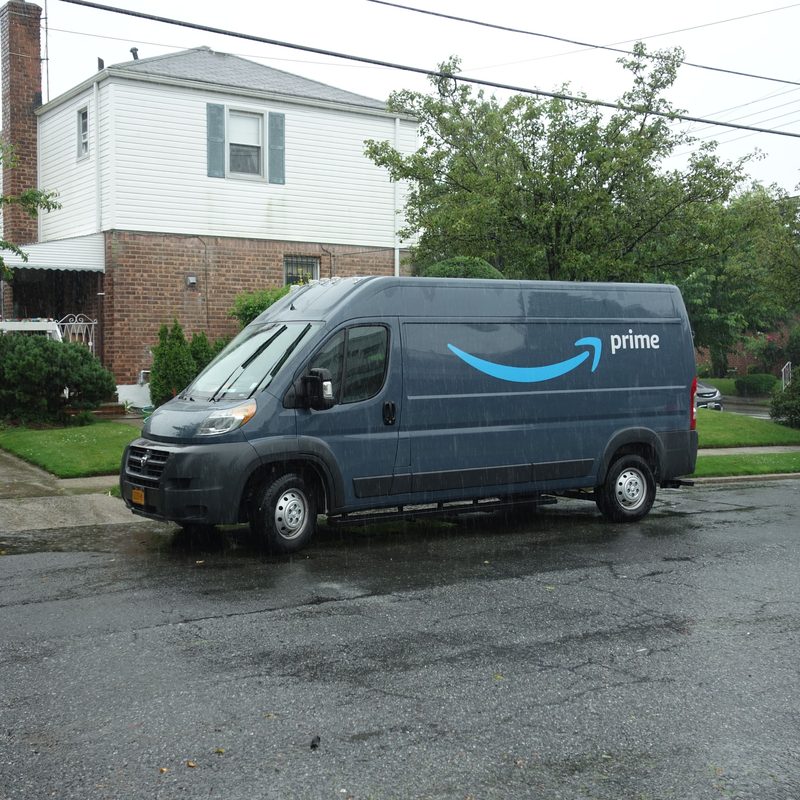
Council Member Tiffany Cabán: Yes, so you mentioned Amazon, but the industry is basically controlled by three big companies. 90% is Amazon, UPS, FedEx, 10% are some smaller companies. Using that Amazon example, you might have a driver that's wearing an Amazon vest, driving an Amazon van, delivering an Amazon package, who ultimately does not technically work for Amazon, despite the fact that they're setting the routes, the quotas, and really dictating the behavior on the job.
When things go wrong because of that behavior that's being set down through Amazon policy and orders, then they say, "Well, you can't hold us accountable." What we're seeing or what we're trying to solve for is, first and foremost, a public safety issue. This is an industry that is growing exponentially, and it's virtually unregulated. We're seeing three million packages being delivered every single day just in New York City. We're anticipating a billion this year.
What that's come along with is a 137% increase in truck-related crashes near last-mile facilities. It's also coming along with an injury rate, an employee injury rate that's three times the national average for private employers. It is an unsafe, exploitative industry. In order to make it safer for everybody, for people who are navigating our streets, for people who are the workers delivering the package, we have to get to the root. Right now, we can't because of the shell, the subcontracting model, where they put all the liability on these small DSPs and leave them holding the bag. They can just cut them off whenever they see fit.
Brian Lehrer: I sometimes see unmarked cars, just what look like plain, individually owned cars, not labeled Amazon or any other company, park on the block where my building and other buildings are. Somebody comes out of the car and is delivering some packages to the lobbies. Is that sometimes an Amazon deliverer or deliverer for other companies that they have famous names, but the cars aren't marked?
Council Member Tiffany Cabán: Yes, so are you talking about cars or vans? Because if you're seeing personal-looking vehicles, that is the Amazon Flex model. That operates, and it's much, much smaller than the subset of workers that we're talking about. That operates more like a gig model, and so does not fall under this bill.
Brian Lehrer: I see, but these subcontractors that Amazon calls "delivery service partners," that's what allows Amazon to say, "Not our problem when something goes wrong." Is that basically the issue?
Council Member Tiffany Cabán: Yes, so I'm going to lay it out for you, right? It's the key to this exploitative industry. The vast majority of Amazon packages, for example, using this easy example, are the delivery service providers. These facilities, they churn through working-class New Yorkers, injuring them, pushing them beyond what any workers should face just to enrich people like Jeff Bezos, who, "If you want to call my guy, just give us a call. We'd love to talk to you."
This model, it exploits these DSP owners because I-- actually, there's a really disturbing report that was in Motherboard about the toll that this model has taken on DSP owners that bears out the exploitation. Companies like Amazon, they displace all of their insurance, the repair costs, the debt, et cetera, onto these smaller companies. It allows them, the parent company, to reap maximum profits while letting the owners of these subcontractors shoulder the risks.
We've heard stories of people who started these DSPs, thinking it would be an opportunity to become entrepreneurs. As soon as something goes sideways, Amazon cuts off the contract and leaves the owner saddled with debt, putting workers out of a job. If the workers decide that they want to organize at a DSP and unionize, Amazon pretty much immediately cuts the contract with that DSP.
We heard, and we just recently had the bill heard in the city council. We heard from a former DSP owner, this guy named David, who went out of business. Well, he closed his business. He didn't sell it. He closed it because he said, "This is completely unsustainable. It was either choose to stay profitable, or make my workers unsafe." He couldn't do both. He said, "Well, I'm not going to do this." The only people this model really works for are the executives of parent companies like Amazon.
Brian Lehrer: Why would their workers not be safe? Is it because of what your press release calls unrealistic delivery quotas?
Council Member Tiffany Cabán: Absolutely. Like I said, and this is coming into the pandemic, the way that consumers buy products has just really shifted. I think at the hearing, we heard that one in every three people in New York get a delivery daily. Ultimately, the last-mile delivery facility, that's the last stop before that package gets from the person you bought it from to your door. The quotas are getting higher and higher and higher.
When you see these vans parked in the middle of the street or in a bike lane or blocking a hydrant, those are unsafe practices that you're being shepherded into them because of these high quotas. You're supposed to get 30 minutes for lunch and two 15-minute breaks. In order to make your quota, you end up skipping those breaks. We've heard horrific stories of Amazon workers urinating in bottles to make their quotas. It's a model that incentivizes a race to the bottom.
That's where you see the increase in crashes. We're also seeing a proliferation of pollution in certain areas. We want these employers to be good partners to our community and to make sure that we're keeping people safe. If they don't reach the quota and if they refuse to engage in these unsafe practices, well, the next day, they might not have a route there for them. It's really a matter of survival for these drivers. They're forced to make these impossible decisions.
Brian Lehrer: I think John in Westfield is going to say one of his family members had a job like this. Hi, John, you're on WNYC.
John: Yes, hi, Brian. Yes, my daughter took the job. She was really excited about it and had all of the rules. She looked at them very, very strictly and followed them. Make a long story short, by following the rules, she couldn't make quota and was terminated. That happens, and it happened to her. She since then got another job. She was pretty upset about that because she really tried.
Brian Lehrer: Could you give us a little more on that? What was the quota? Why was it hard to meet? Did it cause her to drive in certain ways or anything else?
John: Well, it didn't cause her to drive. That's the point. Basically, I believe the quota was she needed to make 40 deliveries and take a picture with the right format to prove delivery. When you took the photo, you couldn't have the street number in the photo. There were some conditions there. Really, it was how to drive, where to park, all of that, the speed, never go above the speed limit, which most people seem to do. She followed the rules, and it didn't work for her.
Brian Lehrer: 40 deliveries in, what, an eight-hour workday?
John: Yes.
Brian Lehrer: John, thank you for sharing that story. What were you thinking, listening to it, Council Member?
Council Member Tiffany Cabán: It's a lot of what we have heard. I know that the quotas are much, much higher in really high-volume areas. The fact is that to his point, he said it didn't work out for his daughter. Because if you decide to be safe above all else, and then you don't hit that quota, you can forget about having a route the next day. It goes beyond even just the pace, but also because a lot of these DSPs aren't getting the help from Amazon. They're undercapitalized.
They're working with these vans, and they don't want to ground them. You ground them, you lose time. You don't make your quota. I've had workers send me videos and pictures of vans being held together with tape, doors falling off. I've heard about vans' transmissions going out on the highway and feeling really unsafe, really worn brake pads. The maintenance isn't there because the model doesn't create a situation where the money is there to do that sort of thing. We hear that a lot.
A personal story I'll give, which is part of the reason why I started thinking about this bill when I first got into office, was my dad. He's retired now, but he was an elevator mechanic. He had to do, among other things, those safety inspections of the elevators. You see the little paper in the elevator last time he was inspected. Early on, when he was on the job, he had gotten a quota to do these inspections. It was way too many of them that he could do in a period of time. His supervisors was basically telling him, "Cut corners. You can skip through some stuff."
My dad was like, "No, this is heavy machinery. I'm not going to cut corners." Ultimately, he was retaliated against and almost lost his job. The reason why he kept his job is because his union fought for him. These are things that we see in different industries. This is a particular industry where, like I said, it's grown so fast that it's like the wild west. There are basically no regulations right now. It's our responsibility as government officials to do that to keep people safe.
Brian Lehrer: Listener writes in a text message, "The pressure on the delivery drivers is so great that in my case, at least they leave packages on the street with photos where they disappear or toss them down a next-door alley with a locked gate, or lie and say package was delivered and I signed for it. All the while, I'm upstairs. No one has buzzed, no package. I don't like to complain to Amazon, even though I will get a refund because I know Amazon will lower the boom on the driver, but I paid for the package." That's one listener. Amazon submitted formal testimony against the bill for your hearing last week. Their argument, as I understand it, isn't really about subcontracting as a principle. It's that the bill would threaten their delivery partners, these contractors, and put thousands of workers out of a job. How do you respond to that?
Council Member Tiffany Cabán: Yes, we are seeing a multi-million-dollar misinformation campaign by opponents of the bill, including Amazon. Amazon is paying tens of thousands of dollars to a PR firm to run a spin campaign. They are part of a main opposition group coalition that they're backing that is running TV ads with misinformation. Also, they got into the sweepstakes business recently.
They said they put out this email and this ad to delivery drivers, saying, "Hey, you have a chance to win $1,000 cash from us if you just send us a video telling us how much you love your job. The best 100 will get that $1,000, and the best 10 will get a $5,000, all-expense-paid vacation." Those are the kinds of things we're seeing. Oftentimes, we will see from these multimillion-dollar companies that oppose regulation because regulations cut into their billion-and-billion-dollar profits at the expense of worker safety, at the expense of consumer safety.
They'll say things like, "Well, it threatens the model. It'll drive jobs out of New York City," and we've seen that debunked time and time again. I'm going to give you two quick examples. One was when we passed a few years ago, right before I got into the council, a bill that protected fast-food workers that gave them just cause protections. The employer had to have a good reason, a valid reason for firing them and giving them notice.
The fast-food industry was up in arms, and they said, "You pass this bill, we're all going to leave New York City. There won't be fast-food restaurants." A year after the bill was implemented, we actually saw growth in the fast-food industry, right? The sky didn't fall. We've seen this from Amazon before, right? They have said coming in when they tried to do Amazon HQ2 and wanted city subsidies that they would leave, they'd take their jobs with them, and that didn't happen. They're still here.
Amazon is operating in this system where they don't care about the DSP owners. The case in point is the DSP owners who are left saddled with debt and are forced to choose between staying afloat and safety measures in the city. This model, where, again, we're getting three million packages a day in New York City, a billion this year, it hinges on the last-mile facility, the deliverer, being close to the consumer. They're not going anywhere. They're going to be here. This is about, again, first and foremost, ensuring safety as that happens.
Brian Lehrer: Here's another former delivery driver calling in. Lyndon in Brooklyn, you're on WNYC. Hello, Lyndon.
Lyndon: Hello, Good morning to you all and your guest today. It's so true what she's saying. I think two things she missed is the number of packages that you say we deliver in New York City. You need to chunk that number up some more. It's more than that. I also drive, and I used to do at least 160 stops in eight hours. 160 stops consider sometimes 460 package.
Council Member Tiffany Cabán: Whoa.
Lyndon: I probably was the least lowest of all. It's a lot of pressure to do that. Second, with a contract company such as a DSP, they have to look at the parking tickets, too. The parking tickets is a lot because they don't want you double-park fire hydrant, et cetera, et cetera, and it would happen. It's so right what you're saying. It's so right.
Brian Lehrer: What's the solution, as far as you're concerned, Lyndon? Is it just lower quotas and, therefore, less profit for the parent companies, or slower delivery for the consumers who can't necessarily expect everything in 24 hours or whatever?
Lyndon: Exactly, exactly. Less than 24 hours, like next day, within four hours. The ones that do the non-car, that drive the cars like the private cars, the ones what you just call them just now, they do a lot of package, too. They do a lot of stuff to at least, I would say, 80 to 90. That's probably equal to about 70 stops in a private vehicle.
Brian Lehrer: Thank you very much, Lyndon, for helping us report this story. Call us again. Council Member, let me give you a little bit of Amazon's pushback because they organized a coalition called New York Delivers and reportedly bused some of their subcontractors to City Hall to testify against the bill at your hearing, meaning some of these drivers don't want this kind of regulation. Does it tell us anything about the relationship between Amazon and these supposedly independent businesses?
Council Member Tiffany Cabán: Yes. Listen, you said it yourself, the New York Delivers coalition, it's backed by Amazon. Actually, the morning of the hearing, a lot of the drivers didn't know who I was. I was just coming by and saying hello before going to another rally, and said, "Hey, what are you doing here?" Some of those drivers were just like, "I got a text message," or "I got an email last night saying to come here, and they'd pay me for a full shift."
You had some folks who didn't know why they were there, and then you did have a couple of DSPs who did know why they were there, and they were supportive of their bosses. They said, "Hey, listen, I'm somebody who's worked really hard to get a job. I've had a really hard time finding a job, and I've got a job now." All of those things are true. Again, we're seeing a model that is entirely unsustainable, right?
In terms of the conditions, you talked to the last caller about this, like, what can we do to fix it? Well, a lot of this, too, is the subcontracting model where people-- I didn't even mention this before, and he mentioned it. They're incentivized or have to violate traffic laws to be able to make their quota to keep their job, and then they get the tickets. Guess what? The tickets are coming out of their pay.
That's Amazon should be paying those tickets. First of all, Amazon should be making sure that they are contracting and putting out work in a way where it doesn't require that sort of thing to happen. The same thing with the vans that are falling apart and are in bad condition, the folks who don't have hand trucks and are dragging big packages and tearing up their body every day, in and out on the job.
Jeff Bezos is buying yachts for his yachts. He can afford to maintain these vehicles and still turn a tremendous profit. Again, this is about making that connection to make sure workers are safe and consumers and people who are just navigating their neighborhood every day safe. They're going to need drivers and delivery folks to do that job. It is a growing industry, and we'll continue to see that.
Brian Lehrer: We've got three minutes left in the segment, and I want to use it to change the topic and just get your opinion generally of Mayor Mamdani in his first 100 days. People who know you, my guest is City Council Member Tiffany Cabán from Queens, know that you're from an overlapping district-
Council Member Tiffany Cabán: That's right.
Brian Lehrer: -from where Mamdani was in the assembly, and very progressive. You ran for Queens DA on a progressive prosecutor label, so specifically on policing--
Council Member Tiffany Cabán: He was a field lead on that campaign.
Brian Lehrer: Oh, on your campaign?
Council Member Tiffany Cabán: Yes. [laughs]
Brian Lehrer: I didn't know that he was cutting his teeth in politics on a Tiffany Cabán campaign. How's he doing on public safety and criminal justice, in your opinion? I know some people aren't happy that he reappointed Commissioner Tisch or is allowing her to keep the so-called Strategic Response Group in place, which he said he wanted to expand it on the campaign trail. On that set of issues, how's he doing, according to you?
Council Member Tiffany Cabán: Yes, we're seeing progress, right? I think something that we have to also recognize is that we have leaned into a policing and public safety apparatus that took decades to build. Moving away from that is going to take time. I am the unabashed abolitionist in the legislature, right? I want to see a world where we're building out the continuum of care, the infrastructure that really tackles public health issues rather than criminalizing them.
I know that people were critical of him bringing on or keeping Jessica Tisch. I think the continuity made sense, I think, on that appointment. Damned if you do, damned if you don't. We're seeing things where I'd like to see certain changes, and we'll continue to push for them, and seeing some places of really good headway. For example, I was really heartened by the fact that he has opened and started the Office of Community Safety.
I have been someone who has been deeply invested in B-HEARD, an alternative mental health responder model, our overdose prevention centers, all of these different things. To see him really building out that infrastructure and saying, "Hey, we're going to incorporate this into the organizational structure of our city and have these agencies working together to treat mental health, substance use, poverty as the public health problems they are, rather than criminalize them," is a good thing that we will continue to work towards.
Also, we're going to continue to put pressure on him to make sure that he keeps those promises that he made, whether it's the commitment to disband the Strategic Response Group that we've seen cost the city millions of dollars in settlement fees, and how they are responding to people just out there exercising their constitutional right to assemble and protest. The same thing for the gang database.
I want to see us do what we need to do on that front. It's a tight rope to walk. I'm also heartened by the appointment of Stanley Richards as the commissioner of the Department of Corrections. I don't wish that job on anybody. It is a really, really hard job. If there is anybody that I think will go in there with integrity and who really understands the system and can reduce the harm, it's Stanley Richards. I see areas that are great and areas where there's room for improvement.
Brian Lehrer: Listeners, you know. Now, if you didn't know before, Mayor Mamdani gets pressure from the right on criminal justice, and he gets pressure from the left on criminal justice.
Council Member Tiffany Cabán: [chuckles] That's right.
Brian Lehrer: Last question. For you, as a member of city council, there's been a lot of coverage recently of the relationship between the mayor and Council Speaker Julie Menin. Some have framed it as a feud already. From your point of view, is that what you're seeing?
Council Member Tiffany Cabán: It's budget season. This is the mayor's first budget. Certainly, not our first budget, but it's a tense time, right? The stakes are high. We have a gap that we need to fill. This is part of the process. We're getting ready to prep for the executive budget hearings. A lot depends on the state budget. I think pressure is really, really high. There's going to be areas where there is consensus. There's a shared commitment around universal 2k and 3k and strengthening that, and then there's going to be pushback against certain issues. I think it's pretty normal.
Brian Lehrer: City Council Member Tiffany Cabán, we always appreciate when you come on with us. Thanks for today.
Council Member Tiffany Cabán: Absolutely. Thanks so much.
Copyright © 2026 New York Public Radio. All rights reserved. Visit our website terms of use at www.wnyc.org for further information.
New York Public Radio transcripts are created on a rush deadline, often by contractors. This text may not be in its final form and may be updated or revised in the future. Accuracy and availability may vary. The authoritative record of New York Public Radio’s programming is the audio record.
