Title: La Brega: Stories of Puerto Rico's Champions
Brian Lehrer: Yes, it's Bad Bunny. On Sunday, the Puerto Rican reggaeton megastar will become the first Latino and Spanish language artist to headline the Super Bowl halftime show. He's not the first to represent that small but mighty island on the world stage. From athletes to activists, Puerto Rico has a rich history of champions bringing pride to their people. As we look forward to Bad Bunny's history making performance this weekend, we'll preview the new season of La Brega, a podcast that tells stories of the Puerto Rican experience. This season focuses on the stories of Puerto Rico's champions, in particular, the individuals who use their time in the spotlight to celebrate and advocate for their home. With us now to give us a taste of what's to come and play a few more clips is La Brega host, former Brian Lehrer Show producer, former On the Media producer, local girl makes good yet again, Alana Casanova-Burgess. Hey, Alana.
Alana Casanova-Burgess: Hi, [chuckles] Brian.
Brian Lehrer: Episode 1 is already out. It focuses on a specific date. January 24th, 2022. What happened on that day?
Alana Casanova-Burgess: Oh, boy. We all wake up and we see these pictures of a statue in Old San Juan that's been knocked to the ground. It's a statue of Juan Ponce de León. He was a Spanish conquistador. He was the first governor of Puerto Rico, but a pretty violent guy. That day, the king of Spain was coming. The real, real king of Spain. Instead of kind of packing up these two pieces of this broken colonizer away and saying, 'We'll deal with this another time, it's not a huge priority for us," the mayor of San Juan said, "No, no. The king is coming by 5:45 PM today. We'll have the statue right back up."
The episode follows this just absurd, surreal day where we were all following online, like, "Are they going to do it? Also, wait, why are they going to do it? What does it tell us? That this is so important to the mayor of San Juan? Also, don't we have other people we could put on this pedestal?" [chuckles] Literally, metaphorically. I remember the way I saw this news was someone had photoshopped a really funny Bad Bunny picture up onto the pedestal. Obviously we're not going to do that because he's still alive. It was just a really curious day, and so we revisit it.
Brian Lehrer: Here's a 30 second clip from Episode 1 of this season. Listeners, this begins with Alana's voice.
Alana Casanova-Burgess: Someone, it seemed likely that it was a municipal employee had recorded an eight-second video that I can only describe as art. The opening frame shows one of those blue quilted blankets people use to protect precious cargo. A left hand pulls the fabric back-
Speaker 3: Aquí, papi?
Alana Casanova-Burgess: -and reveals-
Speaker 3: Al señor.
Alana Casanova-Burgess: -Ponce de León face-
Speaker 3: Ponce de León.
Alana Casanova-Burgess: -and gives him a short, swift slap.
Brian Lehrer: How does that excerpt play into the story you were just telling?
Alana Casanova-Burgess: Well, the municipal employees came and put Ponce de León in the back of a pickup truck and drove him away. Then sometime in the afternoon, we see this video come up on Twitter and other places, and it was very clear that this municipal employee, who also must have really hated Ponce de León, gives this guy a slap. Your producer Esperanza rightly cut out the last word of the video, which was a curse. It just was so clear to us, like, "Wow, even the municipal employee who is supposed to be taking this to get repaired doesn't want it back up on the pedestal?"
Another thing about that day is that the mayor said, "Oh, well, what a shame that we've got to do these vandals, they really cost us valuable pothole fixing time." [chuckles] Close listeners of La Brega will remember that we use potholes in our first episode to explain what La Brega is. There are so many potholes in Puerto Rico, it's a really big problem, and the government doesn't fix them. It was just this remarkable declaration of priorities. We really care what the king of Spain thinks of us. We really think that our Spanish, I say "we" in quotation marks, is our Spanish heritage really the most important thing? Who are we really?
Brian Lehrer: There's a little sample of Episode 1. Episode 2, I see, focuses on a particular Bad Bunny song. I'm just going to play 15 seconds of it and then you can talk about it. Here we go.
[MUSIC - Bad Bunny: Lo Que Le Pasó A Hawaii]
Ten cuida'o, Luis, ten cuida'o.
Brian Lehrer: Be careful, Luis. Be careful. What is the cuatro?
Alana Casanova-Burgess: Yes, the cuatro Puerto Ricano is our national instrument. We wanted to focus on the cuatro because not only is it featured in Lo Que Le Pasó A Hawaii, which is the song that we were just hearing there, but it's really remarkable that a colony has a national instrument. I think that's a real declaration of pride. The cuatro has this-- it's sort of a guitar/mandolin hybrid, and it's a very particular sound. The "Cuidado, Luis, cuidado," that's Bad Bunny speaking to Luis Sanz, who is the cuatrista who you hear playing that solo. We spoke to him about that experience of playing the solo because he shows up at a music studio in 2024. He doesn't know who's hired him, but he's an extremely accomplished cuatrista.
He shows up and it's Bad Bunny. Like, "Oh my God, Bad Bunny wants me to play a cuatro solo?" The instruction there was, "Play the cuatro as though it's bleeding out. Play it as though it's dying." That song is about comparing Puerto Rico to Hawaii. The loss of cultural identity, the gentrification that happens. It's sort of a warning against being a state. The way of putting it like that, like, "Don't let your cuatro die. Don't let this cultural expression that's so unique to us bleed out." It really moved Luis Sanz to play what I think is just a stunning solo. We'll see if you play.
Brian Lehrer: I'm going to play that clip again because I set it up as just being Bad Bunny, which probably led people to think it was going to be about the lyrics, and I didn't focus them well enough on the instrument. Here's that 15 seconds again. Listeners, you can pay attention to the cuatro.
[MUSIC - Bad Bunny: Lo Que Le Pasó A Hawaii]
Ten cuida'o, Luis, ten cuida'o.
Brian Lehrer: Love it. How significant is it to the people of Puerto Rico from what you can tell and in what way that Bad Bunny is going to be the Super Bowl halftime star?
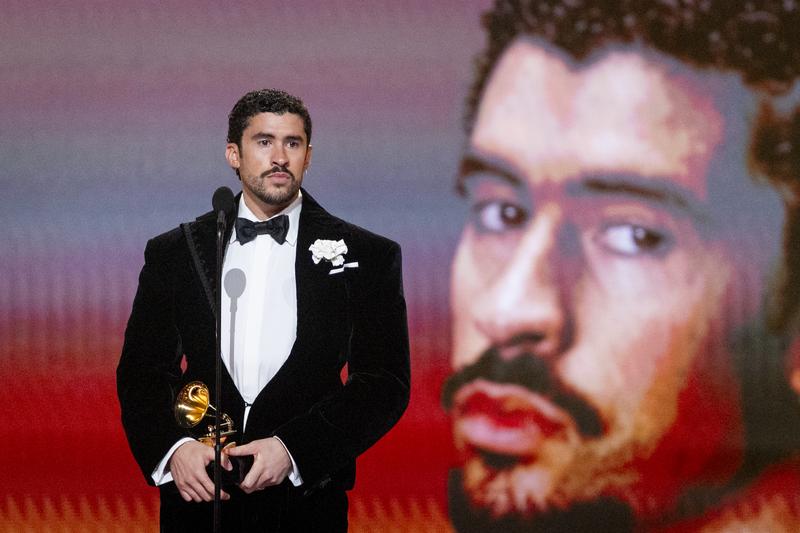
Alana Casanova-Burgess: Well, [chuckles] we just had the Grammys. I can tell you the explosion of pride from him winning album of the year, it's so palpable. It's like watching your cousin on stage winning that award. It's just incredible.
Brian Lehrer: I was watching, and I was so frustrated by the fact. Trevor Noah made this explicit, because of the way he's under contract to the Super Bowl, he couldn't perform at the Grammys.
Alana Casanova-Burgess: I know. He was trying to goad him [laughs] into singing his lyrics. I thought that was great. We'll see. I've had the immense pleasure of seeing Bad Bunny perform a few times, and he really is such a showman. He's such a performer. I'm curious what kind of political messaging is going to come out of it. I think there's this tendency in politics to look for like an anti-Trump or a Trump antagonist. Someone who's really going to carry the banner and stick it to him. I don't know that our guy Benito is-- He's a musician. He's there to perform, and we'll have to see what he says, but I'm trying to not expect too much from him, I guess.
Brian Lehrer: He did at the Grammys. The first time he got on stage, he said, "ICE out."
Alana Casanova-Burgess: He did, yes. I think that's something that's really important to him. Dominicans living in Puerto Rico have been rounded up in these ICE raids. He's spoken about this before in Spanish, and maybe it didn't get as much attention, but this is something that is really important to him. He's also a guy who sings about dancing. He's both things. I hope we can have just a really good time. I've been struck by the videos of people enjoying Bad Bunny as I doom scroll compared to the videos of ICE agents dragging people through the snow. It's just two very different visions of a world we can live in.
Brian Lehrer: We have time for you to talk about one more of your champions from this season of La Brega. Tell us about Isabel González.
Alana Casanova-Burgess: Oh, yes. Well, this is a New York story. Isabel was very young. I think she was 21 when she came to New York in 1902. She was pregnant. She was just a few weeks away from giving birth. She was turned away at Ellis Island. Now, Puerto Rico was already a colony of the United States at that time, had been invaded four years before that. The agents at Ellis island said, "You are likely to be a public charge. You are an immigrant we do not want here." Isabel said, "Well, hold on. United States has invaded my country and I'm not allowed to come to yours?" She took her fight to the Supreme Court.
You'll have to listen to the episode. She doesn't exactly win, but her case for inclusion, I think, really tells us something about how the US has kept Puerto Rico at an arm's length. Maybe more than a few arms.
Brian Lehrer: Just tell people how they can hear this season of La Brega. Is it just "Wherever you get your podcast"?
Alana Casanova-Burgess: It sure is. You can go to Apple, we're on YouTube. We'll also be on On the Media this weekend and Latino USA. You can catch us in a few places. If you are listening in Puerto Rico, we are on the radio in four stations for the next eight weeks in Puerto Rico, which, as a radio girl at heart, I'm super excited about.
Brian Lehrer: That is super cool as we leave it there with Alana Casanova-Burgess, host of Futuro Studios podcast, La Brega. Thanks as always, Alana.
Alana Casanova-Burgess: Thank you, Brian.
Copyright © 2026 New York Public Radio. All rights reserved. Visit our website terms of use at www.wnyc.org for further information.
New York Public Radio transcripts are created on a rush deadline, often by contractors. This text may not be in its final form and may be updated or revised in the future. Accuracy and availability may vary. The authoritative record of New York Public Radio’s programming is the audio record.