
Justice for Epstein Victims Through NYS
Brian Lehrer: Brian Lehrer on WNYC. Jeffrey Epstein has been dead for nearly seven years. He died in federal custody in August 2019 before he could be tried. Since then, the federal government has largely closed the door on his victims. The FBI has argued some cases are too old to pursue, and the Trump administration has shown no appetite for pursuing them further themselves. Where did the women he abused turn now?
One answer being tested in Albany right now, the State of New York. Yesterday, four women who say they were sexually abused by Epstein testified before the State Senate's Codes Committee, some of them speaking publicly for the first time in support of a package of bills that would open new legal pathways against Epstein's estate and the people who helped him. Here's one of those women who went public. Lara Blume McGee.
Lara Blume McGee: Our justice system allowed a web that protected the powerful, the wealthy, and the well-connected people in institutions that profited from and covered up a pedophile's network. Too many survivors carry their trauma in silence. One in four women will be sexually assaulted in her lifetime. For many, it takes years, sometimes decades, to come forward.
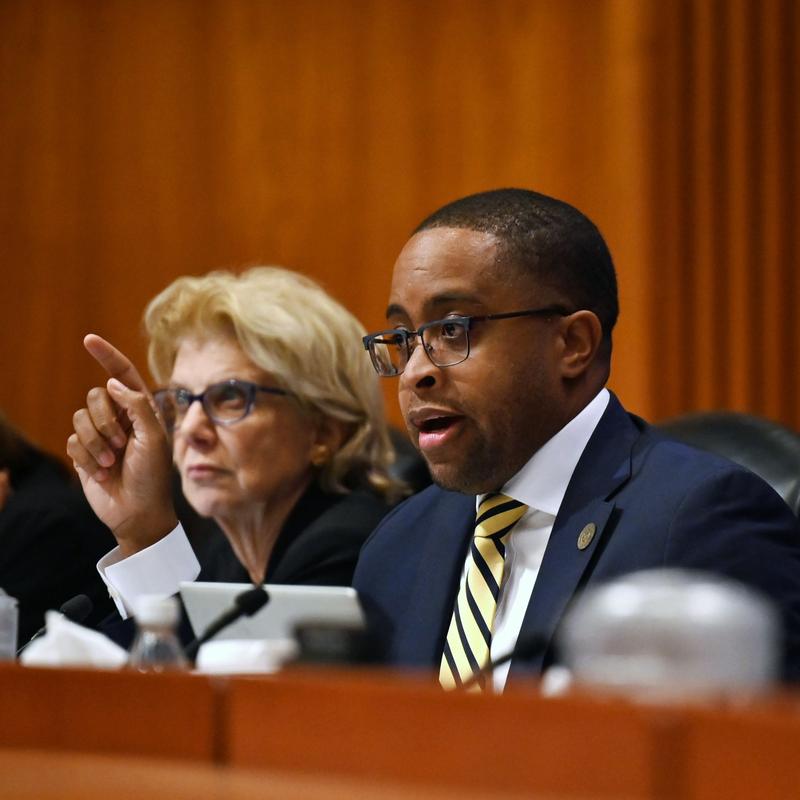
Brian Lehrer: The Trafficking Survivor Recovery and Accountability Act, as it's called, sponsored by Brooklyn State Senator Zellnor Myrie, who chairs that committee, would allow victims to seek punitive damages from Epstein's estate and, among other things, open a one-year window for victims to file claims that are already beyond the statute of limitations. From a hearing in the State Senate yesterday, this is Glendys Espinal testifying about Epstein's abuse.
Glendys Espinal: The Epstein estate has refused to help me because they are arguing that the statute of limitations means that what happened to me is worth zero.
Brian Lehrer: Glendys Espinal. Epstein's estate is, by some accounts, shrinking with every passing month. Senator Myrie is here now to talk to us about all of that, plus other business at the end of the legislative budget year. The new fiscal year's budget is now more than a month late, stuck over taxing the rich, car insurance lawsuit rules, climate rules, and a few other things. Senator Myrie is chairman of the Senate Codes Committee. He introduced that legislation. Some of you may remember he also ran in New York City's mayoral primaries last year and was endorsed by the Working Families Party, along with Zohran Mamdani. Senator Myrie, thanks for coming on again. Welcome back to WNYC.
Senator Zellnor Myrie: It's good to be back with you, Brian.
Brian Lehrer: Tell us more. What would this Jeffrey Epstein legislation actually do?
Senator Zellnor Myrie: You heard some of the emotion from one of the women yesterday who testified about the trauma and the pain that they've had to endure because of the abuse and the network that enabled that abuse of Mr. Epstein. What we are trying to do in Albany is to say, one, that survivors' voice matters, and that they should be heard, and they should be recognized, and they should be appreciated for their courage and their bravery, but if they can muster the courage and bravery to speak about these reprehensible acts, we should have the courage and bravery to give them some avenue of justice.
Right now, the law prevents them from recovering from the estate because we have a history in the state of not allowing for punitive damages to go through when someone has died. This bill would change that. We would also create a new part of our statute that says if you are benefiting from a sex trafficking venture, that you too can be held criminally and civilly liable. What we have seen, unfortunately, with the uncovering of some of the Epstein files is how vast this network was, how many people, entities, institutions were aware or should have been aware of what was happening and who profited from the abuse that Epstein inflicted on many, many survivors.
We are trying to get some measure of justice, and not just for these women. This is the most notorious, this is the most famous case of abuse, but there are many, many, many more instances of this. We are trying to help as many New Yorkers as possible.
Brian Lehrer: Some of our listeners will remember the Adult Survivors Act, which opened a one-year window in New York State in 2022, that closed in November 2023. We talked about some of the cases that came as a result of that on this show. Over 3,000 suits were filed overall. Why didn't that window capture Epstein's victims sufficiently to avoid this legislation?
Senator Zellnor Myrie: I think you pointed out the pent-up demand for seeking justice in a way that requires a look back from the law because it often takes a very long time for people to come forward. One of the witnesses that testified yesterday, a survivor herself, but also a lawyer and an expert on child abuse, told the committee that it takes, on average, 21 years for people to come forward about abuse. In almost 40% of those instances, they take it to their grave, oftentimes by way of suicide. These look-back periods, while very important and in the adult survivors context, saw some of those 3,000 claims, there was no way that it was going to capture all of the activity.
We are trying to open that window yet again. Also, because of the network that Epstein utilized, and because of our law's absence in capturing criminal activity in a network context, they may not have been able to bring that claim either.
Brian Lehrer: Right. I believe that the Adult Survivors Act allowed punitive damages against living abusers. Epstein, of course, is dead, so his estate is a different legal animal. That's one aspect, right?
Senator Zellnor Myrie: That's right, Brian. Just for the edification of the listeners, we have prevented punitive damages on estates for some sound reasons. There is some history, not by way of our constitution or our statutes, but what we call common law, the law developed by the courts. I know we have Professor Murray coming on next, who can speak to this a little more eloquently, but the common law has said, "We don't want punitive damages to reach people who have died," because the point of punitive damages is, one, to express dissatisfaction by society, to say, "This activity is bad. We do not want to see this going forward."
If someone is no longer here, there is a notion that this cannot be discouraged, but I think that sex trafficking should and could be that exception, given the harm and the pain that has been inflicted. What we heard from some of these women that came forward yesterday, after questioning on, "Well, why is it that people don't come forward?" One of the women said, "Fear. It was fear that this network that enabled the sex trafficking would inflict even further damage on me, even though the abuser himself is no longer here."
I think having punitive damages as an option will not only give some measure of justice for survivors, but it will signal to anyone that is involved in that activity right now that this is not a profit-making endeavor, and that you will suffer both criminal and civil consequences for that behavior.
Brian Lehrer: The one-year look-back window is arguably the most important and urgent piece from your legislation. I hear what you're saying about how this is designed to protect survivors of future abuse, but urgent, time-sensitive because attorneys for the survivors say Epstein's estate is dwindling every day. Do you have a sense of how much money is actually left in that estate for damages?
Senator Zellnor Myrie: I think it's unclear. There have been some estimates that put it over 100 million, but I think because there are current suits and current cases dealing with and trying to recover from that estate, that those numbers are not going to be entirely accurate. If I had to guess, I would guess that the number is actually quite higher than that. Yes, it is important because every day that passes, that estate is shrinking. It was set up in a way to avoid any accountability, because as we now really know on a wide scale, that this abuse had been occurring over the course of many, many years. It spanned decades.
It gave Epstein and the folks who enabled him enough time to set up his money and his finances in a way to avoid accountability. It's really important that they have a tool to get justice in our courts.
Brian Lehrer: A few more minutes with New York State Senator Zellnor Myrie. We've been talking about his bill that would add a new look-back window for survivors of Jeffrey Epstein's abuse and others, but Epstein's victims are the main people he's looking to help here, and we can take some phone calls on that, or we are going to get into some other New York State budget-related issues. I say budget. It's really a lot of non-budgetary items that are making the New York State budget more than a month late now. Tax the rich for Mayor Mamdani, that is a budget issue, but also car insurance rules, climate rules.
If you have a comment or a question on the Epstein-related bill or the still lingering budget issues, 212-433-WNYC, call or text. 212-433-9692. Senator, before we go on to the budget, I see your bill passed your committee in the State Senate yesterday, but as of now, there's no assembly sponsor, and you only have a little over a month left in the session for all of 2026. It ends in June. How confident are you that you can get this done in 2026, and why isn't there more support? On a certain level, it seems like common sense to open this look-back window for victims of Jeffrey Epstein.
Senator Zellnor Myrie: I'd note, Brian, that we passed this through the Codes Committee yesterday unanimously with both Democratic and Republican support. I think that speaks to the strength of the issue and alludes to what you're saying in the common sense nature of getting this across the finish line. We are going to have an assembly sponsor within the next few days, and we're going to make a really concerted effort to get this across the finish line. There was a testimony yesterday that spoke to the urgency of getting this done. We, of course, heard from the attorneys for the survivors, but the women themselves who have had to suffer the impacts of this abuse.
I think it's important that we be guided by their pain, what they have had to endure, and ensure that we use every tool at our disposal to get this done as quickly as possible. I know we're going to get into the budget now. That has complicated some of the timelines, not just for this but for a lot of the other things that legislators are trying to get done. I think this issue, given how widespread we have known about the abuse and the testimony from the survivors, I think we are starting off a really strong position.
Brian Lehrer: Here's a question from a listener as we move to things that are stuck in the legislature right now. Listener writes, "Why is there--" Sorry, the listener wants you-- Oh, here it is. "Given his support for survivors, can Senator Myrie comment on Assembly Speaker Carl Heastie's resistance to the Voluntary Intoxication Exclusion Bill when there is so much support for it, particularly among Democrats across the Legislature?" We did a separate segment on this the other week, Senator. I'm sure you're familiar with it.
Senator Zellnor Myrie: Yes.
Brian Lehrer: To bring our listeners up to date, this has to do with some cases in the news right now where women who did participate in drinking with men who later then took advantage of them, they weren't drugged by the men against their will. They got drunk, and then they say they were raped. There's a bill to deal with that more explicitly under the law, not exclude prosecution of men just because a woman might have gotten drunk in the process of being with him. To the listener's question, why can you comment on Assembly Speaker Heastie's resistance to that bill if you agree he's holding it up?
Senator Zellnor Myrie: Thank you, listener, for the question. I didn't get to catch the segment, but this is actually a bill that went through my committee in the State Senate. I believe we passed it through our committee in February. The State Senate passed this bill a few weeks ago in the middle to late April. It is something that I am very supportive of. It is sponsored by my good colleague from the Bronx, Senator Nathalia Fernandez, who chairs the relevant committee on substance use and abuse. I think that this is something that should move in the Assembly.
I am not privy to the conversations happening in that House or with assembly leadership, but it is something that my majority leader, Andrea Stewart-Cousins, and my colleagues have been very supportive of. My hope is that we can see some movement on the other side.
Brian Lehrer: Another measure that stuck in these budget negotiations, the governor has proposed rolling back parts of the state's 2019 climate law, which set New York's emission targets. That's a big ask for a Democratic governor to make it all and to make of a Democratic legislature, but she says it's just unaffordable. It's going to push up utility costs, especially too high, too quickly, and they need to slow it down. It's climate versus affordability in the governor's telling. Where are you on this?
Senator Zellnor Myrie: I ran for State Senate back in 2018 with the hopes that we would get a Democratic majority finally in the State Senate and that we would be able to pass legislation that had been pent up for many years. The climate law that we are now discussing was one of those bills that I talked about as I campaigned and that we passed within the first year that the Democrats took the majority in the State Senate. We care very deeply about that law and the things that it would do to help mitigate climate change and to help us move to renewable energies, and to do justice to the communities that have been disproportionately impacted by climate change.
I think it's unfortunate that this conversation has been joined with affordability and utilities in a way, I think not from everyone, but from some actors, in a disingenuous way. There are a lot of global issues. There are a lot of things not within the control of the state that may be contributing to the utility costs and to our affordability crisis. I think our climate law is not one of those things. I think we can have two conversations at the same time. We can talk about how we can make things more affordable. We can discuss what is within the state's power to do so, and we can be honest about our need, the demand, frankly, for us to stay on track with our climate laws as closely as we can in order to protect our planet.
Brian Lehrer: Governor Hochul is also pushing to reform the state's car insurance liability laws. She says to bring down premiums and crack down on fraud. Trial lawyers say her plan would leave genuinely injured people without enough recourse, and legislators have been demanding data that fraud is actually what's driving the car insurance rates up. Where do you stand on that push by the governor?
Senator Zellnor Myrie: Yes, this has been an issue that has taken an inordinate amount of our capacity in this budget process. If you would have told me about a year ago that our budget would be 35 days late because of car insurance proposals, I might not have believed you, but here we are, nonetheless. I think our concerns are shared with the governor that people are paying too high a price for their car insurance. The real question, as you mentioned, Brian, is what is contributing to that and what is going to help us lower those costs?
I think the discussions are continuing on whether the governor's proposals will, in fact, bring down those costs or whether some other things that legislators have brought to the table might do that. My hope is that we are nearing the end of that conversation, so we can move on to some of the other more important policy and budget issues.
Brian Lehrer: Let me ask you about one other thing that's getting less press than the car insurance or the climate emissions targets. The "federal reconciliation law" that passed last year, with Trump calls it Big Beautiful Bill, cut roughly $187 billion from SNAP or food stamps, and the House just passed a farm bill that locks those cuts in rather than reversing them. Meanwhile, as I'm sure you know, thousands of New Yorkers have already had their existing food benefits stolen through card skimming, with no federal replacement program and chip card upgrade is still a year and a half away.
You've got a bill to create a state compensation fund. Just tell people briefly what you're proposing and why hasn't that one passed? I think everybody's frustrated. You have a Democratic majority, both Houses of the New York State legislature, Democratic Governor, why isn't this one sailing through?
Senator Zellnor Myrie: Brian, I'm trying my very best to answer that question myself as we push to get this done in this year's budget. It is something that we put forward as the Senate as something that should be done in this year's budget. I'm hopeful that conversations, I think, are moving in the right direction on that. What this is is pretty simple. If you are utilizing SNAP, and you are a victim of fraud, this would create a fund that would allow for you to get compensated for having it stolen. This is an issue. I introduced this bill close to four years ago. This was an issue that really became prevalent during COVID.
I started hearing from constituents who were getting their SNAP benefits stolen and who had no recourse, and there was no system set up for them to get it. It is quite literally having food stolen off of your table. Now, what we see from the federal government is a policy position that is stealing food from our children, but if someone is a victim of fraud, I think that the state should be stepping in, in addition to us providing more resources to try as best as we can to cover the funding gaps that the federal government has instituted.
Brian Lehrer: There we leave it for today with Zellnor Myrie, state senator from Brooklyn's 20th State Senatorial district, Central Brooklyn, including some or all of Crown Heights, Prospect Heights, Park Slope. Senator, thanks for some time today.
Senator Zellnor Myrie: Appreciate you bringing me on. Thanks.