
Johnny Carson, Live from New York
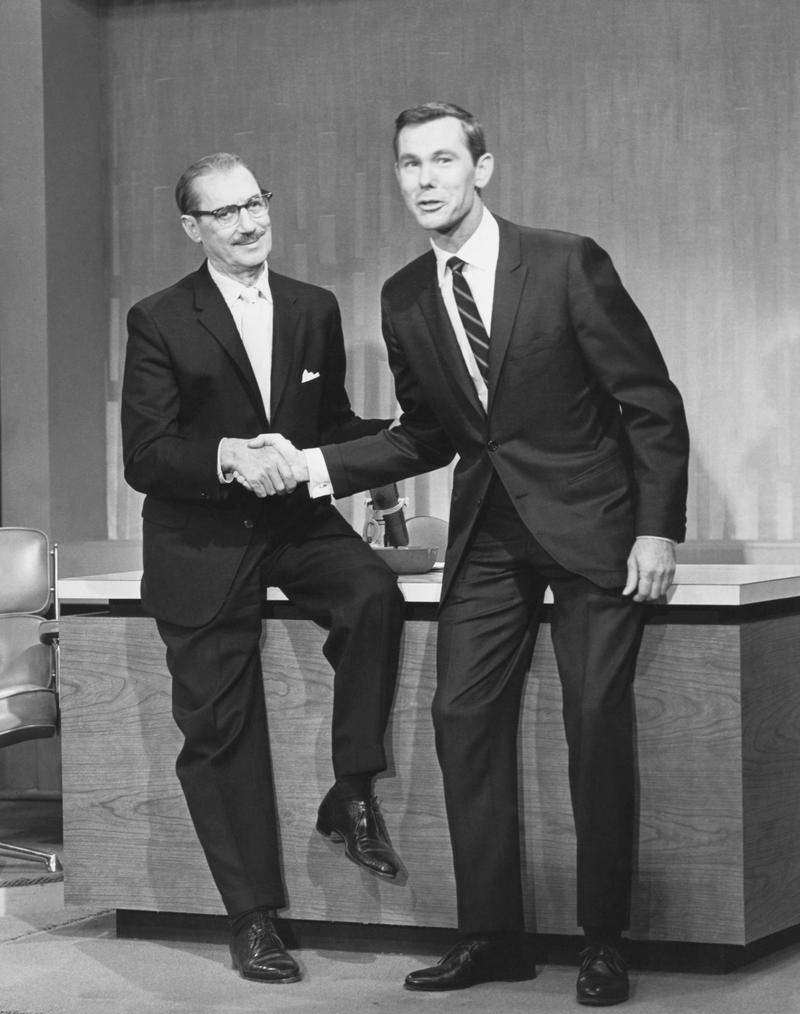
( Courtesy of Carson Entertainment Group / Simon and Shuster )
David Furst: It's The Brian Lehrer Show on WNYC. I'm David Furst, filling in for Brian. To end the show today, a little fun on this Friday morning. We're going to look at late night, in particular, the life and legacy of the former king of late night TV, Johnny Carson. The centennial of his birthday just passed in October. Johnny Carson, of course, hosted The Tonight Show for nearly 30 years before he passed away in 2005. He's the only late night talk show host who's been awarded the Presidential Medal of Freedom.
Carson entertained generations of Americans over those three decades, launched the careers of countless comedians, people like David Letterman, Joan Rivers, Richard Pryor. He brought on music legends like Aretha Franklin, Elvis Presley. He also invited Jim Henson's Muppets onto the show, including on an episode hosted by Kermit the Frog.
Carson also brought political heft and substance to his widely viewed program, talking about the social issues of his day, even if he felt that it wasn't always the job of an entertainer to do so. Some of those moments really jump to the forefront of our thinking as we see what has happened with Stephen Colbert being canceled and Jimmy Kimmel being taken off the air over this past year. Joining us now to talk about all of this is Mark Malkoff, comedian and host of The Carson Podcast. He's out with a new book titled Love Johnny Carson: One Obsessive Fan's Journey to Find the Genius Behind the Legend. Mark, welcome to WNYC.
Mark Malkoff: David, it's good to see you. Thanks for having me.
David Furst: We want to hear from you during this chat, too. Any fans of Johnny Carson and The Tonight Show out there? Maybe you have a childhood memory of being allowed to stay up late at night and watch him. What really stands out from those memories? You can call or text us 212-433-9692. That's 212-433-WNYC. I have to ask you about the title of your book. Let's start right there. Obsessive fan. That's what you call yourself, right? What makes you an obsessive fan?
Mark Malkoff: I think anybody that talks to over 400 people about somebody, about one single person, Johnny Carson and The Tonight Show, probably would get the label obsessive. Listen, I was a fan of comedy. My dad got me in very early into old school comedy. Kids on the playground were talking about Mickey Mouse. I was talking about Jerry Lewis, Buddy Hackett, and Johnny Carson.
My dad got me in very early, and I had all these questions about what went on behind the scenes of The Tonight Show. The stories weren't there. Who was holding the curtain open for Johnny? How did the people get on the show? I went around the country and everyone from Mel Brooks, Carl Reiner, Carol Burnett, I sat down most of them with in person and they just wanted to tell me their stories.
David Furst: You seem like someone who would have been a little on the young side to be growing up watching Johnny Carson. How old were you when he was on TV?
Mark Malkoff: I was 16 when he went off the air.
David Furst: Were you watching back in those days?
Mark Malkoff: I was. Letterman was the cool kid, and that's what everybody in my high school was watching. I loved Dave. He was great. I ended up working for him on a CBS show. Johnny, there was just something old school showbiz and something so likable about him. Just the fact that he's been off the air for over 30 years and we're still talking about him. All the late night hosts still talk about Carson. He makes headlines all the time. It's just a 30 years dominant in American culture. This is an icon. The fact that we're still talking about him speaks volumes about him and his show.
David Furst: Well, you have a lot of big words in the title of your book. We mentioned obsessive, but also in there, I see the word legend and genius right in the title. Was Johnny Carson a genius? What made him great, and what was he great at doing?
Mark Malkoff: I think anybody that can survive 30 years and change American culture without anybody coming close competition-wise in terms of longevity. The only other entertainment entity I can really think of is Lorne Michaels with Saturday Night Live and the same thing. Both of them share that they were relentless. They know their audience, and they both knew, at the end of the day, it's an entertainment show. At the same time, Johnny was way more political than people give him credit, especially in the New York days. He influenced elections. I mean, pure and simple. Some of the people he had on his show were so controversial, the late night host now would never put them on.
David Furst: Really?
Mark Malkoff: Yes.
David Furst: You write about how, for three decades, Carson was a highly visible public figure during some of the most tumultuous times in American politics. We're in a kind of a tumultuous time right now, I would follow. He had a strong view of what his role should be and how political things should get on the show. How did he initially think about his job when it comes talking about politics in particular? Did that thinking evolve over time?
Mark Malkoff: He was convinced he was going to do an entertainment show. His predecessor, Jack Paar, was the hottest thing in TV. Would cry on air, was controversial. Carson said, "I'm going to be an entertainer." Slowly, as the show became a real hit, he would never give his political opinions, but he would put on certain guests that he shared politically aligned with. He was very much against Vietnam. He would put Gore Vidal, he put someone, really people like Janis Ian, people that really had strong, strong views politically.
Carson, in 1968, did the most gutsy thing. NBC was very shocked when they put Harry Belafonte as a guest host for an entire week in February of 1968. He had Bobby Kennedy, Martin Luther King Jr. NBC was terrified. Johnny Carson called up Mr. Belafonte, said to, "Put on whoever you want." He shared Mr. Belafonte's politics, but he knew that he would lose at least half of his audience if he declared his political view. He kept it to himself, but Mr. Belafonte, it was historic television.
David Furst: Historic television. What was the response?
Mark Malkoff: The response was all over the country, a lot of hate mail with people like, "How dare you give Mr. Belafonte a show?" Then the other half were heralding Carson a hero. I mean, he was putting on guest hosts. He would give substitute hosts, people like Pearl Bailey, Della Reese, Flip Wilson, Sammy Davis Jr. He would give them over the show. Back then, that just didn't happen a lot.
When Anita Bryant, she was a very famous singer in Florida, and she was supporting anti-gay legislation in the '70s, Carson hammered her on air. Not all the country, a lot of places were very conservative. Some places still now, and Carson wasn't afraid to shy away from that controversy. He hammered her, made her look ridiculous night after night.
David Furst: Let's take some of your calls right now. We're talking about Johnny Carson, the number 212-433-9692. Let's hear from Craig in Morganville, New Jersey. Welcome.
Craig: Hey, guys, how you doing? The one thing that was great about Johnny was that he didn't just have celebrities on to plug their book or their movie. He would have real interesting people. If somebody did an amazing feat like walked across the country or had an unusual potato chip collection and you would think they would be a horrible guest, but they ended up being very engaging and would make Johnny funnier, but he would never make fun of them. You know what I mean? He would never do. He knew it was a crazy thing, but he still had respect for them and would never belittle anybody.
David Furst: That's a beautiful comment right there. I got to say, I think the potato chip collection would be a great guest.
Mark Malkoff: It was. Johnny would put these people on almost always first. You would have a huge star like Sean Connery.
David Furst: Really? That's your A segment?
Mark Malkoff: Yes, the first, he would have the potato chip lady. It was this 65 year old woman, Myrtle Young, a potato chip inspector. She became world famous. She traveled with her potato chip collection. She noticed the potato chips were in different shapes and looked like different people. Johnny made her a star.
There was this other gentleman that I interviewed who was known as a manualist. He would play songs with his hands, he would cup his hands. He went on the show five times, quit his job as an attorney in Michigan and made more money playing Las Vegas lounges because of Johnny Carson. The power that this man yielded, careers like David Letterman, but even musicians sat down with me. Jimmy Buffett said, "Mark, you're the first one that's ever asked me about Johnny Carson, the biggest break of my life."
David Furst: No kidding.
Mark Malkoff: 1981. He said, "I couldn't get booked on the TV."
David Furst: You really hear the story when it comes to comedians getting their big breaks. What you're talking about really something different there.
Mark Malkoff: I mean even like Ross Perot in 1968 or '69, first Billionaire. Johnny put him on as an unknown. Perot showed up by himself, no security because they would do pre-interviews in person. Launched him. Even someone like Bill Clinton in 1988, Carson saved his political career. Clinton spoke at the DNC and was long-winded. Supposed to speak 15 minutes to 32 minutes. Booed the critics, ripped him apart. He went on Carson and played saxophone long before Arsenio Hall. The AP said that Clinton went from the doghouse to the clubhouse faster than anybody in political history. That was all Johnny Carson. He saved Clinton's political career and made him presidential of a contender in '92. We all know what happened.
David Furst: We're speaking with Mark Malkoff, a comedian who is out with a new book, Love Johnny Carson: One Obsessive Fan's Journey to Find the Genius Behind the Legend. Following up on that having political candidates on the show. You write about in the book about at the height of the speculation that he would run for president, Richard Nixon went on The Tonight Show, November 1967. Let's hear a clip from that interview. This is where Carson asks Nixon about his relationship with the press.
Johnny Carson: You find that the press often misquotes out of context what people say in your particular case.
Richard Nixon: Well, I understand there's some press here. Any other questions?
Johnny Carson: You won't get misquoted on the answer?
Richard Nixon: No, actually, Johnny, whether it's press or television commentating, every political man, and I'm sure that you have the same problem sometimes when you're wondering about the notices and so forth that you receive in the reviews, is perhaps never satisfied with the press he gets. I think I tend, after having been out of government and out of politics actually for the last four or five years since my loss in California, I tend to become somewhat more tolerant. More tolerant, at least at this point. I do feel that it is vitally important not to infringe on the right of the press to take on a candidate.
David Furst: Mark, you write about how Carson came to maybe regret giving Nixon such a big launch pad. Talk about that. Also, what stands out to you in that clip?
Mark Malkoff: He made Nixon look presidential and witty. He actually went to Ed McMahon's apartment, and Ed McMahon coached Nixon on this appearance. They gave Nixon some witty lines at the top, made him look really funny. Then it was the first time Nixon looked good on television. Famously, with the Kennedy debates, he looked terrible. Nixon reached out to Carson afterwards and said, "Would you please lend me your makeup person?" Johnny didn't like confrontations, said, "Sure, okay, you can have him."
Johnny's makeup gentleman, Ray Vogue, would go to D.C. and do all of Nixon's appearances. That was something Johnny grew to dislike. He despised Nixon near the Watergate years. When he found out Nixon was drinking in the White House right before the resignation, he stopped with the jokes. If somebody was an alcoholic or somebody was really down and out, he would stop the jokes.
David Furst: Let's see if we can get to another one of your phone calls. Let's hear from Nick in Roslyn Heights, Long Island, talking about Johnny Carson. Welcome.
Nick: Hi. Thank you for taking my call. I'm a Baby Boomer, big Johnny Carson fan. There was a movie that came out a couple years ago about the launching of Saturday Night Live. It was the first night the show aired, and there was a scene in the film with Johnny Carson. You hear him making a phone call to Lorne Michaels. It was a really nasty phone call. Like, "You're not going to take over for me." I just wonder, is that docudrama, do you think? I'm wondering if that really actually happened.
David Furst: Mark, do you know much about that?
Mark Malkoff: It did never happen. Mr. Reitman is a very talented filmmaker, but a lot of the things that happened in that movie just simply didn't happen. It was a very entertaining movie. Lorne Michaels and Dick Ebersol. Lorne, the creator of SNL, 29 years old. They sit down with Johnny Carson and they have to get permission to do this new show called NBC Saturday Night.
Johnny Carson does not want Tonight Show reruns anymore on Saturdays at 11:30. Johnny gave his blessing for Saturday Night Live. That's how it happened. Johnny was fine with Saturday Night Live until Chevy Chase shows in as an unknown that the New York Magazine put him on the COVID and herald him as the successor to Johnny Carson. Then they started making jokes about Johnny. Dana Carvey started doing mean spirited sketches, and that is one of the reasons Carson retired. They were mean spirited in Carson's eyes. I really did think a lot of them were funny.
David Furst: Dana Carvey's Carson was pretty funny. [laughs]
Mark Malkoff: Oh, I thought the Robert Smigel sketches were hilarious. Johnny, they never occurred to that Johnny would be that famous, that he would be so easily hurt, but that was one of the main reasons he retired.
David Furst: Wow. We have a lot more to talk about, but I have to mention this. You have a Johnny Carson event happening at the Museum of the Moving Image this weekend. Can you give us a quick preview?
Mark Malkoff: We're going be in Astoria on Saturday, and we're going to be there Sunday at one o'clock. We're going to be showing clips. We're going to be showing Johnny Carson and The Muppets clips. Jim Henson and Carson had this mutual love for one another. Henson went on the show for decades and Kermit even guest hosted The Tonight Show. We're going to be showing the clips.
David Furst: Henson was the best on talk shows.
Mark Malkoff: He was. He was so, so good. Carson's final show, he showed a clip of Henson, and there was this love. Johnny Carson at home watched the episode where Kermit the Frog did a monologue and was at the desk interviewing people like Bernadette Peters. Carson called Henson the next day and said, "That was one of the best things I've ever seen on television." I'm going to be signing books afterwards and speaking with a gentleman named Craig Shemin, who's the Muppets historian expert. We're going to be in Astoria, the Moving Image. Please, this weekend, if you can get through the snow, we'd love to see you there.
David Furst: [laughs] That's good. Bring the boots, bring a lot of gloves. It's going to be cold as well. That's where we're going to have to leave it today, unfortunately. You can catch Mark at the Museum of the Moving Image in Queens. Again, it's this Saturday, January 24th, and Sunday, January 25th, at 1:00 PM Did I get that right?
Mark Malkoff: You did, David. Thank you so much.
David Furst: Keep an eye on the weather, though.
Mark Malkoff: Oh, yes.
David Furst: For more information, you can go to wnyc.org/blshow. Mark, thank you so much for coming on. Once again, the book is Love Johnny Carson: One Obsessive Fan's Journey to Find the Genius Behind the Legend.
Mark Malkoff: Thank you, sir. This was fun.
David Furst: That is all we're going to have time for. I am David Furst. This is The Brian Lehrer Show here on WNYC. Have a great weekend. Don't forget to bundle up. Looks like we could be getting up to a foot of snow in New York City starting as soon as Saturday night. Be prepared and stay tuned for All of It that's coming up next.
Copyright © 2026 New York Public Radio. All rights reserved. Visit our website terms of use at www.wnyc.org for further information.
New York Public Radio transcripts are created on a rush deadline, often by contractors. This text may not be in its final form and may be updated or revised in the future. Accuracy and availability may vary. The authoritative record of New York Public Radio’s programming is the audio record.
