
Jim Clyburn's History
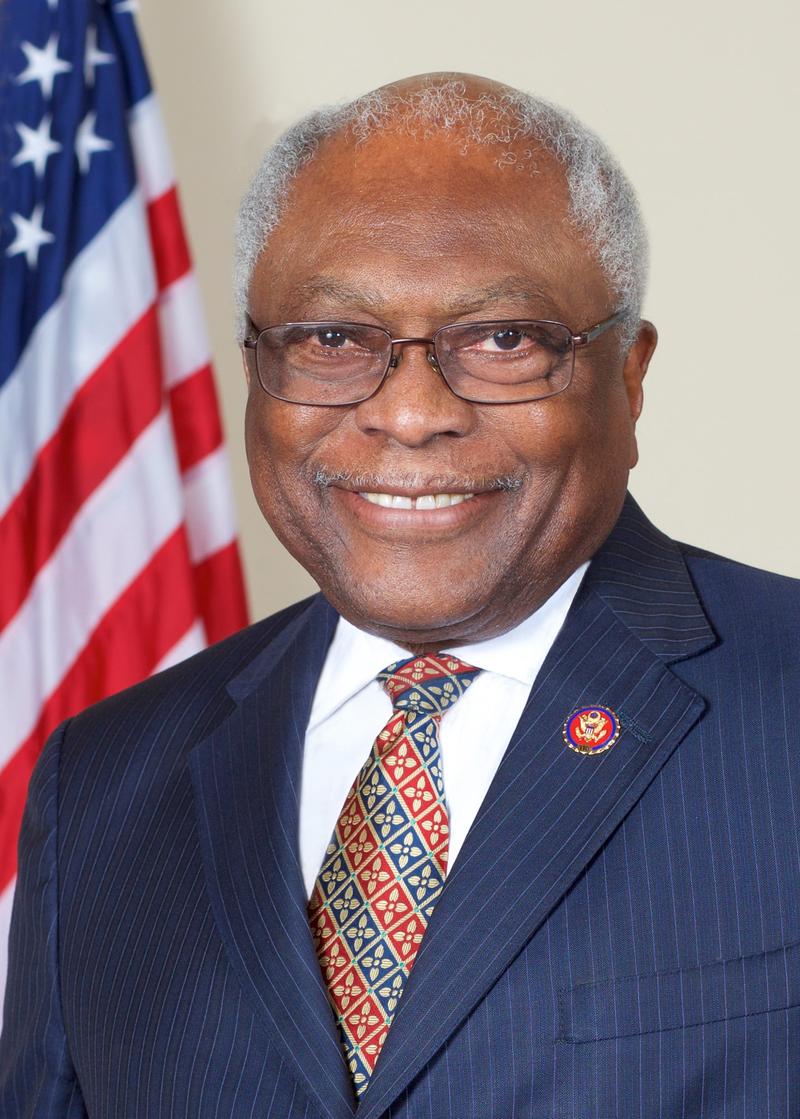
Brian Lehrer: It's the Brian Lehrer Show on WNYC. Good morning again, everyone. Congressman James Clyburn is with us, the longtime Democratic congressman and former majority whip. He's out with a new book called The First Eight: A Personal History of the Pioneering Black Congressmen Who Shaped a Nation, which uncovers the lives and legacies of the eight Black congressmen elected from South Carolina before him.
For decades, many people have assumed that Clyburn was the first Black person to represent South Carolina in Congress, at least since the Civil War, but as he reminds us, he was actually the ninth, following a generation of men who rose from slavery and struggled to build one of the most progressive state governments in the country at that time. Jim Clyburn, representing District 6 in South Carolina and a recipient of the Presidential Medal of Freedom, joins me now to discuss his book.
We'll also talk about some things in the news, including the suspension of SNAP benefits by the Trump administration and the government shutdown, the possible abolition of the centerpiece of the Voting Rights Act that the Supreme Court may be about to order, and more. Congressman Clyburn, thank you so much for joining us. Welcome to WNYC.
James Clyburn: Thank you very much for having me.
Brian Lehrer: You write that when people see the portraits of the first eight in your office, they're surprised. They assume you were the first Black congressman from South Carolina. You've been correcting that misunderstanding your whole career. What finally made you decide it was time to write this book?
James Clyburn: Just after I finished and released my memoir 10 years ago, 2015, some visitors to my office commented about those eight pictures, asking who they were. When I explained to them who these eight people were, one of them expressed surprise, having thought that I was the first African American from South Carolina. I playfully said to her, "No, no, before I was first, there are eight."
Later that day, I said to the staff, "I think my next book should be about these eight people, their history, their tremendous contributions to helping to make this country what it is," and of course, as I explained to those people that day, the big issue is that there are 95 years between number eight and number nine. To write about those 95 years, I thought, would be a good history lesson for people.
Then January 6th, 2021, happened. That's when I really got serious about doing the book because I noticed exactly what was taking place after the 2020 elections when they had all those shenanigans going on up there in Michigan, trying to get into the elections office, trying to set up bogus electors, same thing in Pennsylvania, trying it down in Florida and Georgia. That's what happened in 1876, and that is what caused the demise of so-called Reconstruction, and that's what led to Jim Crow.
That to me is the importance of this book, letting people see exactly what happened in 1876, how similar things are happening today. Project 2025 mirrors the edict that was written by Matthew Witherspoon Gary back in 1876, and how they used that playbook. They've replaced it like the red shirts back then, now are red caps. The Ku Klux Klan back then have now become the Proud Boys. It's so similar, until I thought it was very, very important to get this book written, and of course, Little Brown decided it was important to publish.
They will release the book on November 11th, and I think people will be very surprised to see that what happened on January 6th, 2021, was not the first time that something like that has happened in this country.
Brian Lehrer: Project 2025 is the new Jim Crow, a very strong statement. We'll get back to more from today's news, but I want to give you a chance to talk about some of these eight. I think our listeners will take from the answer that you just gave that since there was 95 years between number eight and you as the ninth Black congressman from South Carolina, that they all were from the Reconstruction era, which finally gave way to Jim Crow, or too quickly gave way to Jim Crow.
Let's take an individual you call Robert Smalls, the most consequential South Carolinian in memory, not just of the eight congressmen, but of any South Carolinian. Tell everybody who Robert Smalls was.
James Clyburn: Robert Smalls is a very interesting and compelling character. Robert Smalls was born into slavery in Beaufort County, South Carolina. When he was about 12 years old, his mother lived there in the house. Now, Robert Smalls, no one ever knew or his mother never revealed who his father was, but Robert Smalls was mulatto. That we know. The question is, who was the father?
Because of his status, Robert Smalls was given certain privileges, and he hung around with John McKee, who was the owner of him and his mother. She talked him into letting Robert Smalls go to Charleston because she didn't want him to get into trouble, because he was not really acting the way she thought he needed to act in order to maintain his safety. He was sent to Charleston, and he worked on the waterfront. He did some other jobs previous to going to the waterfront, but when he got on the waterfront, he started plotting his escape from slavery.
He studied the currents, he studied what the captain did to maintain that ship, and he watched how the people who were running the ship, they would take off on Friday nights and would not show back up until the next day. He plotted an escape. Of course, if you read the book, you will see exactly how he pulled it off. He escaped with his family and his friends, and he delivered that ship to the Union Army and was rewarded with cash and his freedom. Became very wealthy, but he didn't run away from the South.
He had many opportunities. People in Philadelphia wanted him to live there in New York. He came to New York, and there were people in New York who wanted him to stay there. He was a big-time hero, but he went back to the South, got permission from Abraham Lincoln to enlist Blacks into the Union Army. Was authorized to get 5,000. He did so. It got up to 40,000. Historians say, but for those African American soldiers in the Union Army, that war would probably have gone in a different direction.
He became, later, a 10-year member of the State Legislature, then became a 10-year member of the United States Congress. A big-time businessman there in Beaufort. If you look at the consequences that flowed from his life, nobody in South Carolina, [inaudible 00:09:00] if you're on that side of the spectrum, or Strom Thurmond if you're a little more modern, they don't touch Robert Smalls when it comes to the consequences of his life.
Brian Lehrer: Thank you for putting him more in people's awareness. Let's do one more of the eight, and then we'll get to some news of the day. You describe Richard Harvey Cain as a minister who saw politics as a practical way to extend his ministry. Now, I know your father was also a minister, and I read that you considered following him into ministry but chose politics instead. I wonder if you feel like you learned things from Richard Harvey Cain from back in the day about combining faith and public service.
James Clyburn: Absolutely. I did not grow up in the AME Church. I am a member of the AME Church today in large measure because of, of course, Richard Allen, the founder of the AME movement, but Richard Harvey Cain was. He started out as a Methodist minister. He was then sent out to Missouri. He fell out of favor with the Methodist Church and went to Wilberforce University and AME University in Ohio, got a college education, and he left Wilberforce and went to New York.
He pastored at Bridge AME Church there in New York City before going down to Charleston to reestablish the AME Church in Charleston. The Emmanuel AME Church had been burned down over the Denmark Vesey Insurrection of 1822. The AME Church sent Richard Harvey Cain to Charleston to rebuild that church. He was so successful until the church got too big. He built a second AME Church, Morris Brown. I became a member of Morris Brown AME Church, and Richard Harvey Cain was the founder of the town now located just outside of Somerville, South Carolina, Lincolnville. Named it after Abraham Lincoln.
A very successful minister, I believe, was the 17th bishop in the AME Church. He is the founder of a college down in Texas, and then, of course, became the bishop here in Washington, DC, before he passed away. All of these people now, Robert Smalls, we just mentioned, he was number six among the eight. Richard Cain was number four among the eight.
Brian Lehrer: Listeners, if you're just joining us, you may recognize the voice. My guest is Democratic Congressman Jim Clyburn of South Carolina, who has a new book called The First Eight: A Personal History of the Pioneering Black Congressmen Who Shaped a Nation. We invite your phone calls for Congressman Jim Clyburn. Maybe he's someone whose career you have followed to some degree and always wanted to ask him something, but you never had him over for dinner.
If you want to call and ask Jim Clyburn a question, just about anything relevant to him or certainly about any of the people he profiles in this book, 212-433-WNYC, 212-433-9692. You can call, you can text. Congressman, let me ask you about some things in the news as a current member of Congress. The suspension of SNAP benefits ordered by the Trump administration as part of the government shutdown, while they continue to fund other things. Trump seems ready to cave on that from what's being reported because enough people are horrified, never mind actually beginning to go hungry. Do you have any information on how and when that might resolve?
James Clyburn: I don't have any hard as far as information. I'm going to be a part of a telephone conference call tonight. I suspect I will be updated at that time on exactly what negotiations or if negotiations will begin to take place, but I do have a very strong hunch that what is going on today is an anticipation of what may or may not be the results of tomorrow's elections. I believe that we will get some definitive movement come Wednesday.
Whatever the headlines are coming out of Virginia and Pennsylvania, and maybe a little bit of California will, I think, change the narrative when it comes to this issue, and we will see movement, I believe, strongly Wednesday and Thursday. I would suspect that the first of the week, next week, we'll see the government reopened.
Brian Lehrer: Oh, that's an interesting set of predictions. What are you seeing in your district, if anything yet, that you can report since the food assistance was cut off on Saturday?
James Clyburn: I must congratulate my governor. Governor Henry McMaster has moved very swiftly to bring entities together in South Carolina to prevent any real, serious, elongated harm from coming to people who need food assistance, and of course, we especially-- At least me, I'm the only Democrat among the seven in South Carolina. Interesting, because at the time of the first eight, when they left office, South Carolina had seven congressional districts, and the seventh was the only one occupied by an African American. Today we have seven, and the sixth that I represent is the only one occupied by an African American.
Of course, I'm the only Democrat. Back then, the seventh, the Black guy, was the only Republican. It shows you how things can change, but how they sometimes remain the same. Today, I am advocating on behalf of people all over the state, though I'm only 1/7 of the state, just like happened with George Washington Murray when he left office. Back then, it was a big hurricane that hit South Carolina down around Hilton Head. That was the big issue that the president was hesitant to send aid because Hilton Head at that time was basically African American.
Today, the big issue is food insecurity, and this president seems to be hesitant to provide the aid because, as he says, those are Democrat programs. Of course, we are the Democratic Party. I don't know why they keep trying to insult us by taking the last suffix off of our name. The fact of the matter is, it is the South Carolina Democratic Party, it's the United States Democratic Party, and not the Democrat Party.
Brian Lehrer: Did you say there are seven members of the House from South Carolina, and you're the only Black one?
James Clyburn: Yes, sir, and the only Democrat.
Brian Lehrer: What percentage of South Carolina's population would you estimate is Black?
James Clyburn: 28% Black and around, I would say, 40 to 44% Democratic voters. We vote anywhere from 40 to 45% Democratic in South Carolina, yet only one of our House members is a Democrat, and only one of our House members is Black. That means we're 14% of the representation, though we are 28% of the population.
Brian Lehrer: From what I read, even your district might be harder for you to maintain with the pressure on the Voting Rights Act. Now, the redistricting that the Republicans are trying to do in the state, and particularly the Supreme Court case now under consideration, that would undo the part of it that led to creating Black majority districts to not dilute Black voting power in quite a number of states. You know that Chief Justice John Roberts wrote in a school integration case that "The way to stop discrimination on the basis of race is to stop discriminating on the basis of race." How would you talk back to that?
James Clyburn: I would tell him he ought to consult with some of his previous members on the court, and one of whom wrote, I think very eloquently, that in order to get race behind us, we must first take race into consideration. That is a fact you don't ignore. We know what the racial problems are. John Roberts is a smart guy. What white person in the United States of America was ever denied an education? What white person was denied the right to vote? What white person was ever denied a job, full citizenship, was in slavery? He knows what the history of this country is.
He knows what the history of the South is, and he knows that in order to get beyond that history, we must take race into account. If you've been using gerrymandering, they did it back in 1870-- It was 1890, when they gerrymandered the state, and put all the Black people in the state-- Not all, but the vast majority of the Black people in the state into one congressional district. They called it the shoestring district that ran from Beaufort all the way up to my home county of Sumter, just going through picking up Black neighborhoods, and so made it impossible, when you racialize the voting, for a Black person to get elected in any other district outside of that one shoestring district.
That's how they gerrymandered to keep Black people out until one-person-one-vote became the law of the land. You had congressional districts sometimes with 10,000 people in it and another congressional district with 50,000 or 60,000 people in it. They said, "You have to equalize these congressional districts." When that happened, that is when the gerrymandering was used to really be inclusive.
Now, what the court is now saying, the Supreme Court, John Roberts, if you hang your egg on the peg of politics, if you say, "I'm not gerrymandering based on race, I'm gerrymandering based on the way people vote, and so I'm just picking up Republican voters, never mind that those Republican voters happen to be anti-Black voters. We're going to pick them up. If I do it politically and don't do it on the basis of race, then there's nothing wrong with it, although it will have an adverse racial impact on people of color."
Now, let me correct one thing. My congressional district is only 47% African American, and I still get an overwhelming vote. If they reduce it to 40%, I think I'll still get reelected if I were to choose to run again, which is a decision I'm going to make around the first of the year.
Brian Lehrer: On the larger Trump administration and other conservatives' assault on all kinds of DEI and affirmative action and everything, some of them argue, "Look, it's been 60 years since the Voting Rights Act, Civil Rights Act were passed. That's enough time to give a preference to a previously discriminated-against group. Now, everything should exclude that." What would your answer to them be on the 60 years issue?
James Clyburn: We're not asking for preference. Robert Smalls wrote eloquently about that in this book that I just finished. We are asking for protection. We do know that if you have an administration that says that "We are going to remove Jackie Robinson from any mention in the Smithsonian. We're going to remove the Tuskegee Airmen from any mention," that that's DEI. How is it DEI to mention the Tuskegee Airmen, and it's fine to mention General Doolittle?
This is the kind of foolishness that we are being subjected to. The fact of the matter is, I would say to the United States Supreme Court, "You are protecting this president. How about to protect some of these Black people whose history has been to deny education?" My father was not allowed-- He grew up in Kershaw County, South Carolina, at a time when the county of Kershaw, the state of South Carolina, did not provide education for Blacks beyond the seventh grade. White people got education all the way up in the public schools, then to the 11th grade, but not for Blacks. How do you square that? Let's just say the Chief Justice should be ashamed of himself.
Brian Lehrer: Listener asks, "I would like to ask Congressman Clyburn a two-part question," in this text message. Says, "What for him was the most rewarding thing about the January 6th Commission, and what was the most disappointing?" You served on that commission.
James Clyburn: I did not serve on that commission.
Brian Lehrer: Oh, sorry.
James Clyburn: The commission was chaired by one of my best friends, Bennett Thompson, who I've known for years. We've been here in Congress together for 32 years, but we knew each other for about 20 years prior to coming here. I was a strong advocate for him as chair of the Homeland Security Committee to chair that. He did a great job, I thought, with that committee. The thing that I thought was most rewarding was for them to stand up to the Department of Justice.
You may recall that in the middle of those hearings, the Department of Justice tried to force him to turn all of his findings over to them. He resisted doing that. Just think about now, we can't get the Epstein files from the Department of Justice. What would have happened if they had turned those files over to the Department of Justice? He kept those files of his findings, they released those findings, and we now know that that is what was used in order for Congress to act to subject this president to what he should have been subjected to, and that was impeachment.
That, to me, was the most rewarding. The most disappointing to me was the fact that the Senate, just as the Senate did with Andrew Johnson, who was the president who succeeded Abraham Lincoln, who was a racist, a former slaver. He was Lincoln's vice president because Lincoln had cut a deal with the South in order to get reelected. He put him on the ticket, and then when Lincoln was murdered, Andrew Johnson then started trying to undo what Lincoln had done when Congress resisted. They impeached him. The House impeached him, but when it got over to the Senate, the Senate failed by one vote. The Senate failed to convict him.
I'm telling you, for people who would like to know really what is happening today with all of us around us, they should read this book and you can go to Amazon and go to Little Brown, you will see and get a very good understanding of exactly what is happening today, because I've been studying this pretty much all of my adult life, and I finally decided to write it down. I think it's written in such a way that everybody will be able to understand it.
Brian Lehrer: I'll tell people in a minute, before you go, about your upcoming appearance in New York regarding the book, but on the election again of Donald Trump last year, and the Democratic Party having historically low approval ratings generally now post Biden, listener writes, "Dear Congressman Clyburn, I admire and respect you for your great service to our country over these many years. Do you have any regrets for your actions in helping get President Joe Biden elected?" That would be especially in the South Carolina primary against Bernie Sanders.
James Clyburn: Absolutely not. I am proud of every moment of that. I don't think that anybody who sees the direction of the country-- Go back and read what I said back in 2017, when I said at the time that watching what President Trump was doing after getting elected in 2016, I made the comment on CNN TV with the Don Lemon Show. I said, "Don, this man does not plan to give up this office." A lot of people laughed at me. There were people who, when the Post and Courier down in Johnson wrote about what I said, they chastised me for it.
What do you hear every day? Here's one of his big supporters saying, "We've got a plan on him still being president in 2028." What does that mean? I don't know why people would say that it was a problem with electing Joe Biden. The problem was not keeping Joe Biden.
Brian Lehrer: Related, I guess, on what some Democrats are calling the gerontocracy in the party, you endorsed Andrew Cuomo over Zohran Mamdani in the Democratic Party primary for mayor of New York. Afterwards, from a clip I saw of you on CNN, you said you support Democratic nominees, therefore, you support Mamdani without exactly endorsing him, is the way I understood it. Are you at all lukewarm about Mamdani rather than enthusiastic?
James Clyburn: Absolutely not. That's the way you understood it, but that's not the way he understood it, because two days later, I got a phone call from him thanking me for my endorsement, and I gave it on--
Brian Lehrer: Fair enough. I'm just curious about Cuomo now in the general. Does it matter to you, as someone who has devoted much of your life to fighting against racism in politics, as your book is about, as much of your career has been about, that Cuomo went on Fox News the other day as part of his endgame strategy, pointed to things like that Mamdani was born in Uganda, said Mamdani would be the first Muslim mayor, drew attention to that, and that "He doesn't understand what 9/11 meant?"
You know he laughed and agreed on a conservative radio show recently, when the host said Mamdani would cheer another 9/11. He then started to walk it back, but for someone with your particular moral compass regarding playing to racism, would that be disqualifying in any case?
James Clyburn: I am very, very disappointed in that. I have read those statements. I've listened to people's reactions to them. I remember when I got defeated after having been declared the winner back in 1970, a reporter asked me the next morning, what did I think happened? Why was it that I lost, especially when it had been determined that I was the winner? I simply said I didn't get enough votes. I know what the rumors were. When the reporter said to me, "Well, you know what they're saying?" I knew what they were saying, but I simply said I didn't get enough votes. That's the way that I approach politics.
After the primary, when Cuomo did not win the primary, I would have hoped that he would have accepted that as having not gotten enough votes and do as I did back in 1970, endorse the winner. I've done that several times. I lost three times before I got elected, and when I lost in the primaries, I always supported the winner of the primary, no matter how difficult that may have been. I learned a lot by overcoming difficulties.
Brian Lehrer: Then you got elected a lot. Congressman Jim Clyburn's new book is called The First Eight: A Personal History of the Pioneering Black Congressmen Who Shaped a Nation. Here's an event coming up, listeners. It's at the 92nd Street Y, called On Leadership, Legacy, and Democracy: Jim Clyburn in Conversation with Sharon McMahon. That's next Tuesday, November 11th, at the 92nd Street Y. Hope you enjoyed that trip to New York, and thank you very much for coming on this show. We really appreciate it.
James Clyburn: Thank you very much for having me.
