
Is There a Youth Christian Revival?
[music]
Brian Lehrer: Brian Lehrer on WNYC. Now, we will close out this Holy Week with another look at religious life in the United States. Yesterday, we had a conversation about how mass deportations are affecting church attendance and the political divide among Christians in this country. Today, on Tuesday, we talked about the divide among American Jews over support for Israel, showing up at people's Passover seders, and more.
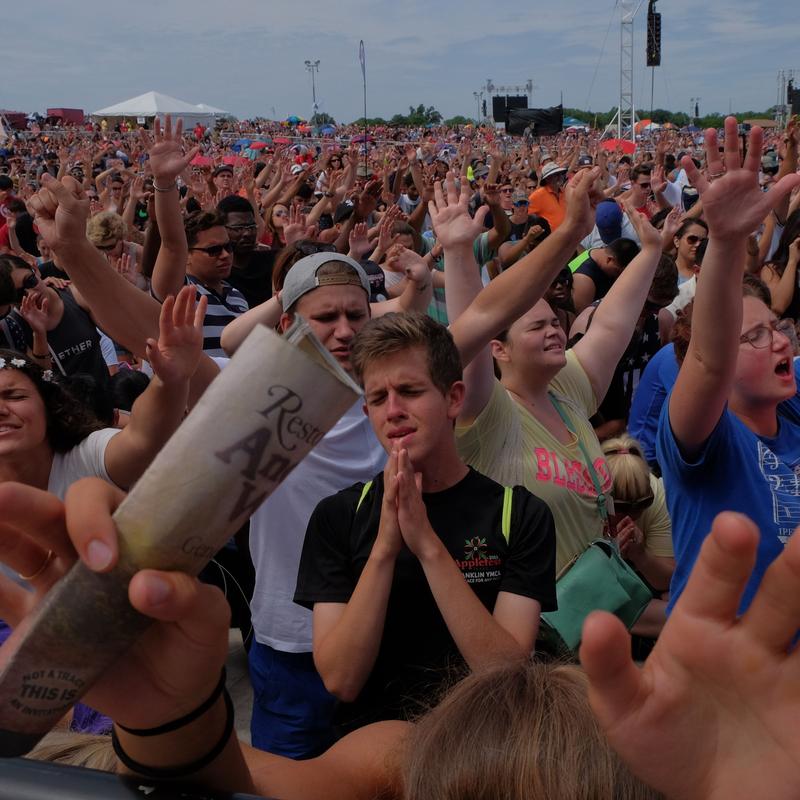
On this Good Friday, we will ask whether Christianity is actually making a comeback among Gen Z and younger Americans more broadly. From packed pews in cities and podcasters like Joe Rogan talking openly about going to church and reading the Bible, there is a notion among some that Christianity is back in vogue. Our guest, in just a minute from The Atlantic, will say that's a little bit true. In this year's State of the Union address, President Trump touted that and took partial credit with a shout-out to the late Charlie Kirk.
President Trump: I'm very proud to say that during my time in office, both the first four years and in particular this last year, there has been a tremendous renewal in religion, faith, Christianity, and belief in God. Tremendous renewal.
[applause]
Brian Lehrer: He continued.
President Trump: This is especially true among young people. A big part of that had to do with my great friend Charlie Kirk. A great guy, great man.
Brian Lehrer: How much of this is vibes and wish-casting by politicians on the right who see conservative Christian values as complementary to their worldview versus statistical reality? Our guest, Luis Parrales, staff writer at The Atlantic, took a hard look at the data behind the claims of a Gen Z Christian revival. His article is called "The Real Religious 'Renewal' Happening in Gen Z." He's with us now to share his reporting. Hi, Luis. Welcome to WNYC.
Luis Parrales: Hey, Brian, good to be with you.
Brian Lehrer: Your article starts at a church in Greenwich Village with a pretty young congregation. Want to start there with us?
Luis Parrales: Sure thing. I spoke with Father Jonah Teller, who is a Dominican friar and priest at St. Joseph's Church in Greenwich Village. Each week, they host something called In Vino Veritas, Latin for in wine there is truth. It's basically a gathering of young adults ages 18 to 35, and they talk about their faith in different dimensions of the faith. They might talk about the virtue of hope or the nature of freedom. They might look at art, they might look at church history. They might look at poems that touch on theological themes. Really, through this emphasis in conversation and community, Father Teller told me that young people are finding just a lot of excitement over questions about their Catholic faith.
Brian Lehrer: What's the data that you cite on U.S. Catholics as a whole?
Luis Parrales: The broad story of religion in America has been a story of a rapid decline since the 1990s, but more recently, a period of stabilization. US Catholics in particular are generally older, as with most Christians in the country. Over the past five years, something interesting has happened, which is the number of Christians has stabilized at around 60% of the population, and the number of people who don't identify with their religion, so that's atheist, agnostics, or nothing in particular, has stabilized a little bit below 30%.
Some of the numbers are different depending on which polling you look at. That's different, however, from what a lot of people have been talking about recently, which is talking about something more dramatic, or revival or renewal.
Brian Lehrer: Right. To give a few more data points on that, you cite the large number of millennials and Gen Z Americans who describe themselves as religiously unaffiliated compared to past generations. In the surveys that Pew and Gallup conduct, Pew found 29% of all respondents say they are unaffiliated, 44% of millennials and Gen Zers say they are religiously unaffiliated. Why do you think that is?
Luis Parrales: Well, there's a couple of reasons here. I think most of the time when we talk about religious disaffiliation, we focus on politics, we focus on ideology. I think that's certainly true, especially for the millennial generation, you found that some of the more traditionalist denominations, traditionalist beliefs ended up driving people away on questions like abortion, questions like same sex marriage. I think something that's interesting and worth considering here as well is the reasons for disaffiliation are often sociological, not ideological.
What do I mean by that? Millennials and especially Gen Z have been raised in a just considerably less religious milieu. Everything from going to Sunday school less frequently, or something informally as praying before meals. Those sort of childhood experiences carry over to adult religiosity; the less religiously laden childhood experiences, the less likelihood that you have of being religious when you grow up. I think that's a big part of the story.
Brian Lehrer: Now, listeners, how much does any of this sound like you? 212-433-WNYC. Help us report this story at 212-433-9692. Are you a millennial or member of Gen Z who is religiously unaffiliated, while your parents were affiliated when you were growing up? Tell us what changed from their generation to your generation and why, in your case? 212-433-9692. Are you a millennial or a Gen Z member who has recently gone toward traditional religion of any type? Tell us your story. Tell us why. 212-433-WNYC. 212-433-9692. You can also call if you are the older parents in this equation. Compare you and your Gen Z or millennial kids. 212-433-WNYC 433-9692. Call or text or call if you're a member of the clergy.
We're talking mostly about Catholics so far, Christians in general. This could also be true for you as Jews, Muslims, or leaders of any other religious faith. 212-433-WNYC. 212-433-9692 for Luis Parrales, staff writer at The Atlantic, who has written "The Real Religious 'Renewal' Happening in Gen Z." That article in The Atlantic. Did you cover this already? You write about two different interpretations of the growth in churches that attract members of Gen Z. You might have touched on this, but maybe you could go deeper. What are those competing interpretations?
Luis Parrales: Sure. I even hesitated to use the word debate in the piece, partly because it feels that where I feel that these two competing narratives about how Gen Z is relating to religion and traditional Christianity in particular aren't often in conversation. That's something that I tried to do in the piece. On one hand, you have people, whether that's influencers, politicians, pundits, as well as pastors on the ground, noticing that something is happening. Usually, with the language of religious revival, renewal among Gen Z, conversions to Catholicism or Orthodoxy, increased mass attendance, churches packed with Gen Zers. That's one interpretation.
When you talk to sociologists, demographers of religion, I think the ones that I spoke to largely acknowledged that that might be happening in particular communities or particular congregations. The story, by and large, is a story of stability, not a story of renewal or revival, which you would see happening across the country and in higher numbers. What I wanted to do is to ground this conversation on that important observation that nationwide, broad look at nationwide data, but at the same time, give due credit to what's happening in particular communities in particular congregations, especially in metro hubs or college campuses, where I do think there's some real excitement.
Brian Lehrer: Yes. For example, you spoke to a campus minister at the University of Michigan who described students coming to college with a quote, "Longing to be seen and known outside of achievement culture." How much of what you're observing is about Christianity specifically, or religion specifically, versus young people searching for community and something more than careerism when they go to college?
Luis Parrales: Yeah, that was one of my favorite conversations for this piece. I mean, I definitely think, and this extends beyond religion, that there's conversations around a longing for finding identity and community with others. I think what was interesting about that conversation with program coordinator at a campus ministry at the University of Michigan, who herself is a recent graduate, is that the way she described this type of community is this one that wasn't predicated on particular achievements. I asked her, "You're a student or were a student at a large campus where there are plenty of clubs, pre-professional or social, where you could find people with similar interests, career aspirations, and so on."
I think what she told me that she found in her own experience and what she tries to relay to students that she works with now, and the response she gets from students as well is that there's something about the religious component and in this particular case it was a Catholic campus ministry that adds something different to the sort of groups where students find community. That this was a community founded not on a sense of advancing your status in the meritocracy, but rather on your identity as a person being inherently valuable and full of dignity. That's a distinct Catholic principle. That students found that to be find that to be really appealing.
Brian Lehrer: Listener writes, "I think we Gen Xers saw so much neglect and hypocrisy. We turned away from our parents' religions and wanted our kids to have a chance to choose for themselves, so did not press any religion upon them, which is how Gen Z got this way, meaning so many unaffiliated." Interesting theory from a Gen Xer there. You're right. If you focus on particular communities like the college community at Michigan, it's hard to miss how some young Americans are discovering traditional Christianity anew.
I was curious reading that sentence, what you mean by traditional Christianity? Does that line up with political conservatism among those new young churchgoers? Are these J.D. Vance Christians, mostly converted to Catholicism, and we know his politics? Are they Charlie Kirk Christians who, you know, Trump shouted out Charlie Kirk in the State of the Union address, and the clips we played at the top? He, of course, was, before he was assassinated, a very politically hard-right person with a lot of those views; he would say, stemming from his Christianity.
Luis Parrales: Yes, I'm glad you asked this question. By traditional Christianity, I mean something a little bit more specific, which is long-established denominations, whether that be Catholicism or Orthodoxy, whether it's evangelical Christianity, whether it's the mainline. These are not all groups that are seeing the same kind of periods of enthusiasm right now among Gen Z. I didn't necessarily mean something or didn't mean to connote something political there. Now, I do think that when you speak to recent converts, there is a tendency, and I'm Catholic, sometimes Catholics joke about the zeal of the convert usually does translate to more right-coded priorities and messaging.
I don't think it's limited to that. I'll mention this, for example, within Catholic circles, we'll go a little bit in the weeds. Thank you for non-Catholic listeners for indulging this. Dominican friars. The parish that I went to in Greenwich Village is usually regarded as a bit more traditionalist, a little bit maybe more conservative. The parish that I went to in Michigan is run by the Jesuit order, which typically is considered to be more theologically progressive, more liberally coded. Both of these were places that we're seeing excitement among students. I think there's something to the political story, but I don't think the political story captures the entirety of what's going on here.
Brian Lehrer: Elmo, in Saddle River, New Jersey, you're on WNYC. Hello, Elmo.
Elmo: Good morning. One of my favorite shows in the whole world. It's so interesting that I see. Well, my religiosity is thus, that my grandfather was an Episcopal minister, priest, I should say, from Brown University, so my mother, a devout atheist, made me read the Bible. My question is this. Do we believe that this has anything to do with white nationalism?
Brian Lehrer: Luis?
Luis Parrales: Just to make sure that I heard, did you say white nationalism or nationalism more broadly?
Elmo: No, white nationalism, because the Catholic Church is based around a male-centered theocracy. There were no female disciples. The Pope is a male guy, although celibate, because when they got wind that their children were getting the riches from the exploitation of the Third World, they couldn't marry. My question is, what does Mr. Hedgehog's Jerusalem cross have to do with this? What does white nationalism have to do with, we didn't discuss this, a lot of young white people joining the Catholic Church?
Brian Lehrer: Elmo, thank you very much. When he says Hedgehog, for those of you who didn't get it, he's referring to Pete Hegseth. Of course, we could do a whole separate segment about the origins of priest celibacy in the Catholic Church, but his basic question is an important one. How much is this move, slight as it may be, toward Christianity among some young Americans, a white nationalist or white Christian nationalist, also patriarchal, from what he was referencing there, move?
Luis Parrales: Right. I guess two points. One to the immediate point, I wouldn't say that the reason for excitement among Gen Z to traditional Christianity is driven by white nationalism. I think I feel pretty confident about that. I do want to make a broader point, sort of how we talk about religion. I think one of the most interesting things about covering, about thinking about it, is that you really see the messages of the human experience just laid before you when you look at religion. That includes incredibly difficult and shameful periods of the past.
It also includes stories that just don't comport with our present political expectations. Let me give you one example. The piece that I wrote before this one was about a book that came out recently. The book is called Why I Am Not an Atheist. It was written by a novelist called Christopher Beha, who was the former editor of Harper's Magazine. His conversion story was essentially, look, he was Catholic, grew up Catholic. In his 20s, through a series of difficult life experiences, he fell away, kind of became deeply invested in atheistic thought.
In his early 30s, he met the woman who would end up becoming his wife, and felt that he didn't really have vocabulary to express just the love that he had for her. He ended up finding that framework and vocabulary through, in his case, Catholicism. I don't want to discount that there's definitely kind of politically coded motivations. I think you definitely see in the culture ways in which religion is used as a tool to advance politics. I also think that it would be a little bit too simplistic to leave the story there.
Brian Lehrer: Some texts that are coming in with people's stories. Listener writes, "Millennial here. I was raised in a very secular household and only started going to church in my late 20s. I still struggle with my faith. There's something to be said about the community in which churches build into and around somebody's life. The morals instilled and accountability from the church and its members within a person's life and throughout it are hard to find in any other places. We weren't meant to do life alone," writes that listener.
Another one. "As a member of Gen Z, I completely agree with your guest. A whole host of social and political factors make us all feel like the world is unstable right now. Especially for those of us who came of age with social media, we've grown up feeling more and more isolated, despite the illusion of connection. With so many of us experiencing the COVID-19 pandemic at crucial points in our lives, mostly late adolescence, the importance of in-person connection and community has become ultra clear to us. It makes perfect sense to me that members of my generation would find solace and connection in religious or spiritual spaces." Nicely written by that member of Gen Z. Let's go to Katie in Jersey City. You're on WNYC. Hello, Katie.
Katie: Hi, Brian. Thanks for having me.
Brian Lehrer: Sure. You have a story.
Katie: I do. I went to 16 years of Catholic school, and while my parents like to debate kind of theological principles, I would say deeply entrenched in it, but also questioning. Your guest today, Luis, you made me think of a lot of different things. One, I'm not practicing, but when I fill out a form, I would say that I'm Catholic. Why is that? I think it's, as I've gotten older, I've started to identify it as kind of a cultural background. Sure, you can take me out of the church, but can't take the church out of me sort of a thing. I think that that's one component that's happening here, of I can't deny how much of a force that was in my life, even when it was very social justice kind of themed and not traditional.
The other is that, you know, I'm 38 years old. I have friends with kids who were having discussions about how do you create a moral framework and what does that mean. My husband did not grow up with religion, but I did, and others who are seeking that out. Like a friend in Manhattan that says she grew up Catholic, but calls it her Mumford and Sons church. With guitars and culture.
I do see a broader kind of folks who have left the church because of what was happening with our queer friends or the sexual abuse in our formative college and high school years, but also friends of all backgrounds. I was at a DSA meeting of all places last night. Friends talking about being practicing Buddhists and inviting folks into that space to learn and explore about these different traditions. I think that it ultimately is kind of a community and cultural lean in my experience.
Brian Lehrer: Luis?
Luis Parrales: Yes. Thank you for the call. One of the things that your comments made me think about, and this is, hopefully, a future piece that I'll be writing is just, it seems to me that the kind of attitude towards religion for people who themselves were not religious in say the early 2000s, beginning of the 2010s, sort of the heyday of the new atheism was kind of combative, pugnacious by reflex. I've been seeing a lot more recently. This might be the new Knives Out movie that came out last Christmas.
It's just a movie that centers on a Catholic priest made by a former evangelical. I watched Taylor Tomlinson, she's a comedian who had a Netflix special earlier this year herself. Again, not religious, but speaks very fondly in some ways. She talks about religious trauma for sure, but it's also very clear to say that she really dislikes people, just offhandedly dismissing religion as a whole.
I do think there's something here for people who had past experiences with religion, oftentimes not positive, nevertheless holding on to some sort of cultural component, be that community, be that the moral aspirations that it offers, as opposed to kind of reacting antagonistically offhand for it. Though I will say, important as community is, sometimes I do wonder how much the theological principles help enable that community orientation. How much does a parable of the Good Samaritan emphasizing the importance of neighborliness extending beyond tribe? Something that also helps inspire a stronger sense of community.
Brian Lehrer: Thank you for your call and your story, Katie. We're just about out of time. At the risk of throwing a wedge in between members of the particular congregation in Greenwich Village that you wrote about, St. Joseph's in Greenwich Village, listener writes. "I'm a former parishioner of the Greenwich Village Church that is covered in the story. It's generational.
When it was run by boomer Dominicans, it was liberal. These newer Gen X and Z Dominicans are far more conservative and actually courting the right-wing young people. They went from having a soup kitchen every week to having the St. Joseph parish priests appearing on Fox News." I don't know if that's consistent with your reporting on St. Joseph's in the village, is it?
Luis Parrales: I don't know what it was like beforehand. I can't speak to sort of the political dimensions there. What I do think is true, and as a reporter and as a Catholic, I find this fascinating, is that you do have these sorts of generational and intra-Catholic kind of squabbles cropping up over time. I think that's real. At the same time, I do hope that some of the things that we might consider political, say, the outlet where someone speaks or the kinds of traditions that they hope to emphasize, need not be so.
Again, the description of the gathering that I opened the piece with, In Vino Veritas, was ultimately about questions of theology, questions of church history, questions of how you grow closer to God. Is there a case to be made that some aspects of Catholic teaching were not being emphasized, perhaps? I think that's a very fair question for someone who went to that parish to raise, but I don't think the political valiance necessarily needs to be the main thing emphasized there.
Brian Lehrer: Last question, also kind of in a political context, you end your piece by arguing that some of history's most consequential religious revivals, the abolition movement, the civil rights movement, were driven by small, committed countercultural communities, not mass revivals. Do you see anything like that in any direction coming out of this, even as narrow and community-specific bit of a revival that you're documenting here taking place?
Luis Parrales: Yes, again, I'd emphasize the data folks that I talked about before. I think it's too premature to call what's going on a revival, right now. The answer to your question about what the fruits of this moment will be, it really depends on the particular congregants and the particular parishes, I think, insofar as they take what I think is the best of religion. The way in which it points you towards higher aspirations and closer to your fellow human being, something really cool could happen, but it's too early to tell.
Brian Lehrer: Luis Parrales, staff writer at The Atlantic, his article, "The Real Religious 'Renewal' Happening in Gen Z." Luis, thank you so much for this. Listeners, thank you for your Good Friday stories about yourselves and people you know. Happy Easter to all of you who celebrate. Luis, thanks again.
Luis Parrales: Thank you, Brian.
Copyright © 2026 New York Public Radio. All rights reserved. Visit our website terms of use at www.wnyc.org for further information.
New York Public Radio transcripts are created on a rush deadline, often by contractors. This text may not be in its final form and may be updated or revised in the future. Accuracy and availability may vary. The authoritative record of New York Public Radio’s programming is the audio record.