
Irish Language Loss And Restoration
[MUSIC - CMAT: Euro-Country]
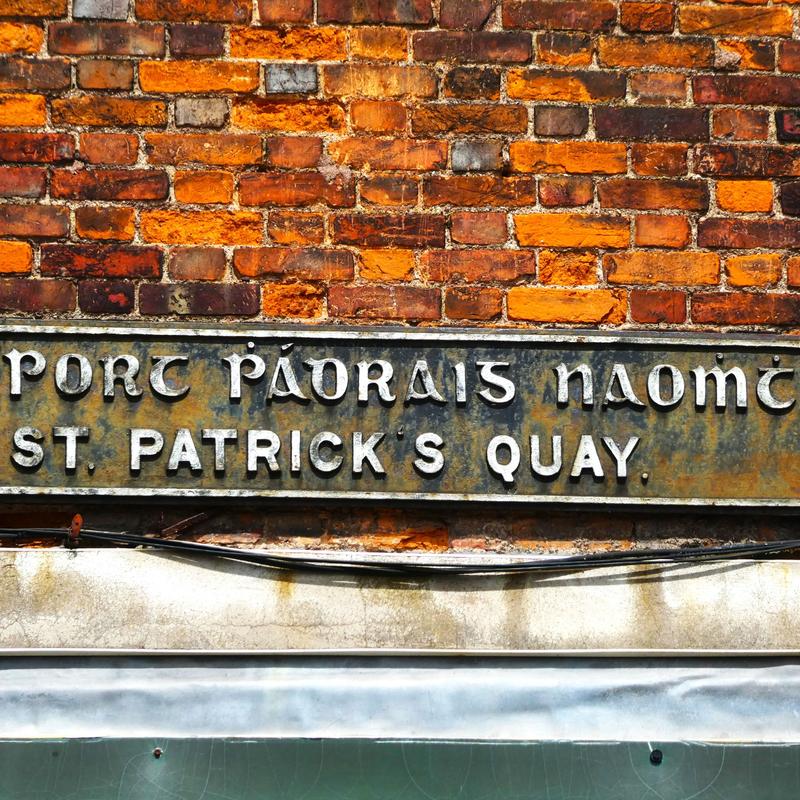
Brian Lehrer: It's not the Brian Lehrer Show theme. It's a young Irish artist named CMAT. That song is from her album, Euro-Country, which came out last year. If you couldn't make out the lyrics, that's because they were in Irish. I have a translation here that says, "What am I to do if I'm not meeting you? I have an empty head and a new personality. I become more invisible. You're gone from my life. There's nothing left in the mirror. Will I be beautiful bold?" For St. Patrick's Day, we're going to talk a little bit about the history of the Irish language, including a decline in speakers that many in Ireland are working now to reverse.
We're going to invite you to call up and say something in Irish if you have a favorite word or phrase. Joining us today is Nicholas Wolf, associate director for research and publishing initiatives at Glucksman Ireland House. That's NYU Center for Irish and Irish American Studies. Nicholas, happy St. Patrick's Day. Thank you for spending a little bit with us.
Nicholas Wolf: Many thanks. Brian and [Irish language]
Brian Lehrer: Whatever that means. What does it mean?
Nicholas Wolf: That means Happy St. Patrick's Day.
Brian Lehrer: Listeners, here we go. Our phones are open. This may be a needle in a haystack in New York these days, but if you speak Irish, not just if you are Irish, but if you speak the actual language of Irish at all, call up and say any word or phrase in Irish that you enjoy saying or that you think our other listeners would enjoy hearing. 212-433-WNYC. 212-433-9692. Again, if you speak Irish, call up and say any word or phrase in Irish that you enjoy saying or that you think our other listeners would enjoy hearing. 212-433-WNYC. This time, I'm not saying call or text. We want your calls. We want to hear your voice.
212-433-9692, or maybe you have a story about learning the language or not learning the language, because this is different generation by generation for people living in Ireland. 212-433-9692. Can you tell us first, how widespread is use of the Irish language in Ireland and why that has changed over the last couple of generations?
Nicholas Wolf: Sure. Surveys done in recent years still continue to show that between 40% and 50% of the population would claim a knowledge of Irish or would have used it recently. Many of them learn it in school, and so it's kind of a school-imparted skill. That's the good news. The bad news is that in terms of native speakers or speakers who use it daily, many of whom are located in the Gaeltacht, which is the region of Ireland that are designated officially as places where the language is spoken as a native language, you have something like 30,000 individuals in that category and maybe another 50,000 outside the Gaeltacht who claim to use it on a daily basis.
In terms of a living language, a language you use daily, even in Ireland, it is something that is under pressure for sure.
Brian Lehrer: By the way, I'm following your lead here, but why do we say Irish instead of Gaelic?
Nicholas Wolf: That is the official way that it is referred to in the English language. Interestingly, in Irish it is known as Gaeilge. Obviously, there's a similarity there between Gaeilge and Gaelic, but that is the official term that is used in legal terms and whatnot for the Irish language in English, interestingly enough.
Brian Lehrer: Fiona in Madison has a phrase in Irish she would like to say on the radio. Hi Fiona, Happy St. Patrick's Day.
Fiona: Happy St. Patrick's Day, Brian. My favorite Irish phrase to say to people is [Irish language] which means get home safely when they're leaving. Then the other thing I'd like to share, my husband has a t-shirt that says [Irish language] which means broken Irish spoken is better than clever English.
Brian Lehrer: Oh, very good. That get home safe, that was your first one. That assumes there wasn't an Irish goodbye, where people leave without telling anybody. [chuckles]
Fiona: That's not a thing in Ireland. That's really only a thing here.
Brian Lehrer: [laughs] Thank you for your call. Here's another one. Bill and Manasquan, you're on WNYC. Hi, Bill.
Bill: Hi, how are you?
Brian Lehrer: How are you?
Bill: I know my favorite saying is, [Irish language]
Brian Lehrer: Which means?
Bill: Which means, please may I use the bathroom? When you're a kid in elementary school in Ireland, in national school, if you want to be excused, you have to ask it in Gaelic. I grew up in London and spent all my summers in Ireland on a farm. If I wanted to join my cousins in their school classroom, I had to learn. [Irish language]
Brian Lehrer: Yes, you may, and thank you for calling. There is one Nick I bet you didn't expect to come up.
Nicholas Wolf: No. That's a good one, though. That's useful. [chuckles]
Brian Lehrer: There are so many more people on the board, we'll have some fun listening to some more callers with their favorite Irish words or phrases. By way of history, am I right that the language experienced a severe decline during British rule over Ireland?
Nicholas Wolf: It did. It's not necessarily a question of any single year or single event, but rather an erosion over many centuries. You'll recall that in the 16th century, Tudor conquest of Ireland removed a lot of the Irish-speaking ruling class, both Gaelic and Anglo-Norman, and a lot of the patronage that would have been for Irish language arts, particularly the poetry that was written at the time, beautiful poetry, often carried today in manuscripts that you can find in archives. Certainly, it didn't help that in subsequent years in the 18th and 19th century, Irish did not have an official status within the education system. In fact, it was frowned upon to be instructing anybody in Irish.
All the instruction was through English in Ireland, and even other important units of fostering language such as the church or the media. Neither of those were strongholds of Irish language speaking. During all those years up until independence in the 20th century, Irish language fortunes were under certain duress.
Brian Lehrer: Is there a global context for that of language endangerment globally as a function of colonialism?
Nicholas Wolf: Yes, absolutely. You see adoption of English in a lot of places around the world that were subject to British imperial reach. The only thing that we also have to keep in mind, though, is that there were high hopes at independence for that to change. Obviously, you have a post-colonial society in Ireland, throwing off that rule. Yet it's continued to be a struggle in the 20th and 21st century, that despite this national project to restore the language, since the 1930s, it's been one of the official languages of at least the Republic of Ireland.
Yet, through problems of resource allocation and just certain attitudes have sometimes undermined that project that was such bold statement at independence for Ireland to do that.
Brian Lehrer: Megan in Jackson Heights here on WNYC. Hi, Meg.
Megan: Hi, [Irish language] I'm just calling. I'm a third-generation part of the diaspora, and I am so excited to be connecting to my heritage, learning Irish. I think it's so important. I'm sorry, I'm getting so emotional, and of course, [Irish language] I would love to see a united Ireland in my lifetime.
Brian Lehrer: In your family, did the language fall out of use, and you're recovering it?
Megan: It's interesting. I have 32 cousins that I know that live in Dublin and a smaller city called Dundalk. I've visited them, they came to my wedding in New York. I've been to their weddings. In the part of the diaspora, yes, it definitely fell out, but my cousins in Ireland all speak their Gaeilge.
Brian Lehrer: We hear how much it means to you. Thank you so much for sharing that with us. Bruce in Westchester, you're on WNYC. Hi, Bruce.
Bruce: Hey, Brian. How are you?
Brian Lehrer: Good. What you got?
Bruce: I'm not Irish, but back in the '70s, I was a video producer in New York, and I had a client in the Irish tourist board. I learned what is my favorite Irish expression, which I'm sure I'm going to pronounce it wrong, but it went something like [Irish language] which means 100,000 welcomes. I just thought that was such a nice way to greet somebody.
Brian Lehrer: Nicholas, you want to take that greeting and talk to Bruce for a second?
Nicholas Wolf: Sure. [Irish language] 100,000 welcomes, as they often say, it's a wonderful phrase. It's one of many that are in the Irish language that are great to learn.
Brian Lehrer: Bruce, thank you very much. I think Jack and Neptune has an anecdote for us. Jack, you're on WNYC. Hi.
Jack: [Irish language] Thanks for taking my call. I was born and raised in Hudson County, and just about everybody I knew as a kid seemed to have someone at home, a grandparent, usually, who spoke another language. Most of my little friends were to some degree bilingual. I'm 100% of Irish ancestry. My grandparents did not speak anything but English. One day, I asked my grandmother why it was that we didn't have a home language like everybody else, and she said, "Oh, well, we did, but the English stole it." I was about 10 years old, and I decided right then, I said, "Damn it, I'm going to get it back."
Thanks be to God through personal study, through summer school in two wonderful institutions in County Donegal. [Irish language]
Nicholas Wolf: [Irish language] That's an amazing-- someone from [unintelligible 00:11:44] who can speak. They always--
Jack: [Irish language]
Nicholas Wolf: That's right. That's a great place to learn Irish.
Brian Lehrer: [chuckles] Jack, thank you so much for your call. We hear from our listeners that there seems to be a trend of trying to recover the Irish language. Is that the headline here?
Nicholas Wolf: Absolutely. This is like the golden age, I think, for doing it despite, obviously, the challenges of maintaining the language in Ireland. We have Irish spoken twice at the Oscars last night. It was amazing to hear that on that stage. And it's part of movies currently. [unintelligible 00:12:24] Banshees of Inisherin. You hear it there. You hear it in musical groups like Kneecap. It's a very amazing time presence for the language in media and with learning resources as well.
Brian Lehrer: Yes, Kneecap. There's Derry Girls. As if you thought we didn't watch the Oscars and pull this two-second clip of Jessie Buckley.
Jessie Buckley: [Irish language]
Brian Lehrer: Saying thank you for the award for her role in Hamnet. There we leave it with Nicholas Wolf, associate director for research and publishing initiatives at the Glucksman Ireland House. That's NYU Center for Irish and Irish American Studies. Thank you, and happy St. Patrick's Day.
Nicholas Wolf: [Irish language]
Brian Lehrer: [Irish language] Did I say that right? Thank you for joining us. Brian Lehrer on WNYC. Stay tuned for Allison.
[music]
Copyright © 2026 New York Public Radio. All rights reserved. Visit our website terms of use at www.wnyc.org for further information.
New York Public Radio transcripts are created on a rush deadline, often by contractors. This text may not be in its final form and may be updated or revised in the future. Accuracy and availability may vary. The authoritative record of New York Public Radio’s programming is the audio record.
