Iran is 'Prepared' For War
( Anonymous / Getty Images )
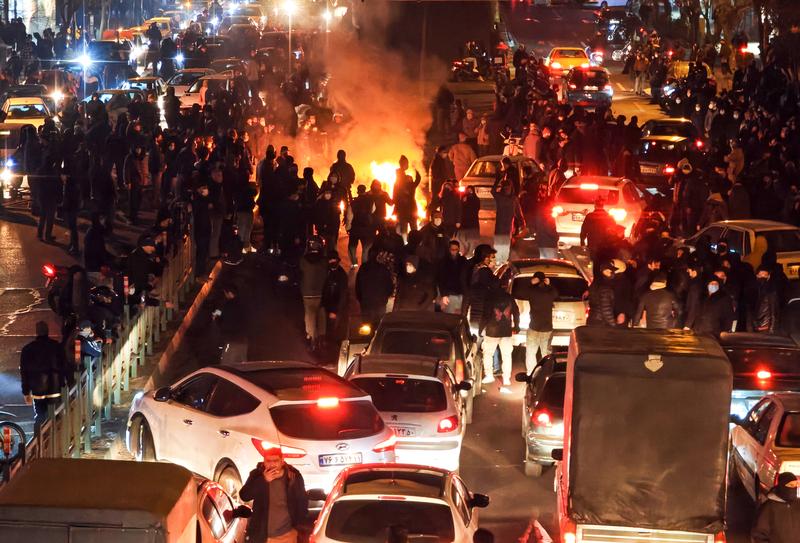
Amina Srna: It's The Brian Lehrer Show. I'm producer Amina Srna, filling in for Brian today, who is taking care of a family member. Now we turn to Iran, where mass protests against the country's regime have turned deadly. At least 2,500 protesters have been killed in a brutal crackdown by Iran's government. That death toll from a widely cited report by the US-based Human Rights Activists News Agency. The head of Iran's judiciary is saying that protesters, excuse me, detained by the security forces could face quick trials and executions. Yesterday, President Donald Trump weighed in. He urged protesters to continue on his social media platform, Truth Social, adding that he canceled all meetings with Iranian officials until the killings of protesters stop and that "Help is on its way." Joining us now to explain the political upheaval and why the US might get involved is Robin Wright, contributing writer and columnist for The New Yorker and author of several books on Iran. Her latest for The New Yorker is titled Iran's Regime Is Unsustainable. Robin, welcome back to WNYC.
Robin Wright: Great to be with you. Amina.
Amina Srna: Listeners, those of you with ties to Iran, help us tell this story. What, if anything, are you hearing and seeing from friends and family about the current wave of protests? 212-433-WNYC. That's 212-433-9692, or anyone else with questions or comments on Iran's protests, President Trump's remarks on U.S. intervention or potential intervention there, or anything else. 212-433-WNYC. That's 212-433-9692. As always, you can text that number.
Robin, you've spent a lot of time and written a lot of books on Iran. Let's start with the reality for Iranians on the ground. You write that the current protests erupted on December 28 after merchants in Tehran's lofty Grand Bazaar shuttered their shops as the value of the Rial, the national currency, went into free fall. How has inflation impacted life in Iran, and what happened that day?
Robin Wright: Just to put it in perspective, when I first went to Iran in 1973, $1 bought 70 Rials. Today, $1 buys 1.4 million Rials. Inflation in the past year has hit 40%. For food, it's above 70%. Life is untenable for growing numbers of people in Iran. The mission, the stated mission of the revolution, was to help the oppressed. Iran has utterly failed in providing basic things like water and electricity. It's done very little to improve the lives of the lower middle class as the revolutionary zone families seem to be doing very well.
Amina Srna: On December 28, the merchants in Iran, in Tehran in particular, shuttered their shops as a form of protest. Can you give us a little bit of a perspective of this merchant class and the symbolism behind shuttering their shops?
Robin Wright: One of the problems is that the shop owners have very few shoppers coming in to buy things. As business got bad, this was a way of signaling that the government needed to do something, that life was, for the Grand Bazaar, which is one of the truly remarkable old institutions in Iran, that they couldn't do business. What's interesting is in 1979, during the run-up to the revolution, the bazaaris were also the ones who shuttered their shops. There were three legs of society that brought down the Shah. The bazaaris first, the cleric second, and finally the military, when the military decided they wouldn't shoot on people.
We're in a similar situation today in that the bazaaris started it, and people are turning out. The question now is how far the security forces will go in obeying the orders to kill, arrest, and abuse Iranians on the streets, and even begin executing them.
Amina Srna: I've seen it reported that it's difficult to know just how big these protests are and what the protesters want. Some reports say protesters are chanting "death to the dictator". Others are calling for the royal family who ruled Iran before the revolution to return. Foreign reporters aren't allowed in the country, and the Iranian government is shutting down dissent online. What do we know about who's protesting in the demands?
Robin Wright: Well, that's one of the key questions. Just like the Arab Spring in 2011, Iranians know what they oppose, and they are acting decisively to make that clear. What's unclear is who will be the leader? What is their manifesto? What is their set of demands? I'm not sure they're at the point of the kind of unity that would transition easily to something else.
In comparison, in South Africa over decades, there was a leader, obviously, in Nelson Mandela, who was held behind bars, but in the background, there was the building up of the African National Congress as a party, as a military outside South Africa. There was the infrastructure, once white majority rule stepped aside, for a Black party and others to step in. We don't see that in Iran. Yes, you're right. The son of the exiled, now deceased Shah has advertised himself as a transition.
From my experience in Iran, and I've been going there now for over a half century, I'm not sure he has vast public support. He hasn't been there for a half century. I'm not sure that Iranians want the restoration of a monarchy. It's unclear what role he might be able to play in a viable way or in a long-standing way. I think that's one of the great problems. The protesters can destroy buildings, banks, and other things, but it's clear that we need to see a leadership and an organization emerge to make sure that there's something as an alternative to what has been an entrenched Islamic theocracy over the past 47, 48 years.
Amina Srna: Let's go to a call, Elon in Manhasset. Excuse me. You're on WNYC. Hi, Elon.
Elon: Hi. I wanted to call in because I'm Iranian-American, and most of my community in Long Island is a pretty significant Iranian-American population. Most of us here are really emboldened by the protests. It just gives me goosebumps just watching videos of Iranians protesting because, like you said earlier, Robin, I would say a substantial, perhaps majority demographic of Iran generally has a negative opinion of the regime now.
There's just from inflation to oppression, particularly the Kurdish population experiences, just a terrible, terrible, terrible oppression. It's almost like apartheid with the experience. The protests are a culmination of all of that anger that I think has built up over the past 30, 40 years now.
Amina Srna: Elon, thank you so much for your call. Robin, you wrote about this recently in your latest for The New Yorker, this culmination, and also maybe the distance from the Iranian Revolution in 1979. You note that we're coming up on almost half a century since the revolution took place. How do you want to weigh in on Elon's call and how that connects to your recent reporting?
Robin Wright: A couple of things. First of all, we're now in the third generation, and the vast majority of Iranians don't remember the Shah. They have a nostalgia for something else, but they don't remember the complaints or the sense of injustice that a lot of Iranians felt during the monarchy.
Secondly, what's really interesting, and it goes to his point, is that people in Iran and informal polls have indicated that 80% of the population, even 85% of the population is unhappy about at least one of the many flashpoints that have triggered these protests. The rule of thumb in political science is that if a regime has 30% of support, it can man the bureaucracy. It has enough for the security forces. It has enough, either through bribery, slavery, corruption, or taxes, to survive, at least for the regime itself, the members of government, economically.
We're at a point, I think that the regime has a hard core of support, but it's much smaller. Its supporters are older. When I go to Friday prayers, I see mainly gray-headed men and women. I think he's got a valid point.
Amina Srna: On the regime, a listener texts, "With the political void in Iranian leadership, would the Revolutionary Guard just step in and take over?" What would that look like? Do you have an idea?
Robin Wright: Yes, that's certainly a possibility. When you look at what happens next, does the Revolutionary Guard play a role? After all, it's not just a military force. It controls something like 60% of the economy in telecommunications, construction, and some of the big companies, corporations in Iran. It wants stability. It doesn't want its businesses as well as its standing as a military force to be disempowered. It, at some point, could move in. That's certainly one option that people have explored. The Latin American model, instability, and the military moves in and says it's going to pave the way for democracy. That takes a long process.
We really don't know what's going to happen next because we don't have a sense of who's the leadership as an alternative inside the country. I don't think any exiles are going anyway. It's just been too long. The military is one option, unfortunately.
Amina Srna: I want to play you a clip of something I heard this morning. NPR's Steven Inskeep spoke with Youseph Yazdi, a professor at John Hopkins School of Medicine, about his recent visit to Iran and participating in protests that he saw there. He is the son of a well-known Iranian dissident. Let's take a listen.
Youseph Yazdi: I think they benefit from the escalation of violence. For example, in one of the squares in the city near my mother's house, a major, very beautiful mosque was burned down, the square was trashed, and the government just plays those video clips ad nauseam on the state media. There's a video clip of somebody setting a right cop on fire, throwing stones. The escalation of violence really plays into their hands, and the government benefits from that because if the protests were nonviolent, I think the crowds would be 100 times larger, a thousand times larger, but people are hesitant.
Amina Srna: That went accidentally to our next clip to President Donald Trump. Before we move on to that, Robin, the U.S.-based Human Rights Activist News Agency is saying 2,500 protesters have died so far. I've seen reports of much higher numbers than that, but those are the ones that NPR and Reuters are reporting. Many have been detained and threatened with the death penalty. What do we know about the brutality of the government's response? Robin? Let's take a call while we get Robin back up. George in Manhattan. Hi, you're on WNYC.
George: Yes, good morning. Okay. I think it's so ironic, this entire discussion, because Iran was a perfectly democratic country until the United States had a coup against Prime Minister Mossadegh to remove him. Why? Because Prime Minister Mosaddegh nationalized the oil, and he didn't want to concede to the US interests in having the United States take over their oil production. After he was removed by the United States, the Shah was installed, and then there was the revolution thereafter. It's a very sad story, what's going on now, because that all happened because of what happened in the coup by the United States in 1953 to remove the democratically elected prime minister, Prime Minister Mossadegh. That has to be taken in context.
Amina Srna: Thank you so much for that historical context, George. I believe that we have Robin back. Hi, Robin.
Robin Wright: Hi, I'm back with you.
Amina Srna: I don't think that you heard George, but George was making a parallel tying in the current US intervention in Venezuela to how the US in 1953 installed basically the Shah. I think you had started going to Iran after that period, obviously. Any sort of parallels you see as we move on to talk a little bit more about US Intervention in Iran or potential US Intervention in Iran?
Robin Wright: I think it would be a terrible mistake for the United States to go in and try to take out the government officials, the supreme leader. I think this, again, would echo what happened in 1953 when the US put the shah back on the throne. Iranians have struggled for more than a century to achieve some kind of democratic form. The first elected parliament, the first constitution were both in Iran. It looked like the end of monarchy, and then a semi-literate army was the first Pahlavi king. He mobilized support. He pushed himself into power. That led to the two Pahlavi Shahs.
1953 was a moment when a democratically elected prime minister nationalized oil, which dissatisfied the United States and the outside world. The CIA and British intelligence managed to get the shah back from exile back onto the throne. Iranians have been trying ever since to get something that was really representative. Venezuela is certainly not a good model for Iran. I want to speak to the previous question, too, if you've got a second.
Amina Srna: Oh, yes, of course.
Robin Wright: Your caller was right in that if this regime survives through the use of force, brutal, ruthless force, then the protests will, in the very short term, be to their advantage for propaganda, but for propaganda only. We've seen sporadic protests since 2009 over very different issues. Fraudulent elections for president, the hiking of gas prices by 300%, and other price hikes for basic commodities. Then the Women, Life, Freedom, which was over personal freedoms.
Now we're back and with each of these that were flashpoints over specific issue, they grew into something that always ended up saying, death to the dictator, death to the ayatollah. They've all mobilized around this common theme of rejecting the system. That's why, even if it works to the benefit of the regime short term, my point is that the regime, as is, is unsustainable. The ideology is untenable. It has failed in every possible way. Without basic water, electricity, they can't afford to help boost the economy. Giving $7 per family a month is not a solution. That's the only thing the regime has offered.
Amina Srna: We have a listener to that point who writes, "I have never agreed with a murderous, psychotic, clerical leadership, but keep in mind that they thoroughly believe they have God on their side and will do what they must to maintain power." Robin, before I ask you about President Trump's recent statements, I think worth noting that economic sanctions have been reimposed by the US and Europe in part due to stalled nuclear negotiations, among other reasons. How much did these sanctions sink Iran's economy and put us to where we are today?
Robin Wright: Sanctions have clearly hurt the economy in Iran, but that's not the only reason that people are out mobilizing. The system itself has just failed. Remember that the United States had a deal with Iran that included Russia, China, and the three most powerful European countries. It's the one issue that the six major powers agreed to, and Trump was the one who walked away from it and led to this spiral of crises not related to inside Iran, but between Iran and the United States. This is what I'm concerned about. That we've created the crisis.
We had a nuclear deal that would have limited Iran's capabilities, left what they had for use only with building electricity, providing electricity, which Iran desperately needs, nuclear reactors, and they have a right to under the National Non-Proliferation Treaty. The United States has created a crisis with Iran that gives us pretext, or Trump believes, gives us pretext now to take military action. That's not going to solve the problem of the nuclear issue either. We're now in a very complicated situation that I'm not sure massive military strikes by the United States will solve.
Amina Srna: To that point, President Trump has weighed in on the Iranian protests several times over the past few days. As we mentioned at the beginning of this segment, he posted on Truth Social that help is on its way to the protesters. Here he is speaking to CBS News yesterday.
Donald Trump: We don't want to see what's happening in Iran happen. If they want to have protests, that's one thing. When they start killing thousands of people, and now you're telling me about hanging, we'll see how that works out for them. It's not going to work out good.
Amina Srna: Robin, you were talking a little bit about proposed military intervention and not seeing that as being a viable solution. As of Yesterday, Elon Musk's SpaceX began providing free Internet access via its Starlink satellite service to users in Iran. What about non-military interventions? Have you looked into any of what might be on the table or what people are talking about in Washington?
Robin Wright: I'm not in the inner circle of the Trump administration, so I can only, as an analyst and long-standing Iran expert, think about what's worked in the past. Cyber operations would probably be very effective as Stuxnet was in limiting or hurting Iran's nuclear program. There are ways of taking up communications among the military leaders within the political system so that they're the ones who can't communicate with each other.
I think they are mobilizing the international community to speak with one voice. I think trying to take leadership on behalf of the world is going to be hard without it backfiring, like it did in 1953. Remember, actions take a long time. They are looked at from history, and this could backfire on us.
Amina Srna: Let's go to a caller who's reflecting. A couple of texters that we're also getting. Arthur in St. Albans, Queens. Hi, you're on WNYC.
Arthur: Thank you for taking my call. I won't touch on Mosaddegh because the other caller did. All I can say is that we were being, at least in the past at some time, led by people whose professions or being diplomats and politicians. Even with George Bush, when he told the people they could go ahead and fight Saddam, and then later he had left back in '91. Right now, you have the back of the class leading-
Amina Srna: Did we lose Arthur?
Arthur: -like it's 1950, and look at what you're doing in this country today. That's really what I wanted to say. You're telling them, don't kill people over there, but look at what's happening to protests here in America.
Amina Srna: Arthur, thank you so much for your call. Robin. Yeah, we're getting a lot of texters. How can anyone take Trump seriously about being against killing protesters when he's encouraging abuse and killings of protesters here in America? Others saying, "I don't care about what's happening in Iran other than why Trump and his team are pursuing US involvement in this dysfunctional country?" Pretty much U.S. staying out of the Middle East. I wanted to and I wanted to reflect that sentiment from the callers.
Before I let you go, I wanted to ask you about how you compare the current situation in Iran to the Arab Spring, which toppled leaders in Egypt, Libya, Tunisia, Yemen. What lessons do you think the Arab Spring could provide for Iran?
Robin Wright: I think there are many comparisons because just like the Arab Spring, the protesters in Iran don't have the organization. I don't think they have the political maturity as an institution to provide an alternative. Therefore, that gives the edge to those trying to repress them or marginalize them, detain them, or imprison them. Democracy also, as has been written widely in political science, takes three generations or three waves. You don't, with one fell swoop like a light switch, go from an autocratic or authoritarian or fascist regime to something that's democratic. It's a very difficult process. There are failures before there is some kind of sustainable success.
If the protests are contained this time, that does not mean this regime is going to survive long-term. I believe after covering this place for so long, after seeing so many protests, that the majority of Iranians really are fed up. The fact that they're still protesting with the knowledge of how many are dying and what the regime is threatening, and the numbers who are being detained, and that they're continuing, even if it peters out. The fact that they've tried so hard at such expense, I think, tells you that the regime is going to continue to face challenges, whether it's this time, next time, but the regime can't survive long-term, as is.
Amina Srna: Robin Wright is a contributing writer and columnist for The New Yorker and author of many books on Iran. Robin, thanks so much for coming on the show today and explaining all of this for us.
Robin Wright: So good to be with you.
Copyright © 2026 New York Public Radio. All rights reserved. Visit our website terms of use at www.wnyc.org for further information.
New York Public Radio transcripts are created on a rush deadline, often by contractors. This text may not be in its final form and may be updated or revised in the future. Accuracy and availability may vary. The authoritative record of New York Public Radio’s programming is the audio record.