[MUSIC - Marden Hill: Hijack]
Brian Lehrer: Brian Lehrer on WNYC. Now, more Iran coverage. Earlier, we talked to a White House Foreign Policy reporter covering the Washington angle. Now we've got The New Yorker's Iran and World Affairs Expert Robin Wright. She's the author of books including The Last Great Revolution: Turmoil and Transformation in Iran. Robin, we always learn when you come on with us. Welcome back to WNYC.
Robin Wright: Hi, Brian. Such a difficult time right now.
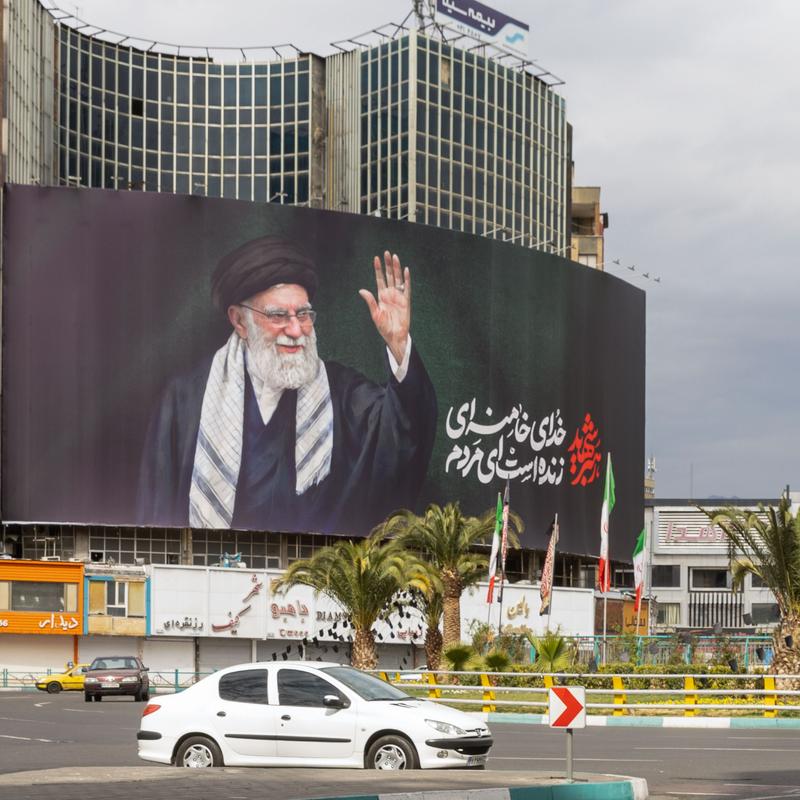
Brian Lehrer: Yes. And I see your latest article is called What Ayatollah Ali Khamenei Meant to Iran and What Comes Next. Let's take each of those separately. I see you had breakfast with Khamenei way back in 1987, before he came to power as the supreme leader, and you found him naively arrogant about theocratic rule. You wrote, "Naively arrogant about theocratic rule." Why did you use those words?
Robin Wright: I met him when he was president of Iran, a position he held for eight years in the 1980s before the death of the revolutionary leader Ayatollah Khomeini. It was his only trip to the United States, or in fact, to the West. He spoke at the United Nations, and I had a working breakfast with him. I thought, because of his lack of travel or education or contact with the West, that he was petulant and furious about the past US interventions in Iran and quite a bit naive about how to deal, how to close the gap.
Remember, this is at a time that Iran was at an eight-year war with Iraq and Iran was fighting back, but it was at the time the US was providing intelligence to Saddam Hussein, the president of Iraq, for him to use chemical weapons against Iranians. This was one of the probably the toughest time in US-Iran relations before the current war. It was really interesting to meet the first revolutionary leader to come out to the outside world after the 1979 revolution. It was a really interesting moment.
Brian Lehrer: We know about the protests since December, and that the Khamenei regime was willing to kill thousands of protesters in the streets. All the reports say thousands. What is the protest movement about? What mix of economic grievances and freedoms for women and others from the authoritarian theocracy?
Robin Wright: The protests began in 2009 over a fraudulent election, at least that's what many Iranians believed. Millions took to the streets across the country. The protests ran on sporadically for about six months. Since then, since 2017, particularly, there have been protests over issues such as price hikes over gasoline, which we may be seeing ourselves and the hardships of daily life. We saw in 2022 the protest movement over personal freedom in the Woman, Life, Freedom movement. There have been many triggers for protests in Iran.
One of the difficult things at the moment is that the regime arrested tens of thousands of people since the current protests began in December. When the United States is calling for regime change, many of those who might be out in the streets protesting and demanding something different are in jail.
Brian Lehrer: Now, let's go on to what comes next. Your article asks, can the regime survive without Khamenei? Can you describe this three-person committee, people appointed by him, I believe, prior to his death, and how you see their goals or their hold on power?
Robin Wright: There was always a system in place that there would be a three-person council to run until a new supreme leader was picked. The mechanism for that selection is in the hands of 88 senior clerics who were popularly elected, who then make the decision, who select the supreme leader. It's comparable to the College of Cardinals in picking a pope. Until that selection, the president of Iran, the head of the judiciary, and a senior cleric who is a member of that assembly of experts are running the show. Now, how they're running the show is hard to see, given the military conflict and the fact that so many of the leaders, military and apparently political, have been taken out.
I think this is a tenuous moment for the regime. It's a tenuous moment for the protesters and for the Iranian public in trying to understand. I think there are a number of options. One is that there's a new supreme leader who doesn't have quite the credibility or the leverage that Ayatollah Khamenei had, but the system stays in place. The second is that the Revolutionary Guards, who have enormous political sway, whose veterans have seats in parliament, and who have their tentacles in the economy, whether it's telecommunications or construction. The third option is that there is some kind of regime change. The problem is that no one knows how that regime change happens in a country of 92 million people. There are a lot of young Nelson Mandelas, but there is no African National Congress, which was the group that Nelson Mandela led, that had an infrastructure, organization, leadership, and so forth. There's no obvious alternative in Iran.
Brian Lehrer: How divided is the Iranian public? I think what most of our listeners have heard is one of the clips of President Trump saying, "It's on you now, Iranian people. We overthrew Khamenei, killed him. Now, you have to rise up and take back your country." This is a 90 million people country. It's a lot bigger than Venezuela or even Iraq. Plus, there is the Revolutionary Guard and other security forces. How much is the Iranian public divided over even that as a goal? I have seen there have been pro-regime demonstrations in the streets, as well as other Iranians dancing in the streets at the death of Khamenei.
Robin Wright: You're right, Brian. As always, there's a bifurcated response. There were people in the first night dancing in the streets and honking their horns, and celebrating, but there were also millions who turned out to mourn the supreme leader. This is where there is a division between the anti- and pro-regime factions. Even among the public, they don't have the unity that would lead us easily or quickly to a new regime. As I said, many are in jail, and there's no obvious leadership alternative.
The reformers, who at one point appeared to be the hopeful alternative to the hard-line faction in Iran, have been marginalized. Some of them, including the leader of the takeover of the US Embassy, are now in jail. Many of the reformers were arrested at the end of the protests. As you rightly point out, the military still has the tools to repress. The real question is, what will the military, particularly the Revolutionary Guards, do? Will there be the kind of defections that led to the demise of the monarchy in 1979?
We have not seen any signs of that yet. We may in the days to come. Iran has over 600,000 people, men largely under arms in the military, conventional as well as Revolutionary Guards, the police, all kinds of levels of security forces. It can rally more than a million if it calls up reservists and paramilitary forces.
Brian Lehrer: Here's a clip of Trump from his Saturday morning video that isn't getting as much play as the one in which he urged the Iranian people to rise up. Listen to what he urges and puts on the table here.
President Trump: To the members of the Islamic Revolutionary Guard, the armed forces, and all of the police, I say tonight that you must lay down your weapons and have complete immunity, or in the alternative, face certain death.
Brian Lehrer: That makes it sound like there would be a big surge of US troops, and they're going to try to kill every one of those hundreds of thousands of armed security forces who don't give up their weapons and defect. That can't be what he's planning.
Robin Wright: My initial reaction on hearing that was, "Dream on." Who's giving them immunity? Is this the current regime or the new supreme leader and the new government? Is this the United States? Who makes those decisions? Does the US Have a list of all of the hundreds of thousands of military forces? I thought that was a very naive line. There are aspirations, maybe, but how do you do that?
We had the same problems when we dealt with the wars in Iraq and Afghanistan, that when we tried to form governments in both places, it didn't go well, and it led to insurgencies in Iraq that became ISIS. In Afghanistan, the Taliban came back and seized power in our longest war. This is where we just don't know so much
Brian Lehrer: In our last minute, I wonder if you can give us a take on other countries in the region, because Iran responded by attacking a whole list of Gulf states in addition to Israel, of course. But my question is about the Gulf states, seen as US allies or otherwise enemies of Iran in some way. Qatar, Bahrain, Saudi Arabia, Oman, I think so. Did the Gulf states want this war?
Robin Wright: No, absolutely not. I think the crown prince in Saudi Arabia reportedly was urging Trump to start this war, even though he was publicly saying he didn't want war. I think none of these countries wanted to become targets of Iran's response. We've already seen the fallout, the three planes shot down today in friendly fire by the Kuwaitis and Americans died in Kuwait over the weekend. This is playing out ways across the Persian Gulf that I don't know that the United States anticipated.
I think President Trump said today, I think maybe to CNN or one of the shows, that the US didn't expect that widespread response by Iran.
Brian Lehrer: Robin Wright from The New Yorker, her latest article, What Ayatollah Ali Khamenei Meant to Iran and What Comes Next. Thank you so much for sharing your insights with us, Robin.
Robin Wright: Thanks, Brian.
[00:12:41] [END OF AUDIO]
Copyright © 2026 New York Public Radio. All rights reserved. Visit our website terms of use at www.wnyc.org for further information.
New York Public Radio transcripts are created on a rush deadline, often by contractors. This text may not be in its final form and may be updated or revised in the future. Accuracy and availability may vary. The authoritative record of New York Public Radio’s programming is the audio record.