
International Law, War Crimes and the War In Iran
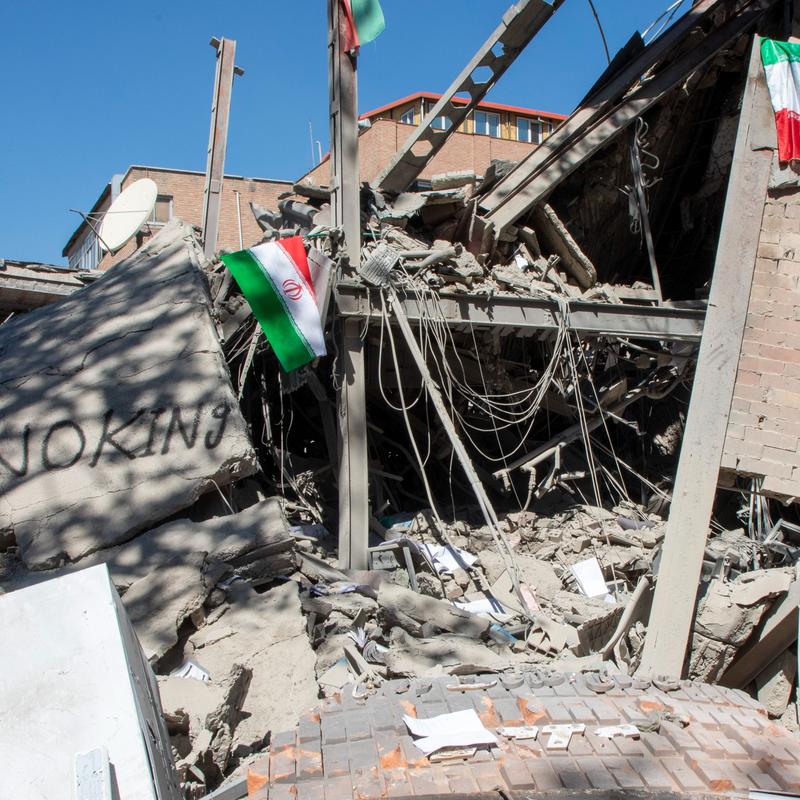
Brian Lehrer: It's The Brian Lehrer Show on WNYC. Good morning, everyone. The two-week ceasefire between the US and Iran is the headline. We'll talk about some of the details, and what might come next. For our lead conversation today, we want to focus on what almost happened, which might still happen in around two weeks from now, and which is still happening right now in Lebanon. The purposeful destruction of civilian infrastructure, and the killing of many civilians to achieve a military goal.
It's still happening in Lebanon, because Israel did not fully sign on to the ceasefire with respect to that front in the war, as I'm seeing it reported. Of course, Iran and its proxies have not been shy about killing civilians either. We have two guests, including a former chief legal advisor for international law at US Central Command, but I want to start with some clips from the 2004 movie The Fog of War. It was a documentary built around an interview with former US Defense Secretary Robert McNamara.
He was an architect of the Vietnam War under Presidents Kennedy and Johnson in the 1960s, but arguably, the most striking part of that film was when McNamara spoke about the role of the United States in ending World War II, and spoiler alert, he says we committed war crimes. I'm going to play a few clips in this first one, 45 seconds. He references General Curtis LeMay, who ordered the dropping of the nuclear bombs on Hiroshima and Nagasaki, but focuses here on what the US did before that in Japan.
Robert McNamara: Why was it necessary to drop the nuclear bomb if LeMay was burning up Japan, and he went on from Tokyo to firebomb other cities? 58% of Yokohama. Yokohama is roughly the size of Cleveland. 58% of Cleveland destroyed.
[music]
Tokyo's roughly the size of New York. 51% of New York destroyed. 99% of the equivalent of Chattanooga, which was Toyama. 40% of the equivalent of Los Angeles, which was Nagoya. This was all done before the dropping of the nuclear bomb, which by the way, was dropped by LeMay's command. Proportionality should be a guideline of war.
Brian Lehrer: Proportionality should be a guideline of war, so did he think the US acted proportionately in what he described regarding Japan?
Robert McNamara: Killing 50% to 90% of the people of 67 Japanese cities, and then bombing them with two nuclear bombs, is not proportional in the minds of some people to the objectives we were trying to achieve.
Brian Lehrer: Here's Robert McNamara's conclusion. One more 45-second clip.
Robert McNamara: The US-Japanese war was one of the most brutal wars in all of human history. Kamikaze pilots, suicide-- Unbelievable, what one can criticize, is that the human race prior to that time, and today has not really grappled with what are I'll call it the rules of war. Was there a rule that said you shouldn't bomb, shouldn't kill, shouldn't burn to death 100,000 civilians in a night? LeMay said, "If we'd lost the war, we'd all have been prosecuted as war criminals," and I think he's right. He and I'd say, I, we're behaving as war criminals.
Brian Lehrer: Former US Defense Secretary Robert McNamara, a leader in escalating the Vietnam War, looking back on World War II in the 2004 film The Fog of War, some context to keep in mind, as we discuss what President Trump is still threatening in Iran, and what Israel is doing in Lebanon, and also what Iran and its proxies do. My guests for this conversation are former Lt. Col. Rachel VanLandingham, Professor of National Security Law, now at Southwestern University in Los Angeles, and she was a former-- She was the Chief Legal Advisor for International Law at US Central Command, where she advised on international law issues related to the Iraq and Afghanistan wars, and Eliav
Lieblich, Professor of International Law at Tel Aviv University, and author of books including International Law and Civil Wars, and Occupation in International Law. He joins us from Tel Aviv. Both our guests are contributors to the journal Just Security, which focuses on national security, democracy, and the rule of law. Professor Lieblich is on their editorial board. Professor Lieblich, Colonel VanLandingham, thank you very much. For some time today. Welcome to WNYC.
Rachel VanLandingham: Thank you so much for having me.
Eliav Lieblich: [crosstalk] Likewise.
Brian Lehrer: Colonel VanLandingham, before we get into the present moment, I'm curious for you. As a former chief legal advisor for international law at US Central Command, as a matter of history, how much did the US bombing of Japan in World War II, as described by Secretary McNamara in those clips, set the terms of the debate for the Geneva Conventions on protection of civilians during times of war, which came after World War II, or codes of conduct for the Pentagon as a matter of US Policy?
I know this is a big opening question, but those McNamara clips are chilling. They're about the United States, and about what Americans generally consider the last unambiguous, righteous war, World War II, contextualized very differently by him there.
Rachel VanLandingham: Thanks, Brian, and please refer to me as Professor. It's been over a decade since I've worn the uniform. It's hard to parse out the impact of the specific operations that Secretary McNamara was describing there, in particular, the dropping of the atomic bombs in Japan. I think the modern Geneva Conventions, modern, being that they were updated in 1949 in direct response to the massive scale of human suffering that was incurred during World War II, so I think it's all of it, right?
The entire panoply of the body of international law, and it's not just international law. What the United States is party to, and believes is binding on it as part of US law, and has been institutionalized and incorporated within a plethora of US laws and Department of Defense regulations, but these things were all a reaction to the massive suffering. Of course, as after every war, there's the victors claiming, "Hey, look, we were the good guys here," as you mentioned, with the idea of it was the last righteous war, but the United States did engage in massive inflection of human suffering as well, and it's not like distinction.
The division of the battlefield between civilians and fighters, and military objects and civilian objects was brand new after World War II. Now, it did exist during World War II, but it was the fact that, that line was hurdled over by both sides, right? The firebombing in Dresden, and of course, you have the bombing of London by the Germans, by the Nazis. You have a plethora of examples of how civilians became targets during World War II by both sides, so I wouldn't want to attribute it particular just to what happened in Japan, or any particular one in operation in Europe.
It was the massive total, the millions and millions and millions of civilians that not only suffered, but that actually gave up their lives. That died during World War II, and then you had the atomic genie, now the nuclear genie, out of the bottle, and the world leaders said, "We just can't. We have to actually put restraints on this." Those restraints would be a doubling down, a reinforcement, additional supplemental rules to actually operationalize the idea that civilians are to be protected, and civilian infrastructure, civilian property, is to be protected during war as much as feasible, because we still have to balance it against military necessity, these laws.
The law of war is not a suicide pact, so to answer your broad question with a broad answer, the answer is, yes. I mean, the modern international humanitarian law, as many of our allies call it, but the United States calls it the law of war, the law of armed conflicts that, I think, rightly focuses on the fact that it deals with violence, it deals with war. This isn't very humanitarian. It has humanitarian ends to lessen human suffering during war, and stop that is the goal for the laws that govern the conduct of warfare, the means and methods of warfare, and provide protections for those caught up in war, such as prisoners of war.
At the end of the day, the law of war allows for a massive amount of lawful violence, and so the United States focuses on law of war, law of armed conflict, and recognizes that there are lines that cannot be crossed, because we don't want a World War III. We don't want the level of suffering that the world incurred in World War II, and the United States did participate in US as, or did contribute to, but the understandings today are very much colored by and influenced by, and of course, the law is grounded in a renewed appreciation for the need to have restraint during war due to World War II.
Brian Lehrer: Professor Lieblich, any thoughts on that same question before we move toward the present?
Eliav Lieblich: Yes, but I would just add that another very important development post World War II has to deal with the level of the legality of the resort to force, so Professor VanLandingham is, of course, correct to point out that the laws of war, or laws of armed conflict developed in response to a lot of the human suffering during the time, but not less important is the fact that only after World War II, we have a very clear prohibition on the resort to aggressive force to begin with, which is another level of analysis.
Brian Lehrer: Now, let's talk about today. Professor VanLandingham, I see you co-authored an article on the Just Security website called When War Crimes Rhetoric Becomes Battlefield Reality. The context, of course, is what all our listeners have been hearing about. Before the ceasefire agreement last night, President Trump's historically unprecedented post on Sunday that called the Iranian regime, "Effing bastards," that sarcastically and offensively included the words, "Praise Allah," and the threat that Tuesday would be, "Power plant day and bridge day, all wrapped up in one, each and every one of their electric generating plants," and here he is on Monday, reinforcing the threat.
Donald Trump: We have a plan, because of the power of our military, where every bridge in Iran will be decimated by twelve o'clock tomorrow night, where every power plant in Iran will be out of business, burning, exploding, and never to be used again. I mean, complete demolition.
Brian Lehrer: Trump on Monday, and as if all that wasn't enough, he posted on Tuesday that Iran's, "Whole civilization will die," if Iran didn't make a deal with him. Professor VanLandingham, would you define that as threatening genocide?
Rachel VanLandingham: Well, at the minimum, it's threatening the war crime of indiscriminate attack. It's completely repudiating the fundamental premise of the law of war, which is that we're going to divide, and we do divide the battlefield into, "combatants, fighters, belligerents, military assets, military objectives, and protected civilians," so at the minimum, it's the threatening of a war crime, and indeed can constitute, as my colleague and I wrote about, a war crime in and of itself, which I can address in a moment.
It sounds like it mirrors the last threat. The very last one about destroying an entire civilization. I mean, we go back to the Genocide Convention, which, again, is a result of a direct reaction to the holocaust of World War that occurred during World War II, and it speaks to genocide as acts committed with intent to destroy in whole, or in part, a national, ethnical, racial, or religious group, and then it gives examples. The threat to eliminate an entire civilization is incredibly chilling, and does reverberate with the concept behind the atrocity crime of genocide.
Brian Lehrer: Professor Lieblich, does anything about international law preclude even that kind of language, or should we just shake our heads at the words, but focus on actions as what really matter?
Eliav Lieblich: Well, on two levels, I think that international law has something to say. First of all, the laws of armed conflict themselves prohibit spreading terror among the civilian population, so threatening to wipe out an entire civilization, or to destroy all of the power plants, which actually results in reverberating effects like destroying health care, sanitary conditions, food stocks, and so on and so forth, so that spreads terror in itself.
In addition, to the extent that we can, I think it's an open question, but to the extent that we can interpret this as a threat to commit genocide, that in itself is also international wrongful act, so, of course, focusing on actions is important, but I also think that we should take words seriously, because words also legitimate actions, and words by a commander-in-chief also resonate with the troops on the ground and convey expectations.
This also has to do with a lot of things that we're hearing from the Secretary of War Hegseth, things that leadership says resonate on the field, so I would take them seriously, even if we have a tendency to just see them as tweets that have not been thought out well enough.
Brian Lehrer: Professor--[crosstalk]
Rachel VanLandingham: Can I jump in there for a second?
Brian Lehrer: Sure.
Rachel VanLandingham: I can't agree more strongly with my colleague than I do, and that's why I wrote about when rhetoric, war crimes rhetoric, becomes a battlefield reality that too many individuals want to excuse, or just minimize the commander-in-chief, President Trump, the President of the United States comments as pure bombast, or a bullying, a negotiating tactic, when the Actual threat to eliminate an entire civilization as well.
I mean, and coupled with this previous threats to destroy every power plant, and every bridge in the country of Iran of 93 million people, those statements in and of themselves are criminal. They are criminal, and they send a completely different message, the inverse of message to the US service members who are actually fighting, and even if it's purely subconsciously, it can seep into the rigorous processes and determinations and assessments of what the lawful way of lawful fighting, of determining lawful military objectives.
Because in each one of the assessments that is supposed to be individually made, for example, for a lawful target, for to first identify what is a lawful military objective, there is going to be some subjectivity, and that subjectivity can be inappropriately colored by, influenced by commander's intent when you have the commander-in-chief making criminal statements, because as my article noted, as Eliav just accurately noted, you cannot threaten.
The law of war prohibits threatening civilian populations, and that includes threats of violence with the intent to sow terror amongst the civilian population. We can infer that President Trump intends the natural and probable consequences of his words. It's reasonably foreseeable that Iranian civilians will be terrified to hear that their civilization was going to come to an end last night, so we can infer that he intended that. That in and of itself is criminal, and it's the reverberating effects of that rhetoric of those words on actual tactical level decisions by service members all the way from strategic to operational, but really the tactical level, those reverberating effects cannot be ignored. I mean, and we ignore them at our peril.
Brian Lehrer: You also said such threats could put US service members at physical risk. How so on that? You wrote that in your article.
Rachel VanLandingham: Sure. I mean, you think about, especially with the regime, the Iranian regime, the enemies that the United States and Israel are facing, Iran and its proxies, Hamas, Hezbollah, Houthis, who have shown zero respect traditionally for the actual law of war, for actual following what the international community tells them, and everyone agrees that they ostensibly are going to follow.
They've shown zero respect for that, except for to try to gain some kind of legitimacy, the whole lawfare concept. If Iran hears this, why not just rain complete destruction and terror on its neighboring Gulf countries? It's already engaged in some indiscriminate attacks, some attacks that do not seem to be to comport with, at least based on the effects and the intelligence out there, to comport whatsoever with the law of war. Well, where's-- Why exercise any restraint after hearing that, if the United States isn't going to be bound by the law, why would anybody else?
Brian Lehrer: Listeners, some of you are calling and texting already, I see, and we invite your comments, or questions on international law, and the way the US and Israel, and Iran and its proxies are conducting the war short term and longer term. Later, we'll get to decoding the terms of the ceasefire. 212-433-WNYC, 212-433-9692, call or text. Professor VanLandingham I'm going to stay with you for another question before we bring Professor Lieblich back in from Tel Aviv.
In your Just Security article, you wrote, "Iranian power plants and other critical civilian infrastructure are protected from attacks by the laws of war the United States helped craft after World War II. Such an object can lose its protection only if it is used for military purposes by the enemy, and its destruction offers a definite military advantage." I guess, as we start to talk about the exact targets that President Trump was threatening, how do you, or how do the Geneva Conventions define military purposes for things like bridges and railways that might generally be considered civilian?
Rachel VanLandingham: Sure. I mean the actual language from the law, from what's called Additional Protocol 1, it's a supplemental treaty to the Geneva Conventions. The United States is not a party to it, but it has acknowledged that it believes the vast majority of it constitutes binding, what we call customary international law on the United States, and we've incorporated into things like the Department of Defense Law of War Manual into operational targeting processes.
A lawful military objective is one that, by its nature, location, use, or purpose, that is its current use, or future intended use, provides an effective contribution to military action. It does not have to be direct. It's just effective contribution to military action, and whether the targeting would, under the circumstances, whether we're going to neutralize it, or actually destroy it, provide a definite military advantage. Mind you, this is only step one of what I view as a tripartite targeting process for the legality, so there's still other steps that have to be taken.
The fundamental step, and the one that President Trump's comments over the last several weeks regarding targeting, destroying all bridges, and all power plants, the fundamental first step is that you have to discriminate between civilian objects, and military objects. You have to first find a lawful military objective. Hence why threatening to attack all of them is threatening to engage in what's the war crime of indiscriminate attacks. That's total warfare, saying, "We don't view any difference between civilians, and military in Iran, we're just going to destroy absolutely everything."
That completely pulls out the rug underneath our war fighters regarding the honorable way of fighting, and the legal way of fighting. For example, for a power plant to become a lawful military objective, to find an effective contribution to military action, we can take an easy example. If that power plant is providing all of its power to that military, [chuckles] to a nearby military base, or maybe it's-- Then, it's obviously right, then is providing an effective contribution military action, and providing a definite military advantage.
The more difficult scenario, of course, is when it's-- In the much more typical situation, indeed, if not all of them, would be if that power plant is providing electricity predominantly to civilian homes, civilian hospitals, civilian way of life in the modern world, and also is providing electricity to a military installation, or to a particular weapons manufacturing factory, for example. At that point, then you're saying, "Okay, even though that's not a direct effect, it's an indirect contribution to military action," then there would have to be an assessment whether the targeting under the circumstances would provide a definite military advantage.
What's a military advantage? Is that base actually even being used anymore, or is that factory that's making missiles, is it actually making missiles at that period? What about going after that missile production facility, instead of going after the power plant that's actually providing power to the civilian population? I just want to highlight for your listeners that, that's only step one.
Of course, if we go back to bridges, bridges traditionally, typically, can become legit, lawful military objectives because of their location, and their use, or their intended use, and so we saw that there was a bridge that was targeted and destroyed by the United States military last week, and the United States military there was reporting that the Iranians were using that bridge to transport missiles over it.
For its use, and then if it was-- We had intelligence, it seemed likely that they were going to intend to continue to use it as a logistical line. I mean, lines of logistics have traditionally have long been a classic military target during war, because you need to cut off the logistical supply to the enemy's war fighting forces, but that doesn't mean every bridge. It's not a speculation of, "Well, every bridge possibly could someday be used by the Iranian military to bring stuff, military provisions over." No, that's completely antithetical to this rigorous analysis.
You have to have intelligence that it's either being used, or where they're going to-- They intend to use it. Not just speculation, or by its very location. Maybe there's a particular bridge, whereas it's the only way to get to resupply an entire area, and therefore, by its very geographic location, and provides that strategic importance where it makes an effective contribution to military action, or definitely will in the future, so it's very context specific, but that's the first analysis level of the analysis.
There still has to be the level of analysis regarding taking all feasible precautions and attack to mitigate the impact of targeting on a particular lawful military objective on the civilian population, and that means considering things like the timing of an attack. Will the attack harm less civilians if it occurs at night, versus during the day? Can the United States, for example, if we're looking at electrical infrastructure use carbon fiber bomb such as has been employed since at least the first Gulf War, that temporarily disables an electric grid versus completely destroying it, so that it can come back online to serve the civilian population faster, et cetera?
Feasible precautions and attack if it's feasible. The losses it has to be taken, and this really connects back to, and operationalizes the fundamental duty that's in the background of the law of war, but it's the leading, but it's in the background, and that is all military must take constant care to mitigate the impact of its military operations on the civilian population. It's the fundamental respect for the principle of distinction that civilians are to be protected, and yes, they are going to be impacted by war, but we have to take constant care to ensure that it's as less as possible balanced against military necessity, and then I haven't even gotten into proportionality yet. [chuckles]
Brian Lehrer: Oh, and I'm going to bring up proportionality right now, but with Professor Lieblich in Tel Aviv, and listeners, if you're just joining us, my guests are Rachel VanLandingham, Professor of National Security Law at Southwestern University in Los Angeles, and former Chief Legal Advisor for International Law at US central Command, and Eliav Lieblich, Professor of International Law at Tel Aviv University, and author of books including International Law and Civil Wars, and Occupation in International Law.
Professor Lieblich, now we get to the much broader attacks in Lebanon and Gaza affecting civilians that Israel would say are dual use targets, maybe much in the way that Professor VanLandingham was just describing. The rationale in Gaza for the massive number of civilian deaths, and schools and hospitals among the targets has been that Hamas fighters are embedding there specifically to use the civilians as human shields, while the fighters plot more attacks on Israeli civilians.
With respect to what they're doing in Lebanon now to destroy Hezbollah. Here's a clip of journalist William Christou from The Guardian on our show last week from Beirut describing one way Israel is targeting healthcare workers in Southern Lebanon, to help with that goal.
William Christou: We're seeing in those areas, there's a widespread targeting of medics, including through the use of double tap strikes, which is when they strike somewhere, wait for paramedics to come, and then they strike the area again, hitting the paramedics in the process. What we saw in the last war, what we saw in Gaza is that the point of this, is to make it increasingly difficult for people to stay in those areas, to clear those areas out, so that Israel can fight their war easier, and human rights groups have warned against this, saying that it amounts to forced displacement.
Brian Lehrer: William Christou from The Guardian. Assuming that description is accurate, Professor Lieblich, are those war crimes?
Eliav Lieblich: Yes. First of all, let me just jump in where Rachel finished, because I think it's highly relevant, so the issue of proportionality, and that ties into your question about dual use objects, even if we assume that something is a dual use object, meaning that it is usually a civilian object, but it is being used, or having effective contribution to the adversary's military operations, attacking it is still subject to proportionality, meaning that you have to point at a concrete and direct military advantage that is not excessive in relation to the civilian harm.
A lot of the critique against Israel's operations in Gaza was precisely that, even if we assume that you could point out that there was a certain Hamas fighter there, or a certain military objective otherwise in that area, you just can't really make a credible case that the harm, even if it was incidental, that's a charitable reading, was not excessive in relation to that military advantage.
Also, to point out, and this also relates to the attacks in Iran that President Trump was threatening, that the advantage that counts is only the concrete, and direct military advantage, so a political, diplomatic, economic advantage, or an advantage in terms of morale, that doesn't count, because that only allows you to inflate one side of the proportionality in equation in a manner that would just allow you to inflict almost unlimited harm, so this is a proportionality.
Now, regarding Lebanon, of course, I have nothing to say about reports of targeting health care. That's a layup in terms of law, unless they are actually fighting, that's prohibited, and can amount to a war crime if intentional. I want to say something about the source. The recording discussed displacement, so the laws of armed conflict allow evacuating civilian populations from territory. It also mandates giving an advanced warning before an attack.
This can only be done for the purpose of sparing the civilian population. You cannot use the language of evacuations when what you really want to do, is to apply pressure on the civilian population, or the adversary, or the enemy's government. What we see in Lebanon is, again, we see this dualism. This also relates to President Trump's tweets that the political echelon says stuff like, "Nobody is going to return until Hezbollah is no longer a threat," whatever that means. Then, you have the military echelon saying, "No, this is actually meant to spare civilians." Who are we supposed to believe?
I think this highlights a broader trend with these type of populist governments that we're seeing today, both in the US and Israel, and in other places that there's just the messaging is just highly problematic.
Brian Lehrer: I want to ask, is this even a contentious debate in Israel? So much of the coverage I see, says there is broad support across the political spectrum in Israel for the way they've carried out the war in Gaza, and the way they are carrying out the war in Lebanon. To the question of proportionality. I think the world generally accepts that, of course, October 7th was a war crime, to take that big example, around 1,200 civilians killed at a music festival and elsewhere, as the targets were civilian, plus, the civilian hostages who were taken, but we see what the response has been, what your description regarding proportionality has just been. Is there a meaningful debate in Israel about this question?
Eliav Lieblich: Yes, there is a meaningful debate, but not nearly, I think wide enough in the general public. Among-- In academia, in courts, when people file petitions, so there is a debate, and there has been criticism of the Gaza campaign, but not, as I said, nearly in a widespread enough manner. I think a lot of it has to do with the political opposition in Israel that just leaves the field of the discourse to what Netanyahu allows, in a sense, so he poses the limits of what is the legitimate debate, and everybody follows through without really criticizing the premises, the basic premises of these activities, or these military operations, so, no, so I don't think the debate was nearly as critical enough, or widespread enough as it should, but it does exist.
Brian Lehrer: Given what you've just been saying, so much of US and Israeli policy toward Iran is built around stopping them from getting nuclear weapons, because given the nature and behavior of the Iranian regime, they're considered more likely than other countries to actually use them, but then should the world be having the same concern about Israel's presumed nuclear weapons, because Israel in Gaza and Lebanon has shown its willingness to go to extreme military ends to accomplish what it sees as its rights in self-defense? I get questions from listeners all the time. Why aren't we debating Israel's ability to have nuclear weapons, and putting pressure on it not to, considering its record as we do with Iran?
Eliav Lieblich: No, I think by no means we should minimize the harmful and problematic behavior by Iran in recent decades, and I think Israel and others in the world are right to be concerned about the premise, the idea of Iran possessing nuclear weapons, but of course, it raises a legitimate question about the other states in the region. What I think is important is, if we go back to international law, is that this worry of future possession of nuclear weapons, which is quite unclear whether it's going to happen, or not happen, and then whether they will be used, or not be used.
All of this type of speculation is precisely why international law does not allow what we call preventive self-defense, which is resorting to war on the basis of speculation about future behavior. Because that can be, again as you said, the same logic can be then used against Israel, and other states in the world, including the United States and others, so I think there is much wisdom in the way that international law is phrased. I don't think it's perfect, but I think the rule against preventive self-defense makes a lot of sense.
Brian Lehrer: When we continue--[crosstalk]
Eliav Lieblich: Brian, if I could add something to that. [crosstalk]
Brian Lehrer: Professor, go ahead. Yes.
Rachel VanLandingham: Thank you. I think Eliav's statement regarding the international law governing the resort to the use of force, and that not being speculative, is that it places after World War II, a premium on war is the last resort, not the first resort that we're going to try to do everything else first to resolve the dispute short of war, because war can be so incredibly awful, and it can lead to the destruction of the entire planet giving nuclear weapons.
I want to go back to how that is linked to the very discussion we're having about how rhetoric becomes reality, and how it affects the operationalization of the law of war actually by the war fighters. Because when you start talking about nuclear weapons, and of course Iran, unlike Israel, the United States, Iran has threatened to eliminate Israel, to destroy it completely, and so that puts a sharper point on the fear that they will develop a nuclear weapons capacity, because they've said that they will use it to destroy Israel.
That doesn't mean that, that threat has realized, or has become close, and therefore, there cannot be preemptive, speculative war. There's not supposed to be. However, that rhetoric, the concern of the existential concern, existential angst posed by nuclear weapons that then perverts that very important proportionality rule in the law of war that says, "Hey, look, even if you have a lawful military objective, even if we know that power plant is contributing effectively to some kind of military action," even if you consider feasible precautions, at the end of the day, the harm to civilians that will be caused cannot be, "Excessive compared to the direct and concrete military advantage gained."
If war fighters continue to hear that it's an existential threat, that if you don't do this, your country, your parents, your brothers and sisters, your wives and husbands no longer exist, then any civilian harm, no civilian harm will ever be considered excessive, so you can have a perversion of the very rules that are supposed to be protecting civilians that flow from the rhetoric, harmful criminal rhetoric that overblows the threat, or here in the United States with President Trump's comments that just reject the fundamental premise of how we fight anyway.
Again, as Eliav pointed out, the civilian population is not to be manipulated in order to bring an enemy to the bargaining table. I mean, that's one of the fundamental lessons from World War II. Brian, I did want to go circle back, because you did ask me originally, why in my article with the wonderful Margaret Donovan, why in our article we pointed out that this kind of rhetoric, if it becomes a reality, can harm service members outside of just the fact that, even though the law of war is not based on reciprocity, we follow it despite what our enemy does, because we don't want to be our enemy, and we don't want to act like our enemy, and we believe in the pragmatic effectiveness of following the law of war.
There's also the idea of, "Well, if that one side's doing it, the other side then gets free range." If there were any, if there was restraint before, it's gone. Our point in our article was that, "Look, obedience to orders after Nuremberg, and including in US Military law is not a defense to an unlawful order." To engage in indiscriminate attacks is an unlawful order, and it must be disobeyed.
What I understood what was happening within the US military, is that the US military is not saying, "Yes, sir, we're going to end indiscriminately attack every power plant and every bridge in Iran." Instead what I believe, knowing that our service members rely on their training, and on their processes, that they were transforming what possibly was an unlawful order. If the rhetoric actually turned into an order, they were identifying target sets which they could find, yes, it was a lawful multi objective.
Yes, in this discrete example, we can have a-- This bridge which contribute. We know that's going to contribute to military action, and yes, the harm to civilians will be-- Is not considered excessive. My concern overall, though, so is that the-- Again, our service members would be at risk if they did obey that order to, a potential order to indiscriminately attack, but you can see how.
I also think there's grave liability for our service members and particular for the moral injury that they would occur if, despite finding individual discrete targets being individually meeting the legal parameters in total, the massive civilian harm that would have ensued, if anything even close to what President Trump was threatening to occur occurred yesterday, it's very difficult to see how that would not be considered excessive compared to the concrete, and direct military advantage, again, which is not political.
It's not bringing the parties to the negotiating table. It would be very difficult to see how that proportionality test would be met, and how our service members could look themselves in the eye and say, "We're the good guys, and we fought the right way, and the honorable way, and the way according to our law and values."
Brian Lehrer: When we continue in a minute, I want to get your takes on the two-week ceasefire that's now been agreed to. Brian Lehrer on WNYC.
[MUSIC]
Brian Lehrer: Brian Lehrer on WNYC, as we continue for another few minutes to talk about international law, and President Trump's threat to destroy, "A whole civilization and bomb all the bridges and power plants." As well as the actions by Israel, and certainly including, as you you've been hearing, Iran and its proxies. Also, now about the two-week ceasefire that Iran and the US agreed to.
We continue with former Lieutenant Colonel Rachel E. VanLandingham, Professor of National Security Law at Southwestern University in Los Angeles now, and former Chief legal Advisor for International Law at US Central Command. and Eliav Lieblich, Professor of International Law at Tel University, and author of books including International Law and Civil wars, and Occupation in International Law, and they both contribute to the website Just Security.
Professor VanLandingham has an article there now. Professor Lieblich is on their editorial board. I'm going to read one line from a text from one listener that sums up so much of what we have on the board. Professor Lieblich, you first. Listener writes, "Please talk about enforcement. Some people are finding the discussion very interesting, but very theoretical when the countries on all sides and the proxy groups on the Iran side seem so willing to just violate these standards of international law that you've been parsing the limits of."
Eliav Lieblich: Right, so, I mean, that's the traditional weakness of international law, so we don't have central enforcement bodies that you would think, we like to think we have in functioning states. First of all, if we look at Israel, the fact is that Prime Minister Benjamin Netanyahu is under an ICC arrest warrant. Whether people agree or not, he can't leave the country basically, to most of the world.
It wouldn't just completely dismiss hard enforcement, but I think that international law works a bit different than domestic law in that sense. It's more of a process in which when you continuously violate the law, or show disrespect to its premises, you chip in at your legitimacy in a way that, at the end of the day, might really narrow your ability to operate. For instance, Israel and Gaza, so we know that, because of the global outrage to some of the pictures that we've been seeing, and some of the policies, so Israel had a harder time to import weapons.
We've seen demonstrations on campuses in other places and states. All of these things affect the way they can really manage their affairs. International law, a lot of its enforcement, has to be analyzed on the long run as a social process, as a process of contestation and legitimacy, and not just as a moment in which somebody's getting arrested and thrown in jail. It's a bit more complex than that.
Brian Lehrer: Professor VanLandingham, same question.
Rachel VanLandingham: I agree with my colleague that so much of this is about soft power, and the erosion of soft power through the degradation of legitimacy, but I also believe that "enforcement" can come through. Again, I mean, Nuremberg, World War II, said, "Look, states can be wrong, but individuals commit crime, so therefore, there has to be individual criminal accountability for things like war crimes and atrocity crimes, crimes against humanity, and, of course, genocide."
We've seen a paucity of such prosecutions even here in the United States, because of politics, because of the failure to truly understand that a failure to follow the law, the orders of commanders, breaks down good order and discipline, and that service members sitting in judgment of each other, who convict each other of a war crime. They're upholding that good order and discipline with the unit, but there's often political pressure of, "We're the good guys. They were just in a tough spot."
What I see as a part of enforcement that is eventual a type of soft accountability, or at least a consequence of violations of the law would be a strengthening of law itself, and a strengthening of training, and case in point, the Department of Defense instituted its Department of Defense Law of War Program in direct response to the atrocities US Forces committed during Vietnam.
We had very little criminal accountability for My Lai and for Sơn Thắng, and the other shameful killing, murders of civilians, and in Vietnam. We did have a court martial of Captain Kelly, and of his superior Medina, but the liability there went, of course, much farther, but what we did see is a renewed commitment to adherence by the United States to the law of war, and not just in rhetoric only. It was operationalized by requiring training at every single level of the law of war.
Not training just sitting in a power-- In a lecture hall listening to some lawyer drone on and give PowerPoint slides, but actually incorporate into training exercises. They might not even hear the phrase "law of war," but you'll have legal advisors at the National Training Center, for example, here in California at Fort Irwin, where the army engages in these massive exercises, reviewing how these exercises, these mock battles are actually being conducted, seeing the requirements for the law of war incorporated into things like a targeting methodology, et cetera, and requiring lawyers at every single level.
We don't see, for example, the United States engaged in war crimes, engaged in perpetrated torture, and cruel and inhuman and degrading treatment over the "global war on terror." There was vanishingly few instances of criminal actual accountability for that, but what did we see in response? We saw renewed-- We saw new law, Detainee Treatment Act. We saw new law, for example, requiring that, at the time knew the field manual regarding interrogation that was rewritten after Abu Ghraib, it becoming mandated by law for all federal officials, not just the United States military.
We saw actual mechanisms and process processes put into place that better aligned with our obligations of the law of war, versus individual criminal accountability. We have seen individual criminal accountability for war crimes, and unfortunately, this administration, during its first Trump 1.0, went out of its way to actually pardon individuals that were convicted by their military peers of what constituted war crimes.
Brian Lehrer: I think what you're saying is, it's a constant struggle, a push and pull between the enforcement of, or training around international law in war, and the propensity by many, including some in the United States, chain of command to break international law, but don't just throw up your hands and say, "Well, people break it, so what's the point?" Keep coming back with training, with laws, and it's never going to be perfect, but you got to keep at it. Is that fair?
Rachel VanLandingham: That's completely fair. Don't just throw up your hands and say, "Oh, well, there's no accountability, there's no enforcement, so this just doesn't matter." No, it absolutely does matter. That really goes back to helping ensure folks understand the importance of following these rules, and it's about keeping the moral compass pointed on true north for our service members, in addition to just the pragmatic benefits on the battlefield, but it's also about how we fight who we are as a nation.
Brian Lehrer: Before you both go, I want to get at least a brief take on the ceasefire announcement itself. Here is Defense Secretary or War Secretary Hegseth this morning after the announcement sounding as if the war is over, and the United States won. Listen.
Pete Hegseth: Operation Epic Fury was a historic and overwhelming victory on the battlefield. A capital "V" military victory. By any measure, Epic Fury decimated Iran's military, and rendered it combat ineffective for years to come.
Brian Lehrer: Professor VanLandingham, I'll stay with you first, your take on that. He put all of that in the past tense. Did either side win or lose in this ceasefire as you see it?
Rachel VanLandingham: Well, six weeks ago, the Strait of Hormuz was open to shipping, and I don't even see it open to shipping this morning, so I think it's premature to declare victory.
Brian Lehrer: Isn't that part of the agreement though, that it will be open to shipping?
Rachel VanLandingham: Well, I'd like to see it open to shipping, and I'd also like to know what's going to happen with the enriched uranium that's still remains in Isfahan. I'd like to know, and I mean I disagree with Secretary, it's actually Defense Hegseth according to the law. The law says Defense Department, when he says that--
Brian Lehrer: Do you not like the change that they want to Secretary of War? Does that-- Because some people say to me, "Look, that signals that we're an aggressor, and intend to be, rather than a defender." Some people say, "Drop the euphemism, Secretary of Defense, or Department of Defense, and just call it what it is, Department of War."
Rachel VanLandingham: Well, I mean, I go back to what happened after World War II, in which the United States helped lead the world in crafting the United Nations Charter, and said, "Look, war is a last resort, not first resort." Putting the emphasis on war as first, I think, undermines that fundamental commitment that war is that we view war as a last resort, because war involves massive human suffering. Over 1,500 Iranian civilians were killed in this war.
Yes, the United States military behaved incredibly professionally, it seems like, for the most part, very, very honorably, and they should. The United States spends more money on its military than the next nine countries combined, and the massive portion of our gross domestic product, they better damn well be able to put bombs on target. I'm very proud of them for doing so. It involves immense sacrifice and training, but we better get what we're paying for by the American people.
Just because you achieve tactical operational victory, doesn't mean you've achieved overall strategic victory. When we saw that in Vietnam, right? I would like to see, I'd like to have more hope that the end game here that the Iranian regime, I would love to see the Iranian people living under-- In a democracy in which they're not killed by their own fanatical leaders, but that obviously, regime change really seems to never quite work when it's pushed by the United States and other countries.
I would like to see some more of these strategic objectives that were outlined actually come through to fruition, and it does seem for me, honestly, today, that the United States and the world is less safe today than it was six weeks ago.
Brian Lehrer: Professor Lieblich, good compromise for two weeks, capitulation by one side or another, even if they don't say that, or how would you describe this?
Eliav Lieblich: Well, I agree that there are a lot of tactical achievements, so to speak, so it could be a tactical win in terms of attacking, destroying Iranian military assets, and military leadership, and so on and so forth, but strategically, I'm looking at this ceasefire, and I'm seeing a blunder. You see Iran emerging more confident. It's actually seeking not to return to the status quo ante. To actually be in a better position than before the war.
For instance, it wants to take control over the Strait of Hormuz, which is actually a completely unlawful demand. It has no basis in international law to make this demand, and actually to demand protection money from vessels that are transiting. That should be an open strait. Regardless of legality, the fact that they're in a position to make these demands as condition to maintain a ceasefire, means that they're confident that they have not lost strategically. I think we have to not lose sight on that when we're assessing the situation.
Brian Lehrer: Professor Lieblich, Professor VanLandingham, history does not end today, obviously. Thank you very much for talking about the past, and the present.
Eliav Lieblich: Thanks for inviting us.
Rachel VanLandingham: Oh, thanks so much.
Brian Lehrer: Brian Lehrer on WNYC. More in a minute.
Copyright © 2026 New York Public Radio. All rights reserved. Visit our website terms of use at www.wnyc.org for further information.
New York Public Radio transcripts are created on a rush deadline, often by contractors. This text may not be in its final form and may be updated or revised in the future. Accuracy and availability may vary. The authoritative record of New York Public Radio’s programming is the audio record.