
ICE at Columbia
Brian Lehrer: Brian Lehrer on WNYC. Now we'll talk with two WNYC reporters about two major stories from the last day that converged in a surprising way. Mayor Mamdani's unannounced meeting with President Trump at the White House and the detention and release of a Columbia University student by ICE. We might have seen the meeting coming Tuesday night when Trump gave Mamdani a shout-out at the State of the Union.
President Trump: Even the new Communist mayor of New York City. I think he's a nice guy, actually. Speak to him a lot. Bad policy, but nice guy.
Brian Lehrer: Two days later, without any notice, Mamdani was in the Oval Office. That same morning, yesterday morning, ICE detained Columbia student Elmina Aghayeva in a questionable way. By the afternoon, she was free. With me now to talk about this meeting between the mayor and the president and the events at Columbia are WNYC and Gothamist reporters Brigid Bergin, our senior political correspondent, and Arya Sundaram, who covers race and immigration.
Brigid, Mamdani surprised us all with this unannounced meeting between him and Trump yesterday. What do we know about how this meeting came together?
Brigid Bergin: Well, we know that it didn't appear on either of the officials' public schedules, but it had been scheduled in advance, and the mayor was headed to D.C. to talk about housing. That was the agenda for the meeting. Some of these other issues that we're going to talk about also came up in that meeting. It was a follow-up to their initial meeting back in November. As our listeners would probably recall, that was a meeting that went, I think, shockingly, surprisingly, bizarrely well. People were really taken with the chemistry that seemed to be between the mayor and the president, particularly the extent to which the president seemed to lavish praise on Mamdani, calling him a rational man.
One of the things that they had talked about in that meeting was how they would work together to build things to do big projects for New York City. That was very much the agenda that was on discussion yesterday.
Brian Lehrer: A little behind the scenes here. Usually, the press knows Mamdani's schedule for the day. The mayor's press office sends out an email early in the morning so that reporters know what they want us to cover. Yesterday, that email was empty. They kept this meeting secret. After the meeting, we got this photo. Maybe, people, you've seen it. Trump and Mamdani in the Oval Office. Trump is grinning, holding up two Daily News front pages. One is the real legendary 1975 front page, reading, Ford to City: Drop Dead. The other is a mock-up that apparently Mamdani's team made, reading Trump to City: Let's Build. Brigid, why would Zohran Mamdani give Donald Trump that kind of photo op?
Brigid Bergin: Brian, game knows game. I mean, talk about a queen's son knowing what a queen's son would love. These are two elected officials who are truly experts in political theater. The Mamdani administration, I think, recognized the extent to which our president, who grew up here in New York City, who was a creature of tabloid culture, would be just completely enamored with seeing this headline.
As part of their pitch for this huge housing development at Sunnyside Yards in Queens, a proposal that I should note initially emerged during the de Blasio administration. They mocked up this front page, Trump to City: Let's Build. You see the president holding these two props, beaming, just absolutely beaming. Mayor Mamdani, who we often see with this huge smile on his face, with a much more reserved expression. I think it was political theater of top form and a real strategy to get at the psychology of this president, someone who wants to be seen as a builder, who's thinking about his legacy.
We're constantly talking about projects that he's doing, whether it's the ballroom in the east wing of the White House, or putting his name on the Kennedy Center, or even putting his name on Moynihan Station or Penn Station here in New York City. I think it was a real strategic move to appeal to the president's tabloid sensibilities.
Brian Lehrer: Meanwhile, while this meeting was happening behind closed doors at the White House, another story was breaking here in New York. Arya, walk us through what happened at Columbia University yesterday morning.
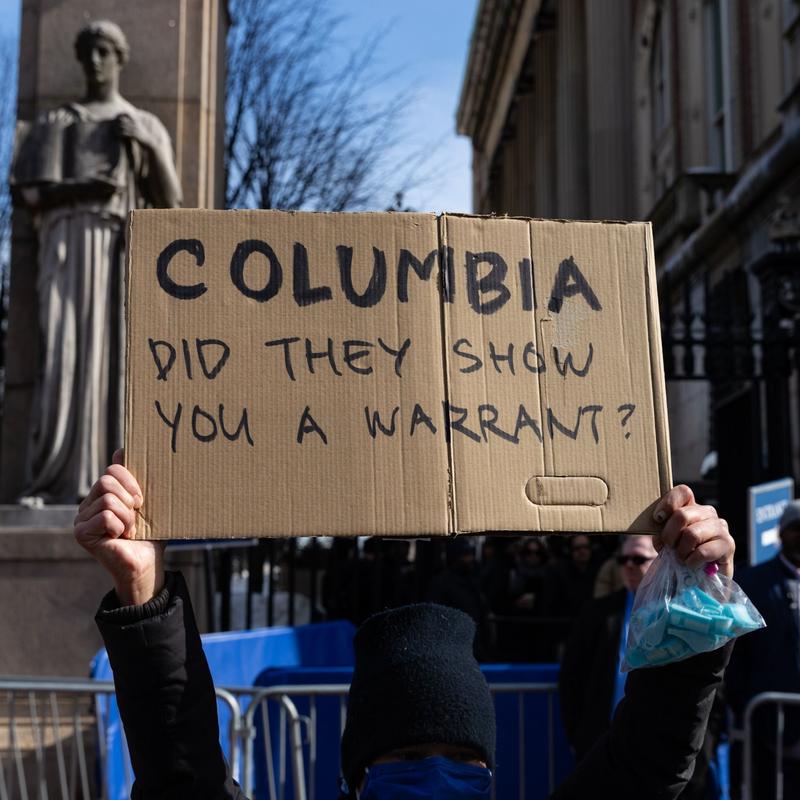
Arya Sundaram: As far as we know, according to Columbia, there were five federal agents who entered an off-campus residential building around 6:00 AM and arrested a student there. Her name is Ellie Aghayeva. Columbia says that these federal officers didn't have any warrant, that agents misrepresented themselves, gained entry by saying they were police searching for a missing child. DHS has refuted some of this, and I'm sure we'll get into some of those contentions later on. Either way, Ellie was arrested.
Swiftly, by noon, there was this massive protest at the campus gates with dozens of people, about 200 people if I had to count, demanding ICE off their campus and pointing some of the blame at Columbia administrators. By the evening, she was released after Mayor Mamdani had requested her release in this meeting with Trump.
Brian Lehrer: I want to read from an email that University President Claire Shipman sent to the entire Columbia community. A student forwarded this to me. It says, "Our understanding at this time is that the federal agents made misrepresentations to gain entry to the building to search for a 'missing person.' It is important to reiterate that all law enforcement agents must have a judicial warrant or judicial subpoena to access non-public areas of the university, including housing, classrooms, and areas requiring Columbia ID swipe access. An administrative warrant is not sufficient." From University President Shipman's email.
What is the university saying about what ICE agents did? Maybe you want to make that distinction between when they're supposed to be able to go into a space and not.
Arya Sundaram: Sure. Columbia says that the federal officers didn't have any sort of warrant, that they misrepresented themselves, that they said that they were police searching for a missing child. DHS, on the other hand, has said that their agents specifically verbally identified themselves, visibly wore badges around their necks, and that the building manager and her roommate let their officers into their apartment. They didn't mention anything, by the way, about whether they claimed that they were searching for a missing child. DHS has refuted some, but not all, of what Columbia has put out there. This--
Brian Lehrer: Go ahead. No, go ahead.
Arya Sundaram: The distinction between a judicial warrant and administrative warrant is important because a judicial warrant is signed by a judge; it has more authority. Again, Columbia says that they didn't have any warrant in this case.
Brian Lehrer: The Claire Shipman email continues. "If law enforcement agents seek entry to non-public areas of the university, ask the agents to wait to enter non-public areas until contacting Public Safety. Public Safety will contact the Office of the General Counsel, the lawyer for the university, to coordinate the university's response. Do not allow them to enter or accept service of a warrant or a subpoena." That's pretty detailed and strong language from the university president about how to resist ICE if you don't think they're there legitimately. Here is Shipman speaking to the press.
Claire Shipman: This was a frightening and fast-moving situation and utterly unacceptable for our students and staff. We started work immediately to gain her release.
Brian Lehrer: Brigid, back to you and the Mamdani White House meeting. Did the mayor get the Columbia students sprung?
Brigid Bergin: Well, we know that the mayor did talk to President Trump about the Columbia student, as well as four other students who have faced immigration cases. Following that meeting, the mayor's office issued a statement saying that Mayor Mamdani received a call from President Trump assuring him that the student would be released. It certainly seems as though the mayor was successful in, at least in this instance, helping someone get out of detention.
Brian Lehrer: Here's a text, Brigid, that just came in from a listener critical of the way Mamdani is playing, if that's the right word, the president. It says, "Mamdani is normalizing a tyrant." Have you heard that critique from anybody else, anybody in the political sector, that by playing nice with Trump, Mamdani is somehow normalizing him, not just getting specific things for New York?
Brigid Bergin: I think that there are people who are more critical of the mayor's interactions with the president based on some of those very concerns. Even as we talk about the instance of getting this one student released, this is an issue that we have seen obviously across the country, but certainly in broader respects here in New York City. It's very good news for this individual student that she had such a strong advocate in the mayor, who was speaking directly to the president. I'm not sure that that makes for a policy that those beyond that individual can feel comfort in.
I was talking to some sources in the City Council who raised concerns about a staffer named Rafael Rubio. He's been held by ICE since January 13th, when he didn't show up for work. There were questions about whether he came up in conversation when the mayor spoke with the president. I asked that question of City Hall, and I did not get a response. I think it speaks to the fact that this is not necessarily a policy. This is advocacy on behalf of individuals.
Then, given everything else we're seeing coming out of the federal government, there are still these incredible warning signs of things that are to come. The only thing that will really change it would be an election. Even in that instance, there are some huge warning signs about things coming for our elections.
Brian Lehrer: Arya, tell us more about Ellie Aghayeva, the student who was detained. What do we know about why she was targeted?
Arya Sundaram: Sure. Ellie is a citizen of Azerbaijan. She's in the School of General Studies pursuing a degree in neuroscience and political science. That School of General Studies generally caters to non-traditional students who are often older than typical undergraduates. She entered the US around 2016 on a visa, at least according to a habeas petition filed by her attorneys. DHS says that her visa was terminated in 2016 for failing to attend classes. We haven't heard back from her attorneys about what they say about this contention at the moment.
Brian Lehrer: The school says that she's currently attending classes?
Arya Sundaram: The school says that she's a student in the School of General Studies.
Brian Lehrer: Would it have just been being out of status from an old student visa, or did they have some other political motivation like they did on some of the Columbia students who participated in or were leaders of the protests in 2024?
Arya Sundaram: That's a great distinction that you draw here. DHS is not saying that Ellie Elmina was a participant in pro-Palestinian protests like many of the other Columbia students who were detained by ICE in the past, like Mahmoud Khalil, Mohsen Mahdawi, but instead, it seems like she was targeted for an entirely different reason. If she was involved in part, like pro-Palestinian protests, that at least certainly hasn't come up from DHS in recent memory.
Brian Lehrer: This is probably outside of either of your beats as a political reporter and an immigration reporter. A listener asks, in a text, the ICE agents actually showed two security guards, Columbia security guards, a phone photo of the fake missing person. That is, they claim they were looking for a missing person, but apparently, they were just looking for the student. The listener asks, "Is impersonating a police officer a crime?" Have you heard anything about this, Brigid? Can I throw that to you?
Brigid Bergin: Sure. I think impersonating law enforcement is something that is a crime. I don't know that we have confirmed exactly the circumstances that took place there. I have also read reports that they were showing a picture of this alleged missing person. I think this raises a lot of questions for the NYPD as well. It would be that law enforcement agency that they would be purporting to be. That raises new issues between the relationship with local law enforcement and federal law enforcement.
Something that I would note, if we think back to what we saw on the ground in Minneapolis, became a particularly contentious issue. Hopefully not foreshadowing of something we may be seeing more of here in New York City, but certainly something to be on high alert for.
Brian Lehrer: Depending what can be proven that the ICE agents did actually do there, it might put the ball back in Mamdani's court as to how much he wants to push enforcement of anything that might have been illegal done by a representative of the president. WNYC's Arya Sundaram, who covers race and immigration, WNYC senior political reporter Brigid Bergin on the Trump-Mamdani White House meeting. Thank you both for joining us this morning.
Brigid Bergin: Thank you.
Arya Sundaram: Thanks for having--
Copyright © 2026 New York Public Radio. All rights reserved. Visit our website terms of use at www.wnyc.org for further information.
New York Public Radio transcripts are created on a rush deadline, often by contractors. This text may not be in its final form and may be updated or revised in the future. Accuracy and availability may vary. The authoritative record of New York Public Radio’s programming is the audio record.
