
How Trump's Self-Depiction as Jesus Lands With Christians
[music]
Brian Lehrer: Brian Lehrer on WNYC. Last night at the University of Georgia, Vice President JD Vance, a Catholic, a convert to Catholicism, said something interesting about Pope Leo at a Turning Point USA event. What he said is worth sitting with for a moment. The Pope, criticizing the US-Israeli war in Iran, had said that Jesus "is never on the side of those who once wielded the sword and today drop bombs." Vice President Vance pushed back on the Pope. Here's part of what he said. 48 seconds.
Vice President JD Vance: Pope said something where he said-- and I'm going to try to remember the exact quote, but he said that God is never on the side of those who wield the sword. God is never on the side of those who wield the sword. I'm pretty sure that he said that exact statement. Now, on the one hand, again, I like that the Pope is an advocate for peace. I think that's certainly one of his roles. On the other hand, how can you say that God is never on the side of those who wield the sword? Was God on the side of the Americans who liberated France from the Nazis? Was God on the side of the Americans who liberated Holocaust camps and liberated those innocent people from-- those who had survived the Holocaust? I certainly think the answer is yes.
Brian Lehrer: You hear the vice president started to get heckled there at the end. That heckling went on for a little while, but the vice president went on to say this.
Vice President JD Vance: I think that it's important in the same way that it's important for the Vice President of the United States to be careful when I talk about matters of public policy. I think it's very, very important for the Pope to be careful when he talks about matters of theology.
Brian Lehrer: What did he mean by careful on matters of theology?
Vice President JD Vance: I think one of the issues here is that if you're going to opine on matters of theology, you've got to be careful. You've got to make sure it's anchored in the truth. That's one of the things that I try to do, and it's certainly something I would expect from the clergy, whether they're Catholic or Protestant.
Brian Lehrer: That's the vice President of the United States, a Catholic convert, a Catholic by choice, telling the Pope to stay in his lane on theology. One headline this morning said, "Vice President to Pope, 'shut up.'" This is an interesting moment for Christianity in Trump's America in various ways. Some of his most prominent evangelical supporters have long compared him to Jesus.
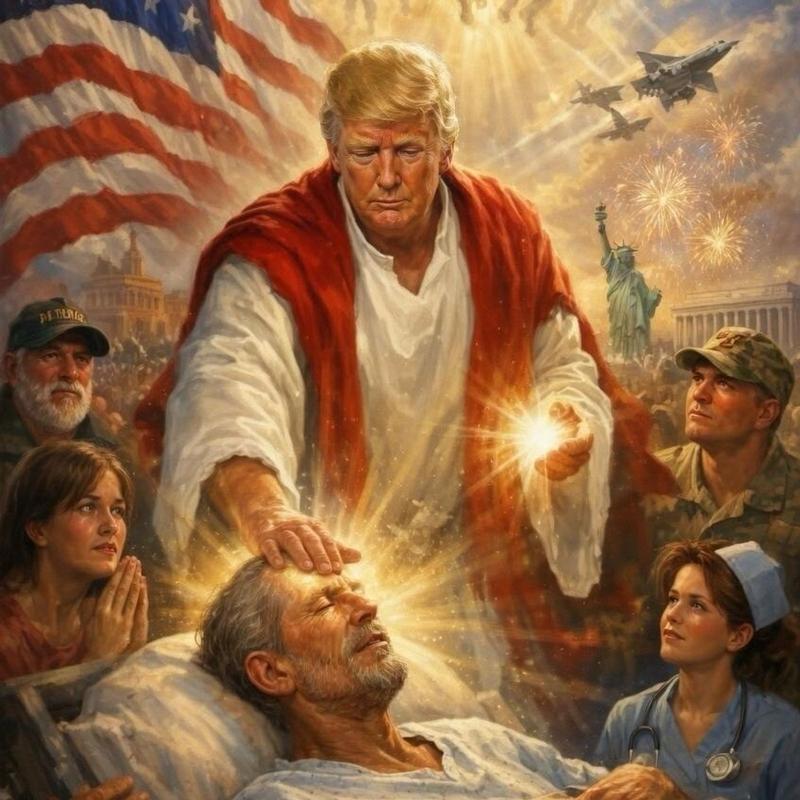
That was going on before the thing that got a lot of headlines over the weekend, when Trump shared that AI-generated image of himself on Truth Social, appearing in white robes with glowing hands healing a sick man. As soldiers, bald eagles, the American flag, and fighter jets filled the sky behind him. It looked to virtually everyone who saw it like Trump depicted himself as Jesus Christ. He deleted it after some people, reportedly including House Speaker Mike Johnson, asked him to. Trump's explanation to the public, he thought it was a picture of him as a doctor.
Now, for some of his most devoted Christian supporters, this was a bridge too far. For some, not. Many others in his orbit defended it. His own spiritual advisor had compared him to Jesus publicly just two weeks earlier on Palm Sunday, of all things. None of this is happening in isolation, we should say. It is part of a decade-long story about what has happened to Christianity in America. Maybe it's really a much longer story even than that. In some other parts of the world, too, in the age of Trump and Viktor Orban, for example, in the way he had used Christianity before he got defeated in his reelection bid this week.
We're going to try to put it in context now with Robert P. Jones, president and founder of the Public Religion Research Institute, known as PRRI, its initials, and the author of several books, mostly on white Christianity and American politics, including The Hidden Roots of White Supremacy. He's got a new book coming out in September called Backslide: Reclaiming a Faith and a Nation after the Christian Turn against Democracy. Dr. Jones, thanks for coming on at this really interesting and-- I don't know, in a way, tense and fraught and weird moment in Christianity in America. Welcome back to WNYC.
Robert P. Jones: Oh, thanks, Brian. Yes, tense and weird. Those are apt descriptors of where we are today.
Brian Lehrer: Listeners, you're invited in here, too, especially if you're a Christian of any kind, including certainly a Christian who voted for President Trump. What do you make of him posting an AI image of himself as Jesus? Are you a Christian who feels your faith has been hijacked by politics on one side or another? Do you think Trump is really doing God's work, and has the confrontation between Trump and Pope Leo and now JD Vance and Pope Leo made you rethink anything on any side? 212-433-WNYC, 212-433-9692. Call or text with Robert P. Jones. Let's start with the JD Vance appearance and that language last night in those clips. Did this surprise you?
Robert P. Jones: These days it's, I think, hard for anything to truly surprise me because just when I think we've seen the last-- yes, to use your word, weird thing, things that cross lines, we see something else. It's not the first time that JD Vance has tangled with the Vatican. There was an episode before Pope Francis died where Vance, as you say, who's not raised Catholic, is a convert to Catholic, got into a tangle with Pope Francis, where he tried to explain the Catholic theology of ordo amoris, the ordering of loves. He tried to explain it in a way that was like, "Okay, first we love our family, and then we love our friends," in this concentric circle out. It was a way of talking about it and limiting our love for others who are further from our immediate circles. He immediately--
Brian Lehrer: Immigrants in particular. Right?
Robert P. Jones: That's right, immigrants in particular.
Brian Lehrer: That was a way of defending immigration restrictions, because the order of love has us first focused on the people closest to us.
Robert P. Jones: Essentially, it was a Christian nationalist, America-first version of this theology. Immediately, there was a very unusual response from Pope Francis, who said, "No, this is not at all what this theology says. It's about the Good Samaritan, and it's about thinking equally about our obligations to others." He's had this tangle with the Vatican. Two different popes now. This one, it's particularly rich, I think, for particularly a Catholic convert to be lecturing the Pope and telling the Pope to be careful about wielding theology.
The thing that Vance did not quote is actually the sentence before the thing he did quote. That is what Pope Leo said this. He said, "God does not bless any conflict." I think in that short sentence is the heart of what Pope Leo has been saying. It's actually the heart of the Just War tradition inside of Catholic theology. Just in a nutshell, it means that this is a 1,500-year-old theological tradition that goes back to St. Augustine in the Catholic Church. Speaking of being careful, you've got 1,500 years of developed theology that Pope Leo is speaking out of.
The simple sentence, "God does not bless any conflict," doesn't mean that certainly the Catholic Church has never been pacifist, but there are limits, though, to war. What Pope Leo has said very clearly is that the war in Iran violates the most basic premises of the Just War theory, namely that there is no such thing of a just war that is preemptive. That's an impossibility. War always has to be a last resort. This line, "God does not bless any conflict," so there is permissible conflict. There is maybe even morally justifiable conflict if you meet certain criteria. Even that does not mean that God blesses the conflict. I think that's the thing that Vance and Trump both have really missed.
Brian Lehrer: Maybe the way you describe it, that there is such a thing in Catholicism as Just War theory. Vance and the Pope agree more than those clips might make it sound like, because his argument last night was essentially the Pope's statement that God is never on the side of those who drop bombs. Vance says that's too sweeping. He said, "What about the Americans who liberated France or freed the Holocaust camps?"
It's actually a theologically interesting question, isn't it? Can you say in general that God is never on the side of those who use military force when there genuinely have been just wars, including wars of liberation? I guess what you're saying is Vance goes wrong by only referring to the general principle and not addressing the Pope's critique of this war in particular, because it's a preventive war, as the Pope sees it.
Robert P. Jones: I think maybe both those things were right. Certainly, in the Pope and other statements, has been very clear about referencing these things like it has to be a last resort. For example, another principle from Catholic Just War theory is that it has to be an imminent threat. The response has to be proportional to the threat. All of these principles. You could imagine a world in which the administration maybe knew of these principles and tried to make a case that might meet those principles, but there really has been no real effort to do that.
I think the key here that's maybe getting lost is this idea of something that can be morally justifiable, and it's something Christians may and even maybe should engage in. Take the war against the Nazis maybe a example where we have mostly consensus around that. Even then, I think there's a humility here to say that God is never just on the side of one side of a human conflict. I think that's the thing that's always dangerous and that I think proper Christian theology has always been very careful about trying to say, even if this is morally permissible, even if Christians maybe even are required to engage in this thing, we should stay one step shy of saying, yes, just simply then, that, ergo, "God is on our side." I think that's about a respect for the broadness and the largeness of the divine.
Brian Lehrer: What about this backlash to Vance even challenging the Pope on theology? One could argue that, hey, liberals and progressives feel free to criticize the Pope on things like abortion rights and gender and LGBTQ issues and defend their right to speak against the Pope, who they would say represents institutional power. Is this any more sacrilegious or just on a different issue? It breaks down differently as to who's going, "Yes, JD Vance, speak your mind." Those who are going, "Look what he said to the Pope."
Robert P. Jones: I don't think there's any problem with JD Vance disagreeing with the Pope. I think the challenge is, and particularly if he weren't Catholic, he'd have a lot more leeway. As a Catholic, he stands in a different relationship to the Pope. He really ought to engage, I think, in a more-- my first thought was like, "Wow, here's someone not carefully engaging the Catholic Just War tradition at all, while lecturing the Pope about being careful."
I would have a lot more respect for a critique that says, "Yes, okay, I want to say this was maybe not careful. Let me explain what, and let me do it in a way that really does engage the broad theological tradition here. Let me make my case in myself in a careful way," rather than just saying, criticizing on the other hand.
Brian Lehrer: Julie in Hastings, you're on WNYC with Robert P. Jones. Hi, Julie.
Julie: Hi, Brian. Thanks for this rich discussion, and thanks for wanting us to do perspective. In terms of historical perspective, Pope Leo may be the first pope to interrogate a president by name. Obviously, Pope Francis criticized the administration without the name. Also, looking back, John Paul II sent a delegation to the Bush administration asking them not to go to war in Iraq. John, I'm sorry. Paul VI in 1965 and the hall of the United Nations said, "No more war. Peace is what we ask." As the US was escalating in Vietnam. He didn't use the word Vietnam, but I think people knew what he meant. In 1963, John XXIII, with his magisterial encyclical Peace on Earth, as the US and Soviet Union were threatening each other with nuclear bombs.
Brian Lehrer: Right. Then the political arc shifted in the Vatican when Pope, I think it was John Paul, who came out of Poland, was more concerned with the ravages of the Soviet empire, and the politics of the Vatican shifted. Right, Julie?
Julie: Yes, and he also was-- To your good point about all of these popes being conservative on social issues. Yes. He still carried out the Just War theory when it came to Iraq.
Brian Lehrer: Julie, thank you very much. Robert P. Jones, any thought on that little exchange?
Robert P. Jones: I'm just thinking about the long pattern here, and we have seen different strategies. I think Vance was, I think, trying to engage on a theological level. We've had Trump basically telling Pope to stay in his lane. To stay out of politics and stay in theology. That's also, given the long history, an odd thing to say. I think for many Christians, it's an odd thing to ask for as well. The whole point of careful theological thought is to bring the resources of a religious tradition into conversation with contemporary events and try to provide a framework for thinking morally about politics.
It is all about trying to have a conversation where theology brings some-- and it brings multiple perspectives, and there can be debates. It's not just one thing. To say, "Yes, this is improper," is, I think, really misunderstanding how religion works for most religious people, that it actually informs their views on morality, informs their views on politics.
Brian Lehrer: Maybe with knowledge of your expertise on white Christianity in particular in mind, here's Kylie in Northern Virginia. Kylie, you're on WNYC. Thank you for calling.
Kylie: Good morning. Thank you for the conversation. I wanted to put this down. I'm a Christian. We actually just put our son in a Christian school, which is a surprise to me. That's another conversation. What I want to contribute here is that I think that the basis of Trump's Christianity and of people who support Donald Trump's Christianity is racism. I don't think that that's a stretch. I think that the more Trump and his people separate love and the love that Christ has called us to from their actions, this becomes more clear, which is really surprising to me because I would think that at some point in time, even Christian nationalists in this country would say, "Okay, this man--" like there are diminishing returns here.
What I wanted to just say is that this conversation is not really surprising or confusing for Black Christians. In America, we use the Bible to support slavery. We get this. My question is, I wanted to put this Bible verse forward for the guests and then also just for the Christians among us. If you go to Matthew 7:21-23, it says, "Not everyone who says to me, 'Lord, Lord,' shall enter the kingdom of heaven, but he who does the will of my Father in heaven. Many will say to me in that day, 'Lord, Lord, have we not prophesied in your name, cast out demons in your name, and done many wonders in your name?' Then I will declare to them, 'I never knew you, depart from me, you who practice lawlessness.'" I wondered if your guest could speak to that.
Brian Lehrer: Robbie Jones, go ahead.
Robert P. Jones: Great. Thanks for that. I want to take off a little bit just about the issue of race and ethnicity and Christianity. I think we're so accustomed to it in the US to seeing the racial divides inside of Christianity, that it no longer surprises us. There was a theologian named H. Richard Niebuhr, who wrote a book really 100 years ago now, called The Social Sources of Denominationalism. He was one of the first people, I think, to really take seriously in academic theology the most obvious thing on the ground. As Martin Luther King later said, 11:00 AM on Sunday mornings, the most segregated hour in America, that remains largely true.
So much true that when sociologists today study religion in America, and particularly Christianity, we not only separate, like for analysis, Protestants from Catholics and from Orthodox folks, but we also actually even separate people by race and ethnicity. The reason for that is because, one, the churches are still largely organized separately on the ground. Two, Christians of color tend to have very, very different views politically, socially, morally on the ground.
Just an example here that in the last election, and this has been true every time Trump has been on the ballot, it has essentially been two-thirds of white Christians supporting him, and Christians of color not supporting him. African Americans down under 20% support. This is true in the Catholic Church, about 6 in 10 white Catholics voted for Trump, only about 4 in 10 Latino Catholics voted for Trump. It's not just a Protestant thing, but a Catholic thing.
That division is just so very real today. We can see it in favorability ratings around the Republican Party. Then the two parties have sorted themselves along these lines. Today, the Republican Party is more than two-thirds white and Christian. The Democratic Party today is only about a quarter white and Christian. If you understand that's the way our politics has been divided, some of these divides, particularly around Christian nationalism and really white Christian nationalism, that's become fused with the MAGA movement, and now the MAGA Trump takeover of the Republican Party, you start understanding a lot of our politics start making more sense.
Brian Lehrer: Kylie, thank you for raising that. I want to get to the image that Trump posted of himself looking like Jesus. People can roll their eyes and say, "Oh, there goes Trump again. He's just trying to create a meme so people like us talk about it on the media. Maybe he gets more than he loses politically from the controversy that surrounds it." I think maybe more important is that he didn't generate it himself, as I understand it, it came from another Truth Social user, a supporter, and there is a branch or some group of evangelicals, mostly, who actually do compare Trump to Jesus.
Like his own spiritual advisor, Paula White-Cain, compared him to Jesus on-- I said Palm Sunday before. It might have been Easter Sunday, I'm not sure. This very public, White House-connected figure comparing Donald Trump to Jesus. What's going on?
Robert P. Jones: There has been that long-standing sentiment inside. Yes. Paula White-Cain-- it was actually on Easter, which I think makes it even more telling that Paula White-Cain made that comparison to him worth noting, too. Just behind all this, it was only a year ago, after Pope Francis died and actually in the immediate wake of Pope Francis, that Donald Trump was asked if he had a preference about the next Pope, just to tie these two conversations together. He said, "Well, maybe I'd like to be the Pope." Then, immediately, similar thing happened. Another user generated an AI image of Trump as the Pope in papal vestments, and then Trump reposted on social media.
We had that from a year ago, and now we got this one with Trump in the style of Jesus healing the sick with all kinds of, again, Christian nationalist things around it. I think that's important, actually, not move too fast past that. It is this messianic figure of Trump in a white robe, this red sash, glowing palms, laying his hands on someone who's sick, obviously healing them in an image that looks very, very familiar to anyone who's looked at religious Christian iconography of Jesus the healer. It's mixed in with a soldier, the American flag. It is a Christian nationalist meme there.
It was also true that all the people in the image are white. It's a particular kind of savior, if you will. It's one that not only is healing the sick, but it's ushering in this image of a white Christian militant America. Part of this is, as you said, is Trump's performative self, but he's always testing the limits. I think that's part what this is. He makes these statements like, "I could walk down Fifth Avenue and shoot someone in the middle of the street, and people would still vote for me." A statement, by the way, he made at an evangelical college. I think people forget that he made it in front of a group of white Christian supporters.
Here is the same as, "I could style myself as the messiah. People will still vote for me." He's always, I think, looking to see how far he can push it before he gets pushback. I think he actually has found pushback in this particular image and not just from the left, but even from people inside of his own movement, who found it blasphemous, frankly.
Brian Lehrer: Sure, there's that. There are people who do see him as a messiah-like figure, right?
Robert P. Jones: Yes, there are, actually. I think that we've watched particularly white Christians who are his base. White evangelicals have voted more than 80% for him every time he's been on the ballot, for example. We've seen a fishing around for the right frame. Like early on, when he first ran for president, there were serious debates about whether evangelicals could even support him or not. Paula White-Cain was one of the people who made the argument, "Oh, well, he's a baby Christian, he's a new convert, so he's just learning. Maybe his faults are very apparent. As he grows to be a Christian, they'll be less apparent." We're not hearing that argument from her today.
What has settled in is something like, "Well, he's God's imperfect instrument." That maybe he himself is not godly, but he is bringing about God's will. It's a different kind of messiah. It's actually a little more of a dangerous version because it means that he's set morally free to do any actions that can just be lumped into that, "Oh, he's God's imperfect instrument. Maybe he's hurting people, and maybe he's killing people, but even that is in the service of God. He is going to still be considered our savior." After everything, we've never really seen his support among white evangelicals, for example, fall below 2/3 support. His support in the country is down in the low 30s now, but it's essentially 70% among white evangelicals.
Brian Lehrer: Before you go, before we run out of time, I want to touch on one more thing in the news that's probably relevant to your forthcoming book, Backslide: Reclaiming a Faith and a Nation after the Christian Turn against Democracy. That subtitle itself is provocative. Just referring to a Christian turn against democracy. I haven't seen the book yet. I know it doesn't come out till September. Consider yourself invited for a proper book interview at the time.
Robert P. Jones: Thank you.
Brian Lehrer: Maybe one thing that materialized too late for inclusion is that of Viktor Orban's defeat in Hungary over the weekend, because he described his project as building an illiberal state. He used that phrase, illiberal, while promoting what he called Christian democracy. Christian illiberal democracy. Many of our listeners know he was a darling of CPAC, that Conservative Political Action Conference world of Tucker Carlson, of the American Christian nationalist movement generally. Now he's been voted out. I'm just curious if you think his defeat means anything for the global Christian Nationalist Project, particularly for its American branch.
Robert P. Jones: I'm so glad you phrase it that way, because I think that's exactly what's going on. It's worth noting that JD Vance was there just ahead of the elections and was literally campaigning for Viktor Orban there, and for that merger of, particularly there in Hungary, the Catholic Church and the state, and really hijacking and saying that, "Look, this old idea of Christendom and conservative values, this is what we're going to reinstitute here in an illiberal--" that's I-L-liberal democracy here. Vance was fully supportive of that.
We have other movements across Europe looking-- Reform in the UK, National Rally in France, and other places that are starting to tap this idea of-- You'll hear this term a lot coming from Vance and others. Rubio gave it at a speech in Germany. This idea of Western civilization is really code for this Christian nationalist version of a pseudo democracy. It really undermines anything that you might call a liberal or pluralistic democracy because it just reemerges Christianity and a very conservative particular form of Christianity with state power.
I think you're absolutely right to link that here. One of the reasons why Vance was there was because, absolutely, the MAGA movement, Trump, and Vance see themselves really in league with an international movement to bring and uphold Christian nationalist states across the US and Europe.
Brian Lehrer: We're out of time, so we didn't even get to one of the other things in the news that I was hoping to bring up. We'll have to do a separate segment on this, folks, with somebody else later. The women who want to give up their own right to vote based on their version of religious conservatism. The Times did an article on this the other day. They actually have gone that far into the tradwife lane, thinking that there should be a household vote, and that the man gets to decide who the candidate is, who the household will vote for. That, of course, assumes a heterosexual marriage as well. We will do that separately.
We did a lot with Robert P. Jones, president and founder of the Public Religion Research Institute. His forthcoming book, out this September, and he'll be back, is called Backslide: Reclaiming a Faith and a Nation after the Christian Turn Against Democracy. Thank you so much for coming on with us.
Robert P. Jones: Oh, thanks so much for having me.
Copyright © 2026 New York Public Radio. All rights reserved. Visit our website terms of use at www.wnyc.org for further information.
New York Public Radio transcripts are created on a rush deadline, often by contractors. This text may not be in its final form and may be updated or revised in the future. Accuracy and availability may vary. The authoritative record of New York Public Radio’s programming is the audio record.
