
How to Stay Healthy as Flu Season Ramps Up
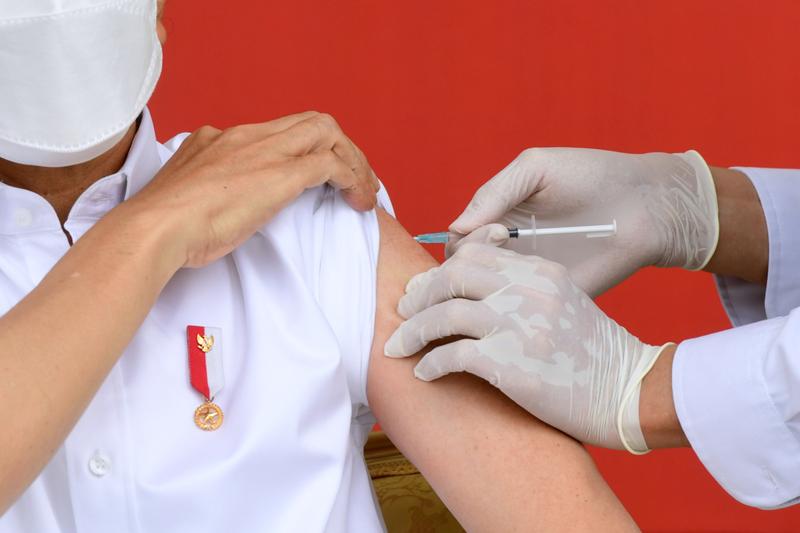
( Presidential Secretariat Photo by Muchlis Jr., Government of Indonesia / Wikimedia Commons )
Brian Lehrer: Brian Lehrer on WNYC. I don't know if you want to wear a mask when you get together with your family for Christmas or at your New Year's Eve party, but according to data from the Centers for Disease Control and Prevention, New York City and the surrounding areas saw the highest levels of flu in the nation during the week ending December 13th. New York City's health department raised a red flag after seeing a 22% increase in flu-related emergency room visits the week before.
In response to this particularly active respiratory disease season, the City's health department launched the Don't Miss Out media campaign to help us have less sick time and more time together with family and friends. Here's one kind of bracing example. The New York Times reported that one school in Brooklyn, Poly Prep Country Day School, closed for two days earlier this month after 200 students were sent home due to flu-like symptoms.
With me now to talk about the Don't Miss Out campaign and other public health news is Dr. Michelle Morse, interim commissioner of health at the New York City Department of Health. We'll also ask her a little bit about the incoming administration and maybe whether or not she's interested in staying in the job. Dr. Morse, welcome back to WNYC. Very nice of you to join us again.
Dr. Michelle Morse: Good morning, Brian. Thanks for having me on.
Brian Lehrer: Listeners, we can take questions for Dr. Morse about this year's flu season, and we can add RSV and COVID-19 to that as well. 212-433-WNYC. Even things relating to public health in New York during the Trump administration, federal funding for the health department is down, and things like that. 212-433-WNYC with a story, a question, a comment. 212-433-9692. I guess my first question, Dr. Morse, is how bad is it?
Dr. Michelle Morse: It's a great place to start the conversation, Brian, and I'm so glad that you have me on. We are experiencing what is already shaping up to be a pretty tough flu season, unfortunately. The way that we can track that and kind of know that is because we started to see a pretty significant rise in flu-related emergency visits and cases about two or three weeks earlier than we would normally see.
We are in the steep part of the curve where flu cases, ER visits, hospitalizations, et cetera, are going up significantly. In fact, last week they were up 7% over the week prior, but the most important message for everyone listening today is, it's not too late to get your updated flu shot. That flu shot is going to keep you out of the emergency room, out of the hospital, or worse, and keep you healthy and with your family. That is my goal as the City's doctor, is for all New Yorkers to have the information they need to stay healthy and spend more time with their family these holidays.
Brian Lehrer: Talk more about the flu shot because I've seen reporting that indicated that the flu shot that they developed this year is not a perfect match with the strain or strains that are actually going around. How true or false is that?
Dr. Michelle Morse: It is important to know that this updated flu shot this season, it was developed before this particular kind of mutation occurred recently. It's called subclade K, but it's really important that everyone realize also that even though that has happened, that is honestly what happens every year. The flu changes and adapts and tries to evade all of our efforts at decreasing the spread of flu.
Despite that, actually, we still see that the updated flu shot, the one that's available right now around the corner from you in the CVS or at your primary care doctor's office or wherever you like to get your shots, is still quite protective. In fact, we look at data from other countries that are further along in their flu season than we are here in New York City. In the UK, that flu shot, again, the one that's available right now, still decreased the chances of hospitalization and ER visits for kids by 70%.
Even when the match is not perfect, like this this season, we've seen that happen year after year. We do play a bit of a matching game. There is still significant protection from the updated flu shot. The most important thing is it's going to really keep you from those bad complications like being stuck in the ER on Christmas Eve or on Hanukkah or on any of the holidays you celebrate, Kwanzaa or otherwise, it's going to keep you out of the hospital.
Perhaps most importantly, it is life-saving. We see 1,500 to 2,000 deaths from flu and pneumonia every winter. I want to see that number go down. The best way to do that is still to get the updated flu shot right now.
Brian Lehrer: The stat that I read in the intro from you at the New York City Health Department that there was a 22% increase in flu-related emergency room visits earlier this month, is this year's strain making people sicker than in previous years, not just more people sick?
Dr. Michelle Morse: This is, unfortunately, a relatively robust strain. I know lots of folks are experiencing exactly what you're describing. Lots of people they know are sick with the flu right now, and flu-like symptoms right now. We do see that the strain of the flu that's circulating predominantly this season is the H3N2 strain. It's a strain we've seen in the past. It's not exactly a new overall strain.
However, what we do know is that any season where H3N2 is the predominant strain, we do see some more severe illness. That's particularly true amongst young people as well as amongst our olders over the age of 65. If you look at our respiratory illness web page at the New York City Health Department website, you'll see that, actually, kids under 18 have had the most significant increase in ER visits in recent weeks. Again, our flu numbers are going up, but get those shots. They are protective, and it's not too late.
Brian Lehrer: Your department launched the Don't Miss Out campaign, playing on the concept of FOMO, Fear of Missing Out. We talked about getting a flu shot. Are there other pieces of advice you're sharing with listeners? I think I heard you in a news sound bite say something about masking when you're indoors, so you could talk about under what circumstances and anything else you want to share.
Dr. Michelle Morse: Absolutely, yes, you're right. The flu shot, the updated flu shot, is just one part of the package. If you're sick, the most important thing is to both stay home and go see your primary care doctor or whoever you see for care to get tested. If it turns out it's the flu, you might qualify for a treatment that could cut down the days that you're sick. If it turns out to be COVID, there are treatments for COVID as well.
Paxlovid is the medication that really decreases your chances of getting long COVID, shortens your symptoms, keeps you out of the hospital. It's important to know, "Is it flu, COVID, RSV, or something else?" because you might qualify for treatment that'll make you feel better and keep you out of the hospital. Then the other thing to know again, as you stay home when you're sick, mask around your family members or people that live in the house with you so you keep your germs to yourself.
Then I also do strongly recommend that if you're getting on a plane, for example, if you're on the subway, if you're in a very crowded setting, it does not hurt. There is really no downside to wearing a mask at a time when we have all of these viruses swirling in the air, particularly in enclosed settings. Wash your hands a million times a day. You don't even realize how you might touch something and pick something up. Of course, that tried and true that your mom told you, please cover your cough and sneezes. We don't need your viruses and germs spreading all over the place. All those things still work.
Brian Lehrer: Robin in Harlem, you're on WNYC. Hello, Robin.
Robin: Hello. Thanks for taking my call. I don't have flu or COVID or strep, I'm negative for all that, but I'm not well. I've got the symptoms of all that, so it's just a cold, says the doctor. What can I do to shorten the course of this? What? Is there a couple of magic bullets, so to speak, that are the best medicine? I know tea with honey and lemon, but what else to make this go away faster because it feels like crap?
Dr. Michelle Morse: I'm so sorry you feel so sick, and it's as you said. Thank you for following our public health advice in going and getting tested. Unfortunately, there are no magic bullets for what we call the common cold. However, the things that we know work and help to improve symptoms are things like getting a lot of rest, certainly, whatever works for your symptoms. Some people really like a rub on their chest with something that's kind of menthol-y.
Some people really prefer tea with honey and lemon. It is totally fine to take Tylenol or, excuse me, acetaminophen, or ibuprofen. Again, each person has to tailor that to their own specific medical context, so your provider can best advise you about whether or not those medications are safe, but they often help people to feel better as well. Then, again, it's really about trying your best to make sure that it doesn't spread to other people in your family and your community.
Then the last thing I'll say is that, depending on your medical history, some people have underlying lung disease. Some people, unfortunately, smoke. Some people have other chronic medical illnesses that can make it harder for them to heal more quickly from the common cold or COVID flu or RSV. Those things do just take time. I'm sorry I don't have a silver bullet for you, but those are the things that do tend to help symptoms improve, even if you can't get on a treatment that's specific to COVID or flu.
Brian Lehrer: Robin, I hope that's somewhat helpful, and I hope you feel better. Thank you for calling in. We have a number of very short and direct questions coming in, in text messages. One says, "Your guest has emphasized the current flu shot. Is there a difference between the flu shot given in September and now?"
Dr. Michelle Morse: That's an awesome question. There is not a difference between the one from September and now. The flu shots are kind of teed up and planned quite long in advance, and it's based on the flu season in the Southern Hemisphere. It's the same shot. Again, it really is not too late. If you haven't gotten that updated flu shot yet, the chances are that it's still going to really protect you, in particular, from ending up in the emergency room, the hospital, or worse.
Brian Lehrer: Another listener asks, "Are the flu and COVID vaccines free? I don't have health insurance."
Dr. Michelle Morse: Well, first and foremost, I'll say for the person who called in or texted that question, I'm glad you're raising this issue. We are bracing for the impacts of HR1 and bracing for fewer people having health insurance, unfortunately. The first step I would still strongly recommend is call 311 and get hooked up with some of our health insurance enrollers. There are still options that are low-cost to get enrolled in health insurance, and you may qualify for those.
That's the first step. The second step is, we unfortunately do still have many people in New York City who are uninsured. This is something that the health department cares deeply about, and we are still working in partnership with many institutions to try to continue to decrease those rates of uninsurance, but despite that, we know that some folks don't have health insurance, and the thing to do is to go to our New York City Health Map.
Our Health Map is available on our website nyc.gov/health, and that website actually allows you to put your address in, and you can look up places that are no- or low-cost for any of these vaccines, and you'll be able to see which one is closest to you. You can get right in there and get those shots for low or no cost, depending on the setting. I encourage all the New Yorkers to check out our Health Map. Again, it's not too late to get those updated shots.
Brian Lehrer: Another listener texts, "Can really young kids like one-year-olds get the flu shots?"
Dr. Michelle Morse: That's an awesome question. Any babies six months and older can get the flu shot. We do strongly recommend it. If you check out our respiratory viral dashboard, you'll see that, unfortunately, babies aged 0 to 4 and then also kids 5 to 17 are amongst the groups with the highest number of emergency room visits right now. I know no parent wants to be in the emergency room for the holidays. It is definitely not too late. Again, six months and older, you can get the updated flu shot and/or COVID shot.
Brian Lehrer: Alex, in Brooklyn, you're on WNYC with the New York City health commissioner, Dr. Michelle Morse. Hi, Alex.
Alex: Hey, how's it going? I got the vaccine about three weeks ago, and then just last week, I started coming down with some flu-like symptoms on Thursday. Then on Saturday, I had a really high fever, went to a city MD, and tested positive for the flu. I have a pregnant wife at home. Luckily, we both got on Tamiflu, which I think for me shortened it like today. My fever broke yesterday, but today I'm mostly recovered, but still masking around the house.
This is not like, "Don't get the vaccine or anything," but I was just going to say from my personal experience, I could see how this was really, really brutal for me. I don't think I've had the flu in probably about 10 years or so, even though I kind of have been on and off about getting the vaccine on any given year, but I could see how, without the vaccine, this could put you in the hospital or something like that, if you were immunocompromised or anything.
Brian Lehrer: Thank you for sharing your experience, Alex. We just have a few--
Dr. Michelle Morse: Can I make a quick comment, please?
Brian Lehrer: You want to say something briefly to him? Yes.
Dr. Michelle Morse: Absolutely. Well, Alex, I'm glad that your fever broke and you're starting to feel better, and I just want to call out and say how much I appreciate you sharing your experience because you really did follow the right steps there. Exactly as you said, if you hadn't gotten that flu shot, chances are you'd be feeling even sicker and perhaps even ended up in the emergency room or the hospital.
That is one of the biggest benefits: the flu shot is life-saving. Even if you end up getting the flu after having gotten your flu shot, the chances are very, very high that the shot will decrease your possibilities of ending up in the ER, hospitalized, or worse. You got the right message, Alex, and thank you for sharing it.
Brian Lehrer: Before you go, the last time you and I talked, it was largely about funding cuts from Washington under the Trump administration to the New York City Health Department for a program that included measuring health disparities. They don't want things that measure disparities by race or other demographics, which I guess they see as discriminatory DEI.
Now, you recently had an op-ed in City & State critical of the administration. Among your lines, "Millions of New Yorkers will lose their Medicaid, Medicare, and Supplemental Nutrition Assistance Program, or SNAP, benefits because of the Republicans' One Big Beautiful Bill Act." How do you imagine these cuts impacting public health in New York City in particular, which is, of course, your charge?
Dr. Michelle Morse: It's a really, really difficult time in public health right now. Exactly as you said, Brian. This is a time where we believe that our job in the New York City Health Department is more important than ever. I feel very proud of what our agency and the 7,000 staff across the agency have done to really continue to protect public health and prevent chronic disease and do all the things that are a part of our mission, but unfortunately, what's happening is the federal government is making it very hard for us to be successful in our mission.
Specifically, I do want to underline that I think making America healthy, of course, is our goal. Making New York City healthy is my entire job. Unfortunately, when programs like the Chronic Disease Centers at the CDC are defunded, despite the fact that they've had incredibly successful programs, decreasing people's hypertension challenges, improving control of hypertension, decreasing the number of people who smoke by the millions because of the campaigns to show people how they can quit and give them access to treatment to quit smoking, these are life-saving programs.
Now, why they would be defunded when the evidence is so clear that they work is a very, very, very big question, and I don't understand that policy decision, but I can tell you this: in New York City, we are going to continue to push our work forward using evidence and data and make sure that New Yorkers have access to all the care and support and preventive measures that they need to the very best of our ability. I hope to get to do that in partnership with the next administration.
Brian Lehrer: Aha. Answering that question, do you have any quick thoughts in our last minute about, since Mayor Elect Mamdani ran so much on fighting inequality, how that might be implemented differently at the Health Department than it is currently?
Dr. Michelle Morse: It's a really great question. I think one of the things that the Health Department is most excited about our incoming mayor is that all of the initiatives in his platform, whether it's free buses or low-cost groceries with close access or freezing the rent, universal childcare, these are all things that public health leaders and advocates have been pushing for for quite some time.
When they are implemented in the City, they will have a tremendous positive impact on the health of New York City, and that is very exciting. At the same time, we still have to play a lot of defense. We have to protect our vaccination programs. We have to protect our chronic disease prevention programs. We have to make sure that we don't have some of the infectious disease outbreaks that are quite likely in a time when, again, the federal government is withdrawing from the World Health Organization and changing policies at the CDC that used to be based on evidence.
We've got offense and defense to do for sure. The New York City Health Department has been doing that for 220 years, and I know that that will continue well into 2026 and beyond.
Brian Lehrer: Dr. Michelle Morse, interim health commissioner for now at the New York City Department of Health. We'll see if you get kept on and become the permanent health commissioner under the Mamdani administration. If so, and maybe even if not, we look forward to speaking with you many more times.
Dr. Michelle Morse: Thank you so much, Brian. Happy holidays.
Brian Lehrer: You, too.
Copyright © 2025 New York Public Radio. All rights reserved. Visit our website terms of use at www.wnyc.org for further information.
New York Public Radio transcripts are created on a rush deadline, often by contractors. This text may not be in its final form and may be updated or revised in the future. Accuracy and availability may vary. The authoritative record of New York Public Radio’s programming is the audio record.
