
How Queens and Brooklyn Are Coping with the Blizzard
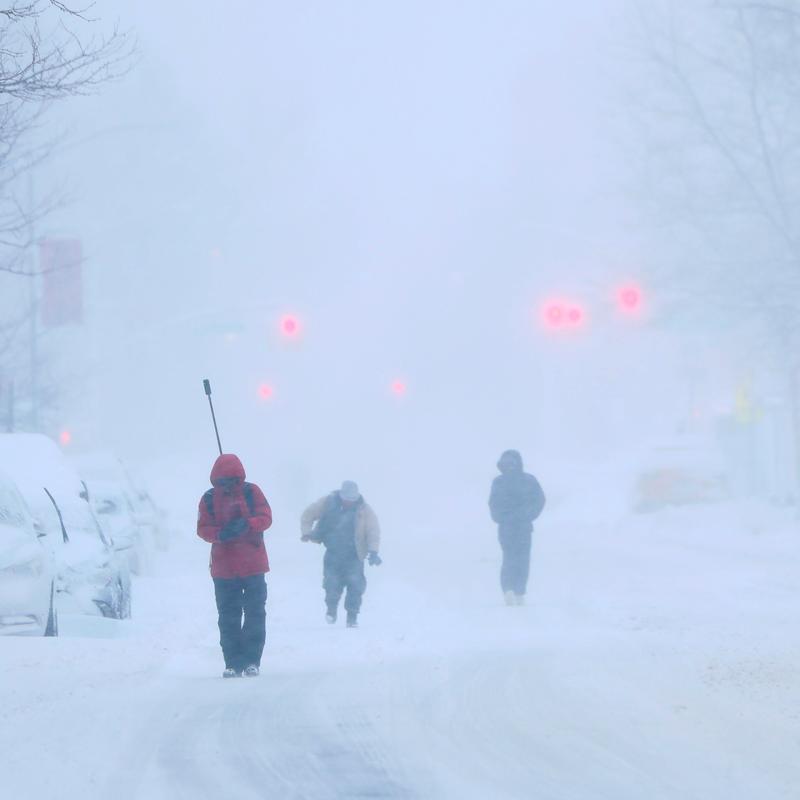
Brian Lehrer: It's The Brian Lehrer Show on WNYC. Good morning again, everyone. The National Weather Service is reporting 15 inches so far in Central Park, 15 at LaGuardia and JFK in Islip toward the east end of Long Island on the south shore along the ocean, 22 and a half inches in Islip, Long Island. Let's check in with how some of the elected leadership in the city is handling this, and what they think you need to know. We'll let you report on conditions to them as well. We're happy to have with us Queens Borough President Donovan Richards and Brooklyn Borough President Antonio Reynoso. President Reynoso, President Richards, welcome back to WNYC.
Borough President Donovan Richards: Thank you for having us on, and we know who's the better borough.
Borough President Antonio Reynoso: [laughs] Happy to be on. Happy to be on, Brian.
Brian Lehrer: There you go. Listeners, call in. You don't have to be in Queens or Brooklyn, but if you want to speak to your borough president about a particular condition anywhere in Queens or Brooklyn, you certainly can. Let us know what the conditions are, where you are, or what you need, wherever you are. 212-433-WNYC, 212-433-9692. How are the streets? How is your heat? Are you worried about someone vulnerable on your block and not sure they're getting the outreach from the city or anything like that? 212-433-WNYC, 212-433-9692, call or text. All right. Borough President Richards, where would you start to just describe conditions around the borough of Queens right now?
Borough President Richards: Well, I have two power outages between Rosedale and the Rockaways. I live in Rosedale by-- anyway, I'm not out, but the other side of Rosedale is out. We're working with the Office of Emergency Management to make sure we can get power restored for individuals during this storm. I would say, don't expect no blacktop [chuckles] at this moment. A lot of constituents call us. They want to see blacktop on their streets. As the storm continues to decrease in its tenacity, we'll be working with sanitation up until tomorrow to make sure that we can get as many streets cleared as possible.
Brian Lehrer: Do you know what caused the power outages?
Borough President Richards: Our power grid has historically been overtaxed and is something we work with Con Edison on and with LIPA on, and a national grid. While there are some upgrades that certainly have taken place, we still have a lot of work to do to make sure that we're delving into renewable energy because more people are using energy than before, between these storms, between the heat island impacts. We just have a lot of work to do on our grid.
Brian Lehrer: Of course, the power outages tend to be more widespread outside the city because the power lines tend to be underground in the city. They tend to be above ground outside, and they can be brought down by heavy snow. Where would you start to describe conditions in Brooklyn, President Reynoso?
Borough President Reynoso: Yes, we're having the same issues. We have some power outages. Almost 500 residents right now don't have power in Brooklyn. We're working with Con Edison and OEM to handle that. We have heat and hot water issues in two NYCHA developments. One in North Brooklyn and one in Coney Island. It's going to be quite an adventure for the next couple of days. It's not just blacktop. I think we have an expectation that in a couple of days after the snow, there's going to be some work that needs to be done.
Right now, what we're trying to do is just make sure that the emergency cases are being handled. We have about six warming buses that are available in Brooklyn. We have the locations on our website if anybody wants to go on. Right now, we're still dealing with, I guess, the impact. It hasn't slowed down one bit. Folks should still not be outside and should be very cautious. If they have any issues, please call 311. If you want to call our office, Instagram, Twitter, Facebook, we'll make sure that we're forwarding those messages to OEM.
Brian Lehrer: For those who are in power outages, the New York State Emergency Services Department has a page. I'll just read a little bit of this, I did earlier in the show, but it was a while ago. Turn off major appliances to prevent damage from a possible surge. When the power comes back on, keep one light turned on so you know when the power returns. If you go outside, avoid all down power lines and report them. If you see any, assume all down power lines have electricity, live electricity. Obviously, that's for areas where there are the above-ground power lines.
It says use only flashlights for emergency lighting. Candles can pose the risk of fire. Keep your refrigerator and freezer doors shut to keep food from spoiling. Do not use a charcoal grill or generator indoors, and do not use a gas stove for heat. They could give off harmful levels of carbon monoxide. Some tips for those of you who do have power outages from the New York State Department of Emergency Services. Let me take a phone call. Here's Annette in Laurelton, Queens. Hi, Annette. You're on WNYC.
Annette: Yes, good morning.
Borough President Richards: Good morning.
Annette: You know the area very well because you're a former counselor. I live on Francis Lewis. When you were in office, you used to have a program to help the seniors out when we have this terrific snowfall. I need help with getting this snow out. Do you still have a program like that that you could--
Borough President Richards: I'm shoving you out myself. I used to shovel people out myself, but if you want to give Brian-- I don't want to put your address online. If you can give it to them back door, then I will make sure that we get some help for you, but absolutely.
Annette: I'm not online as I said before, so who could I get--
Borough President Richards: I don't want to put your information online, but I would suggest maybe offline. Just give Brian the address, and then he'll send it to my staff. Then I'll make sure that we get you some assistance. You never know who's going to show up. I used to show up to shovel people's stuff. The only thing is I showed up one time, and it was a 20-year-old guy in the house. I'm like, "He could shovel." All right, that's another story for another day.
Brian Lehrer: Did you show up as a member of city council as a public service, or did you show up as--
Borough President Richards: I showed up as a member of the city council to shovel this young lady's garage out, and her 20-year-old son was sitting in the house playing video games. That's another story for another day. [laughs]
Brian Lehrer: Not as a high school student trying to make a buck. All right. Now, we have a Brooklyn call. Here's Lynn in Prospect Heights. You're on WNYC. Hello, Lynn.
Lynn: Hey, guys. It's really nice to have the radio on and have company in the house. [laughs] I'll tell you. From the looks of my backyard, there's about 18 inches of snow piled up on the table, so we're in it deep. I took the dog out for a walk. I was very impressed to notice that all the side streets seem to have been plowed at least once. People walking in the streets, there are no cars. I did see a bus actually going up Flatbush Avenue. That was pretty impressive that the buses were running. I don't know where anybody's going.
The other amazing thing is, yesterday, I got an email from District 35 from our councilwoman, who said that we could get paired with people to come shovel us out. I can handle up to maybe 8 inches, but 18 is over my pay grade. I signed up for it, and it's great. This guy got in touch with me. We've been in contact. He's going to come by and help finish the job. I did a little bit, but he's going to do all the hard parts for me. I'm impressed. I think things are in pretty great shape, at least.
Brian Lehrer: Thank you for mentioning that program, Lynn. Borough President Reynoso, anything to say?
Borough President Reynoso: Yes. If anyone needs help shoveling or getting out of their homes in any emergency case or because of disability or age, let us know. You could go on our website. You can call our office that is picking up their phone calls right now, and let us know. We have operations all over the borough through council members, through not-for-profit organizations, through some volunteer efforts that are helping specifically our seniors. If that is something that folks want to do, please call the borough president's office.
The easier way is always going through the website. Yes, we have programs to assist people. I also want to say, Brian, what we're seeing with our power outages is not the above-ground wires. It's the underground ones. The salt is corroding the infrastructure below ground. What we saw in Prospect Park, where we saw a ton of homes, thousands of homes lose power, it was actually corroding wires on the electrical side underground. We keep seeing that more and more as we throw salt in our sidewalks.
Brian Lehrer: Here's Andriana in the Rockaways, who says she has been through a power outage in this storm. Andriana, you're on WNYC. Hello.
Andriana: Hello. Sorry, I'm a little bit under the weather. Thank you for having me. Thank you, Borough President Donovan, for being on today. Just a question about the snow. Last snowstorm, our two-lane road here on Beach 118 turned into a one-lane road. As I'm looking out the window now, how are we going to-- because we already have the snow that was left in the last storm. Are we going to have any of those snow melters or those ice melters that would be able to come and get rid of the larger quantities of snow that we had from the last time, and with the new snowfall? What's the plan on trying to get rid of the actual snow if the plows come--
Borough President Richards: Yes, we've been in constant contact because the Rockaways were a problem the last storm. I do have a snow call tomorrow with all the agencies and community leaders as well. I want to give them an opportunity to do what they need to do, being that the storm is just ending. Then tomorrow, we'll have a lot more to say on what they should do on the snow melting. I visited a few garages the last storm. For instance, like one garage, the salt spreader actually defunct.
We are in contact with them. We will be monitoring the Rockaways even more than the last storm, being that we know that there needed to be more services the last time there. In Southeast Queens, too. Even today, we're monitoring between the Rockaways and Southeast Queens. We're monitoring the maps. We're seeing that we're not getting as much service as other parts of the borough. My office is already in communication with sanitation department to say they need to speed up services within these communities.
Brian Lehrer: Couple of texts coming in. Andriana, thank you for your call. Go ahead, Borough President Reynoso.
Borough President Reynoso: Yes, I just also want folks to know that what happened the last storm was that we had freezing conditions for a week after the storm. That made it so that ice wasn't melting, and it was freezing. In past storms, we have a day that's 40 degrees, 41 degrees where it rains and really allows us to start seeing the snow clear up much sooner. It seems like the forecasting right now shows that tomorrow will be freezing, but then it'll be above 32 degrees thereafter.
That gives us an opportunity to see snow melt, not allow it to turn into ice, which means that we can manage it better. This idea of having to take snow and melt it really comes from the freezing cold weather that we've had for the week after the storm. In this one, it seems like there's going to be warm weather, at least two days after, towards the end of the week. That's going to be helpful.
Borough President Richards: I just want to add to that. In Queens and the Rockaways, we're going to see storm surge. We're already communicating with DEP on that as well. We will see a storm surge over the course of the next 24 hours or so. We're monitoring that very closely as well.
Brian Lehrer: Yes, and then you'll have Lake Flatbush Avenue, Lake Linden Boulevard, and all of that when the rains come. A couple of texts coming in. Listener writes, "From an upstate firefighter. Don't just avoid the downed power lines themselves, but stay 30 feet away from them in all directions, as they can electrify the ground around them. Even standing too near a down power line, especially in snow or water, can risk a shock or electrocution."
Someone else writes, "I would remind folks to stay away from heavily treed areas as the heavy wet snow and wind has been taking down branches." Another listener writes, "Are there snow--" Oh, Borough President Reynoso, I'll give this to you, after the caller from Laurelton, Queens, who talked about the snow-shoveling service for seniors there. Listener writes, "Are there snow-shoveling services to help shovel cars out of the snow elsewhere in the city?" Anything in Brooklyn?
Borough President Reynoso: I don't know of a program. We know we have some young teenagers that are walking around charging $20 to get cars out of their spots.
Borough President Richards: $20, that's an-- What? $20? [laughs]
Borough President Reynoso: $20, where Brooklyn got good prices, Donovan. We're not price-gouging the way Queens does, but I do want to say that they should still call us. If there are seniors, regardless of whether it's to get them out of their home or get their car moving, they should let us know because we would be able to quickly move from a sidewalk to a car. I don't know if we have a program dedicated to getting cars out of their space.
Brian Lehrer: Let you know through 311 or borough president's office?
Borough President Reynoso: Yes, the borough president's office, I think, would be better. They should call 718-802-3700, so 718-802-3700. Give us your address. If it's not Borough Hall directly, we would join one of the local community organizations or council members and give them that information, but we'll get to you eventually.
Brian Lehrer: All right, Borough President Richards, the mayor says the city added more than 100 beds at a newly opened shelter in Manhattan. Do you believe there's enough capacity and enough outreach for unsheltered residents in Queens? We know that there have been nearly 20 deaths in the cold since the beginning of the year.
Borough President Richards: No, and I would say argue that Manhattan is the outer borough, and we need to make sure that we're having an avenue for each borough, right? You shouldn't have to travel to Manhattan. What happens with us is because we are what we consider the end-of-the-line train stations. You have a lot of homelessness, for instance, on the E train station or the F train station, because you can ride it for an hour, and it's the end of the line. I don't believe Manhattan is the answer to this issue. I think that we need to be more strategic in making sure that every borough has capacity to work with those who are unhoused.
Brian Lehrer: President Reynoso?
Borough President Reynoso: Yes, I also think we had 20 people die during the last snowstorm for one reason or another. One death is too many, especially when we talk about preventable deaths. I just feel that we could really work to open up more temporary locations in the outer boroughs that can really help address the crisis that we have at hand. Look, I don't think that we're meeting the crisis-level moment that we had before on ensuring people are out of the streets and into safe spaces. I think we need to be very deliberate and more intentional about that, and I'm hoping that we can find-- Just give one example, Brian.
During the migrant crisis, we put up for a lot of emergency hotels. I know a lot of folks were concerned about that, but it doesn't mean we can't put four hotels in outer boroughs that can take on 50 people each and really get everyone out of the streets if we need to. Those are emergency contracts that we could write up day-to-day, which is what they were doing during the migrant crisis. I just think that there's deliberate things that we can do to make it happen. I do want to say that--
Borough President Richards: Let me say this, Brian. Let me add on to this. Safety in the shelter. A lot of people, a lot of our unhoused individuals, don't want to go to shelter because their stuff is stolen. We speak to them. They don't feel safe. We have to make these shelters deliberately, as my Brooklyn borough president said, more safe. People would rather go, and you'll see.
One of the things I often hear from people in Rikers Island when I visit, they'll commit the crime during the winter because they are guaranteed heat. Well, not all heat, but they will deliberately commit the crime before the winter so that they can have a bed as it gets cold. The bottom line is we have to make these shelters safer. I think that that is one way you get people off the streets.
Brian Lehrer: Well, do either of you have any difference with the mayor on his standards for when to remove and when not to remove people involuntarily from the streets in weather like this if they're not willing to go? President Richards?
Borough President Richards: Well, the mayor has just changed his stance on it, right? I feel very strongly about people having their civil liberties, right? If you're talking to someone and they literally are dealing with mental health challenges, they don't know where they're at, absolutely, they should be removed. I take homage in saying that we want to give people the right to do whatever they want to do. Being homeless should not be a death sentence as well, right?
Brian Lehrer: You think they're getting it right or wrong at City Hall at this point?
Borough President Richards: I think they've gotten it right the last few weeks. Once again, as Borough President Reynoso said, one death is too much, but tell out 20. These people have names. The individuals have a story. We, as a city, have treated them like trash. We just have to do better.
Brian Lehrer: President Reynoso, same question, 30 seconds, then we're out of time.
Borough President Reynoso: Yes, I want to say this. If you're outside and you're sleeping outside, you're already a harm to yourself. My thing is the circumstances by which we're engaging folks is very clear that if you're outside and it's freezing and there's snow, that we should be able to take you in. I just think that these conversations about voluntary and involuntary actions and the civil liberties are things we could talk about during the summer when being outside is less harmful.
This cold can kill you. If you are making a decision that you rather stay outside than come inside, then you are posing a harm to yourself. I think they should be moved in. I think I'd rather be taken to court than go to a funeral. I think that the city of New York needs to be a little tougher in bringing people in and ensuring their safety and their health.
Brian Lehrer: The borough presidents of Brooklyn and Queens, Antonio Reynoso and Donovan Richards, thank you both very much for coming on with us in the middle of all this. I'm sure you have a lot to do. Oh, here's one more late-breaking text that I'm sure you're going to agree with. It says, "Can you please remind dog walkers that snow does not make dog poo magically disappear." You agree, right?
Borough President Reynoso: Yes.
Borough President Richards: Clean up your [beep].
Brian Lehrer: Oh, the last word from Borough President Richards was a word he can't say on the radio, so we edited it out with our so-called dump button, but thank you both very much for joining us. Brian Lehrer on WNYC. More in a minute.
Copyright © 2026 New York Public Radio. All rights reserved. Visit our website terms of use at www.wnyc.org for further information.
New York Public Radio transcripts are created on a rush deadline, often by contractors. This text may not be in its final form and may be updated or revised in the future. Accuracy and availability may vary. The authoritative record of New York Public Radio’s programming is the audio record.
