
How Democratic Socialism Won in New York City
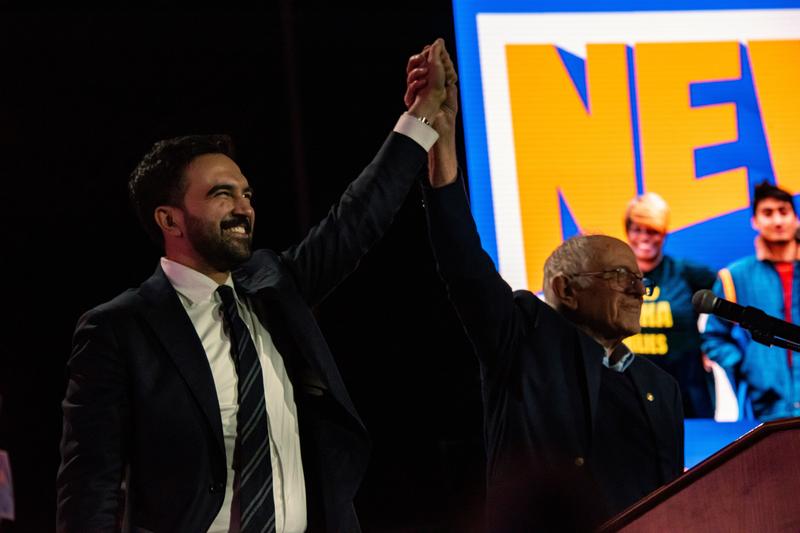
( Neil Constantine/NurPhoto / Getty Images )
Brian Lehrer: It's The Brian Lehrer Show on WNYC. Good morning, everyone. How many of you know who Eugene V. Debs was? Many of you do, and I'll guess that many of you don't. If you don't, maybe you were scratching your heads for just a second when mayor-elect Zohran Mamdani began his victory speech Tuesday night with this.
Zohran Mamdani: The sun may have set over our city this evening, but as Eugene Debs once said, "I can see the dawn of a better day for humanity."
Brian Lehrer: In brief, for those of you who don't know, Eugene V. Debs is described this way on the AFL-CIO website. It says, "The best known apostle of industrial unionism in the early years of the 20th century, Debs ran for President of the United States on the Socialist Party ticket five times between 1900 and 1920, winning millions of votes." Right out of the gate, the mayor-elect was leaning into not shrinking from his political identity as a socialist who runs for high office. Later in the speech, he added this.
Zohran Mamdani: I am young, despite my best efforts to grow older. I am Muslim. I am a democratic socialist, and most damning of all, I refuse to apologize for any of this.
Brian Lehrer: No apologies for being a socialist. Why should he apologize after garnering more votes than hyper capitalist Michael Bloomberg in any of Bloomberg's three elections as mayor and having seen a volunteer army of about 100,000 people canvass on his behalf, many organized by the New York City chapter of the DSA, Democratic Socialists of America? The chapter says half of its 11,000 members joined within the last year. The circle between Mamdani inspiring them and them helping Mamdani rise was very direct and significant. It'll be interesting to see how this relationship continues, but to that governing as a socialist can mean different things to different people, including at different levels of purity, you might say, and can come with political battles. For example, on October 30, POLITICO had an article that said, "Zohran Mamdani and the New York City's Democratic Socialists of America will have some relationship issues to iron out if he's elected. He wants to retain NYPD Commissioner Jessica Tisch, beloved by the business class but politically a walking antithesis, says POLITICO to the DSA's membership. "He has committed to following through with the city's plan to build four new jails to replace Rikers Island, a policy he and DSA had previously opposed.
He has distanced himself from portions of the national organization's agenda, like ending prosecution of misdemeanors, and he has apologized for past criticisms of the NYPD and ended his calls to defund the police." from Politico. Let's talk about all of this. With me now are two prominent DSA members, Micah Uetricht, editor of Jacobin magazine and co-author of the book Bigger Than Bernie: How We Go from the Sanders Campaign to Democratic Socialism, and Susan Kang, associate professor of political science at John Jay College of Criminal Justice and a frequent commentator on state and local politics. Micah, welcome. Susan, welcome back to WNYC.
Micah Uetricht: Thanks for having me. Brian.
Susan Kang: Thank you.
Brian Lehrer: Listeners, DSA members will get first dibs on the phones here to start out. What do you most want Mayor Mamdani to do that's consistent with your DSA values or agenda priorities, or what would you be most disappointed about if he doesn't do it? 212-433-WNYC. Again, DSA members will get first dibs on the phone to start out today. What do you most want Mayor Mamdani to do once he's in office that's consistent with your DSA values or agenda priorities, or what would you be most disappointed about if he doesn't do it? 212-433-WNYC, 433-9692. You can call or you can text.
Also, if you just joined the DSA in the last year, as we referenced in the intro that a lot of people did, we would love to hear from you. If that was inspired by the Mamdani campaign or if you are a DSA Mamdani campaign volunteer, you can tell everyone your story of what you did and what that was like for you. DSA members, on your top priorities for Mayor Mamdani, plus those of you who joined this year or volunteered on the campaign, call or text. 212-433-WNYC, 212-433-9692. You get the phones first for today and this week. Susan, Mamdani opened his victory speech with that Eugene V. Debs reference. What did that signify to you, if anything, or should it signify to New Yorkers in general?
Susan Kang: What I understood was that Zohran Mamdani was linking his victory to the great history of socialism in the United States. I think that people who were critical or opponents of Mamdani wanted to paint this as something foreign or threatening, but in fact, socialism in America is a long, beautiful tradition. One that doesn't get taught in schools, but one that speaks to the importance of working people organizing to fight for a better future, better working conditions, a better economic system.
One that was very successful. Not necessarily led by the people who call themselves socialists, but in terms of things like the New Deal or the trade union movements. I think that that was a really smart choice. I thought it was a really beautiful quote. The thing is that even with the Cold War, even with tens of millions of dollars spent against a democratic socialist candidate, this won. I think it was, it was a really great way to tie it into our history.
Brian Lehrer: Micah, any first thought from you on Mamdani leading with Eugene V. Debs or declaring his democratic socialism by name within the speech, in addition to what Susan just said?
Micah Uetricht: It's a testament to who Zohran Mamdani is. He has a range of politics that he grew up with that led him to be the person that he is today, but democratic socialism has been central to his politics. I think he indicated on election night that that is something that he's not going to run away from. He's very proud to be a part of the noble democratic socialist political tradition in this country that Susan just mentioned, and he is not going to run away from being a democratic socialist.
He doesn't see it as a dirty word. I think in New York City right now and in America, across the country, increasingly, this is not a dirty word. This is a movement that represents hope to people, that represents actually speaking to people's material needs and a better and more humane way of organizing society.
Brian Lehrer: To it not being a dirty word, I think it's very generational. From the polls, I've seen people who did not live through the Cold War don't have that same knee-jerk response to the word. Given the state of inequality and lack of affordability all over the country today, not just in New York City, it piques more interest without that baggage than it did in decades past. Susan, maybe remind people some of the democratic socialism basics after it got used so heavily against Mamdani in the campaign.
Andrew Cuomo said socialism hasn't worked anywhere on the globe, not in Venezuela, not in Cuba. He said, "My opponent represents democratic socialists. The word democratic shouldn't be there." By referencing Cuba and Venezuela and then saying explicitly that the word democratic shouldn't be there, he's implying that this is going to come with some kind of authoritarianism or totalitarianism. Would you talk about the term democratic socialism and whether Cuba and Venezuela are any kinds of points of reference from what might work in New York or what the mayor-elect might be planning?
Susan Kang: I really appreciate that Andrew Cuomo was trying to say that democratic socialists aren't democratic and trying to create this conflation because it demonstrated how desperate he was to make the movement seem like it was illegitimate or unfair or authoritarian, and people know that that's simply not the case. He was trying to conflate particular regimes that were associated with a certain economic idea of justice with a democratic movement. A movement that seeks to democratize our economy, our political system, in a way that creates more economic justice, and voice for workers and people about all things that are economic in our lives.
It's not just about political democracy, which we have in the United States. Not perfect, but we certainly have a tradition of allowing for elections and free speech. When it comes to economics, none of us consented to a system in which we have millionaires, billionaires, and now trillionaires who are hoarding wealth and not using it to benefit anyone but themselves. Not even really enjoying their wealth. Instead, we all are forced to accept an economic system. We don't have a say in it. We're forced to accept the conditions of our work. We have to watch idly by while our federal government plays chicken with our health care.
None of us probably would have chose a system of health care that's distributed based on markets and profits. The general idea is that we are trusted to decide our political outcomes. We also should have a say in economic outcomes, whether it's through the workplace, democratizing our workplace through unions, or just allowing for more questioning and a restructuring of the ways that economic decisions are made.
They could be inclusive. We should have more protection for housing, health care, higher education, all these other things than they currently are, but it's never about force. It's never about authoritarianism. I think that Cuomo was really desperate to try to confuse people. Everyone understood that democratic socialism is about using democracy in a number of ways, whether it be electoral or otherwise, to try to create a more just set of economic conditions.
Brian Lehrer: Micah, in this context, for people who don't know your publication or the word Jacobin in political history, the Encyclopedia Britannica website says, "The Jacobin Club, the most famous political group of the French Revolution, which became identified with extreme egalitarianism and violence, which led the revolutionary government from mid-1793 to mid-1794."
The Merriam-Webster dictionary says, "A member of an extremist or radical political group, especially a member of such a group advocating egalitarian democracy and engaging in terrorist activities during the French Revolution." Wikipedia and others cite Robespierre and the Reign of Terror aspect of the French Revolution. What is Jacobin to you in the contemporary US context?
Micah Uetricht: If I could just speak quickly to the previous question on the question of democracy. I think that it's rich that Andrew Cuomo is trying to level the charge against Zohran Mamdani that he's not interested in a democratic political system. A small d democratic political system, when Andrew Cuomo's campaign was characterized by tens of millions of dollars poured in from corporate interests. Not much of a ground game to speak of versus the Mamdani campaign, which was powered by an army of grassroots volunteers, the likes of which has not been seen in this city in quite some time, maybe ever.
In other words, Zohran Mamdani won this campaign through doing small d democratic politics at a time when democracy is under assault in this country. It is democratic socialists that are trying to rebuild democratic politics through grassroots means, like the canvassing operation that the New York City DSA ran and through engagement with large numbers of people around the issues that affect them in their daily lives.
Our magazine has the name Jacobin. We've been a democratic socialist publication since the onset of Jacobin. You can read an essay by our creative director, Remeike Forbes, about the Black Jacobins of Haiti and the overthrow of slavery. Also, Jacobin refers to a spirit that, when we were founded as a publication, I felt was really lacking in American politics, which is the idea that we should be incensed at the immense inequalities that exist in this society.
If you read the magazine, you know that we do not counsel terrorism or violence. Far from it. We counsel the exact opposite. We counsel democratic means for achieving a democratic society. The fundamental Jacobin spirit is that things are very wrong in our society right now, and we should be saying so. In the time since the magazine has been founded, that spirit has taken hold in our politics. I think that the kind of politics that we advocate for is maybe best encapsulated in a campaign like Zohran Mamdani's.
Brian Lehrer: If you're just joining us, our guests are Micah Uetricht, who was just speaking, editor of Jacobin, and Susan Kang, a John Jay professor. They are both members of the New York chapter of the Democratic Socialists of America. As we talk about that aspect of the Mamdani campaign and what it might mean going forward, once he is, in fact, the mayor of New York City. We will get to some of the tensions between Mamdani's actual campaign platform and what the New York DSA chapter says it's for, and whether, as POLITICO suggests, there might be some "relationship issues" there.
I invited DSA members to get first dibs on the phones and in our text thread today on what you want Mayor Mamdani to do, or if you joined in the last year, as apparently so many people did because of the Mamdani campaign. Here's a text that says, "Hello, I became a dues-paying member of the DSA on the day Hakeem Jeffries voted for the resolution honoring Charlie Kirk. Mamdani's primary success moved me to ask for more from all of our elected Democratic officials, and to follow up on Brian's mentioning of living through the Cold War. I am 53."
I guess this person was around when socialist was a dirty word for more of an active reason in the United States. Greg in Greenpoint, a DSA member. Greg, you're on WNYC. Thank you for calling in.
Greg: Thanks, Brian, and thanks for doing Jacobin. I've been a subscriber since I was at the Whitney Independent Study Program. Not the recent one, but the OG Ron Clark. They had some criticisms of the magazine, but it was really great to pick it up and to see the villages article and be like, "Ooh, that's where my in-laws just moved." I'd like to drill down on universal child care. My wife and I have a 10-month-old son. We're both adjuncts. We work to pay the nanny or school. The previous union cozied up to the admin and turned out he was embezzling. He's now indicted for embezzling $300,000. [crosstalk]
Brian Lehrer: Make the connection to what you want Mamdani to do as mayor.
Greg: I just want to make a connection, Brian, that you see this in politics again and again, like de Blasio, that they get subsumed by interest and bought off and become absorbed by the system. I just want to ask the question, is universal childcare a moonshot?
Brian Lehrer: All right. Susan, as a commentator on New York state politics, is universal childcare a moonshot?
Susan Kang: No. I appreciate this caller's question. I remember very much staying up late, crying, trying to figure out how I'd pay for childcare for two kids. My children's father at the time was also an adjunct. Absolutely not, because first of all, Governor Hochul's already signaled that she's willing to do this. This is not something that comes out of the air. There have been advocates on the ground and legislators fighting for universal child care in New York State for many years now.
The great thing about Mamdani's campaign is it's brought this to the forefront. I work at John Jay Policy Scholars here at John Jay and many other places have been saying the great failure of the pandemic was the inability for us to solve the childcare problem. Which I'm a young Xer. People always boomers never solved that issue. They didn't solve parental leave. They didn't solve childcare, so now we have this crisis. There's a problem with demand, there's a problem with supply, and it's so expensive, but the workers don't get paid much.
It's not a moonshot. It's something that people are actively gearing up to fight for at this moment, and conversations are being had. If the caller wants to plug in, they should plug into the DSA and the existing childcare campaigns to make this a reality. I want everybody in New York City and beyond to be able to have the families they want, and to have that be possible through things like universal childcare, which are very normal all throughout the developed world except for the United States.
Brian Lehrer: Listener writes, "I'm over 50 and grew up in the Cold War. I also volunteered for his campaign and found myself battling so much misinformation about democratic socialism being conflated with communism and authoritarianism, not to mention the amount of Islamophobia we saw as volunteers. My biggest hope as a DSA member and a volunteer is that he will hold strong and protect our immigrant population. Be able to follow through on universal childcare, because I think that will win a lot of people over and improve mental health services." To another caller, a DSA member, John in Washington Heights, you're on WNYC. Hi, John.
John: Hey, Brian. Those people who talk about democratic socialism should remember in our lifetime, Willie Brandt, the Democratic Socialist, was the mayor of West Berlin who fought the Communists and the Nazis. What I want to get to is that I think this election had a very fundamental basis. Madison Square Garden has not paid a penny in real estate taxes since most of the callers here were born.
Cuomo is very much a product of that real estate machine. He was willing to rip down most of central Manhattan for Vornado Realty Trust. I think Zohran's election is much bigger than we think. I think he's really challenging the power structure and how we tax and how we spend. I don't think anything he's put on the table is unreasonable. I think it's mostly very positive and very forward-thinking. Thanks.
Brian Lehrer: Challenging the power structure might strike some people as being abstract when they want things like universal free childcare that will make life more affordable. Do you relate the abstraction to the more concrete, or how do you relate that?
John: Absolutely. We built a tax base in New York City that essentially rewarded the people who were already rich and powerful. We only built new subway lines to benefit real estate interests, like Hudson Yards is a perfect example. They haven't put a single piece of affordable housing in that that they promised. If we have a mayor who prioritizes the 99%, we're going to make some significant progress. It's very big. Like the childcare issue, the money is there. We could [inaudible 00:21:37] we could have beautiful public schools. We could have free buses. If the Dolan family simply paid their taxes, that would be hundreds of millions of dollars.
Brian Lehrer: Thank you very much. Another caller, DSA member Carl in Manhattan, who says he just joined in September. Carl, you're on WNYC. Thank you for calling in.
Carl: Thank you very much. I was very moved by Mr. Mamdani, and I went out and joined in September. I decided to go to central Bronx, where he was giving a press conference in front of a hospital, and he said this hospital draws 90% of its patients from Medicaid, and if the Medicaid funds continue to be cut, thousands and thousands of people will no longer receive Medicaid. I would note that 80 million Americans receive their health care through Medicaid. He speaks to the masses, and I'm very excited about his election. Thank you.
Brian Lehrer: Carl. Thank you very much. We'll continue in a minute to talk about Mamdani and the DSA. We will get next into where there might be sources of tension over possible Police Commissioner Jessica Tisch if she, in fact, stays on, and some other things. Then a little later in the hour, we're going to talk to Democratic Congressman Tom Suozzi from northeast Queens and Long Island.
We're definitely going to talk to him about the government shutdown compromise that seems to be in the works and whether he supports it. He was also skeptical of Mamdani and supported Andrew Cuomo in the mayoral election. We'll get a different take on all this from Congressman Suozzi as well as talk about government shutdown politics coming up, but we continue with Susan Kang from John Jay and Micah Uetricht from Jacobin, and your calls and text right after this.
Zohran Mamdani: New York will remain a city of immigrants, a city built by immigrants, powered by immigrants, and as of tonight, led by an immigrant. Hear me, President Trump, when I say this. To get to any of us, you will have to get through all of us.
Brian Lehrer: Again, Mayor-elect Zohran Mamdani from his victory speech on election night, as we continue with two prominent DSA members. We're talking about Mamdani and the Democratic Socialists of America and Mamdani as a Democratic socialist with Micah Uetricht, editor of Jacobin magazine and co author of the book Bigger Than Bernie: How We Go from the Sanders Campaign to Democratic Socialism, and Susan Kang, associate professor of political science at the John Jay College of Criminal Justice, part of CUNY, and a frequent commentator on New York state and local politics.
Micah, was that smart of Mamdani to go so hard and so defiantly after President Trump that way? We see some cities like Chicago, where Trump is really going hard, maybe some other cities, maybe like San Francisco, where the mayors have been a little less outspoken, where he's not quite going as hard against immigrants. What'd you think when you heard that stretch and frankly, the defiant tone of a lot of the speech?
Micah Uetricht: I think it was incredibly smart. I think Donald Trump is not someone who responds in a positive, progressive way, or less of an authoritarian way, to what he perceives as weakness. He's someone who, when you stand up to him vocally and using whatever obviously nonviolent means are possible, that he tends to back off because he's a bit of a paper tiger in some ways. I think this idea that Donald Trump will somehow lessen his authoritarian crackdown on New York City, that I think we all know is coming, if Zohran Mamdani were to say some nicer words to him, is absurd.
I think New Yorkers want a mayor who will resolutely stand up to the cruelty and reactionary meanness that have characterized the Trump administration's second term so far. We're going to need a lot more of that to make it through the next three years. I'm glad that we have a mayor who is willing to stand up and say that he's not going to just sit down and take whatever Donald Trump has in store for this city.
Brian Lehrer: Susan, how much do you agree or disagree, and what do you think that might mean in practice? We might guess that Donald Trump could be susceptible to taking the bait if he hears it as bait, and up the ante on various kinds of crackdowns on New York City, including troops in the streets.
Susan Kang: I agree with Micah, which is that Zohran Mamdani, he built his campaign on an inclusive New York. Like he said over and over again, "I'm the mayor for everyone." Absolutely, it was the right thing to do. I didn't find it to be defiant, but rather an expression of his deepest commitments to his voters and to the rest of New York City. New York City is great because we are a city of immigrants, no matter what right-wing folks might like to say. I thought it was the right move.
Look, Trump will do whatever Trump thinks he can get away with. I'm teaching a class right now on Democratic erosion right after this, and we're talking about things like executive overreach and what happens when democratic norms are just disregarded. I think that the strength of the United States is that because we are a decentralized political system, it's the onus, if you care about democracy at all, for every level of government, federal, state, local, to stand up to executive overreach wherever you are on the political spectrum.
You don't have to be a democratic socialist to say, "Hey, this is a form of dictatorship." We all need to be standing up and saying, "Absolutely not." Trump before November 4th sounds a little bit different than Trump after November 4th, because Democrats across the country won in a lot of significant races. I don't know what the national Democratic leadership is planning to do because they were doing a whole lot of nothing before, but I think Mamdani represents a model of being unapologetic in saying that American democracy needs to be protected.
Civil rights, political liberties absolutely need to be protected, and that it's inappropriate for our president to engage in politically motivated threats using executive power. It's not appropriate. It's dictatorial. It's not something we should tolerate in the US. Before Mamdani was elected, he was already making threats to cut our budget for things like our overly woke educational curriculum. He's going to try to take, and it's our job to say no.
Micah Uetricht: Brian, if I could add quickly, I think we saw for the majority of this year what it looked like when the Democratic Party did not stand up to Trump in any serious way. We saw Trump unleash the horrors on streets across the country in the face of effectively a missing and absent opposition party. We know what it looks like when you don't try to stand up to Donald Trump. It doesn't look great. It looks like more erosion of democracy and a rising authoritarianism. The Mamdani approach is a different one that I think has a lot of promise in halting that spread of authoritarianism.
Brian Lehrer: We have been taking calls from listeners who are DSA members. They got first priority on the phones over the first half hour. Now we're going to take a call from somebody who says she's a former DSA member. Pia in Queens, you're on WNYC. Hi Pia.
Pia: Hi, Pia from Queens. I'm a former DSA member. I will be transparent. I stopped my membership after October 7th because I felt that DSA did not make enough effort to teach about anti-Semitic teachings and really help working-class people, and understand the cultural norms. Mind you, I am a Muslim woman. I lived in every borough except Staten Island. I have a lot of reservations about DSA because I feel like it is very elite. It has very few people of color who have lived in the city as leadership, and I did not feel welcomed in it.
I just felt like they could have done a lot better to serve people of color, actually. I also think very pro-union DSA, but has DSA ever run a unionized campaign in the city? It's moving in a very capitalistic way. Those are my reservations. I always want DSA to do better, and I'm always happy to rejoin, but I do think there is a problem with diversity and inclusion.
Brian Lehrer: Pia, thank you for your call. Susan, your response?
Susan Kang: I'm very sorry to hear that this caller did not have whatever experience she was hoping for. As a member of Queens DSA now for I'd say about eight years, this has not been my experience. I'm somebody who doesn't reflect what media likes to say is a typical DSA member. I'm a woman of color. I have children. I'm older on average than the average DSA member. I believe that the DSA is what we make of it. I'm sorry, someone did not link her up with our Afro Socialists, which is our DSA caucus for Socialists of Color, or the DSA like Socialist feminists, because we actually do have a lot of great work that we do in the org specifically for people who are looking for that kind of work.
The great thing about DSA is that I would argue DSA changes every year. I've been a member since January 2017. It is a radically different organization than it was then, as compared to what it is now. I'm sorry about the experience you had in 2023. DSA is more diverse than ever. The people who are coming to DSA 101s, which is our introduction to DSA, they're very diverse. They represent the diversity that we've been able to bring in through the Mamdani campaign and lots of other organizing that we've done.
I'm going to actually let Micah talk about the union organizing because I feel like that's something he can speak more to. DSA worked closely with organizations like Emergency Workplace Organizing Committee. We do work to support workers who are on strike or like Amazon workers. We have our own labor working group. All the work we've done with unions, somehow she didn't learn about it because we're actively very much involved in both the union movement, helping workers who organized in the workforce.
I don't know. All of our staff are unionized. I guess I don't really understand where she got her information from. I'm really sorry that she seemed to have gotten a lot of misinformation, but every single one of our staff is in our staff union. I would say that we have done a great job fundraising, for example, for our campaigns. I don't know if that's what she means by capitalists, but we are in no way a profit-seeking organization.
Brian Lehrer: Micah, is there a friction yet, or could there be between Mamdani and the local or national DSA? I read from that POLITICO article earlier what they called potential relationship issues, including POLITICO described Police Commissioner Jessica Tisch as a walking antithesis to DSA members, and there were some other things. What do you see coming or what's already here?
Micah Uetricht: Sure. Just briefly on the previous question, I'm also sorry the caller had that experience, but I've never heard anyone say that Democratic Socialists of America does not talk enough about the labor movement. Democratic Socialists of America members are quite obsessed with the labor movement, are active in unions across the city, played key roles in getting union endorsements for Zohran Mamdani, have created organizations like the Emergency Workplace Organizing Committee that supports workers to organize wherever they are.
There's a very robust labor movement infrastructure that DSA has created, really some amazing, innovative strategies that DSA members are responsible for in the labor movement. I don't get the sense that there is the kind of friction that I think mainstream media might be desperate to gin up around the Mamdani administration and the DSA. I think that DSA members understand that in an office like the mayoralty of the largest city in the country, you're not going to be able to institute every agenda item that you want to see instituted, and that that's what it means to hold an executive-level office like this.
You're constrained in many ways. You live under a capitalist system, and it is capitalists who hold the power in this system. It's a robust democratic organization. I'm sure people will be unhappy about certain things that Mayor Mamdani is going to do, but I also think that the vast majority of the members of this organization understand that success will be judged not by every single action being exactly what DSA members would like to see Zohran do, but rather moving forward an affordability agenda and making the city one where average working class people are able to live with more dignity.
Brian Lehrer: Next issue. The caller also raised her disappointment with the DSA's response after October 7th, 2023. I wonder if you expect or advocate BDS in city contracting, investments, et cetera, or other pro-Palestinian measures that actually affect municipal policy. Here's a bit of the mayor-elect on the show for a campaign interview this summer. This begins with a question that I asked him while discussing this topic. Of course, you would speak your mind as mayor, but my question was about whether you would try to do anything at the policy level as you tried in the Assembly.
Zohran Mamdani: I've said that where Eric Adams has taken our city out of step with international law, that is something that I would rectify because I believe that this is a city that should embody those same values.
Brian Lehrer: How, for example?
Zohran Mamdani: This is a mayor who promised greater cooperation with Israeli settler leaders. That is not something that I think advances New York City's interests or the tenets of international law, which have been so trampled upon in so many recent months.
Brian Lehrer: Susan, I know you've got to go in a minute. Micah's going to stay with us a little longer. How do you hear that answer, and what it suggests he might do? I also note that there was a New York Post article the other day called Here's the Democratic Socialists of America's Demands to Zohran Mamdani on this issue. it lists banning Israeli products from the city run grocery stores Mamdani wants to open, investigating real estate agents "hosting illegal sales of stolen lands in the west bank", stripping tax exempt nonprofit status from entities that raise funds for the Israel Defense forces, end the NYPD's training with Israeli occupation forces, arrest Prime Minister Benjamin Netanyahu and dismantle a New York City Israel Economic Council formed by Mayor Adams in addition to BDS per se, divesting the pension funds of Israel bonds.
Susan, as a New York DSA member, is the Post, right? Is the chapter advocating all those things, and do you, and do you think Mamdani's going to act on any or many of them?
Susan Kang: I'm not familiar with that article, and I don't know when that list was from, and I imagine it was a list of possible policies. Of course, people should ask for things knowing that not everybody gets what they want. That's how politics works. We ask for things, we get what we end up getting as a result of a negotiation because that is the way power works. I want to say this. I'm not just a DSA member, I'm also a public employee with the public pension.
When people ask this question, there's this assumption that there's never been any consideration about these questions politically when it comes to our public funds. One of the things that we do know is that Brad Lander did divest some public pension funds from Israeli bonds in 2023. This is not something new that's happening in New York City. As a member of my union, I've worked with people to try to get our pension divested from fossil fuels. I think that Zohran Mamdani will be part of the broader democratic political process about public funds and how they reflect political and social values.
I think that that's appropriate for a mayor to do. This is not him coming in and being the first person to do it, but rather another person stepping into a wide-ranging, long movement towards divestment. I'm not saying he is or isn't going to do things because, like Micah said, we all know that when you get power, you work within the constraints of that institutional system. Nobody's expecting that we snap our fingers and that miracles happen. Political contestation continues under a different set of conditions. R
I would love for my pension funds to be divested from a number of things, and we know that that's a political negotiation and a struggle. I look forward to continuing that as a pension holder, and I think that many feel the same. Thanks so much for having me on. I do have to go, but I really appreciate you having DSA members here on the show. Thanks so much. Bye.
Brian Lehrer: Thank you. Bye. Susan Kang from John Jay asked to go teach a class. Micah Uetricht, editor of Jacobin, is still with us for another few minutes. Did you want to add anything to that answer?
Micah Uetricht: I think first, just to remind people that the campaign that Zohran Mamdani ran was focused principally on affordability. That is going to be what the centerpiece of his agenda as mayor is going to be. I think that the focus on questions about Israel, Palestine was an effort by some in the mainstream media to try to take the conversation in a different direction, but that is not what Zohran Mamdani is actually going to do once he's in the mayor's office.
Brian Lehrer: The clip from him on the show did seem to indicate that he was going to realign city policy in some way with international law with respect to Israel, that he felt Adams had taken it away from.
Micah Uetricht: I would hope so. I would hope that this city would be-
Brian Lehrer: Meaning what?
Micah Uetricht: -in line with the national law. I read, for example, last week he told New York Jewish Week that he agreed with what Brad Lander, the comptroller, has done on divesting city pensions from Israel. He said that he thought that we might want to do more of that. I also just want to say generally that I don't find it controversial that the Democratic Socialists of America has taken a strong stance for Palestinian rights against the genocide that is happening there.
I think that the record of NYCDSA since October 7th is an extremely noble one, and it is one in which this organization has stood up for Palestinian lives, including at a time immediately after October 7th when doing so was very difficult. I think that history will look quite kindly on those who had the courage to stand up to the slaughter that has happened in Gaza since October 7th and before. I think that this organization's legacy on that question is a very proud one, as is Zohran Mamdani's.
Brian Lehrer: All right. Just acknowledging that different people will disagree on whether the word genocide applies. Two quick things before you go. Listener writes, "What about all the Scandinavian countries? They're socialistic." There was an NPR piece after Mamdani was elected about democratic socialists and the DSA that says-- I'm getting this quote. "Proponents say democratic socialism goes further than social democracy," which I think indicates the Scandinavian country, social democracy. "Which often involves a strong welfare state operating under capitalism." I guess they're quoting the DSA website. "We believe there are many avenues that feed into the democratic road to socialism. Our vision pushes further than historic social democracy and leaves behind authoritarian visions of socialism in the dustbin of history." What about the social democracy comparison there?
Micah Uetricht: Democratic socialists have been key players in building social democratic welfare states around Europe, around the globe. We do have a vision that says that we can actually build something even better than what has been achieved in the most advanced welfare states. Life in a country like Sweden, Norway, is, is pretty good. It's not perfect, but there's less economic inequality than we have here. There are policies like free publicly provided childcare for people, often free higher education.
These are societies that have shown that they didn't require some kind of radical break and reconstruction of society from the ground up to build societies that allow average people to lead dignified lives. You can do that in a world that is awash in immense amounts of wealth if you don't let a small number of wealthy people hoard it all for themselves. The democratic socialist vision is one that thinks that we can actually go quite beyond that.
We're not subject to the whims and desires of the ultra wealthy, but that we can actually build a democratic society that allows for the flourishing of all people in democratic rights and democracy extended into places like the workplace and the economy.
Brian Lehrer: Last thing. You want to hear one of the most surprising moments from the campaign on this show? Here's Curtis Sliwa from his campaign interview here this summer.
Curtis Sliwa: I listened to Mamdami say that we should have free bus fare, and everyone else gets bent out of shape, "Oh, that's socialism." I say look, we had socialists in New York City, in our City Council, Congressmen from East Harlem who represented people there for many years. We've had communists elected before. Nothing to be frightened of. The state of Israel, Ben-Gurion, is a socialist country. Rabino is socialist. Stop the labels and stop the nonsense.
Brian Lehrer: Micah, did that surprise you, or do you want to build on any of those historical references before you go, that the Republican nominee named quite the opposite of what we heard from the erstwhile Democrat, Andrew Cuomo?
Micah Uetricht: I disagree with Curtis Sliwa on a wide range of issues, but I agree with him that you should not be afraid of socialism. That it has a, as he referenced, a long history in this city, and in fact, socialist contributions to the politics of the city have made it a more humane and democratic place, one where working-class people are able to flourish. Zohran Mamdani's mayoralty is a part of that noble tradition of socialism. I think we're going to see that socialist movement grow in New York City under his mayoralty and across the country as people realize that we need some alternatives to a bankrupt Democratic Party establishment thathas led us into a place where we're not able to live the lives that everyone deserves, to say nothing of the kind of authoritarian populism that's on offer from the Republican Party. Me and Curtis agree. Don't be afraid of the socialists.
Brian Lehrer: There's our headline. Editor of Jacobin and Curtis Sliwa agree to end the segment with Micah Uetricht. Obviously, this is just the very, very, very beginning. We will see how it all works out. Thank you very much for coming on. We look forward to having you back.
Micah Uetricht: My pleasure.
Copyright © 2025 New York Public Radio. All rights reserved. Visit our website terms of use at www.wnyc.org for further information.
New York Public Radio transcripts are created on a rush deadline, often by contractors. This text may not be in its final form and may be updated or revised in the future. Accuracy and availability may vary. The authoritative record of New York Public Radio’s programming is the audio record.
