
Hochul and Mamdani Propose Universal Childcare for 2-Year-Olds
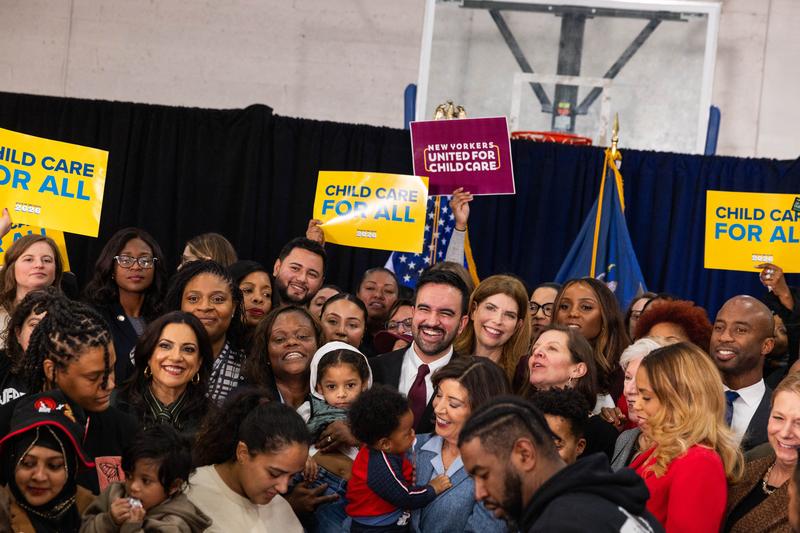
( Jason Alpert-Wisnia and Hans Lucas / AFP / Getty Images )
[MUSIC - Marden Hill: Hijack]
Tiffany Hanssen: It's the Brian Lehrer Show on WNYC. I'm Tiffany Hanssen, in for Brian today. We're turning now to an announcement from Governor Kathy Hochul and Mayor Zohran Mamdani yesterday about the future of child care in New York. They stood side by side at the YMCA in Flatbush to unveil a proposal to roll out free child care for kids as young as two in New York City. Here's Governor Hochul speaking in front of elected officials, advocates, and the press yesterday.
Governor Kathy Hochul: Today, I'm proud to announce that New York State is paying the full cost to launch 2-Care for the first time-
[applause]
Governor Kathy Hochul: -universal daycare for 2-year-olds as proposed by Mayor Mamdani. We're not just paying for one year of the program. We don't usually go one year out in our budget, but just to let you know how serious we are, we're taking the unprecedented step to not just commit for the 2027 budget, which I'm working on right now, but also the following year as well, to show you we're in this for the long haul.
Tiffany Hanssen: In addition to the rollout of 2-Care, which is that official name that Governor Hochul mentioned there of the program, the governor also shared that her upcoming state budget proposals includes funding to extend Pre-K access throughout the state, expand Pre-K and 3-K in the city, and increase funding for the state's child care subsidy program. Here's Mayor Mamdani talking about the additional funding for those programs at yesterday's press conference.
Mayor Zohran Mamdani: We will build on the city's existing 3-K program and say no longer will a family in Flatbush be offered a seat but have to find out that that seat is in Astoria. We will add seats in the neighborhoods where demand has not been met.
[applause]
Mayor Zohran Mamdani: This will be felt by expanded subsidies for tens of thousands of additional families. It will be felt when parents look at their bank accounts at the end of the year and see that they have saved more than $20,000 per child.
[applause]
Mayor Zohran Mamdani: It will be felt when neighborhoods no longer feel hollow and empty because those we love haven't been forced to move away to raise their children elsewhere. It will be felt when our children receive high quality care and enjoy better outcomes later in life as a direct result.
Tiffany Hanssen: This announcement, this press conference yesterday from the governor and the mayor comes as President Trump froze billions of dollars, as we heard earlier this hour, in federal funding for child care and other assistance for needy families in five Democratic led states, including New York. We're going to get into what we know so far about the governor and the mayor's ambitious proposals for expanding free child care in New York and how the Trump freeze might impact those plans and the ambitious goal to provide universal free child care.
We're talking about all of this with Rebecca Bailin, who is the executive director of New Yorkers United for Child Care. She was also a member of Mayor Mamdani's transition team, specifically focusing on child care within his broader affordability agenda. Rebecca, welcome.
Rebecca Bailin: Hi. Thanks for having me.
Tiffany Hanssen: You got it. Okay, let's just start with an explainer here on this proposal for 2-Care. What does it encompass precisely and how will it work?
Rebecca Bailin: Sure. If it's okay, I'd love to take a step back and explain a little who we are.
Tiffany Hanssen: Sure.
Rebecca Bailin: New Yorkers United for Child Care, we are a movement of now more than 10,000 New Yorkers in New York City and state. We are parents and would-be parents, grandparents as well, who are organizing to win universal child care. We started in the fall of 2023 in response to Mayor Adams' cuts to our universal 3-K and 4-K programs. We actually launched the campaign for 2-Care with the United Neighborhood Houses in a large coalition just about a year ago. Then we launched our campaign for a statewide 3-K and Pre-K guarantee last month with United Auto Workers in a large coalition.
It's a really exciting moment because the mayor and the governor are now implementing our plans, and everything we know, of course, the details are still getting worked out, but the 2-Care proposal from the state will fund the first two years. Year one, the highest needs area, my understanding is about 2,000 kids. Year two will expand to 10,000 kids, which really matches with our blueprint that we released in November, kind of outlining how the administration can roll out 2-Care.
Then really important as well, is that the state for the first time will be putting in funding for New York City's 3-K program, $100 million investment to make sure that we can really fix what Mayor Adams broke, restore seats and strengthen access throughout the city.
Tiffany Hanssen: To be clear, these are still proposals. These are part of the proposed budget. Nothing is set in stone. I want to get to a little bit more about what you think about whether or not this measure will pass and what the political landscape looks like in Albany, but I want to invite our listeners into this conversation. Rebecca Bailin is the executive director of New Yorkers for Child Care. We're talking about Governor Hochul and Mayor Mamdani's proposal to create 2-Care, and also to expand childcare access.
What's your experience trying to find a 3-K seat here in New York City? What about the other programs? Let's talk about 2-Care. If implemented, will it affect your family planning? Will it affect your family's day to day life? You can call us at 212-433-9692. You can also text us at that number. I want to bring in Ben here really quick into our conversation, Rebecca. Ben in Brooklyn. Good morning, Ben.
Ben: I'm a dad in Brooklyn, actually, I'm also a member of New Yorkers United for Child Care. I have two kids, they're four and six now, but it was really tough. [unintelligible 00:06:08] paying for child care tens of thousands of dollars. We were lucky enough to have access to 3-K. We were waitlisted for a while. It was really touch and go, but we got a seat. We know parents who didn't or who couldn't afford it. My daughters have friends who had to move out of the neighborhood or out of this city entirely because their parents couldn't afford childcare.
That's really hard to explain to a 3-year-old or a 4-year-old, why their friend had to move away. I'm just so excited and so happy to hear that this is being made a priority by our governor and by our mayor. This is going to be huge for New Yorkers and for our kids and families. This is a very, very exciting moment, as Rebecca said.
Tiffany Hanssen: Ben, thanks so much for the call. Appreciate it. Rebecca, let's just talk a little bit about the political landscape here. These are proposals. How optimistic are you that this is all going to happen?
Rebecca Bailin: I am extremely optimistic, and I want to say that Ben is a member of our organization, and he actually stepped up with his wife to fight the cuts to 3-K, and that helped him and his neighbors get a seat. That's why I'm optimistic. We started this organization because nobody was organizing parents and would-be parents. This is a critical constituency to make it a political priority of the governor, of the mayor. It's no accident that we are in this moment where we have the political momentum. The mayor, the governor, the speaker of the city Council, the new speaker, the entire city council basically wants to make this happen. On Monday or Tuesday this week, wait, earlier this week-
[laughter]
Rebecca Bailin: -who knows time anymore? Earlier this week, we stood with 30 state legislators on the first day of session in Albany calling for 2-Care and a Pre-K and 3-K guarantee. That was an incredible day. Many of those legislators are parents themselves. I think if New Yorkers continue to make it clear to the mayor and the city council and to our state legislators and the governor that this is their priority, that this is going to help keep them in New York City and state, that this is going to help them stop going into debt or scrambling to patch together complicated child care solutions, and that they want to see this, then I think our elected officials are going to have to listen, as they are already doing.
Tiffany Hanssen: In that clip that we played from the governor at the press conference earlier this week, she touted, of course, that it's not funding just in that she's proposing for this coming budget, but for the following as well. Just explain for folks how that would work in the annual budgeting process, because as I understand it, we do this every year, and this is an election year. She might not even be here the following year to get that money back on the table and push for it in the following year's budgeting. I'm just wondering how realistic that claim is.
Rebecca Bailin: Look, if we get this program up and running, it's going to be really hard to cut it. We got organized because Adams was cutting universal 3-K, and people were outraged. So we channeled that outrage into power. I think that elected leaders have really learned that lesson. Mayor Mamdani ran on universal childcare because he saw how important it was to his constituents, because of our organizing. Governor Hochul is doing the same. I think whoever is governor, be it her, anybody else, they're not going to mess with what's popular and they're only going to expand.
As I said, the legislators, the state senators and state assembly members stood with us on January 7th, the first day of session, to make it clear this will be their priority. I really think this is the beginning of a very important change, sea change in New York City and state for families. We're going to finally start to get on the pathway to universal childcare that families deserve.
Tiffany Hanssen: Forgive me for not knowing this, but were there politicians that-- you mentioned this number. What? 30-some politicians? Were they on both side of the aisle?
Rebecca Bailin: I believe so, yes. Although I don't have that number off the top of my head. We did have legislators from all across the state. We had Senator Gounardes helping to lead it in Brooklyn, we had assembly member Solages on Long island, we had Senator Skoufis, we had Hinchey [unintelligible 00:10:47] all across the state, really standing with us. That's really significant because this isn't just about New York City. Parents with kids under 6 are 40% more likely to leave New York State because of the costs and complications of child care, and it having a huge impact on our economy.
Legislators themselves, they stood with us holding signs that said I am a parent and an elected official for universal child care. They are really understanding this crisis themselves. I think that the wind is really at our backs. Of course we still have to keep fighting this year and next year, but I think this is incredibly popular, and frankly, we have the plans. The city and the state are pushing our plans, our 2-Care plan and our Pre-K guarantee plan. Parents are going to be really excited to advocate for it and make sure it gets across the finish line this year in Albany and in the city.
Tiffany Hanssen: We have a text here that gets at one of my questions, Rebecca. The texter says, how much will taxes raise for regular middle class New Yorkers? As a liberal child free person by choice, this is certainly an unpopular opinion, but I'm not convinced that my tax dollars should go to someone else's choice to have children and not be able to afford it. I think what I'd like to ask as a follow up to that is, where is the money coming from?
Rebecca Bailin: That's a really great question. I'd say a few things. One is, we collectively pay for a lot of things that sometimes we don't directly use, but we all benefit from. We all pay for K through 12. There is really no debate at this point in New York that we shouldn't be collectively paying for K through 12 because we know that it supports our economy. We know it helps all of us in a lot of different ways, from crime to education to the future workforce. Right? This is part of that. We know that everybody has doctors or they go to the restaurants.
All those people that are serving them in all these various ways, often need child care themselves. If we want our workforce to stay here, we need to have affordable child care. In terms of how it's going to be paid for, our understanding is right now, from the general budget, that could change. Long-term, we really do need to raise revenue. In fact, what we're trying to do is make it less of a burden on the middle class. Right now, the Middle and working class are paying an undue burden for child care right now.
Overall, across the state, we are spending $14 billion collectively. We're saying let's shift the cost. Let's actually make it more fair. Let's make sure maybe businesses can chip in a little more, corporations can chip in a little more, and make it a little more fair. That would really bring a huge economic investment. We spend all this money on economic development in the state, in the city, and there's no better economic development spending. A $2 billion investment would yield $26 billion in return. We lost, in New York City, $23 billion in one year due to this crisis. There is no better spending of our money collectively than universal child care, and it will save us all money in the long run.
Tiffany Hanssen: We're talking with Rebecca Bailin, who's the executive director of New Yorkers United for Child Care. She was also a member of Mayor Mamdani's transition team. We're talking specifically here about the proposal that was laid out earlier this week from the mayor and from Governor Hochul for 2-Care, and also broadly about the mayor's proposals and his campaign promises for universal child care.
Listeners, we, of course, want you in this conversation. How are you thinking about the state's responsibility as it relates to child care? Do you have thoughts on 2-Care? Do you have kids that will benefit? Will your family benefit from this? Are you a parent caregiver who will benefit? Call us, text us, let us know how it's affecting your family. 212-433-9692. You can call us and text us at that number. Let's just talk a little bit about-- getting back to this, where's the money coming from?
There are a couple of different programs, some of which affect kids statewide, some of which affect kids in New York City. If you can just break, really make that clear, what's for whom and where is that money going? Some of this gets at, I think, which is some of the concerns that folks outside of New York City have had, which is that, I'm living in Poughkeepsie and I'm paying for childcare in New York City. Just, first of all, break it down for us and then maybe address that.
Rebecca Bailin: Absolutely. I agree with this person. That's why we're fighting for them as well. In New York City-- Overall, my understanding is that there's going to be an almost $2 billion investment for 2-Care in New York City. We'll have a $75 million investment in the first year, $500 million in the second year, $100 million to fix 3-K in New York City for the whole state. We're going to be seeing a historic $470 million investment to make sure that every single 4-year-old gets covered but with universal Pre-K by 2028, and that will start this year because we have had this outrageous inequality where New York city has had Pre-K and 3-K, and the rest of the state families have been left out, and we're fixing that, ideally, if we can win this in the budget.
Tiffany Hanssen: Right.
Rebecca Bailin: [unintelligible 00:16:56] the governor is proposing a universal pilot program for infants regardless of income. That will start in just a few areas, I don't know where yet, but that's huge. We can show them that this works, and we can fight to expand it. Those pilots will be outside of New York City counties ready to move to universal access. This is huge. I agree. We need families across the state to get access. The worst access is actually in Long Island and Hudson Valley. We have problems all across the state, that's why we launched in December the campaign for a Pre-K, 3-K guarantee.
This individual can get involved. Go to our website, united4childcare.org, the number four, and sign our petition. Get involved in our campaign because we need to hear from these families who want to make sure that the whole state gets access. We're hearing that people are going into debt, people are relying on grandparents, people are leaving the state entirely, and it's not fair, it's not right. In fact, I'm excited to hear that this person wants these programs. Let's fight for it, let's win it. Let's get universal 0 to 5 throughout the entire state.
Tiffany Hanssen: Just to be clear, we've said it, we can reiterate it. It is a proposal which means there's not a lot of detail around where the money is coming from, but I do think that a lot of people start there like, "Oh," they hear another program, how are we paying for that? I appreciate you being willing to answer that. I also am curious about this stepping stone approach because many of the mayor's supporters, he ran on the promise of delivering universal childcare for all kids ages 6 weeks to 5 years. Governor Hochul really alluded to the fact that what we have here is a stepping stone, and I think we have a clip from the governor on that.
Governor Kathy Hochul: When I announced we're going to begin on a path to universal childcare, I said this has to go first. It doesn't happen overnight. You just don't declare we now have universal child care in the state of New York. Right? You're all with me on that. Okay. It has to start somewhere.
Tiffany Hanssen: It has to start somewhere. You agree with that, Rebecca?
Rebecca Bailin: I actually do. Anybody who knows me would not call me an incrementalist. I actually don't see this as a weak incremental approach. I see this as a powerful approach. If we can expand universality by age, that will save families sometimes $30,000 a year. Knocking off a year at a time is huge. We can't just snap our fingers and have full universality because there's a lot we need to do to get there. We need to make sure that we have the revenue to pay the workforce. They are making poverty wages. It is cruel, it is unacceptable.
We need to make sure that we have the workforce there, the buildings available. All the pieces need to get together, so, aging the system down is actually what we have been proposing. In November of 2024, we released a roadmap to universal public child care that outlines how we can get to that universal child care in five years if the steps are followed. Because, like I said, we can't just turn it on overnight, but New Yorkers desperately need relief immediately, and we can really follow the example of New York city, starting with Pre-K, then going to 3-K, hopefully now going to 2-Care and replicating that fairly in the rest of the state.
I think that this is really the right answer. The one thing I'll say is we have to balance moving quickly as well, because parents need relief right now. I have a 7 month old, I am paying $32,000 a year on child care. If we can get 2-Care by the time my child is 2 years old, that's going to knock off another $30,000, and overall, I'll be saving $90,000 a year. That's pretty major. Then I am very excited for those who will be able to benefit from that 0 to 5 and those who might decide to have a second kid or have a kid at all or to stay in New York. I actually do think this is the right approach as long as we continue to move quickly in a way that doesn't destabilize the providers as well.
Tiffany Hanssen: Rebecca, we have a text here from someone who's responding to what we were-- The texter, I think, that was saying, I don't want to have to pay for child care, essentially, out of my taxes. This texter says, "I'm so tired of hearing people say they don't want to pay for something because they don't use it. Invest in children now. They are the future that will care for those who don't have children when they are older. Also, we pay one way or another."
I'm just wondering what you might say to New Yorkers as we're talking about these graduated steps toward universal child care. You mentioned there's a plan. You have a plan laid out for this, but there are some New Yorkers who might be a little disappointed that it's come-- What do you say to them?
Rebecca Bailin: I'd say keep fighting with us. I think a lot of us are going to benefit. Ben fought with us, the caller earlier, to save 3-K. His kids are older now, so he might not benefit from it, but his neighbors will. He might have friends who have kids, including me, who will be able to decide to stay in the city. They will have colleagues and co-workers who will be able to have an easier time, take fewer days off, maybe not even quit the jobs entirely and not move out of the city because of this. It really will benefit all of us. Maybe our sisters who are aunties, our parents who are grandparents. This is going to benefit all of us. Keep fighting with us. It is a bummer when you miss the boat, but you might have another kid or your friends might have kids, and it's a really beautiful, powerful moment. We need you to keep fighting with us, and we need to hear your stories about how this would have benefited you as well. So we need all of you in this fight.
Tiffany Hanssen: Well, let's hear from some of those folks here. Rebecca, how about Remy in Washington Heights? Hi there.
Remy: Hi. How are you? Thanks for taking my call. I actually really agree with a lot of what the last caller said about worried about missing the boat. I'm a big fan of the new mayor, and I feel like politically I would be sad-- I have two kids that are 2 and 4, and I'd be sad if our kids didn't get to have some of this benefit. I feel like he only has so much capital in his first year of his administration. I feel like the slow rollout might hurt his approval ratings. The other thing though, I wanted to say, is that they've talked a little bit about opening up seats for 2-Care that would be some seats in some specific low income communities or pilot areas, which is obviously amazing.
I also wish they would consider across the board subsidies to take some money off of, create grants or something for all child care so that we're obviously still going to be paying for daycare, but what if we could be getting some money off through this program right at the start? I think there might be ways to roll it out so that people get to feel the benefit right away, and that, I think, would generate a lot of goodwill and additional support for the program.
Tiffany Hanssen: Remy, thanks so much for the comments. Rebecca, there were a couple of things in this proposal that we haven't really talked about, one of which is community based daycare, but also child care subsidies. To Remy's point, can you just explain a little bit about what's in there for child care subsidies?
Rebecca Bailin: Yes. Well, first I actually want to say that he will benefit from this fight because 3-K was gutted by Adams and we have been fighting to fix it. Now Mayor Mamdani, Mayor Adams gutted it, Mayor Mamdani is committed to fixing it and Governor Hochul is giving money to make sure it exists, so he will benefit. We have a lot of members in Washington Heights who were struggling to find good seats for 3-K. His 2-year-old will benefit from this and get that 3-k. Same with his 4 year old who hopefully is in Pre-K. I hear him, I would say to him on that, just keep fighting with us. Let's make it clear. Maybe there is a world in which we can move faster, but let's not discount how groundbreaking 2-Care would be, and fixing 3-K would be for all of us and for the entire city. In terms of subsidies.
Tiffany Hanssen: Subsidies, yes.
Rebecca Bailin: I don't have the exact detail on the subsidies. There's really incredible groups working on that. They are the Empire State Child Care Coalition, Alliance for Quality Education, but I'll have to get back to you on exactly what was won for the subsidies. My understanding is that there has been an incredible investment there and that is key. I have it here somewhere. I just have to find it. What was the other-- oh, home based providers.
Tiffany Hanssen: Yes.
Rebecca Bailin: This could only work if we bring all the providers along. Family child care providers have been essential to this fight and are essential especially for infants and toddlers. We can't just start building buildings for these-- We have to work within the system that already is existing. So many infants and toddlers are in family home based care, center based care. Let's make sure that they have the funding they need to work well to provide the quality care and that they aren't left out. In fact, as part of our coalition, we have a variety of groups that work with providers. Everyone from United Neighborhood Houses that work with those center based providers to all our kin who works with the family based providers.
They need to be part of that conversation with the administration to make sure that their concerns are being met. We absolutely agree that we need to keep those home based providers included. I heard that commitment yesterday as well from the governor and the mayor.
Tiffany Hanssen: I think we've really heard you sort of make the case here for why child care is one of the most pressing issues for New Yorkers. This is a high point this week, with these proposals from the governor and the mayor, particularly as it relates to the work that you've been doing. I just am wondering if you can talk a little bit about, as the last question here, what hurdles are you preparing yourself for at this point?
Rebecca Bailin: Such a good question. The biggest hurdle is to make sure that this doesn't get weakened. That we are fighting for that full package, and that actually we even get more. We need to make sure that we are on the pathway to full universal child care. In order to do that, we actually should raise some revenue. We need to end some tax breaks that the rich and corporations enjoy, so that we can make sure that to get to 0 to 5, we have the money, that we are flush with the money to pay the workers what they deserve, that we can set up the systems and that we're not scrambling. I think that's going to be the biggest hurdle.
I want to make sure that we also get Pre-K and 3-K in the state level without any delay, and that 2-Care gets implemented fast enough that we can very soon get to 1, and we need to win paid family leave so that we don't have to actually put that money into the infants and toddlers and parents can stay home in that most difficult year, six months, the first year. I have to tell you, I'm feeling incredibly optimistic. I'm ready to work with our 10,000 plus and more and growing grassroots leaders. We're going to go to Albany. We are going to go to City Hall. We're going to work to support this fight and bring it home.
I ask everybody listening to get involved because we need you. This is really, truly how democracy works, and it's a beautiful moment to see how our elected leaders are listening to parents and would-be parents.
Tiffany Hanssen: Rebecca Bailin is the executive director of New Yorkers United for Child Care. Rebecca, thanks for all your time here this morning. We appreciate it.
Rebecca Bailin: Thank you so much. Have a great day.
Tiffany Hanssen: You as well.
Copyright © 2026 New York Public Radio. All rights reserved. Visit our website terms of use at www.wnyc.org for further information.
New York Public Radio transcripts are created on a rush deadline, often by contractors. This text may not be in its final form and may be updated or revised in the future. Accuracy and availability may vary. The authoritative record of New York Public Radio’s programming is the audio record.
