
History of Black History Month: The Second 50 Years
Title: History of Black History Month: The Second 50 Years
[MUSIC - Marden Hill: Hijack]
Brian: It's The Brian Lehrer Show on WNYC. Good morning again, everyone. Now we continue our three-part Black History Month series on the history of acknowledging Black history. The historical hook is that this is the centennial year of the observance that became Black History Month. There's also the news hook that the Trump administration is on a campaign to de-center Black history.
On Monday, we covered the first 50 years from the establishment in 1926 of what they then called Negro History Week in 1926 through its expansion to Black History Month in 1976. Today, the next 50 years, 1976 to now. Given yesterday's news, one way to frame this period is from shortly after the death of Martin Luther King Jr. in 1968 to shortly after the death of Jesse Jackson this week.
Back with us now is Dr. Karsonya Wise Whitehead, president of ASALH, the Association for the Study of African American Life and History. She's also professor of communications and African and African American studies at Loyola University Maryland and the founding executive director of the Karson Institute for Race, Peace, & Social Justice. Dr. Kaye, thanks again for doing this with us. Welcome back to WNYC.
Dr. Kaye: Thank you so much. I'm excited to be back to continue this conversation.
Brian: Let's start with Dr. King. Did the fact that he was a towering figure across racial lines in the US inspire more public acknowledgement of Black history across racial lines after he was killed?
Dr. Kaye: Oh, that's a very good question, and thank you for that. If people remember that the year that Dr. King was assassinated, his approval ratings were not very high. In fact, he was considered to be one of the most disliked men in America. He did not die with everyone who said they marched with him, everyone who said they loved him today, actually supporting him back in 1968. It was due to the work of Coretta Scott King primarily to really work on changing the way her husband's image was being taught, the way he was being discussed, and the way he was being remembered.
It took years of work on her part, long before they should be able to get the holiday established, to restore and protect his image and his memory and his legacy. It was not right after that. It took some time using the long eye of history before there were public acknowledgments, before there was acceptance, before there was an understanding of where he set in the historical continuum. Then of course, the reshaping of his image then began shortly after that.
Brian: Before there was Martin Luther King Day, officially starting in 1986. We ran out of time on Monday just as you were talking about the organized effort to get Black History Month officially recognized at the federal level. That happened in 1976 under President Ford. Why was it expanded from one week? We mentioned the original so-called Negro History Week that was started in 1926, to Black History Month.
Dr. Kaye: Thank you for that. Negro History Week, which is a terminology that was used at that time, I like to remind people that before we started using the term "Black," before we started using African American, after we used the term "color," the term "Negro" was how we described ourselves. It was aptly named when Dr. Woodson launched Negro History Week in 1926. From there, it was picked up all around the country, and by the time you got to the 1960s, as you know, Brian, Black folks started moving from calling themselves Negro to using the term "Black."
When people started celebrating Negro History Week, they just began adopting the moniker "Black History Week." It was college students who actually began to push it from one week to a month. We have a documented celebration that happened at Kent State, which is what we look at the first time that Black History Month was celebrated in the country. That's what was used when we had the proclamation coming out from President Gerald Ford in 1976 during the year of the bicentennial.
Brian: We have that bicentennial year in 1976, the establishment of Black History Month, Martin Luther King Jr. Day, first observed on January 20th, 1986, signed into law in 1983 by President Ronald Reagan. Are you surprised, by the way? Should people be surprised that it was Ronald Reagan of all people who signed that into law?
Dr. Kaye: No. I think when people look at the work that was being done in the community, in the ways in which Black history was being recognized and the ways in which people were trying to make inroads into the Black community, I believe that two things can be true at the same time. You can both have Reaganomics, which was really very detrimental to the Black community when it comes to income levels, when it comes to resources.
At the same time, you have this kind of marked observance, this moment where it's, "I am doing something for the Black community. I am lifting up the holiday of Dr. King. Don't look at everything I'm doing on the left, don't look at all the cuts to the social programs, don't look at the challenges in your community, look at this kind of big moment that I'm marking here with the holiday." I am not surprised by that. I think if you go back to 1976, I think that's really where the shift began to take place.
Once you had President Ford doing that during the Bicentennial year, in his own words, he talks about seizing the opportunity to honor the too often neglected accomplishments of Black Americans. That was why the federal government first observed it. When you go beyond that, when you begin to look at how Dr. King's legacy was being shaped, if there was going to be anyone who was going to have a holiday coming out of the Black community, Dr. King was the one at that moment as the country began to shift with the incredible pressure that was being put on the president by Coretta Scott King and others who were sitting at the table.
Brian: Since we're talking about the history of acknowledging Black history, can you give any examples of how either of those things, the establishment of Black History Month by President Ford or the establishment of Martin Luther King's birthday as a national holiday, 10 years later spread the presentation of Black history in schools or in government observances or in museums or other institutions? Did it do more than just say, "Okay, it's now this day or this month," but actually spread the presentation and the knowledge of Black history?
Dr. Kaye: Yes, this is really good when people think about it and why the proclamation was so important. Even though Black History Week by that time was already being celebrated in some schools, primarily in the Black community, being celebrated in other countries, by having that federal support, that federal proclamation, it meant that the federal government and state-level governments begin to recognize Black History Month. It also opened up funding for programs through the federal government and funding for programs through the state-level governments.
We do not discount the importance of that moment and why that message that came out from President Gerald Ford on February 10th, why that message, when he called on all Americans to really embrace the history of Black people and to celebrate Black History Month, he moved it out of the Black community. It wasn't just for Black people. Black History Month was for all Americans. That came from the highest office in the country, coming all the way down and saying everyone should take some time and really take a look at the contributions that Black people have made. During this bicentennial year, we're talking about America, we're making sure that we're backstitching in an often neglected part of our story.
Brian: Listeners, as we did on Monday, we invite your phone calls with your stories, comments, or questions about the history of acknowledging Black history. Maybe we have history teachers off from school today for Presidents' Week or anybody else about the history of acknowledging Black history, and for today, in the last 50 years, from 1976 to the present. 212-433 WNYC. Maybe a teacher who has been at it for a while and seen your own approach to a change, or your school district's approach to a change, or anything else, or maybe people associated with any institution.
We're going to talk about the Smithsonian and other institutions that have developed more robust exhibits regarding Black history over the last 50 years, or anything else related. Tell us a personal story, ask a question, make a comment. 212-433 WNYC, 212-433-9692, call or text with Dr. Karsonya Wise Whitehead, president of ASALH, the Association for the Study of African American Life and History.
I'm still thinking about Martin Luther King Day. In part one on Monday, you told us that Carter Woodson's original idea for what he called Negro History Week 100 years ago was partly that the veneration of Frederick Douglass's birthday and Abraham Lincoln's birthday as big Black community holidays each February was good as far as it went, but it left Woodson wanting something less focused on so-called great men and more on the whole community's history. Do you think MLK Day and his iconic status generally have been a mixed blessing in terms of where the public focus goes?
Dr. Kaye: If we go back to 1926, this idea of celebrating Douglass Day, that was something that came out of our community. I don't want to have Mary Church Terrell, who was a Black woman activist, an educator, and a suffragist, I don't want to have her work done get erased in this moment because she established this two years after Douglass died with the express purpose of making sure that the unique contributions that Frederick Douglass had made, that it gets remembered, that his legacy gets remembered, that young people are studying his life and his accomplishments.
It is because of that, when Woodson launched Negro History Week, it wasn't just to celebrate great men, Frederick Douglass. It was also to bring in the stories of Black women, Black children, to talk about all the different aspects and areas that we have contributed in this country, from math to science to the arts, through humanities. It was really to broaden up the celebration, which is why Woodson began setting a yearly theme. He said, "Because Black history is so big, it's so vast," you're talking, it goes all the way back to the beginning of this country, "let's narrow the focus every year, and we're going to pick out one part of our community we're going to focus on."
One year is the arts, one year is the sports, and this year, of course, is the century. It's taking place from 1926 to 2026. When you pull up to King's Day and the way in which the purpose of Dr. King's Day was to set a day aside to not just lift him up, because that is an important part of it, but also to make sure that you're telling the stories of some of the nameless and faceless foot soldiers, that you are talking about Dr. King, but you're also remembering Bayard Rustin, who worked with Dr. King, who helped him in the planning of the March on Washington, whose life has only now begun to get celebrated because he was openly gay and that they didn't have a place. They didn't allow openly gay men to be a part of this kind of very Christian leadership of the movement.
If you're going to talk about Frederick Douglass, you open up the space to talk about Mary McLeod Bethune, and you open up the space to talk about Martin Luther King, Jr., and then you open up the space to continue that because people now pull in Barack Obama and Jesse Jackson. They're all included in Douglass Day to make sure we're talking about the full totality of Black history, which is why we want to make sure that people don't narrowly focus only on Dr. King on his day. We make sure that we're looking at all the people who worked alongside Dr. King, who worked when Dr. King couldn't come, and who continued the work after Dr. King physically left the place where he was visiting.
Brian: A couple of Reagan-related texts coming in. One person writes, "Do you have a soundbite from Reagan's announcement of the federalizing of Black History Month? Not exactly enthusiastic." I think they probably refer to the announcement of Martin Luther King Day because that's what Reagan did. Another one that says, "Ronald Reagan resisted and was long opposed to the Martin Luther King holiday. He only agreed to it in the end because the support in Congress was overwhelming."
I'll add to those texts that people definitely evolved on the MLK holiday. One example that comes to my mind, Senator John McCain opposed the holiday at first, but later came to express regret for that and embrace the holiday. I once got to ask him about that in an interview, and he wasn't happy that I brought it up, but he did express regret. Is that emblematic of any kind of larger trend or anything you want to say about those Reagan texts?
Dr. Kaye: I thank people for that because in no way am I trying to position Ronald Reagan as being the champion for Dr. King's day or even being the champion for Black people. I make no mistake about where Reagan really stood when it came to the rights of the Black community. I think of the "welfare queen" trope that he put out there to criticize social safety nets. It was really an attack for many of us on poor or economically disadvantaged Black women. I think about how he opposed the Civil Rights Act of '64 and the Voting Rights Act of '65.
Remember, Ronald Reagan, as president, tried to block a bill to impose sanctions on South Africa at that time because it was apartheid South Africa. I think of an example that my dad often points out of what he did in 1980 when he was launching his presidential campaign in Philadelphia, Mississippi, which is near where the three civil rights workers were murdered in '64. Then he gave a speech there supporting states' rights. For a lot of people, that was a clear nod to white segregationist rights.
It's not as if Reagan was a champion. It was due to the increase of pressure, as I mentioned, really primarily the work spearheaded by Coretta Scott King that had this immense pressure. I think it was done as a diversionary tactic. "I'm doing all these horrible things. Don't pay attention to that. Look at what I'm doing," this kind of Marx symbolic moment, which includes, of course, even putting Clarence Thomas the head of the EEOC.
There were a lot of symbolic moments, but it doesn't discount the fact that it was under Reagan that it did get signed. We have to also mention that because that is important. Who made that final signature to get it across the finish line so it does get recognized? It did get recognized as a holiday that was eventually picked up by all 50 states.
Brian: Let's take a phone call from Marilyn in the Bronx. Marilyn, you're on WNYC. Thanks for calling in.
Marilyn: Thank you. Thank you for this segment. I just want to say I'm a product of the '60s. I was in college in the '60s, and we fought to have Black history on our campus. It's taken 55 years, but we now have a Black studies department. I say it's the plethora of Black studies programs that emerged in the aftermath of really legitimizing Black History Month has just brought out research PhDs in Black history. Our mayor, Mamdani, has his degree in Black African studies and African studies.
All of this has come out of the attention that has the legitimacy that's been given to Black studies. I'm very excited because there are so many researchers, so many books. Nikole Hannah-Jones is one, Clay Kane, all the research on Thomas Jefferson, all the people with PhDs in history, Black and white writers that talk about James Baldwin. It's just research has just emerged. We have a whole new canon of history that wasn't in existence, and it's the young people who came up after this kind of recognition who decided to study history.
I used to hate history as a kid because it was always about white people and it bored me to death. Now I read history. I can't keep my hands off the books. It just opened up history for so many people and so much new history has been generated. That's to me the big blessing in all of this for the whole world to see things that were not known, the hidden history that was hidden from the world.
Brian: Marilyn, thank you so much for that personal history and for raising the topic of Black studies departments at the university level. Do you want to talk about the history of that a little bit, Dr. Kaye? If our topic is the history of acknowledging Black history, that's certainly an important piece.
Dr. Kaye: What you're saying is spot on. I would just kind of twist it a little bit. It's not that new history is being discovered. It's just being uncovered. It has been there. Within the Black community, the histories have been written. They've just never been able, prior to the modern civil rights movement, they were never included into the larger historical canon, which is why we have a Black history canon.
I think it's important to note that that was the work that Woodson, with his PhD from Harvard in history, with Du Bois, with his PhD from Harvard, to William Trotter and his work with The Guardian, to Bertie Washington, that that's the work that them and Black women like Mary Church Terrell, Mary McLeod Bethune were saying, "Look, we have a canon of Black history, and it is our job, our responsibility to make sure that we are keeping the canon growing and moving. Even if it does not get adopted into the mainstream curriculum, we're going to make sure that Black teachers, Black parents, and Black pastors, et cetera, have the research--
Brian: Whoops, did we lose you? Are you there, Dr. Kaye?
Dr. Kaye: I am here. Can you hear me?
Brian: Yes. Your line dropped-
Dr. Kaye: I'm here.
Brian: -down for just a second, but you're there now.
Dr. Kaye: I'm here. It was at San Francisco State University in 1968 through 69 that we had the nation's first Black Studies Department. It was led by Dr. Nathan Hare, and we talked a little bit about that my last time on the show, because it wasn't just something that the university gave to the students. It was after student protests. It was after a five-month strike by the Black Student Union and the Third World Liberation Front. They were demanding an interdisciplinary program that defined the Black experience from an African and an Afro-American perspective. It is not as if anyone has given space for Black history so much as we have demanded and taken the space.
Brian: We have a caller who wants to shout out her own mother's place in Black history, so let's let her do it. Lisa in Manhattan, you're on WNYC. Hi, Lisa.
Lisa: Hi. Good morning. Thank you for having this conversation. It is fantastic. I love it. Black history is American history. As a country, I believe embracing our unsung heroes like my mother, Patricia Banks Edmiston, is extremely important. My mother broke the color line. She wanted to fly as an attendant as a young woman. She attended the Grace Downs School. All of her white counterparts were being hired, and she would go on interviews and nobody would hire her.
Then finally, a kind teacher pulled her aside and said, "You're a Negro. You're not going to fly." My mother, who is alive and 88 and phenomenal, said, "I'm going to sue." She took Capital Airlines to court, sued, it took years, and won. As a result of that, now, when you see a person who's flying, who's a flight attendant, who is not white, think about Patricia Banks Edmiston, because she fought and won for all of us. She's an unsung hero. She should be on the twenty-dollar bill. There should be a street named after her. There should be a building named after Patricia Banks Edmiston-
Brian: An airport, at least, given that story.
Lisa: -an airport named after her. The point I'm trying to make is that as a woman back then who said, "Wait a minute, what? I can't fulfill my dream. I'm going to court." She had death threats. When she finally won and flew, they put her on a southern route. I'm going to tell you a story. In one flight, it was very rocky, there was a lot of turbulence, and this white guy is like, "Come here, sit down and hold my hand. I'm scared." He said something to her like, and I'm probably going to screw this up.
He said something to her like, "Back home where I live, there's Negroes like you who drink and go to church," something very derogatory. She constantly had to deal with that. People were like, "Oh, where are you from?" She's like, "Where am I from?" Because my mom is a fair skinned woman, and people had never encountered anyone other than a white person flying. She started a riot in a town where she stayed in a white hotel.
These are stories of resilience that we need to share for everyone to see that if you want it and someone says no, and you're doing the right thing, keep moving forward, keep pressing forward. Now look, look how our planes are right now. You see everyone. You don't see just the skinny women that you used to always see, everyone had to be a certain size, certain breath size and all that. Now you see the gamut of people as flight attendants in our country.
Brian: You want to say your mom's name one more time for the record for our listeners?
Lisa: Yes, look her up. Invite her to your school. Patricia Banks Edmiston, an unsung American hero.
Brian: Lisa, thank you. Dr. Kaye, that was awesome. Talking about acknowledging Black history, somebody calling up to acknowledge her mother's place in Black history. Did you ever hear that name before?
Dr. Kaye: I did, because her mother back in 2010, if I'm not mistaken, was inducted into--
Brian: Whoops, and your line dropped out again there. Your line dropped out again there for a second. Back in 2010, her mom was inducted into what?
Dr. Kaye: The Black Aviation Hall of Fame at the National Civil Rights Museum. I am very familiar with her mom and the work her mom has done. I'm glad she mentioned her as an unsung hero to lift her name up in this moment.
Brian: What you just said brings me to the next thing I wanted to bring up anyway, as we talk about the history of acknowledging Black history, the development of institutions. You just mentioned one. When was the Smithsonian African American History Museum first conceived of, and how did that come to be?
Dr. Kaye: Oh, that's a great story. I will say, Brian, I'm surprised that I'm dropping out when I'm not too far from you. I'm actually in Manhattan today. [laughs] Maybe it's because I'm in the city-
Brian: Who knows?
Dr. Kaye: -that I don't know what is happening here.
Brian: We'll blame the cell phone company.
Dr. Kaye: [laughs] Let's do that. Thank you again for bringing me back on. Dr. Lonnie Bunch, who we often talk about as being the one who shepherded and pushed through what we call the beloved Blacksonian, which is the Smithsonian Museum of African American History and Culture, what people call NMAAHC, and the work that has been done to make sure that our history is remembered, that our history is discussed, and that our history is part of the larger story. It is a place where everything is collected. It is a place that's become a storehouse for our history.
If you go back, this is a big, huge deal to actually have a museum as a part of the Smithsonian that is uniquely focused on Black history. It's the only museum that is devoted exclusively to the documentation of Black life, history, and culture. It was established by Congress back in 2003. That was after decades of work to try to promote it, to try to highlight it, to talk about the history, talk about the collections, talking about trying to find a place to keep the artifacts of Black people. The work that was done by historians and researchers and museum docents and curators and politicians to get Congress to do that.
The fact that in the museum itself, there's about 40,000 different artifacts, and there are at least four things. I'm almost certain it's just four things that the museum is focused on. One is that it's there to provide an open door, an opportunity for people to find out about Black culture. That if you have questions about the historical contributions of Black people, those questions are answered in the museum. If you're trying to figure out how did we get here, you have to start at the base of which is shaped like a crown. You start really in the halls of the slave ship physically, and it takes you all the way through.
The second is to really help all Americans understand that Black history is American history and understanding the global influences as a part of that. A third is that it's looking at, Dr. Lonnie Bunch talks about this, that the whole idea of the Blacksonian is to showcase the resiliency and the optimism and the hope that Black people had, even despite the horrible circumstances that brought us into this country. There was still this dream that America can be the America of the founding foundational documents.
Then four, it's supposed to be this collaborative space. That's what it's really supposed to be, to open up the museum to folks in Washington, DC and anyone who's coming through the nation's capital to come through this public institution and engage with our history. Something that Lonnie Bunch said, and I keep this quote because I have a list of quotes that really moved me. Lonnie Bunch said at the opening of the museum, and I want to make sure I'm saying this correctly, he said, "There are few things as powerful and as important as a people, as a nation that is steeped in its history." That is the whole idea of what we call the beloved Blacksonian, is that it is a place that has our history, our story, and it showcase and reflects who we are in this country.
Brian: How much did other more regional institutions acknowledging Black history come into being over time? One example I'm thinking of, I was in Cincinnati a few years ago for a family thing. While I was there, I went to the Underground Railroad Museum, which focuses, of course, on that particular path to freedom for some enslaved people who pass through there. I assumed that that museum had been there for many decades, but we looked it up this week, preparing for you, and that was only created in 2004. I wonder if that fit into any larger pattern of regional Black history institutions.
Dr. Kaye: Yes, I know that before we had the Blacksonian, after the Act of Congress in 2003, because after the Act of Congress, then of course, it was the incredible work to raise the money to do it, you started seeing smaller museums opening. I know in Baltimore City, for example, we have at least two. One is the Reginald F. Lewis Museum of Maryland, African American History and Culture, which is really unusual because it's a museum that is focused specifically on the contributions that Black people have made to one state. It does not compete with the Blacksonian. It's only talking about the contributions that Black people have made.
You also have the Douglass Meyerhoff Museum, which is all about Douglass's work as a calker, and students can actually help calk as if they're working on trying to build a boat. These regional institutions, which I would argue are even more important now, now that we're seeing what's happening with the Smithsonian on a federal level, when it comes to being able to talk about these issues in a substantial way, the regional places that are outside of federal funding and on the side of the federal guidelines are even more important because that's going to be some of the places where you can have a more robust, a more honest, and even sometimes even more difficult conversation about Black history, which is American history.
Brian: We're going to continue in a minute in part two of our three-part series on the history of acknowledging Black history here in Black History Month. We'll continue with Dr. Karsonya Wise Whitehead, Dr. Kaye, as she likes to go for the first initial of her first name. More of your calls. We're going to take a little detour after the break from the timeline and talk about the passing of Jesse Jackson and his life. Stay with us.
[MUSIC - Marden Hill: Hijack]
Brian: Brian Lehrer on WNYC as we continue with our three-part Black History Month series on the history of acknowledging Black history with Dr. Karsonya Wise Whitehead, president of ASALH, the Association for the Study of African American Life and History. She's also professor of communications and African and African American Studies at Loyola University and the founding executive director of the Karson Institute for Race, Peace, & Social Justice.
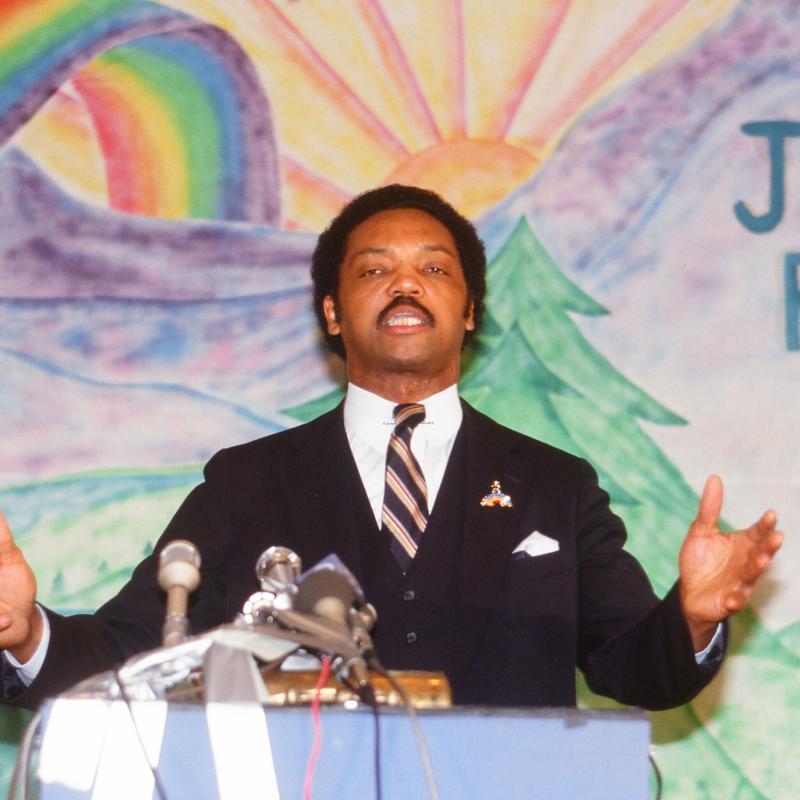
Let's take a detour from the timeline and talk about Reverend Jackson, who passed away yesterday at 84. He was just 26 years old when he worked as a junior staffer with the Southern Christian Leadership Conference led by Martin Luther King. He was with Dr. King at the Lorraine Motel in Memphis at the time of King's assassination on April 4th, 1968. Jackson continued the struggle for civil rights through his organization PUSH, People United to Save Humanity, later organized the Rainbow Coalition, and became the first Black candidate to gain serious traction in a Democratic presidential primary. That was in 1984. Here's about a 30-second clip of his speech at the 1984 Democratic National Convention.
Jesse Jackson: This is not a perfect party. We are not a perfect people, yet we are called to a perfect mission, a mission to feed the hungry, to clothe the naked, to house the homeless, to teach the illiterate, to provide jobs for the jobless, and to choose the human race over the nuclear race.
Brian: Dr. Kaye, you could start with what goes through your mind hearing that clip maybe, but start anywhere you want on the legacy of Jesse Jackson.
Dr. Kaye: Thank you so much for that, Brian. It is difficult listening to the words of Reverend Jesse Jackson. He was a very good friend of my father's. I met Jesse Jackson for the first time when I was six years old. My father had a church in Washington, DC, about 10 blocks from the White House, New Bethany Baptist Church. He was the lead pastor. Everybody who was coming through DC to speak would come through my father's church.
I left college in my first year of school to go and campaign for him in 1988, to campaign throughout the South. He was looking for college students to go and get people registered to vote in South Carolina, North Carolina, Georgia. I remember calling my dad and telling him, and he was just so proud. He told me to be prepared for prison and be prepared for miracles to happen. I didn't get arrested, but I did see miracles happen as we were registering Black people to vote.
That was the main legacy, I think, of Reverend Jesse Jackson is that under him, over 8 million people got registered to vote. It was electric being around him because it wasn't just that he had this fire in him. He just had such charisma. He made you believe that change was possible. He made you believe that despite the horrible history of America, that we could become something better. He made you believe that he saw you. That's what I remember about him.
I remember watching that speech in '88. All of our college students, we got together, we were in front of the TV, and to see college students crying, [laughs] I've never seen that again, as someone's talking about July 19th. He said, "Look, tomorrow my name is going to go up." He said, "I'm just like you. I understand what your life has been like." He said, "I was born to a mother who wasn't supposed to survive, and I wasn't supposed to survive. I'm here anyway. You are somebody." It was incredible. His legacy is something that cannot be denied.
I would argue that Reverend Jesse Jackson had something that King or Medgar Evers, Malcolm X, RFK, JFK did not have. He had the blessing of years to be able to see his children grow up, to grow old with his wife, to see his grandchildren begin to grow up. He had six children and he has like eight to nine grandchildren. That to be able to have longevity, which Dr. King said on April 3rd, 1968, longevity has its place, Reverend Jesse Jackson was blessed with longevity, blessed to be able to sit up underneath at least one or two of the trees that he helped to plant.
Brian: I'm so glad you mentioned the voter registration aspect of his presidential campaign. Yesterday on the show, I mentioned shortly after we learned of Reverend Jackson's passing that that voter registration campaign that went side by side with his presidential campaign was one of the reasons that New York City elected its first Black mayor, David Dinkins, in 1989. Because at 1988, Reverend Jackson presidential primary campaign went along with, or he brought along with it, that big voter registration drive. That got credited after Dinkins was elected with not being the only reason, but being one reason that there were enough voters who were interested in David Dinkins to elect him.
Dr. Kaye: I would agree with that. I know that when Reverend Jackson reached New York, he had just come off of winning the primary in Michigan. We can't discount the incredible energy that came with him because he was fighting for the number one spot with Michael Dukakis. It was Dukakis leading up until Michigan, but he was actually leading when they came into New York.
I think that what happened with Ed Koch, what happened with comments that Jesse Jackson made in 1984 made it difficult to overcome New York, where Dukakis finished first, Gore finished second, Jackson finished third, but Jackson received 93% of the Black vote in New York. I think it was a way of reminding people about the power of New York City that next year, here comes Dinkins, voting him as the first Black mayor. I think that it was Jesse Jackson walking so that Dinkins could run right here in New York City.
Brian: You mentioned the comments in 1984, where he referred to New York City as Hymietown with respect to the Jewish community, and obviously that insulted just about every Jew in the world, probably. He later apologized. Some people accepted that apology more or less, but that's a part of Jackson's legacy as a candidate that also needs to be acknowledged. Alexandra in Oakland, New Jersey is calling with another regional African American museum that she wants to acknowledge. Alexandra, you're on WNYC. Hello.
Alexandra: Hello. Thank you for having me, Brian, and thank you, wonderful listeners of WNYC. I wanted to alert you all to a wonderful museum. I was just riveted in Nashville, Tennessee, called the National Museum of African American Music. It's the only museum in the US that celebrates the history of Black music in the United States. That's how they-- on their website. It's a beautifully put together museum. If anybody is in the Nashville area, I highly encourage them to go. It opened within the last five years or so.
Brian: You want to remember one particular exhibit that stands out to you?
Alexandra: They span the history of music from the songs that the slaves sang all the way to present day rappers. Every room has a different historical element where you can listen to and watch how modern rock and roll really gets its-- It finally recognizes the role of the African spiritual music in the role of creating Elvis. It's the first place I've ever seen that actually acknowledges the African American roots in jazz and rock and roll. I went to Vanderbilt University and when I went back to visit, some of the professors had contributed money and time to the growth of this. It took 30 years, I think, to put together this museum. It's a wonderful tribute.
Brian: Thank you for shouting it out. Dr. Kaye, trying to tie together the recognition of Reverend Jackson and our theme, the history of acknowledging Black history, do you think that his prominence also somehow directly or indirectly led to the expansion of acknowledging Black history?
Dr. Kaye: Oh, absolutely. I think that if you talk about how Black history is discussed today, if you talk about the impact of Black history, you cannot completely underscore enough the impact of Reverend Jesse Jackson's campaign. 1984, of course, because that was where he started, but really it was the '88 campaign. The fact that he was talking about reaching across the aisle that wasn't just appealing to the Black community to get 10% of the white vote as well to open up this expanded conversation around Black history and American history.
Jesse Jackson, just like the rest of us, is flawed. You mentioned his comments in '84. I would argue, and not argue against him, I would argue and say, look, these are flawed humans and I don't expect any politician to be perfect. I think they should all be judged by the sum total of their actual impact in their life and not one or two comments, because I could discount a lot of politicians on one or two comments. The fact that so many people got interested in local politics. You had an influx of Black people running for office.
You had this belief that you don't have to come from the Ivies to be able to run. You can start where you are, and you can start with your contribution by looking to focus on the needs of the working class, on people who are economically disadvantaged, what Dr. King started with the Poor People's Campaign, and you can build from there. That is what I think he was able to do to open up the movement where it wasn't just an intellectual movement, just for college students, just for college graduates, just for professors. It was for every day, particularly the lay person.
Brian: One more timeline point on the history of acknowledging Black history. Juneteenth, as a holiday, signed into law by President Biden on June 17th, 2021. Juneteenth, as a lot of our listeners probably do know by now, dates back to 1865 in Texas when the word of the end of the Civil War and the North's victory finally reached the last people. For a long time, it was largely a regional celebration. When did Juneteenth celebration spread beyond Texas and the Gulf South leading up to that declaration in 2021?
Dr. Kaye: Thank you for that. Juneteenth is actually a controversial holiday within certain Black communities because it's led to a bit of confusion. I understand why it's celebrated and has been celebrated in Texas and Louisiana. I celebrated Juneteenth as a child. I'm from South Carolina. What does it mean to really recognize that this word of freedom didn't matter until it's been heard by everybody, because if you get to Texas, that was the longest outreach of the bastion of the Confederate States of America.
People confuse that and think that was the day that freedom arrived. We did not get legally free until the emancipation of the 13th Amendment which happened on December 6th of 1865. Juneteenth has always been regional. It began to gain in recognition as we have been celebrating Black History Month, King's Day, and it has gained in popularity. It is interesting about the agenda that was set forth before soon to be President Joe Biden, before he became president, about having a Black woman to sit on the Supreme Court, talking about Juneteenth.
For a lot of people, and when I say a lot, it was a number of papers that were written, conversations that we're having saying, "Look, instead of a federal holiday which costs taxpayers anywhere between $800 million to nearly $1 billion, let's talk about reparations." I enjoyed a celebration of Juneteenth, but if you're going to put $800 million to $1 billion to celebrate one day, which is not the day that slavery legally ended, then let's put that towards reparations and let's put that towards teaching people about what happened that day.
Brian: That is going to be the last word for today in part two of our three-part series of the history of acknowledging Black history. We thank Dr. Karsonya Wise Whitehead, president of the Association for the Study of African American Life and History, professor at Loyola, and founding executive director of the Karson Institute for Race, Peace, & Social Justice. Thank you so much for Monday and for today.
Dr. Kaye: Thank you very much.
Brian: In part three next week, folks, we will focus explicitly on the current push by the Trump administration to de-center Black history or not focus as much on how badly Black Americans have been victimized by whites. That's next week in part three. That's The Brian Lehrer Show for today. Thanks for listening. Thanks for participating. Stay tuned for All Of It.
[MUSIC - Marden Hill: Hijack]
Copyright © 2026 New York Public Radio. All rights reserved. Visit our website terms of use at www.wnyc.org for further information.
New York Public Radio transcripts are created on a rush deadline, often by contractors. This text may not be in its final form and may be updated or revised in the future. Accuracy and availability may vary. The authoritative record of New York Public Radio’s programming is the audio record.
