
History of Black History Month: The First 50 Years
Title: History of Black History Month: The First 50 Years
[music]
Brian Lehrer: It's The Brian Lehrer Show on WNYC. Good morning again, everyone. Now we'll launch our contribution to Black-- I'm sorry, let me start that again. Now we'll launch our contribution to Black History Month for this year. It'll be a three-part series on the show about the history of acknowledging Black history both within the community and by a wider audience. The historical hook is that this is the centennial year of the observance that became Black History Month.
There is also the news hook that the Trump administration is on a campaign to remarginalize it, thinking that it's been centered too much. One recent example, just last month, they removed Martin Luther King's birthday and Juneteenth as free-admission days at national parks. Did you hear about that one? Added Trump's own birthday, Flag Day, June 14th, but we'll get to that later in the month as we'll do this series in three parts.
Today, the first 50 years in the centennial timeline, that'll be 1926 to 1976. Then on Wednesday, 1976 to the present. Finally, a specific focus on the current ways that the acknowledgement of Black history is under attack by the government and the struggle over that. Joining me now to take us back to 1926 and even a little before is Dr. Karsonya Wise Whitehead, president of ASALH, the Association for the Study of African American Life and History.
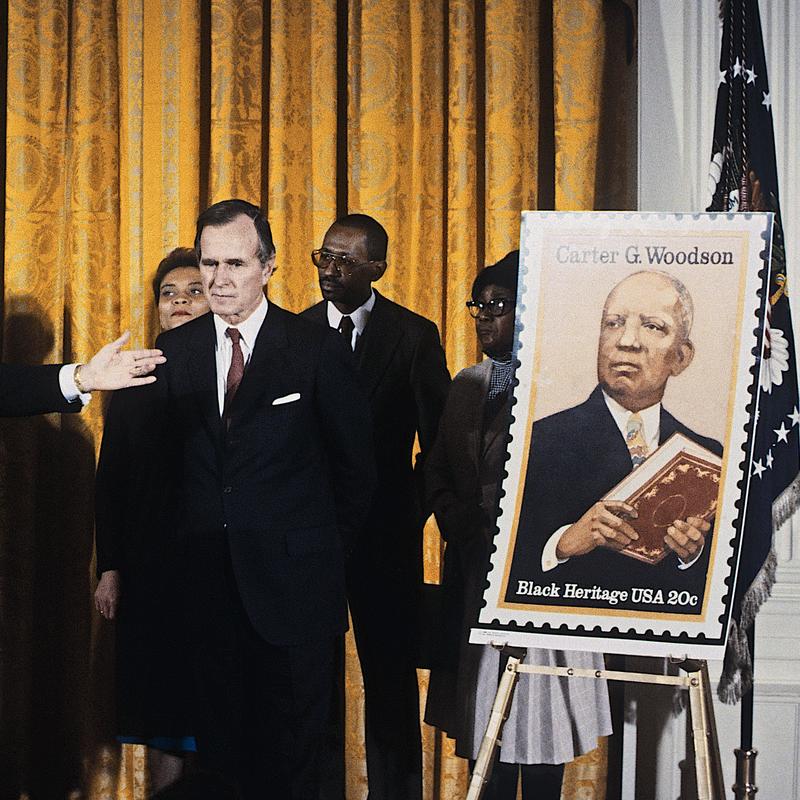
ASALH is the organization founded by Dr. Carter G. Woodson, the father of Black history, as he's often called, back in 1915. Woodson is also considered the father of Black History Month. Dr. Whitehead is also a professor of communications and African and African American studies at Loyola University Maryland and the founding executive director of The Karson Institute for Race, Peace, and Social Justice. She even did a history of Black history presentation for WNYC staff recently. Dr. Whitehead, or I'm told you often go by Dr. Kaye,-
Dr. Karsonya (Kaye) Wise Whitehead: Yes.
Brian Lehrer: -representing your first name. You prefer that, so Dr. Kaye, welcome back to WNYC. Hi.
Dr. Karsonya (Kaye) Wise Whitehead: Thank you so much. I am enjoying, I think, my fellowship at this point with WNYC from a number of different programs, both on the radio and in person.
Brian Lehrer: Indeed. Thank you for being willing to do all that. Before we even get to 1926, I read an article on your ASALH site called The Founders of Black History Month, The Origins of Black History Month, that said Carter Woodson "selected February to encompass the birthdays of Abraham Lincoln and Frederick Douglass, whose birthdays are on the 12th and 14th respectively.
Since Lincoln's assassination in 1865, the Black community, along with other Republicans, had been celebrating the fallen president's birthday, and since the late 1890s, Black communities across the country had been celebrating Douglass'. Woodson was asking the public to extend their study of Black history, not to create a new tradition." Maybe you could start by discussing that prehistory. What were some of the most organized or active acknowledgments of Black history within or beyond the community before Carter Woodson got involved?
Dr. Karsonya (Kaye) Wise Whitehead: Thank you so much. Folks, when we take a look back at history, and I like to use this idea of the long eye of history, as we have this conversation, we have to think about what was happening in 1915.
We often say as historians that by the time we hit 1877, the end of Reconstruction, we hit a period called the nadir of African American history, what we call one of the darkest times in our history because we saw rights that we had received after the ending of the Civil War through the Reconstruction Amendments of the 13th Amendment to end slavery, but that also launched a mass industrial prison complex, the 14th Amendment around civil rights and civil liberties, which was 1868, and the 15th Amendment in 1870, which protected the right to vote for Black men who had received the right to vote through the 14th Amendment.
What is important to note is that you saw a period of time where you had a lot of violence directed towards the Black community, disenfranchisement around Black men being able to vote, the burning down of a lot of Black businesses. You had a rise in lynchings, in beatings, and being stalked and being terrorized. During this period, the nadir, you also saw the founding of a number of different organizations.
To me, kind of a form of resistance, whether it was some of the Black fraternities and sororities, from Alpha Phi Alpha to Delta Sigma Theta Sorority Incorporated, whether it was the founding of the NAACP. Then here comes ASALH in 1915. It was launched in Chicago, and you had Dr. Carter G. Woodson, along with George Cleveland Hall, James Stamps, William Hartgrove, and Alexander Jackson. They were thinking about how do we formalize the study of promoting, researching, and disseminating information about Black life and Black culture, how do we connect the academy to the community.
That's where ASALH was born. ASALH is now called the Association for the Study of African American Life and History, but back then, it was the Association for the Study of Negro Life in History, because that was a terminology used at that time. That was the purpose of ASALH, was to make sure that our history wasn't just in the academy but it was being translated and transferred and shared with the community. I like to see ASALH as the bridge between the ivory tower and the street corner, in a sense.
Brian Lehrer: Did he have white audiences as well as Black ones in mind? If so, why and how?
Dr. Karsonya (Kaye) Wise Whitehead: Well, he did have white audiences in mind. Dr. Carter G. Woodson, for people who are unfamiliar with him, he was born 10 years after the ending of American slavery in 1875. His parents were enslaved and had been freed. He was born in Virginia. He worked in the coal mine along with his father. His father had been involved in the Civil War as a soldier. When Dr. Carter G. Woodson worked in the coal mines, he would read to the coal miners, and they would help him correct the history.
He started to realize that history wasn't just what was in the textbook, it was also a lived experience. He went on to attend high school at the age of 20, graduated from Berea University of Chicago, and he was the second African American, after W.E.B. Du Bois, to get a PhD from Harvard. When we start talking about the audiences, you're talking about the impact of being the first Black person born to enslaved parents to get a PhD from Harvard, no less.
You have a sense that his audience wasn't just the Black community, it was the Black and the white community, but the primary focus with Negro History Week, what it was called, was really to turn the attention and the spotlight on making sure that Black children in particular were learning about their contributions. It was really what he covered in his book The Mis-Education of the Negro. I'm collapsing both the founding of ASALH in 1915 to Negro History Week in 1926. There is a bridge there, and I know we're going to cross it, but I want to make sure people understand where he started with NHW.
Brian Lehrer: Great. Listeners, we invite your questions or your stories maybe from history teachers off from school today for President's Week or anyone else about the history of acknowledging Black history for today, for the first 50 years after the establishment of the original Negro History Week in 1926. 212-433-WNYC, 212-433-9692. We'll do the last 50 years on Wednesday.
Today, things about 1926 to 1976. 212-433-WNYC, 212-433-9692, with Dr. Karsonya Wise Whitehead, current president of ASALH, 212-433-9692, history teachers or anyone else call with your comments, stories, or questions. How widespread was the observance of Negro History Week initially? As we start to move up the timeline, how quickly did it spread, how far? Was the week mainly acknowledged by Black churches, schools, or was this something that even white people were aware of in the early days and started to talk about or acknowledge officially in any way?
Dr. Karsonya (Kaye) Wise Whitehead: Thank you for that. I want to-- as we're moving up the timeline so that people really understand what did it mean for Dr. Woodson to launch at that time what we call Negro History Week, was the impact of his work. He had helped to found ASALH as a primary person in 1915. By 1916, he published a Journal of Negro History, which is still in existence. It's now called The Journal of African American History, which is published twice a year, but it is a journal that pulls together research around what is happening in the Black community, what is happening in America.
You really can trace the long eye of history through the journal publications. By 1924, Dr. Woodson was urging his fraternity brothers, he's a member of Omega Psi Phi Fraternity Incorporated, to really begin to take up the work. They were working with him. In fact, they launched something called Negro Achievement Week prior to Dr. Woodson launching Negro History Week in February 1926.
He sent out a release telling people that we need you to join with us and set time aside to make sure you are actually teaching specifically about our contributions. You have covered already why he chose that week, because, of course, Lincoln and Douglass, the 12th and the 14th respectively, but he really was thinking about, "What do we need to do to make sure that Black children in particular were not being miseducated?"
It spread like wildfire, Brian. It's like people picked it up and they ran with this idea of Negro History Week. It began to go all over the country. It's like good ideas, you can't hold them to yourself. People, as they moved around the country, Black folks were taking this idea of Negro History Week, sharing it with their community. It began to be celebrated in Ghana. It was leaving the country. There was 50 years of celebrations up until 1976 when we got to the bicentennial year when Negro History Week became Black History Month.
I know we're going to get to that as well, because that was a really important moment that I think reset Black History Month and became a national celebration rather than just happening in our communities, happening in the churches, happening in the classrooms. It was growing, but there's a different kind of growth spurt when you have the White House issue an official proclamation.
Brian Lehrer: Starting to head forward in this 50-year timeline, 1926 to 1976, the 1930s were of course marked by the Great Depression. What effect, if any, did the economic hardships of that time have on the observance of what was then Negro History Week or any other historical observances of Black history?
Dr. Karsonya (Kaye) Wise Whitehead: Well, what happened during the 1930s, which was the Great Depression, you had Negro History Week still continuing, in terms of having smaller gatherings, the luncheons were not as large, but the purpose of Negro History Week was to lean into the communities in particular and into the classrooms. Those were not impacted as much. People were still celebrating because the celebration was about teaching knowledge, sharing knowledge, and making sure that young people were involved in knowledge production.
By 1937, Woodson, along with Mary McLeod Bethune, who was the first woman to be the president of ASALH, launched the Negro History Bulletin, which is still in effect. It's now the Black History Bulletin, but that helped Negro History Week because in the Negro History Bulletin, it focused on celebrating the annual theme, because Woodson said, "Every Negro History Week should have a theme," something that we focus on in particular. Maybe it's Blacks in the art, maybe it's Black people in music, maybe it's Black people in politics, but there's a theme that's set, and the work should be around that theme.
The Negro History Bulletin, or now the Black History Bulletin, is full of lesson plans and resources so teachers or parents don't have to do the extra work. You get the BHB, and the lesson plans highlighting the theme and focusing on the theme are already made available for you. Of course, that allowed it to grow even quicker because now people have resources in front of them.
Brian Lehrer: Do you have any particular themes from the 1930s in mind, as they were framed at that time?
Dr. Karsonya (Kaye) Wise Whitehead: Yes. In 1937, they were looking at the escape of William and Ellen Craft and talking about the ways that during the time of American slavery, that people resisted, how did they fight for their freedom, how did they claim their freedom. They did a particular theme around looking at the Negro in the arts. Again, Negro was a terminology used at that time, what did it mean to celebrate our work through literature.
They looked at the work of the Negro when we were trying to connect American history back to African history. Dr. Carter G. Woodson, as an intellectual and also someone who had been a teacher in Washington, DC, he was uniquely concerned about making the theme accessible. That it should be something that anyone, no matter what your educational level, you can pick up very quickly and learn about the theme without having to do kind of standard study. That even connects to our theme this year, which is A Century of Black History Commemorations. It's something that people can pick up and they can teach around.
Brian Lehrer: As I think we're doing in these conversations that we're having with you, I hope, anyway.
Dr. Karsonya (Kaye) Wise Whitehead: Yes, yes.
Brian Lehrer: 1940s, how about a theme from the World War II period, if you know?
Dr. Karsonya (Kaye) Wise Whitehead: Yes. In 1940, with the Negro History Bulletin, what they were talking about was the impact of the early Civil Rights Movement, because they were looking at 1944. They were looking at what was happening with lynchings, the dangers that Black folks were in the 1940s and Black folks contributing to the war effort. This Negro history that was being taught, what they were telling teachers in the South, particularly Black teachers, because those are the classrooms they can get into.
Remember, we're still in the period of Jim Crow, so trying to get white teachers in certain communities, it was much more difficult, as you can imagine, to get a white teacher in a Jim Crow environment to really focus on teaching Negro History Week, or Negro History as a whole, but the Black teachers in the South were making sure that they were teaching Negro history as a supplement to American history, because the work that was still being done early on was trying to get people to accept the fact that Black history is American history. It's not a supplemental part of history, but that's what they were using to get in.
Brian Lehrer: Did you just cite 1944 as the beginning year of the Civil Rights Movement?
Dr. Karsonya (Kaye) Wise Whitehead: No, I was saying that during 1944, they were talking about the early Civil Rights Movement. We have, when you're looking at the Civil Rights Movement, we talk about the modern Civil Rights Movement, and we talk about the more historical perspective around civil rights. When people talk about the modern Civil Rights Movement, they tend to look at 1954, when you start talking about Brown v. Board. Some go back as far 1952, which is the first Brown case, that of course headline the SCOTUS Brown v. Board case.
Some go to the 1940s because there were efforts happening in our community around trying to claim our rights. We didn't just start fighting for our rights with Brown v. Board or with the Montgomery bus boycott in '55. We were doing that work in the '30s and '40s, if you look at the more historical timeline of Civil Rights Movement versus what they call the modern Civil Rights Movement.
Brian Lehrer: You mentioned that important premise that Black history is American history, or emphasizing the word "is," "is American history." Mary in Greenport, Long Island, I think called in to say exactly that. I'm going to let her reinforce or expand. Mary, you're on WNYC. Hello.
Mary: Yes, thank you. As long as the forces can control the history, then they control what happened so that we can look at the condition of Black folks and say, "Oh, look, "They're inferior," and then not acknowledge everything that's been done to keep them in that position. Also, I think it's even more that it works to foster a suppression of the underclass altogether when you're controlling the truth about how people are being treated.
Dr. Karsonya (Kaye) Wise Whitehead: I absolutely agree with you. That's why this work around at that time, Negro History Week, and now Black History Month is even more important because it is about lifting up what is happening in our community. Dr. Woodson really wanted Negro History Week to be Negro History Year. It wasn't supposed to just stay within a week. It really was supposed to do what it is doing now, which is being embedded into our curriculum. If I can, Brian, I just want to raise up one other point before we move on.
Brian Lehrer: Sure.
Dr. Karsonya (Kaye) Wise Whitehead: I don't want to lose the thread, if people are listening. A couple things I just want to note when I mentioned the 1940s, for people to remember that it was in 1940 that Hattie McDaniel was the first Black person to win an Academy Award. By '41, you had the Tuskegee Airmen that were formed in terms of work, in terms of military aviation. The architect Paul Revere Williams, he was honored in '43. You had Jackie Robinson by '47.
Then the most important piece I would argue is the executive order of 1941, which is EO 8802, which desegregated defense jobs. It was the rise of the Double V campaign for victory abroad and at home. I want to talk, just want to lift up some of the key historical moments that happened in the 1940s, which people grant as part of that historical lineage of civil rights.
Brian Lehrer: Was another one from the World War II era, the establishment of Midway Hall in 1943. Maybe you can talk about that.
Dr. Karsonya (Kaye) Wise Whitehead: Yes, no problem. Thank you so much. When we start talking about Midway Hall, and I love that we're using this as a moment to just remind people of all the things that have happened. When you look at Midway Hall, it was a government housing project in Washington, DC, and it was specifically for Black women who were working in the federal government during World War II.
What's interesting for me is that it was inaugurated by First Lady Eleanor Roosevelt and of course, by Mary McLeod Bethune, who I'm sitting in the seat of Bethune. It was set up as a place to provide safe housing for women, Black women who were contributing to the war effort, because you had an influx of Black female government workers. This was a place for them to come and be safe, and a place to provide what they call, the terminology was "Dignified housing" during a time of what we call extreme segregation, of course, housing shortages.
Brian Lehrer: Here's a short but relevant text from a listener who writes, "My mother, born in 1920 in rural South Carolina, talks about celebrating Negro History Week in school. She remembered learning about Frederick Douglass." That's interesting because wherever that was in rural South Carolina, they were using Negro History Week as a hook to teach at least about Frederick Douglass. That would have been in the late '20s and '30s, I guess. Interesting note of history there from a personal anecdote?
Dr. Karsonya (Kaye) Wise Whitehead: I love that. I'm also from rural South Carolina, and I can attest to what the person texting is saying because my dad and my mom learned about Negro History Week when they were growing up. My dad is from Lexington, South Carolina. My mom is from Olar and Columbia, South Carolina. They also remember, with Negro History Week, they remember dealing with Douglass Day. We mentioned that. We talked about the birthday of Frederick Douglass being celebrated.
That was actually set up by Mary Church Terrell. She was one of the first Black women to earn a college degree, and she was a civil rights activist and a journalist and a teacher. Two years after Douglass died, she said, "We need to make sure that we are remembering his life. We're going to make sure that he is not being forgotten," so she launched by 1897 Douglass Day. That's what he built upon and put some structure around when Woodson launched Negro History Week.
Brian Lehrer: Listener writes, "I am of Afro Caribbean descent and lived in New York City, coming up on 40 years, learned from the beginning I would be described and judged by the color of my skin and therefore an African American. That led me down the road of who am I, or more importantly, who is the African American? Therefore, I look forward to Black History Month and what I can learn about the Black people in this country and their experience.
A sobering life they have had, and I understand the almost impossible hurdles they have always had to endure. Proud to be of African descent." Any reaction to that text, including, I guess, the particular experience of Black people who might be voluntary immigrants to this country, if not to this continent. The person saying they are of Afro Caribbean descent and moved here.
Dr. Karsonya (Kaye) Wise Whitehead: Thank you for that. I would say three things that have come up, and I immediately thought about when you started, is I thought about something that Dr. King said, because the person texting in mentioned color of skin. I'm thinking about 1963 and Dr. King's speech around trying to get to a society where we're judged by the content of our character, not the color of our skin. We have not gotten there yet. Second, making the distinction that there is a unity among Black people around the planet that ASALH is uniquely interested in.
It's not just the Black experience of Black folks from America. It's connecting our experience and helping, as Dr. Woodson said, helping young people to understand that our history did not begin with slavery, that we are uniquely connected to the continent. In being connected to the continent, that connects us to the Trans-Atlantic trade system where captured African people were flung through South America into North America, the East Coast of the USA. what does that mean? That there's a shared history there.
Then third is recognizing for everyone, given the fact that Black History Month is celebrated in Canada, Brazil, Ghana, Kenya, South Africa. It is a worldwide movement to really understand and focus on the unique experiences that Black folks have had within an environment where slavery is such an incredible part of the narrative and it's still so steeped in oppression, but there's this story of survival and resilience and tenacity that we have to lift up as well.
Brian Lehrer: By the way, that texter from South Carolina, since you mentioned the particular places that your family came from, she texted back and said, "My mother was from Cross Hill, South Carolina," in case you wanted to know. Listeners, if you're just joining us, we're in part one of a three-part Black History Month series on the show on the history of acknowledging Black history both within the community and by a wider audience on this 100th year anniversary of the founding of what was originally Negro History Week by Dr. Carter Woodson in 1926.
Today we're doing the first 50 years, 1926 to 1976. On Wednesday, we'll do 1976 to the present with the same guest we have today, Dr. Karsonya Wise Whitehead, president of ASALH, the Association for the Study of African American Life and History. Still in the 1940s. Don in Manhattan, you're on WNYC. Hello, Don.
Don: Good Morning, Brian. Thank you for your show and for your guests. My question is, what's the significance of President Truman's 1948 executive order integrating US Armed Forces? I'll take my [crosstalk].
Dr. Karsonya (Kaye) Wise Whitehead: Oh, thank you.
Brian Lehrer: Thank you, Don.
Dr. Karsonya (Kaye) Wise Whitehead: Thank you so much. I love the questions. When we start talking about the work that the three branches have done in terms of their assistance with this fight to bring about a more just and verdant society, a society that is really based on being equitable and being diverse. One of the points that we cite, because we talked about the 1940s, we talked about '41, but going up to 1948, was Executive Order 9981, that President Truman signed, and what it did is it abolished racial segregation and discrimination in the US Armed forces.
We cite that as one of the major building blocks that set the stage for full integration by mandating the desegregation of all the branches in the military. What it did, it began to ensure equal opportunity. It began to build the Black middle class through military service. It was a crucial step in what they call the post-World War II Civil Rights Movement. It was of course a major achievement in Truman's presidency, but it did set the groundwork for what would later become kind of the final blow that struck at the roots of the Jim Crow tree, which happened, of course, in '54 with the Brown v. Board decision by SCOTUS.
Brian Lehrer: Mary in West Orange, you're on WNYC. Hi, Mary.
Mary: Hello. Love this conversation. I just wanted to comment that I am a teaching artist at LaGuardia High School here in New York City. For the past five years, I have taught a course in theater dance history that starts with the African diaspora during the Middle Passage, noting all of the different places in the world where Africans were dispersed and how those influences come back to the evolution of dance and theater here in the United States.
You were mentioning Afro Caribbean, and of course, we bring that into all of the influences that have shaped popular culture here in the United States and how that popular culture drives music and theater and dance. The goal really is to help students understand the deep influence of African culture and music and dance expression on American culture. Of course, along the way, we have to talk about segregation and the oppression and elimination of Black artists from just popular view.
Hopefully, students can look with a more scrutinizing eye at who gets the attention and who is overlooked, and help them to just acknowledge the inescapable influence of African and African American expression on what happens in theater and dance now, because, of course, everything is evolutionary, and hopefully, also help them to look deeper for overlooked voices and influencers from the past.
Brian Lehrer: Mary, can you give us one example of maybe a theater work or a dance work that you incorporate from any time in that 50-year period, 1926 to 1976?
Mary: Well, you can't escape the influence of the Charleston, whose roots can be traced to the Gullah Geechee culture and the-- I could go on for a long time, I don't want to occupy the time, but the Charleston can trace its roots to South Carolina and then the Jenkins Orphanage Band that would travel up north and the street busking that these young kids would do and just be influenced on the street.
A lot of these dances, which are vernacular dances that end up being incorporated into theatrical work, they start just in the community, so the Charleston is seen on the street, and people start imitating it, and it becomes very popular, and all of the elements of the Charleston, whether it's the really recognizable Charleston step or the Shimmy or any kind of those vernacular moves from the '20s, that end up in-- I mean, the Charleston takes the world by storm, and it gets incorporated into theatrical works from the 1920s onward. Then even shows now that might be set in the 1920s, that would incorporate Charleston or Charleston-like dance moves, are still harkening back to that original influence.
Brian Lehrer: Good one, Mary. Thank you. What are you thinking, Dr. Kaye?
Dr. Karsonya (Kaye) Wise Whitehead: I really appreciate that. I would just add just a couple things. One is that we look at where the captured African people came from, and so the impact of that, you're talking Senegambia, Upper Guinea, the Windward Coast, the Gold Coast, the Bight of Benin, the Bight of Biafra, and Angola. You have all of that culture coming together. I would add that from the 1500s up until 1808 legally and 1837 illegally, you're talking about the transportation of approximately 12 million African people across the Atlantic.
You have all that history, all that culture, and all of those people coming together. It does mix itself into not just art, which I appreciate, and music, but also into language and into food. I don't think, Brian, that we actually spend enough time talking about what happens when three worlds meet, what happens when you have these different people coming from different countries in Africa, coming into areas where there are Indigenous people, coming down and being influenced by those from Europe. That there was a lot that went into both the music, the language, the dance, and the way in which they expressed themselves artistically.
Brian Lehrer: We'll continue in a minute with Dr. Kaye and your calls and texts on the history of acknowledging Black history. Going to read you a very interesting text when we come back from somebody who grew up during segregation and then was surprised at how much history people didn't know when she was a teacher and referenced it. We'll move more toward the present from there as well. Brian Lehrer on WNYC. Stay with us.
[music]
Brian Lehrer: Brian Lehrer on WNYC as we continue in part one of our three-part series on the show about the history of acknowledging Black history, our contribution to Black History Month, the historical hook being that this is the centennial year of the observance that became Black History Month. There is also the news hook that the Trump administration is on its campaign to remarginalize the centering of Black history. We'll talk about that explicitly in part three.
Our guest today and again on Wednesday for part two is Dr. Karsonya Wise Whitehead, president of ASALH, the Association for the Study of African American Life-- Let me say that fully, for I'm going to say it right this time. ASALH, the Association for the Study of African American Life and History. I almost threw in African there because she is also a professor at Loyola University Maryland, teaching communications and African and African American studies there.
Here's a text, Dr. Kaye, from Deborah in Brooklyn, says, "I moved to South Carolina in 1963 when schools were still segregated, water fountains and stores were labeled, and Black people could only sit in the balcony at the movies. Fast Forward to the 1990s through the 2000s when I was a university professor in Missouri, my students were incredulous that I had actually seen those restrictions. They said, 'Well, that's just wrong.""
She writes, "I had trouble helping them think critically about what this means for all of us today and that it is still all of our problem." What jumped out at me about that, Dr. Kaye, you could say what jumped out at you, was that within the last 30 years, students in college were incredulous that those restrictions from the Jim Crow era were real.
Dr. Karsonya (Kaye) Wise Whitehead: Yes. I think what is interesting at this moment is that we are doing what I call a lot of restorative work in terms of helping people to understand that the history that is being forgotten or being rewritten or being intentionally and deliberately taught in the wrong way, we are fighting against all of that as well. I find that students that I teach now feel a lot more disconnected from the history.
It feels like so long ago when we talk about it. I think one of the things I do to push against it, I like to show pictures from the Civil Rights Movement in color. Because when people see black and white, they just assume it's like a thousand years ago. "Here's a picture of Dr.--" Because does matter, if you see something in black and white versus seeing something in color, psychologists talk about how a black and white photo for people is a throwback to a long-lost history. When you see it in color, it makes you feel like it's more present. 1965 was not a thousand years ago.
I like to show people pictures in color of Dr. King. I like to connect with them about the Voting Rights Act of 1965 so they can understand that these things were just yesterday that that Black and brown women could get safely to the ballot in '65 even though we got the right to vote in 1920. That's what I mean about trying to connect it and making sure that the students understand the connections.
Brian Lehrer: The 1950s, you mentioned Brown versus Board of Education. Of course, the Supreme Court decision in 1954, did-- I mean, Brown was about who may attend what schools. Did it affect the content of Black history instruction either in affected schools, which would have been in the Jim Crow South, or for that matter, nationwide?
Dr. Karsonya (Kaye) Wise Whitehead: It did. Thank you for that question. It did impact what was taught. We know that coming out of Plessy v. Ferguson in 1896, which started in Louisiana and dealt with the transportation system. Homer Plessy and the train system. This idea of legalizing segregation, cementing into the law, which came from SCOTUS in 1896, but it then began to spread across the South and it began to [unintelligible 00:37:00] into other areas.
It wasn't just in transportation. Moved from transportation to restaurants, to schools, to water fountains. Like before you know it, it was-- you're dealing with sidewalks, like it just filtered down into every single aspect of life. What they found, which makes sense when you add white supremacy into legalize separation and segregation, is that the accommodations were not equal. If the accommodations were not equal when it came to a water fountain, the porcelain water fountain versus a cement water fountain, then you can only imagine how difficult it was to get a first-rate education at a colored school.
You didn't have supplies, you didn't have resources. Everything was secondhand or it was broken or it was old, it was outdated because separate was not equal. The only thing I can equal is absolute equality across the board. That's kind of the way you saw it taught. That was the extra work that Black teachers did and Black pastors and Black parents did to fight against the intentional miseducation.
Brian Lehrer: 1968, as we move up the timeline, such a pivotal year in US history in many respects. Of course, Dr. King was assassinated in April of that year, but also in February of '68, the nation saw its first Black studies program, if I have my history right, that was at San Francisco State. I imagine that didn't just happen. Right? What was behind that demand? How did those programs change what it meant to study history in this country?
Dr. Karsonya (Kaye) Wise Whitehead: When you start talking about what was happening at the university level for the first Black studies program, it was in 1968, and it was actually established at that time. It was San Francisco State College, is what it was called at that time. You had a number of Black intellectuals who were starting to figure out different ways to make sure that college students were able to engage directly with learning, teaching, interpreting, and researching Black history.
Remember, we can directly connect this to where I started when I talked about 1915 and ASALH, that idea of being the bridge between the "ivory tower" and the street corner. In '68, after intense, sustained student activism, and it was a strike. The strike lasted what, 133 days, from 1968 to 1969, that it led to the first Black studies department. The person that was in charge of this, it was led by sociologist Dr. Nathan Hare, who was hired in '68 to coordinate the program and develop the curriculum. I like to talk about Dr. Hare because he's called the father of Black studies. We call Dr. Carter G. Woodson the father of Black history.
Brian Lehrer: 1970, the killings of student anti-war protesters at Kent State, but there was also those at Jackson State, Black students, more forgotten and less acknowledged even at the time, even though it happened right after Kent State. That same year, I believe students also had a hand in expanding what was still called Negro History Week. Right?
Dr. Karsonya (Kaye) Wise Whitehead: Yes.
Brian Lehrer: Talk about how students built momentum for national recognition of what became known as Black History Month 50 years ago.
Dr. Karsonya (Kaye) Wise Whitehead: Thank you very much. I just want to stop for a second and just acknowledge for people the difficulties of this part of the conversation. Because if you talk about the shootings from Kent State and Jackson State, there's no way that you can think about the shootings at that time and not connect them to the incredible number of mass shootings that we have in the country today, and the incredible number of mass shootings that we have on both high school and elementary and middle school campuses and on college campuses. I just want to acknowledge that for this part of the conversation.
The Kent State shootings, it was May 4th, 1970, and that was in Kent, Ohio. The students were protesting about the US invasion of Cambodia, but they also had National Guardsmen on their campus. There was a burning of an ROTC building on May 2nd. When you got to the Kent State shooting on May 4th, there were, I believe, 28 Ohio National Guardsmen. They fired about 67 rounds.
Brian Lehrer: Forgive me, but we have about 30 seconds left in the segment.
Dr. Karsonya (Kaye) Wise Whitehead: Oh, okay, no problem.
Brian Lehrer: Get to where you're trying to get at.
Dr. Karsonya (Kaye) Wise Whitehead: I'll get to where I'm going. Jackson State happened after that, May 14th and May 15th. Jackson State is in Jackson, Mississippi, folks. When we started talking about the focus, they focused on Ohio, not on Mississippi. One is predominantly white students, one is predominantly Black students, but the students at Kent State were the first students documented to actually celebrate Black History Week as Black History Month. They really set the pattern for that, and college students around the country begin to pick up, really pushing the celebration from one week to a month, so we look at college students as being the ones who carry that banner forward.
Brian Lehrer: Dr. Karsonya Wise Whitehead, president of ASALH- You did it, by the way, -the Association for the Study of African American Life and History. That is part one of our two-part conversation about the history of acknowledging Black history. Part two will be with Dr. Kaye back here on Wednesday. Thank you so much for today. Talk to you in a couple of days.
Dr. Karsonya (Kaye) Wise Whitehead: Thank you so much.
Copyright © 2026 New York Public Radio. All rights reserved. Visit our website terms of use at www.wnyc.org for further information.
New York Public Radio transcripts are created on a rush deadline, often by contractors. This text may not be in its final form and may be updated or revised in the future. Accuracy and availability may vary. The authoritative record of New York Public Radio’s programming is the audio record.
