
Has Trump Undermined the DOJ's Independence?
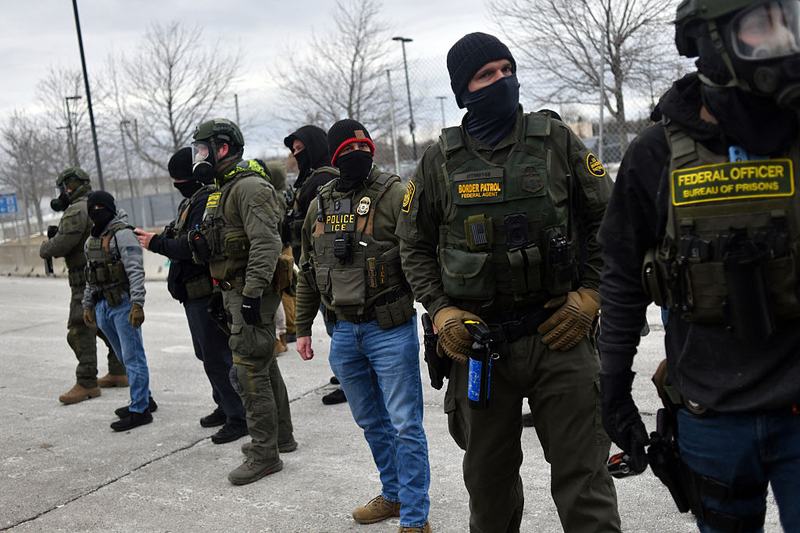
( Octavio JONES / AFP/Getty Images )
Title: Has Trump Undermined the DOJ's Independence?
[MUSIC]
Brigid Bergin: It's The Brian Lehrer Show on WNYC. I'm Brigid Bergin, senior reporter in the WNYC and Gothamist newsroom, filling in for Brian today. He's out because he's taking care of a family member who's dealing with some health issues. Coming up on today's show, my colleague WNYC and Gothamist housing reporter David Brand, will give us an update on the potential sale of 5,000 rent-stabilized apartments by Pinnacle.
The tenants are concerned the new owner will not maintain them properly. Both Mayor Mamdani and State Attorney General Letitia James have now gotten involved in the case, which affects thousands of rent-stabilized tenants, and as David put it, has become a flashpoint in a larger debate over housing policy in the five boroughs. Plus, President Trump has been threatening to take control of Greenland for months now.
We'll talk about how this is playing out and the anxiety it's causing in Denmark and Europe more broadly. We'll wrap today's show with a conversation about politicians swearing. Have you noticed it's more common these days for mayors, or governors, or presidents to curse in public? We'll talk about what this says about decorum, language, and politics, but first, as we were thinking about some of this week's top news stories, we noticed a pretty striking theme running through a lot of them.
Whether it was Federal Reserve Chair Jerome Powell's announcement that he was under criminal investigation or the decision by six career prosecutors in Minneapolis to resign their posts over a push to investigate the widow of Renee Macklin Good, the woman who was shot and killed by Immigration and Customs Enforcement officer last week and even the norm-breaking search of a Washington Post reporter's home on Wednesday in connection with an investigation related to a government contractor in theory.
These stories are just the tip of the iceberg, of course, and the constant in all of them is the Justice Department, a powerful agency with broad authority that in previous administrations operated with a fierce independence. When we decided we would take a look at the state of the Justice Department after a full year of the second Trump presidency, we couldn't think of anyone better than my next guest to help us dig into this week's news and to help us understand how we got here.
Emily Bazelon is a staff writer at The New York Times Magazine. She also contributes to The Times' editorials on legal affairs. She teaches at Yale Law School, where she is the Truman Capote Fellow for Creative Writing and Law and co-host of Slate's weekly podcast, Political Gabfest. Emily, welcome back to the show. It's always great to speak with you.
Emily Bazelon: -for having me.
Brigid Bergin: Listeners, we know many of you have thoughts about the role the Justice Department should play. If there are any lawyers out there or people who have worked for, in, or interacted with the DOJ in the past, what has changed for you? For any listener, how are you feeling about the direction of the Department of Justice under the Trump administration?
Do you just have a question for my guest, legal affairs expert Emily Bazelon? The number 212-433-WNYC. That's 212-433-9692. You can call or text that number. Emily, I ticked off some of this week's stories, and we're going to dig into those in a moment, but as someone who has been studying the evolution of the Justice Department, how are you viewing some of what we're seeing today? Are you surprised, or based on your reporting over the past year, could you see a lot of this coming?
Emily Bazelon: I think the thing that's most important is that there's a radical shift happening in how the president and the administration views the whole role of the Justice Department. After Watergate, there was a kind of reckoning in the United States where people thought, "Wait a second, a presidential administration was able to use the Justice Department and use criminal investigations as a weapon against the other party, right?"
This is President Nixon's White House. His attorney general is mixed up in this bungled burglary of the Democratic headquarters in Watergate. Everyone kind of takes a step back and says, "Wait a second, we need some separation between the presidency and the Justice Department. This is the nation's most powerful law enforcement institution, and we need to make sure that it's not just being used as a weapon."
Everyone kind of stuck with that idea. Since Watergate, there were separations. There were lots and lots of professional norms about who communicated with the White House officials, and a lot of emphasis on making sure the Justice Department was nonpartisan, and all of that is just gone. That is not how President Trump and his aides view the Justice Department. They think that, yes, it should be a tool of the White House.
They say that they're doing that to address abuses of the process under the Biden administration. Really, it all kind of goes back to Trump's intense sense of grievance about having been himself investigated multiple times by the Justice Department, but all of that has just led to this sea change in how the department operates and how it feels to work there, and in how lawyers and FBI Agents do their jobs.
Brigid Bergin: Emily, to underscore kind of how you know what you know and what you bring to this conversation, you have been talking to legal experts both coming into Trump's reelection, and then you did another survey, following up with them eight months into the administration, to understand exactly what you laid out there, how they're feeling about the way it operates. I'm wondering, what were you hoping to learn, and how important was having those benchmarks, being able to look at how they felt going in and then how they felt eight months into the administration?
Emily Bazelon: Yes, thanks for that great question. Before Trump was elected, he was talking about the Justice Department and criminal prosecutions, and the president's control over criminal prosecutions in a way that was different from how other politicians and candidates have talked. I thought, "Okay, well, what about all the people who have worked in the Justice Department previously who served as Solicitor General or Attorney General or US Attorney, going back as far as I could go back?"
We sent survey questions to lots of top-level former Justice Department officials to ask about their predictions. They were concerned about the things they were hearing from Trump as a candidate. They also really relied on the internal norms and ethics of the lawyers in the department, the kind of career staff, to be able to withstand a lot of challenge and assault.
Then, after Trump's election, and he had been in office 10 months, we kind of went back to say, "Well, what do you think now?" People were much more, I think, alarmed at how much the career staff had been battered by the changes in how the Justice Department operates. While our initial survey had some alarm in it, it had more faith that the institution was going to kind of withstand these changes.
Then, several months in, I think it was harder for these former Justice Department officials to have that same faith, not because they thought poorly of the workforce, but because the effort to really shift away from a nonpartisan mode of operating had been much more intense and sustained than they anticipated.
Brigid Bergin: Emily, just so our listeners understand, this is reporting that appeared in The Times back in October, and it just feels like such a salient harbinger of this moment we're in now, but the people that you surveyed, you described them as people who had served in the Justice Department for as far back as you could reach, but this was not a partisan group of individuals that you surveyed. Correct? This was a bipartisan representation of people who had done this work.
Emily Bazelon: Absolutely. We had 50 people, and they were split evenly among Democrats and Republicans. We made sure that that would be the case. We really reached out, and it is not difficult to find Republicans from previous administrations who are really distressed about the direction of this Justice Department, because, since Watergate, there has really been this kind of bipartisan consensus among government lawyers and government legal officials that these nonpartisan rules and approaches were important for protecting everyone, right?
Because when the Justice Department turns into a partisan weapon, well, when you're out of power, people can wield it against you. Among lawyers, there was a sense, it was almost kind of taken for granted that everyone bought into this premise. When that premise kind of falls apart in Trump's second term, even the people who served in Trump's first term were willing to say to us, "Hey, wait a second." There was one person we surveyed who said he was not alarmed; everybody else was some degree of concerned.
Brigid Bergin: One of the things that I was struck by was kind of the overall conclusion that you wrote, looking at the results of this survey. It was "Every single 1 of the 50 respondents believe that Trump and his Attorney General, Pam Bondi, have used the Justice Department to go after the president's political and personal enemies and provide favors to his allies." That is such a break from, as you described, what had been the accepted standard from the Department of Justice in a post-Watergate world. How much did that finding surprise you?
Emily Bazelon: Well, I was surprised by the consensus because there's no consensus about anything, right?
Brigid Bergin: Sure.
Emily Bazelon: You ask 50 lawyers or 50 people a question, you expect some people to say, "Well, wait a second, maybe not." The thing about going after perceived enemies and providing favors is, it's been very clear in public. It's kind of undeniable, right? The only question really is "How do you feel about it?" not whether it's happening.
Brigid Bergin: Listeners, if you're just joining us, my guest is Emily Bazelon, staff writer at The New York Times Magazine. She also contributes to The Times' editorials on legal affairs, teaches at Yale Law School, where she's the Truman Capote Fellow for Creative Writing and Law, and is co-host of Slate's weekly politics podcast, Political Gabfest. We're talking about the state of the Justice Department under the second Trump presidency.
If you have questions for her or comments about the Justice Department, you can call 212-433-WNYC. That's 212-433-9692. Let's go to David in Stytown. David, you're on WNYC.
David: Hi there. Thanks very much. I'm not a lawyer. I didn't live through Watergate. I was just slightly too young, but the impression I've always gotten from my little bit of education, I've always felt like, even in the '90s when I was in high school, I'm like, "Aren't we kind of lying to ourselves about things like the Justice Department is independent?" I've always felt like things like this have always kind of been possible, and relying on norms and decorum is foolish. I actually have the same criticism about other executive powers, a lot of executive powers. Yes. I wonder what you think of that notion. Thanks.
Emily Bazelon: I think that right now is proving you right, that relying on norms can be perilous. If you want the norms to hold, everybody believes in the norms, and then they start to erode, or they're completely shattered. It turns out that there's not a lot to point to to make sure that they snap back into place. I do think it's important to recognize, though, that the rules that existed were not a matter of decorum.
It was really more than that; they were rules; they were some internal policies absolutely limiting communication to certain levels and certain ways of talking about individual cases when you're talking about the White House and the Justice Department, and they existed. They were real. It is both true that they have proved to be far weaker than the people who upheld them for many decades expected, and also that while they were in place, they were quite strong.
Brigid Bergin: Emily, there were some early warning signs when Trump took office again that his Justice Department was going to take a different approach. Certainly, we saw it right here in New York City related to the case against former Mayor Eric Adams. The Trump Justice Department ordered the US Attorney's Office here in Manhattan to drop the charges so the mayor could assist with its mass deportation policy. Did that set off alarm bells in the legal community early in the year, or what were some of the other instances that did?
Emily Bazelon: Yes, that absolutely set off alarm bells, and there were several resignations, right? Starting with the acting US attorney, Danielle Sassoon, and including some of her deputies. People left their jobs that, in a lot of cases, they loved and had done well for years, because they thought they were being asked to do something unacceptable, which was to drop a corruption case against a public official for purely political quid-pro-quo reasons.
There was a lot of dismay about that. Then there's a kind of second wave, I think, and now we're having a third wave. The second wave of resignations is over the prosecutions of James Comey and Letitia James, who is, of course, New York's state attorney general. This was in the Eastern District of Virginia, US Attorney's Office, in which the Acting US Attorney looked into these potential charges.
He knew that President Trump and Pam Bondi wanted him to figure out a way to charge Comey and James, and they did a whole investigation, which you can even question whether that's a good idea, whether we're supposed to be investigating people based on these political directives. He did the investigation, and they said, "Look, my career folks, me, we just don't think there's a legitimate charge to bring."
He was forced out, and other people have left that office in his wake. Now we're having a third set of resignations in Minneapolis about the direction of the investigation into the shooting by an ICE agent, Jonathan Ross, of Renee Good, a woman who was in her car, and you see six prosecutors walk out the door because they are being ordered to take that investigation in the direction of investigating Renee Good's wife, or local activists around who are protesting ICE, rather than fully investigating whether Renee Good's civil rights were violated by the unreasonable use of force by this ICE agent. All of those are signs of real alarm, right? People don't like to walk away from their jobs.
Brigid Bergin: Sure.
Emily Bazelon: To have these three different waves is something that we haven't seen before. What is also striking, though, is it does not seem to be leading to the kind of shame and change at the top that you might expect from a wave of resignations.
Brigid Bergin: Well, we're going to continue to get into some of the news of the week, but I want to bring in another caller who worked for, I believe, the Department of Justice under President Reagan. Let's go to Jeffrey in Passaic, New Jersey. Jeffrey, you're on WNYC.
Jeffrey: Good morning. Yes, and let me say I'm very troubled by a lot of what this administration is doing in terms of the Justice Department. I was troubled by the previous administration, but I think Ms. Bazelon is overstating the degree of separation between the White House and the Justice Department. Previously, I say I served as a political appointee in the Justice Department during the Reagan administration, specifically in the Antitrust Division.
Even just in the Antitrust Division, I can give you three concrete examples. White House told the Antitrust Division to do something that the Assistant Attorney General disagreed with, and he went and did it because he understood the White House, the President, is ultimately responsible. Number one, when they first came into office, there was a case pending against AT&T to break up AT&T.
The White House wanted to have time to consider this and ordered the Assistant Attorney General to go into court in New Jersey and ask the court to stay the trial. The Assistant Attorney General disagreed with that, but he went the very next morning and went into the courtroom, and the judge said no, and that was the end of that, but nonetheless, the White House told him to do something he hadn't wanted to do.
Number two, the Justice Department had a grand jury investigation of price fixing on North Atlantic transatlantic airline routes. Then BOAC, now British Airways, was government-owned and was one of the targets of the investigation. After a meeting with Prime Minister Thatcher, President Reagan, she wanted to privatize that airline, and she knew she couldn't do it with a grand jury proceeding.
She persuaded President Reagan to please, as a favor to her, really, to end this investigation. He ordered the Antitrust Division to do so, and the Antitrust Division did so. Last but not least, orders from the Carter administration had been entered during the Carter administration. It's complicated about how much time had to be spent by television networks on their own program or the maximum that they could spend on their own programming.
The Antitrust Division was prepared to get rid of those orders. The President personally felt a very personal interest in that whole question, and he ordered the Antitrust Division leave those orders in place, and they were left in place.
Brigid Bergin: Jeffrey, let me just give you. You put some really interesting examples on the table, but I want to give Emily a chance to respond to this notion that maybe this idea that there was more independence in the DOJ is perhaps being idealized, or we look back with a little bit less focus on some of these previous types of events.
Emily Bazelon: Yes, I love those examples in that history. Thank you so much for bringing all of that in in such vivid detail. I think, absolutely, you're right that in matters of policy, presidents have always had influence in the Justice Department, right? If you're deciding whether to prioritize immigration enforcement or a certain type of violent crime or drug interdiction, those are policy matters that the president sets.
Your examples, which come from the area of antitrust, are especially interesting because how you think about whether to break up monopolies, whether there's a violation for price fixing or concentrated market share, those are difficult legal and policy questions that don't have a simple answer. Maybe that is an area in which we're particularly prone to the kind of influence you're talking about.
Though I have to say, the example about Thatcher is sort of somewhere between a personal favor and then foreign policy, which is totally interesting. What I was trying to say there was a bright line about, and maybe you would question this too, is who gets criminally prosecuted, right? If you have evidence of public corruption against a Democratic governor or member of Congress, are you more likely to go after it if you're a Republican administration and vice versa?
That's the kind of just very basic partisan decision-making that I think the Justice Department has not been engaged in since Watergate. I'm sure there are counterexamples. Lots of people think that Merrick Garland, President Biden's attorney general, went too far in appointing a special counsel in the Trump cases, but Garland did also appoint a special counsel to investigate whether President Biden had misused classified information, and the Justice Department prosecuted Hunter Biden, Joe Biden's son. It's those kinds of debates and politically sensitive topics and how we handle them that I was talking about.
Brigid Bergin: Sure. We have much more to talk about with my guest, Emily Bazelon, staff writer at The New York Times Magazine, about the state of the Justice Department. We need to take a short break, but we'll have more of your calls and dig into some of the news that came out just this week right after a short break.
[MUSIC]
[MUSIC]
Brigid Bergin: It's The Brian Lehrer Show on WNYC. I'm Brigid Bergin, filling in for Brian today. My guest is Emily Bazelon, staff writer at The New York Times Magazine. She also contributes Times' editorials on legal affairs, teaches at Yale Law School, and is co-host of Slate's weekly political podcast, the Political Gabfest. We are talking about the state of the Justice Department.
Emily, I want to jump back to this week, starting with the investigation into Federal Reserve Chair Jerome Powell. I'm going to play a few clips of tape here just to give a flavor of both how Trump and Powell are framing this moment and, frankly, each other. Let's start a little bit from Trump about what he has said about Powell.
President Trump: He's been a lousy Fed chairman. He was reappointed by Biden. I was a little surprised at that because I didn't think he really earned a stretch. He's been too high on interest rates, and I call him too late. He's too late to reduce. He should have reduced them by more. Despite that, we fought through that.
Brigid Bergin: That was an interview on CBS with President Trump. Here's about a minute of a video statement Powell released last Sunday about the news that there was an investigation into him.
Federal Reserve Chair Jerome Powell: The Department of Justice served the Federal Reserve with grand jury subpoenas threatening a criminal indictment related to my testimony before the Senate Banking Committee last June. That testimony concerned, in part, a multi-year project to renovate historic Federal Reserve office buildings. I have deep respect for the rule of law and for accountability in our democracy.
No one, certainly not the Chair of the Federal Reserve, is above the law, but this unprecedented action should be seen in the broader context of the administration's threats and ongoing pressure. This new threat is not about my testimony last June or about the renovation of the Federal Reserve buildings. It is not about Congress's oversight role. The Fed, through testimony and other public disclosures, made every effort to keep Congress informed about the renovation project.
Those are pretexts. The threat of criminal charges is a consequence of the Federal Reserve setting interest rates based on our best assessment of what will serve the public, rather than following the preferences of the President.
Brigid Bergin: Finally, and briefly, Trump's comments on what is supposed to be at the heart of this investigation, this renovation project.
President Trump: I think I could've done that job. I could've fixed them up for $25 million. He's into billions and billions of dollars, and it looks like they won't open for a long time. He's either corrupt or incompetent.
Brigid Bergin: Okay. Emily, some interesting comments there. It's kind of funny to hear Trump talk about the scale of a renovation project, given the new East Wing ballroom, but what do you make of this investigation, and how unusual did you find Powell's video statement?
Emily Bazelon: I found it very unusual and very striking to see a patrician 70-something-year-old, really just the sort of quintessential representation of the establishment and of American finance, stand up there and say that this totally politicized investigation was happening because the President is trying to influence Fed policy. If you step back a year and imagine that you could've predicted that there would be two members of the Federal Board of Governors who would both be under criminal investigation, because Lisa Cook is also facing this cloud of suspicion, I don't think--
That is just an unprecedented set of actions for an administration to take. These charges seem really thin at best or just kind of concocted. It is really an incredible shift in the way that we think about criminal investigation and the Justice Department for these events to be taking place. One connection I would make between what's happening to Jerome Powell and also what's happening in Minneapolis is kind of rationalizing about an investigation, like what it means to even be investigated.
Obviously, being investigated is different from being charged with a crime and much different from being convicted, but it exerts a real cost on people. It's enormously stressful and time-consuming. People have to hire lawyers. They have to be under a cloud of suspicion, right? Whatever the merit of these charges are against Jerome Powell, they are now being repeated in every news story, because we have to explain what the facts are.
Brigid Bergin: Right.
Emily Bazelon: All of that creates a cost, and it makes it harder for people like Jerome Powell to want to go into public service. He's hardly alone, right? We are seeing a number of public officials with the same cost of being investigated. We also are seeing it with the wife of Renee Good in Minneapolis. It also is this huge power that comes to bear against ordinary citizens. All of that is just not how we expected the criminal justice powers of the federal government to be exercised before.
Brigid Bergin: I want to bring some more of our callers into this. Let's go to Lauren in the Bronx. Lauren, you're on WNYC.
Lauren: Hi. Yes, thank you. I have some questions, which are whether or not the light treatment or lack of any consequences to Donald Trump by the courts contributed to his ability to go the route he's going now. I'm thinking of Judge Merchan, who upheld the conviction, but who didn't sentence him to any time to be served after the presidency, didn't sentence him to pay any fines, and it's unclear to me whether the fines that were imposed on him during the trial were actually ever paid.
There was, to me, a complete lack of accountability when Merrick Garland was in charge of the DOJ. I'm wondering if he had been more aggressive sooner, whether we would still be in this situation. I'm also wondering, where is the Bar Association? Where are they in terms of Pam Bondi? I can't imagine that any basic courtroom lawyer would go out of your basic trial in any town, small town, or New York City, and come out with the clear lies that she comes out like that the ICE agent was run over and the Bar Association wouldn't be just barring that person, at least that's what it seems like to me.
Brigid Bergin: Lauren, let me get Emily back in here to respond to some of the issues you raised. The role of the Bar Association, I think, is an interesting question here, Emily.
Emily Bazelon: Yes, it absolutely is. I actually was talking to someone earlier this morning who was talking about how the State Bar Associations have been sitting out these questions. I think it is completely fair to ask whether that is the right thing for the Bar Associations to be doing, right? They are state by state. The New York Bar Association, for example, doesn't have the power to discipline Pam Bondi when the place where she is registered as a lawyer is Florida.
I think the fact that those internal rules and disciplinary consequences have not kicked in almost entirely is a real way in which the profession is not policing itself and not using its own power in a way that creates some consequence. Now, you can totally imagine why they're not doing it, right? There is a lot of intimidation and cowing that is going on against institutions.
I think the Trump administration has been very effective in threatening retribution in a way that has made a lot of powerful institutions, corporate and otherwise, kind of sit it out or look away, but that doesn't mean that's the right decision to make. That just is explaining what the incentives and what the dynamics are. I don't mean to be excusing it.
Brigid Bergin: Sure. Let's try Jeff in Hudson Valley. Jeff, you're on WNYC.
Jeff: Yes, hi. Thank you for taking my call. Building on the last caller and posing a very pedestrian question, where is the strategy? Because certainly there have been lawsuits against the administration, and clearly from the survey you referenced, there is broad based understanding that this politicization is way beyond any past experience. I don't hear a strategy, not from elected public officials, not from the legal community, as the last guest asked. We need a strategy, and I'm just not seeing it. That scares me more than the actions of the Trump administration, whose actions were advertised and totally predictable.
Brigid Bergin: Jeff, thanks for that question. Emily, I would just add to that my own question, which is, is what Jeff is asking there as much a legal question, or is it a political one?
Emily Bazelon: Yes, I'm not sure who the "we" is in the "We need a strategy." I'm a journalist, and so I don't really think of what political strategies should be. That's not my role. I think one can certainly ask a question about the legal profession. What does it want its operating instructions to be? If the Justice Department has really shifted in this way, what should the profession be doing about it?
Now, there are some parts of the country where State Bar Associations have been issuing really clear statements objecting to things like the investigation of Jerome Powell. I get press releases from the New York City Bar Association that say things like that, but I think the other thing is that the legal profession, if that is the we that you're talking about, it's a big kind of unwieldy set of people and instant state and national institutions, and there isn't necessarily any kind of centralized control that would allow for one single strategy. On the other hand, that can become a kind of excuse for non-action.
Brigid Bergin: I'm curious, you have touched on some of what we saw coming out of Minneapolis this week, Emily, and as we've talked about, the DOJ seeing more career prosecutors essentially fleeing the agency, six prosecutors in Minneapolis this week leaving over the push to investigate the widow of Renee Macklin Goode, who was killed in that confrontation with an ICE officer last week, and as you mentioned, the DOJ's refusal to investigate that officer through its Civil Rights Division. Could you just clarify, traditionally, what has been the role of the Civil Rights Division of the DOJ?
Emily Bazelon: Yes, the Civil Rights Division at DOJ has a storied history. It goes back to the early 1960s, when it first came into place to try to make sure that Black people could vote in the South and in support of desegregation. Because it has this civil rights focus, there have been other Republican administrations that have shifted it away from litigation on the basis of protecting racial minorities or LGBTQ people and shifted it toward things like protecting the rights of religious minorities.
We saw that under Reagan, to a certain degree. We saw that under Bush and in Trump's first term. What is happening now is just decimating the Civil Rights Division. Something like 70% of its lawyers have left by the time I last checked, and that was a while ago, so it's probably more by now. They're not doing any of the kind of investigations into police work that they did before.
They're not interested in trying to uphold the agreements they had reached with city police departments and monitoring them. They are litigating on behalf of white people they think have been discriminated against instead of people of color. They have, in the name of antisemitism, tried to investigate universities in ways that have really troubled a lot of the lawyers who have worked at the Civil Rights Division.
I did a story a couple of months ago where, with a colleague, Rachel Poser, we interviewed about 60 people who were still in the government or had left, and a lot of them were from the Civil Rights Division. It was just really mostly just sad to hear how they felt like they had worked so hard to get these jobs, and this was their calling, but the whole place had kind of crumbled around them.
It's just a very different kind of hollowed-out place than it used to be. There were some early retirements from the Civil Rights Division over not opening a civil rights investigation into the death of Renee Good. That was another thing that happened last week.
Brigid Bergin: Emily, I think part of also what we are seeing here is how the administration is using Justice Department prosecutions and investigations to bolster sometimes unrelated agency policies. Certainly, we know that the top prosecutor who left the US Attorney's Office in Minneapolis was also leading the investigation into the social service fraud in Minnesota, which Trump has used as the rationale for sending in all the ICE officers there.
He's also now gone so far as to threaten invoking the Insurrection Act because of ongoing protests, which could then allow him, potentially, to send in federal troops. We see State Attorney General Keith Ellison responding by saying he would immediately challenge that in court, but from a legal perspective, how have courts been serving as a backstop against these Trump policies?
Emily Bazelon: Yes, that's another great question. We've seen a lot of action from district courts and some from appeals courts around the country, really pushing back, blocking injunctions, blocking a lot of Trump's orders. We've seen much less of that from the Supreme Court. However, since you mentioned the Insurrection Act and federal troops on the ground, the most significant, maybe really only significant thing the Supreme Court has done thus far to push back against President Trump was to say that when he used another statute, not the Insurrection Act, to justify bringing in the National Guard and federalizing it in Chicago, that that was not okay.
The court, it's a pretty tactical reason. It's about the definition of "regular forces." In this statute, not the Insurrection Act that Trump invoked, you were supposed to show that regular forces couldn't do the work of law enforcement that you said was necessary to contain the rebellion or disorder. I'm kind of fudging the words in the statute. You have to have the National Guard.
The court said, "Well, wait a second, Trump didn't use the regular forces. Regular forces means the American military, so they can't have been unable to do the job." Of course, that kind of leads you to the Insurrection Act, right? Because the Insurrection Act says the president has the power to put US Military troops on the ground. That is a big step for Trump to take. Yes, he did threaten it this week.
That is a very broad statute. It is not written in a careful way. People have been warning for a long time about how much power that statute gives the President. I don't know what will happen as a result of it or what the courts will do, but that's the state of play right now.
Brigid Bergin: I want to acknowledge that I wanted to talk to you about the raid on The Washington Post reporter's home and the norm-breaking there, and on the Justice Department investigations into Democratic lawmakers for that video telling service members that they have the right to refuse illegal orders, but, Emily, they're not giving us the whole show, so we have to wrap things up.
I'm really grateful for your expertise and your time. Emily Bazelon is a staff writer at The New York Times Magazine. She also contributes to The Times' editorials on legal affairs, teaches at Yale Law School, where she's the Truman Capote Fellow for Creative Writing and Law, and is co-host of Slate's weekly podcast, the Political Gabfest. Emily, thanks so much for joining me.
Emily Bazelon: Thanks so much for having me.
Copyright © 2026 New York Public Radio. All rights reserved. Visit our website terms of use at www.wnyc.org for further information.
New York Public Radio transcripts are created on a rush deadline, often by contractors. This text may not be in its final form and may be updated or revised in the future. Accuracy and availability may vary. The authoritative record of New York Public Radio’s programming is the audio record.
