
Gov. Sherrill's First Budget Proposal
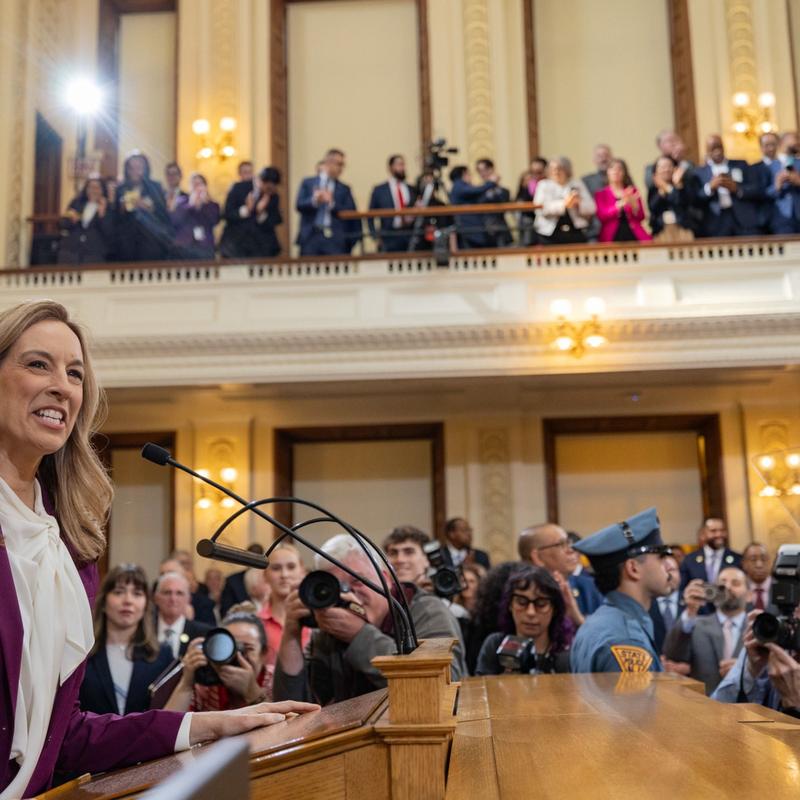
Brian Lehrer: Brian Lehrer on WNYC. In case you hadn't noticed, this budget season in New York and New Jersey, New York State is deep into negotiations with an April 1st deadline. Negotiation is around Mayor Mamdani's tax hike proposals and other things. We've been talking about those. In New Jersey, controversies are focusing on things like property tax rebates, pensions, and how to compensate for cuts from the Trump administration. New Jersey's process kicked off last week, and Governor Sherrill presented her first budget to the legislature working toward a July 1st deadline. She characterized it here.
Governor Mikie Sherrill: This is an affordability budget.
Brian Lehrer: There's the headline. According to her, this is an affordability budget. It comes to $60.7 billion. It adds education funding. It gives and takes a little on property tax refunds and lets Sherrill say she hasn't gone back on her promise not to raise taxes. To go into more detail on what's in there and how the legislature is responding and what you think, New Jerseyans will open up the phones and the text thread for you. We're joined by Michael Sol Warren, who covers New Jersey for WNYC and Gothamist. Hey, Michael. Welcome back to the show.
Michael Sol Warren: Hey, Brian. Thanks for having me.
Brian Lehrer: I will say you've been here before, but this is your first time, I think, as a coworker. Welcome to WNYC. Great to have you on board, really, in our news team. Overall, how does this budget compare to last year's? I've seen the word record in headlines, so I'm guessing it's bigger. I'm sure this is a topic of conversation. If she says it's an affordability budget, is it affordable for the taxpayers?
Michael Sol Warren: Yes. It's a record in the sense of if you long jump a centimeter further than you did last week, that's a record, too. It is up slightly to $60.7 billion. The current fiscal year is $58.8 billion. Really it grew less than the rate of inflation. I've been saying it stayed pretty flat. The goal is certainly affordability.
Sherrill had gone into this. She set the tone weeks before the address, really, with the press conference warning that the state faced a potentially $3 billion structural deficit of revenue not meeting spending. This budget had that in mind as it tried to rein in spending while increasing some revenue from the business sector. Now she's halved that projected deficit to about $1.6 billion.
Brian Lehrer: What's the biggest controversy that's breaking out so far?
Michael Sol Warren: So far, most of the discussion has been focused on the property tax relief side of things. Property tax is always a big deal in New Jersey. There's a number of state programs that aim to help people deal with that cost in their life. There's a relatively large new program called Stay NJ that was created by law in 2024 and started sending out its first checks last month.
The goal, Stay NJ tries to help seniors specifically tackle their property tax burdens. It pays out, under the current setup, up to $6,500 for seniors that have household incomes up to $500,000. It's an expensive program. Sherrill wants to trim it down by scaling that income limit for eligibility down to $250,000 and cap payouts at $4,000.
The administration says this would save the state $500 million and still keep 90% of New Jersey seniors getting benefits from it, but it's unclear how this is going to play out in the legislature. Stay NJ was the pride and joy of Assembly Speaker Craig Coughlin, and he has not had much to say about it publicly yet, but it's setting up quite the intra party fight to start the process.
Brian Lehrer: What is the name Stay NJ supposed to represent to people in the state? You know that in New York they're having this big debate over the Mamdani proposed tax hikes and saying, "Oh, if you increase the income tax on people with million dollar or more incomes, they may not stay in New York." Whether that's true or not is the big subject of debate, but that's the debate. Stay is used in that respect in New York. What does it mean in the context of this New Jersey property tax rebate program?
Michael Sol Warren: It's the same kind of feeling, but in New Jersey there's a lot of emphasis, particularly in recent years, on helping seniors stay in New Jersey. That's what this program is really focused on. It's not the only one. There's other older property tax relief programs that were geared towards seniors.
The concern has really been that you've got these folks that are on fixed incomes and the cost of living, not just their taxes, but all sorts of things are going up all around them and they don't necessarily want to leave. They've got their families here and their long societal ties, but they feel priced out in New Jersey increasingly. That was the goal, Stay NJ, was to help seniors stay in NJ.
Brian Lehrer: Listeners, whether you're a senior who is benefiting from the Stay NJ property tax rebate program or anyone else in New Jersey, you have a question or a comment about how Governor Sherrill is starting out of the gate in any way, and certainly since budgets are policy, what her init budget proposal represents to you in terms of what she's going to be like as your governor, 212-433-WNYC, 212-433-9692. You can call or you can text with New Jersey reporter for WNYC and Gothamist Michael Sol Warren.
She's talking about an affordability budget. What I haven't seen in the coverage that I've seen, and Michael, tell me if I'm just missing it, is the thing that she campaigned so much on to get elected, and that is affordability with respect to utility costs. Is there anything about that in the budget?
Michael Sol Warren: There's a lot about that in her speech and in the budget and brief documents and text. The tricky part with energy costs and utility bills is that so much of it plays outside of the budget process. Those costs are driven by the electric markets themselves and through policies enacted and run by the regional power grid, PJM, that serves New Jersey.
There are programs that the state offers through the Board of Public Utilities that the governor is wanting to keep going or expand, but those are really paid for by either surcharges on other people's bills or through different fees charged to companies and utilities. They're not necessarily through the budget itself. A lot of the language coming out of the governor's office on this is like, "We're going to pursue these programs," and this intense setting, but when it comes to the budget itself, there's the impact it can have on utility bills directly is a little limited.
Brian Lehrer: That's for other legislation. Another aspect of affordability that people are so concerned about these days is child care. I see that there's a boost in state school aid in the governor's budget. Among the things that that money would go for is enabling 2500 more children from low income families to receive subsidized child care. Can you talk about that?
Michael Sol Warren: Yes. We're talking about the state's child care assistance program here. What that does is basically subsidize the enrollment of lower income families being able to put their kids in child care. For these families, the state reimburses child care providers for enrolling the kids. There was a situation last year where essentially the program capped out and they didn't have the capability to enroll any more families and they had to pause enrollment for I believe the first time. It sent shockwaves through the childcare industry in New Jersey.
There's a campaign been big push from advocates to try to get the state to allocate more money to this program so that it can really reach the need that's there. This proposal for another $18 million by Governor Sherrill is projected to do that, and it would be a big win for our lower income families.
Brian Lehrer: How young can a child be to qualify for those programs? We know that in New York what Mayor Mamdani wants is universal free child care for any kids six months or older. What's the New Jersey program?
Michael Sol Warren: It's really geared toward the youngest kids. I'm not even sure there's a limit. I'd have to double check on the how young they could be. There is a max limit. Once they get old enough to get into regular school, it cuts off there. Actually it's interesting.
One of the challenges this program has faced is that at the same time the state has been, in recent years, expanding state funded pre-K program. It's created this take from child care centers because these older kids, the three year olds that maybe would have continued paying tuition to the child care centers are now going to their local school district for the service for free. It's been a bit of revenue loss for the child care centers and increasingly they're more dependent to keep the lights on by enrolling infants in ones and twos.
Brian Lehrer: We're getting a number of calls and texts on the Stay NJ property tax rebate program for seniors. One listener writes, "I'm a beneficiary of Stay NJ and agree with cutting it back to save taxpayer money. My husband and I are both over 65 but not at all poor, so I don't think we deserve the $5,000 or so." Now here is Damien in Hillside who has personal experience with it. Damien, you're on WNYC. Hello.
Damien: Good morning, Brian. Thanks. I love your show, too, by the way. I listen all the time.
Brian Lehrer: Thank you.
Damien: I'm going to be 70 and I rely on just my Social Security income because unfortunately I'm also disabled. It's vital to help. The property taxes are outrageous in New Jersey, the most expensive state in the nation.
Brian Lehrer: As you've lived your adult life and your home has become more valuable, it's incurred more property taxes along the way, and so that becomes-
Damien: Absolutely.
Brian Lehrer: -financially backbreaking without a rebate now that you're retired, right?
Damien: That's right. I no longer have kids in the school system. Never really did.
Brian Lehrer: Meaning that's where a lot of the property taxes go, so you don't have a personal stake in that anymore.
Damien: Yes. Some states in the country, once you get to a certain age, you no longer are responsible for paying board taxes, educational taxes.
Brian Lehrer: Is the rebate program, as it stands, sufficient to keep you in your home?
Damien: It helps. It helps. It's been in effect the last couple years. I fill out. Now, everything is bundled into one form. I've always done this, the senior freeze.
Brian Lehrer: Damien, thank you. Good luck and call us again. Thanks for nice words about the show. Make your voice heard again in the future. There are two contrasting takes from two listeners on Stay NJ. We hear from Damien there on the phone how important it is to him in his situation. The text that I read was from somebody who said, "They don't need as much of a break as they're getting." Another listener writes, "Stay NJ is geared to wealthy boomers while the rest of the state struggles. It has an income limit."
The reporter mentioned seniors on fixed incomes, which brings to mind folks on a pension or SSI. In fact, the limits for Stay NJ is $500,000. For a retired person to still have income of $500,000, it probably means it's all passive income from their savings, so they have millions in the bank. How do you respond to this wave? Maybe it shows some of the tension points in various directions on this.
Michael Sol Warren: I think that's exactly the point. That's been a center part of the debate since Stay NJ was drafted and voted on and signed in 2024. Another major property relief program in the state, ANCHOR, which benefits everyone, not just seniors, caps income at $250,000. Sherrill's proposal to scale back the Stay NJ limit would put it in line there. I think she's banking on people taking that point of view, frankly, and saying this is a reasonable thing to do. The administration again says that 90% of seniors would still be eligible for some sort of benefit even if the income limit comes down to $250,000.
Brian Lehrer: One thing that Sherrill wants to cut is programs that individual legislators have traditionally been able to get included. Some legislatures call them member items. Here's how she put it.
Governor Mikie Sherrill: In the final working days of the last administration, New Jerseyans were stuck with nearly $3 billion in extra spending, $2.5 in corporate tax breaks, and $240 million in giveaways. That can't keep happening. We can't afford the process anymore. It's not accountable. It's not efficient. It's not what the people of New Jersey deserve.
Brian Lehrer: What's that about? You take any legislator from any legislature at the city level, the state level, the federal level, one of the things that they're going to talk to their constituents about constantly is, "I got funding for this in our district." Is the governor saying there's too much of that?
Michael Sol Warren: Yes and no. [chuckles] I think yes, in the sense that obviously she's trying to curtail spending as much as possible, but I don't think she's necessarily taking aim at specific things yet. Her speech didn't call out too many specific items, although she did point out some last-minute tack-ons and lame duck last year. Generally, though, we're talking about these are Christmas tree items, like a couple $100,000 for park improvements or maybe $0.5 million for a foundation funding or something like that. A lot of times even less, maybe $100,000 or less, but they add up. There's a ton of them.
I think that a big part of the frustration with the governor and people outside of power but across the political spectrum is how this has been handled in New Jersey for as long as I've been in the state, which is that it's a very opaque budget process. Much of the negotiations among top legislative leaders and the governor's staff happen behind closed doors throughout much of the budget process.
The trend in recent years has been that the budget bill is only introduced days or hours before the June 30th deadline and the end of the fiscal year. That kicks off this rushed voting process where there's little time for the public to gain any real insight as to what's been tossed in and what's about to be approved for spending. I think that kind of transparency issue is really at the heart of what Sherrill was saying there.
Brian Lehrer: Hey, before you go, let me read a couple of texts that respond to one thing that a previous caller said, and that's that in some localities, seniors who would presumably no longer have kids in the public schools don't have to pay the property taxes that go to the education systems locally.
One person writes, "Just because you don't have kids in the school system anymore doesn't mean you just get to stop participating in the society you reside in by not paying your taxes. There are still kids who need it." Someone else writes, "Everyone, regardless of their child status, has a vested interest in the education system. We all require an educated populace." Is that the case anywhere in New Jersey, as far as you know, or is it an active debate in the way that the caller referenced it?
Michael Sol Warren: I am not aware of any place in New Jersey that opts people out of their local property taxes if they don't have kids in the system. If anything, we know that school spending is the number one driver of property taxes in the state and that the state's single largest expenditure every year is state aid to school districts to help defray those local property taxes. There's $12.4 billion proposed in this budget for just that. If anybody knows of a district where people are allowed to opt out of paying their local taxes because they don't have kids enrolled in the schools in New Jersey, please let me know.
Brian Lehrer: Serious question as we run out of time, do you want to give an email address or anything for, now that you're on the New Jersey beat, for the station for people to send you any kind of tips?
Michael Sol Warren: Absolutely. If you live in New Jersey and you want to talk to me, my my first initial is M and last name is Warren, W-A-R-R-E-N. Mwarren@wnyc.org.
Brian Lehrer: That's Michael Sol Warren, who now covers New Jersey for WNYC and Gothamist. We'll talk to you a lot.
Michael Sol Warren: Thanks for having me, Brian.
Copyright © 2026 New York Public Radio. All rights reserved. Visit our website terms of use at www.wnyc.org for further information.
New York Public Radio transcripts are created on a rush deadline, often by contractors. This text may not be in its final form and may be updated or revised in the future. Accuracy and availability may vary. The authoritative record of New York Public Radio’s programming is the audio record.