
Gov. Hochul's Uber-Backed Push to Reform Car Insurance
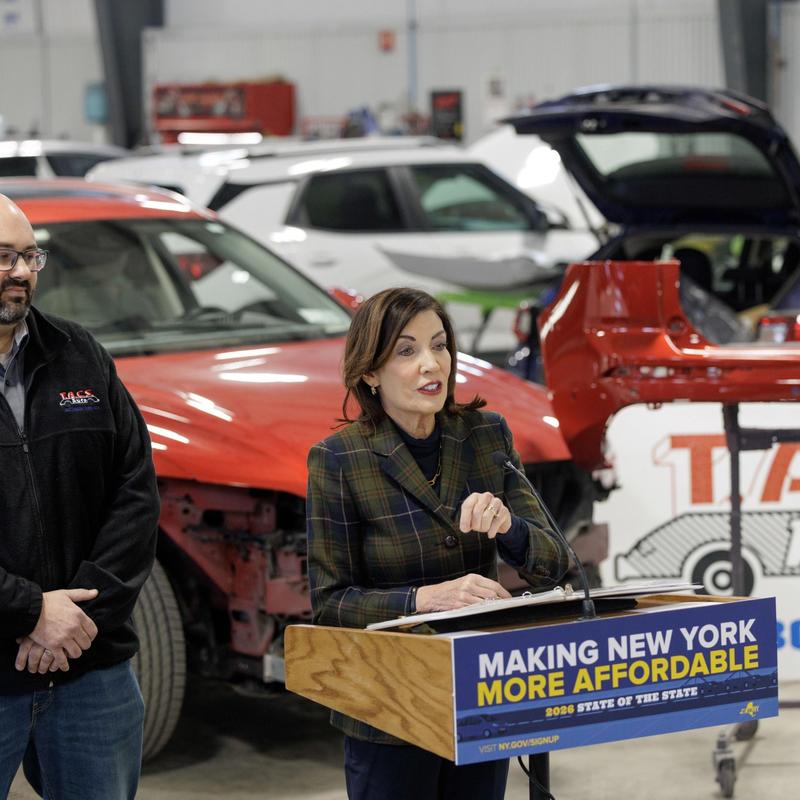
Brian Lehrer: Brian Lehrer on WNYC. Car insurance in the United States is getting more expensive. That's very true in our area, no question, so when Governor Kathy Hochul made lowering auto insurance premiums a centerpiece of her executive budget for New York State, it might have sounded like an easy win for affordability for working families, but it turns out to be politically not that simple. Here's Governor Hochul making her basic argument.
Governor Kathy Hochul: Some accidents really are just that. They're accidents, but others are result of a system that's just riddled with bad actors and fraud and excessive greed that rewards criminals in illegal behavior. That's one of the reasons why New Yorkers pay some of the highest insurance rates in the entire nation, averaging $4,000 a year, a whopping $1,500 a year higher than the national average.
Brian Lehrer: Rampant insurance fraud is driving up premiums, and cracking down on it will bring costs down for everyone, says Governor Hochul. To some, there's a catch. Reporting by Streetsblog, for example, and Streetsblog, for full disclosure, tends toward being skeptical about all things automobile, finds that the fraud epidemic that Governor Hochul is citing may be overstated, and the people pushing hardest for this lowering insurance premiums proposal happen to be Uber and others in big tech, to the tune of an $8 million promotion campaign, which raises some real questions about who this plan is actually designed to help, or maybe Uber and the ordinary Joe and Jane car owner just have similar interests here.
Joining me now is Austin C. Jefferson, Albany bureau chief for Streetsblog Empire State. He's been all over the story. Austin, thanks for joining us. Welcome to WNYC.
Austin C. Jefferson: Thanks for having me, Brian.
Brian Lehrer: Listeners, share your latest car insurance bills. How much have they been going up this year or the last few years? Help us report the story by sharing your car insurance bills. 212-433-WNYC, or anything on the theory that if you're paying too much for car insurance in New York, it might be because of fraud or something else nefarious. 212-433-9692. Help us report this story, at the very least by telling us how much your car insurance bills have gone up this year or the last couple of years. 212-433-9692, call or text. Austin, how much are rates going up?
Austin C. Jefferson: They're not going up nearly as much as the governor suggested. They are higher, for sure, but I think this idea that there's skyrocketing rates that are distorted compared to the rest of the country, I think it's more fuel for a narrative that's based on shaky facts.
Brian Lehrer: We'll see what our listeners report to indicate whether it's being overstated or not, but what exactly is the governor proposing, and how does she say it helps drivers?
Austin C. Jefferson: The governor is proposing to narrow some of the definitions within state insurance law and narrow access to pain and suffering damages for crash victims. The idea being that it will reduce the amount of fraud happening in New York. By cutting those costs that insurance companies bear, it'll lower the cost for ratepayers.
Brian Lehrer: One of the biggest changes would be to how the state would define serious injury. That designation determines whether a crash victim can pursue a larger claim in court. What's the definition now? Or a larger insurance claim, I guess, as well as potentially a claim in court, which, ultimately, in some cases, gets paid by the insurance company. What's the definition now, and how does Governor Hochul want to revise the definition of serious injury in a car crash?
Austin C. Jefferson: The current definition refers to major injuries to organs, like losing a member, a limb, serious broken bone injuries, but within the current definition, there is an allowance for injuries like TBIs and soft tissue injuries that perhaps aren't within that definition of a broken bone or major injury to an organ, but that leave you unable to resume normal life for 90 out of 180 days following a crash. Now, by taking away that definition in the law, like the governor is proposing, many crash victims would be unable to seek additional compensation for injuries that, in a lot of cases, leave them unable to resume normal life for the foreseeable future.
Brian Lehrer: Some pushback. The governor would say that New York's tort system, where crash victims can sue for pain and suffering, is uniquely generous compared to other states. That's what's driving up costs for everyone. Other no-fault states, Hochul uses Florida as one example, have moved to cap those payouts and see premiums drop. Why would New York be different? It sounds like it could work based on the experience of some other states.
Austin C. Jefferson: Well, this is part of the issue with the governor's logic. You mentioned no-fault insurance. Many of the high payouts for insurance claims, they're related to no-fault insurance. Well, the fraud we're seeing is also tied to no-fault insurance, but these changes the governor is proposing have nothing to do with no-fault insurance.
Brian Lehrer: Maybe define no-fault insurance, just by way of background?
Austin C. Jefferson: It's a little bit of what it sounds like. You get into a car accident, before anyone even decides who's at fault for injuries or the incident itself, there's a system of giving out up to $50,000 to victims the second they make a claim. It saves time, it reduces a backlog of claims within the insurance system, and it just makes things easier, but it can be abused.
Brian Lehrer: Let's hear from some callers. A lot of people calling and texting with their car insurance rates. Jacob in Brooklyn, who works as an Uber and Lyft driver. Jacob, you're on WNYC. Hello.
Jacob: Hi. What's going on, Brian? Over the past five years, my insurance rate has went up by at least 25%. I used to pay roughly around $325, and it's went up to, like, since I renewed it last month, it went up to $410.
Brian Lehrer: Thank you. That's a starting point. Here's someone else. Another cab driver. Adam in Manhattan, you're on WNYC. Hello, Adam.
Adam: Good morning, Mr. Brian. Yes, like I told your screener, I start Green Cab two years ago. I paid less than $4,000. Now, I'm paying $7,600. It's like, "You want it? Take it, or leave it." We have no other options because if you're late to pay, you're going to lose your registration, your plate. It's a big mess.
Brian Lehrer: Have you ever asked--
Adam: Nobody is talking--
Brian Lehrer: Have you ever asked the insurance company why?
Adam: They don't have an answer for us. Nothing. They don't explain. I will tell you, they don't explain nothing. It just, "This is the price." If you pay late or something, like I said, it's a big mess with TLC. You're going to lose the plate. Everything is attached in the computer. If you don't pay, one day before that, you'll receive a letter from the state. You're going to lose this and lose that. I don't know how they're going to solve this equation. I have no idea. I follow the flock, and I'm paying what they told us to pay, but it's not ethical. There is no ethics at any institution. There is nothing. Zero.
People are after the money, and people are after the money from the top to the bottom. It's all about the dollar. This is too much greed. Too much greed. Look at the insurance, healthcare insurance. Everywhere you go, there is no ethics. No ethics. Nothing. It doesn't exist.
Brian Lehrer: Up and up and up. No ethics. Adam, thank you very much. We appreciate it. All right. We've heard from two professional drivers. Adam says he's a cab driver. I think that's Yellow Cab. The previous was an Uber and Lyft driver. Here's James in the Bronx, who I think just owns his personal car. Is that right, James? Hi. You're on WNYC.
James: Hi. Yes, I just own a Toyota Corolla, and I have a perfect driving record. I've only owned a car for about three years. My current insurance per year is almost $4,000. It's like $3,996. Before then, it was $3,700. I can't remember what the first year was, but I've had a perfect driving record. I've never had a claim. I've never had an accident. I think, partly, one of the problems is that because I lived in Manhattan for many years, I never owned a car, and so I haven't had a long driving history in terms of being registered as a driver, I mean, as a car owner, even though I've been driving since I was 16 and a half.
Brian Lehrer: Right, but still, you're not reporting as big an increase as the two cab drivers who called. They were saying about 30% increase. If I hear you correctly, you're saying up from about $3,700 to $4,000. Do I have that right?
James: Correct. Yes, exactly. It still was a-- I was paying $278 per month, and now I'm paying $343, something like that. I'm 70 years old, on a fixed income. It's really squeezing my capacity to have a car, to be perfectly honest. I really want and need a car because it's really important to get out of New York and see family, but it's really, really put me in a squeeze. Having a car is just a huge expense, and the insurance is one of the largest of those expenditures because my car has no problems in terms of, other than just maintenance. It's a huge problem. Why does the insurance go up, and go up so much, especially when I have had no problems?
Brian Lehrer: James, thank you. I'm going to get one more like that, and then try to get your question answered by our guest. Richard in Rockland County, you're on WNYC. Hi, Richard.
Richard: Hi, Brian. Appreciate your show. I'm calling because I'm a senior driver, 66 years old. I just noticed that my monthly bill went up 35%, maybe. I called them and wondered why, and they gave me a lot of different facts, but it was the state charge that seemed to be the most hitting. I'm just wondering why. There's this myth. As you become a safer driver in later years, that-- That doesn't pan out, and that's disappointing to me.
Brian Lehrer: Thank you very much. Back to our guest, Austin Jefferson, Albany bureau chief for Streetsblog Empire State. It sounds like these are big increases across the board, Austin, right? The cab drivers, 30%. Still pretty big increases, if they're talking about $88 a month more, according to that caller. The other caller who went up something like that as well. Maybe not quite 30%, but still significant. Is it different? If part of your premise is that the Uber and Lyft companies and others like that have a vested interest here that may not be in the interest of the ordinary driver, it does sound like the rates are going up at a fairly similar rate of increase. What's your take?
Austin C. Jefferson: Well, I think their interest is in their bottom line. I think part of the evidence of that is that this proposal, it strips the ability to seek compensation for crash victims. Some crash victims are drivers, some are Lyft and Uber drivers. I think to say that this is going to be a big boon to the average driver. I mean, sure, they might save a buck or two. It's not been proven how, but that's what everyone's been claiming. Should they get in a crash and find themselves in a situation where they need to seek compensation to resume a normal life, that's in jeopardy.
Brian Lehrer: What's the reason that the rates have been going up so much just in the last few years? That system didn't change just in the last few years, did it?
Austin C. Jefferson: No, I think, at least from what insurance companies claim, it's a mixture of things. It's not just fraud. It's vehicle repairs, litigation, inflation, some fraud abuse, but it's a complex variety of things that are just leading to increased costs for them. However, across the nation, these companies are making money. They're claiming reduced profits within New York State, but they're not struggling to operate necessarily. They're just passing costs on to consumers.
Brian Lehrer: Sure, but you heard our callers. One of them said he's on a fixed income, so with this increase in rates, he's struggling. This isn't just about Uber and Lyft's, what might be, false claims of being struggling companies, or maybe they're not even claiming it, but they just want to make more money or save more money. We heard from at least one individual who says this is threatening his ability as a senior who lives on a fixed income to own a car. Do they have similar interests or differing interests?
Austin C. Jefferson: I think that if these interests were the same, these companies would be pushing for insurers to offer alternatives that save money. You have pay per mile, you have behavior-based driving discounts. These are all things that could be pursued harder by the companies offering policies. I'm sure they would save Uber and the common driver money.
Brian Lehrer: Austin, who's on the other side? Are there big-name opponents to Hochul's proposal?
Austin C. Jefferson: Quite loudly, the New York State Trial Lawyers Association is vehemently opposed to this policy.
Brian Lehrer: You get two kind of corporate sides or in business sides who a lot of people might find it hard to root for, right? The Uber and Lyft establishment versus the trial lawyers establishment.
Austin C. Jefferson: Yes, but at the same time, these trial lawyers, they've made the point that if it is harder to successfully win these cases when they seek compensation for crash victims, less lawyers will take on the cases. I think, yes, they are a large group with their own aims, but they'd like to represent these people.
Brian Lehrer: Sure. What's the fraud allegation? The governor talks about fraud pushing up insurance rates. Not even the legitimate claims that we've been discussing mostly so far, and how much people should be able to collect after being injured in a car crash. What's the fraud aspect here?
Austin C. Jefferson: The governor's claim is that rampant fraud is driving up costs for insurers, and that cost is being passed on to ratepayers, but we've looked at the data. Maybe there's tens of thousand cases of suspected fraud that New York is seeing, and maybe a couple of hundred of those are actually being investigated, even fewer arrests. I think to suggest that this is a giant issue in the way that the governor is approaching the policy changes, I think it is inaccurate.
Brian Lehrer: Right. Of the 43,000 allegations of fraud lodged by multibillion-dollar insurance companies, you write, "The state opened just 243 investigations and made 169 arrests. That's out of 43,000 allegations. The closure rate on insurance fraud would be less than 0.4%." The governor's argument, though, isn't only about fraud, but also about what she calls jackpot lawsuits. Her office says that without a firm definition of serious injury, individuals without significant harms can game the system to win astronomically high awards in court. Maybe that's why it seems like there's an injury lawyer commercial on television every 10 minutes or on every other bus shelter. Here's another clip of the governor from February.
Governor Kathy Hochul: Someone could be driving drunk, got a license, cause an accident, and recover from emotional distress, or a reckless driver who hits another car will sue for pain and suffering. A driver who caused an accident can be entitled to not just modest payouts, but literally millions and millions of dollars from the premiums of regular policy owners, which means all of you.
Brian Lehrer: Any thought about that, Austin? What's the pushback there?
Austin C. Jefferson: Well, I think the pushback is that some of the instances that she's naming, which are valid. I think lying about the extent to which you deserve compensation after something that maybe was your fault or staged, that's not something that people should support, but she mentioned driving on a license. That could mean that you're borrowing your friend's car and then get into a life-changing accident, and yet you are being lumped in with criminals. I'm not seeing the connection to how that's driving up the amount of jackpot lawsuits in New York.
Brian Lehrer: Let's see about another caller on this. Oh, Danny in Manhattan has a story about having gotten into a fender bender. Danny, you're on WNYC. Hello.
Danny: Hi. About six years ago, I was in a fender bender. I was going into the Midtown Tunnel. It just started raining. We were slowing down, the car behind me hits me. We were going about 10 miles an hour. Then I hit the car in front of me. We all exchanged information. There was no damage on my car, and that was the end of it. Then, about six, seven months later, I get a bill, and my rates went up. I was like, "Why did they go up?"
I called the insurance company, they're like, "Oh, you were in an accident, and the passenger was injured." I said, "Wait, what passenger? The guy in front of me was just himself, and there was no passenger." They said, "The passenger had a rotator cuff injury, and we paid out $63,000." I was like, "You've got to be kidding me." They didn't even call me. If they called me, I could have said this, and then they could investigate it and see what happened, right? They didn't even call me.
Brian Lehrer: This is an example of an exorbitant award that might be contributing to pushing up people's insurance rates, correct?
Danny: Yes. It wasn't a huge award. I don't think the guy in front of me was part of a group that regularly scammed the insurance company, but they definitely got away with that one. The insurance company never contacted me.
Brian Lehrer: Danny, interesting story. There does seem to be a mismatch, Austin, in the data that the Division of Criminal Justice Services found, which was that 70% of suspected fraud cases involved no-fault insurance, which you were describing before, and yet the governor's proposal doesn't touch no-fault at all. It looks like she's citing a problem in one part of the system to justify changes in a different part. Can you clarify that for us?
Austin C. Jefferson: Yes. What the governor's changes are doing, it's changing parts of the insurance law that are related to when you can seek a lawsuit for damages. Now, that's completely separate to no-fault insurance, which, again, happens without even having to go through that process. You just file your claim, and then you explain what happened. To conflate the two, it's-- and in the process, make changes that strip coverage from people. It's causing a real dilemma for lawmakers who are faced with this issue of deciding, "Do we want to rightfully try to tamp down on fraud in New York and then bring down prices, but should that come at the expense of people that have nothing to do with the problem that we're trying to address here?" No-fault insurance fraud.
Brian Lehrer: We're getting a call from a lawyer who does some work in this area. Let's see what Dan in Thornwood has to say. Dan, you're on WNYC. Thanks for calling.
Dan: Hi. I just want to say that in terms of fraud, there have been some RICO cases brought by insurance companies lately against certain law firms and their affiliated orthopedic surgeons, whom they claim perform unnecessary surgeries, and that will drive up a verdict very [unintelligible 00:22:56] if you have a [unintelligible 00:22:58] or you're actually--
Brian Lehrer: Unfortunately, Dan's line is breaking up too much. I guess we're not going to be able to get that story, but I guess we get the gist of certain kinds of fraud or fraud allegations. We're almost out of time, Austin. As Albany debates this, what else could they do to bring insurance down for drivers who are genuinely struggling with these large increases over the last few years, if not this?
Austin C. Jefferson: I think the real solution to bring down insurance costs, at least for lawmakers to consider, is creating alternatives to traveling outside of driving. If you're living in Upstate New York or in the suburbs, you're reliant on these modes of travel that lead to these insurance policies, and these cases of fraud, and the high cost of owning a car. If it wasn't a world in a state where you were reliant on that mode of travel, lawmakers wouldn't have to find a solution to bringing down these costs. Moreover, they wouldn't have to find a way to seek alternatives to a proposal from the governor that doesn't address the problem, yet causes nuance for crash victims.
Brian Lehrer: Did you just reveal Streetsblog's editorial interest here? Because the basic vibe of the site is it'll be a better city and a better world if fewer people are driving and more are getting around in other ways. Do your critiques of the governor's plans, or the one you're covering, have a bottom line here of why make it any easier for people to use that polluting and dangerous technology by bringing down their insurance rates?
Austin C. Jefferson: I think our critique is more based in just the flawed method of bringing down insurance. Full disclosure, Brian, I own and drive a car. I don't understand how this would save me money, nor how it would protect me if I got in a car crash.
Brian Lehrer: Austin Jefferson, Albany bureau chief for Streetsblog Empire State, car owner, on Governor Hochul's push to bring changes to the state's auto insurance system. We'll see how the politics of this play out over the coming weeks. Thanks, Austin.
Austin C. Jefferson: Thanks, Brian.
Copyright © 2026 New York Public Radio. All rights reserved. Visit our website terms of use at www.wnyc.org for further information.
New York Public Radio transcripts are created on a rush deadline, often by contractors. This text may not be in its final form and may be updated or revised in the future. Accuracy and availability may vary. The authoritative record of New York Public Radio’s programming is the audio record.
