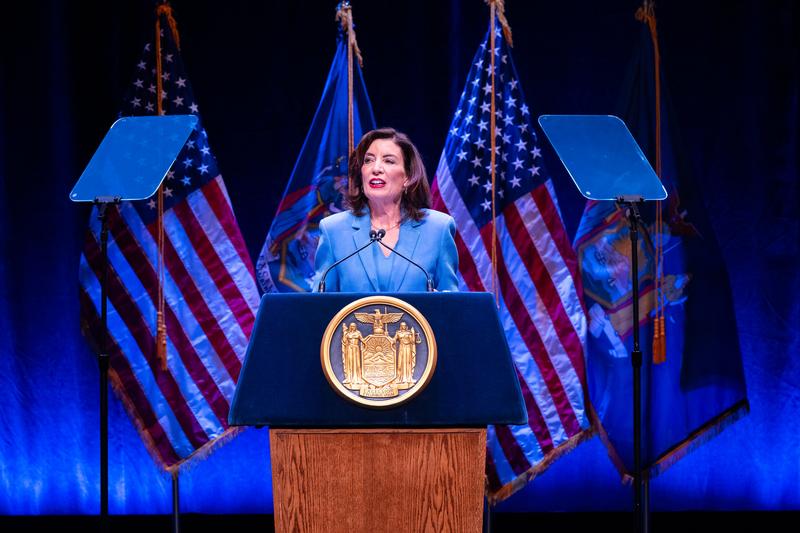
Gov. Hochul's 'State of the State' 2026
Announcer: This is WNYC FM, HD, and AM New York.
Amina Srna: It's The Brian Lehrer Show on WNYC. I'm Amina Srna, a producer for The Brian Lehrer Show, filling in for Brian today, who is taking today off to take care of a family member who's dealing with a health issue.
Coming up on today's show, we'll turn to Iran. Robin Wright from The New Yorker has been covering Iran for many years now. She'll update us on the protests, the government's crackdown, and what this might mean for the regime in charge. Plus, the Supreme Court heard oral arguments yesterday on two cases involving states that have banned transgender athletes from girls' and women's sports teams. The justices will have to decide whether to let these two particular state-level bans stay in place, and this decision will have broad ramifications for transgender people and athletes. University of Pennsylvania law professor Kate Shaw will explain which way it seems the justices might rule.
Today is also Supreme Court decision day. Wait, aren't those usually in June? The big decisions usually do come out at the end of the term in June, but some court watchers think the decision on President Trump's tariffs case might come out today. If it does, Kate Shaw will explain what's in that decision too. We'll wrap up today's show by looking at how Astoria became such a welcoming place for socialism. The Queens neighborhood has elected so many democratic socialists in the past few years that it's gotten a few nicknames, including the Commie Corridor and the People's Republic of Astoria. We'll get into it near the end of the show today.
First, Governor Hochul gave her fifth State of the State address yesterday and the final one in her current term as she gears up for a reelection campaign. Throughout this speech, Hochul repeatedly positioned herself against President Trump, using him as kind of a unifying foil; a way to rally progressives, reassure moderates, and frame New York as a bulwark against chaos in Washington. Also, to no one's surprise, she leaned pretty heavily into affordability; an issue with broad appeal across the party, and one that's become even more central with the rise of a more populist left.
She highlighted an increasingly visible partnership with New York City Mayor Zohran Mamdani. Much of the agenda was what you might call bread-and-butter affordability policy, universal childcare, lowering everyday costs like car insurance, and creating a path to home ownership for the middle class. Hochul argued that she could do all of this without raising taxes, a line clearly aimed at centrists and suburban voters, even as it raises questions among progressives about how she plans to pay for it all. Take a listen.
Gov. Kathy Hochul: Washington's chaos is hitting our bottom line, but here's the good news. We built the boat to withstand the storm. We've managed our money responsibly, and that means we can make transformative investments in our future without raising taxes, without saddling the next generation with mounds of debt. We can get this done.
Amina Srna: That framing is notable with a state budget deadline looming, and as she faces mounting pressure from the left to raise taxes on high earners to pay for some of her more ambitious progressive policy items. All while Trump has been moving to slash federal funding for childcare and anti-poverty programs in the state. So, yes, affordability definitely dominated the speech, but Hochul also touched on a slew of other issues like ICE, public safety, and regulating big tech; again, often turning to Trump as a point of contrast. There weren't the kind of lightning rod proposals we've seen in past years, but there's still a lot to unpack in how Hochul laid out her agenda and what she left out, so let's dig into it.
Jimmy Vielkind is the state issues reporter for WNYC and Gothamist. Jimmy, welcome back to the show.
Jimmy Vielkind: Good morning, Amina. Happy to be here.
Amina Srna: Good morning. Before we dive into some of the policy details Hochul laid out, I want to ask you what you think we can glean from this address when it comes to her reelection campaign.
Jimmy Vielkind: Well [crosstalk]--
Amina Srna: Oh. She's facing a progressive challenger in Antonio Delgado, and she's also built a very public partnership with Mayor Zohran Mamdani. She needs to hold on to progressive enthusiasm while still appealing to moderates statewide. How's she trying to walk the line in that speech?
Jimmy Vielkind: Well, I really think she had to do three things in the speech, and you hit on several of them. The first is just hit the center. New York is a Democratic state. There are twice as many enrolled Democrats as there are Republicans. A key for someone like Hochul, a moderate, is going to be to win over independent voters, to hold that broad center of the electorate that is, this time around, indications are, probably going to pull more to the political left. Politics is tidal. We see, generally, after one party takes power in Washington, in the first midterm elections after that, the tide tends to go against that party. Since President Trump and Republicans are controlling Congress, that's generally good news for Hochul, and she can surf that tide.
The second thing she needed to do, you alluded to as well, which is just don't make any major waves. We saw that the Governor in previous years pick fights with the legislature over criminal justice policy, or a big housing reform that really stirred up a hornet's nest in the suburbs. This time, we didn't really have any of those policies, so she hasn't done anything to really rock the boat in a major way.
Then the third thing, which I think is going to be most interesting, particularly for people in New York City, is to mind her left flank. One key way she's trying to do that is by emphasizing so clearly her alliance and her positive relationship with Mayor Zohran Mamdani. He obviously has a lot of momentum, a lot of energy coming off of his win last year, and he appeared with the Governor three times in the week leading up to her State of the State address and led a standing ovation when she talked about childcare.
Amina Srna: Governor Hochul promised to accomplish her agenda without raising taxes. It was a notable thing to say, given that one of Mayor Mamdani's big campaign promises was taxing the rich. Of course, he needs the Governor's support to levy those taxes, but he also said this yesterday after the speech.
Mayor Zohran Mamdani: We all know the acrimony and the animosity that has long defined the relationship between city and state, and we have long understood that those who suffer as a result are not the politicians, but rather the people.
Amina Srna: Jimmy, it seems like Hochul's and Mamdani's agendas do intersect, and they're both invested in having a positive relationship, as you were talking about, but they also start to diverge in pretty crucial ways, like in terms of taxes, that could matter during budget negotiations. How do you think she's managing that tension?
Jimmy Vielkind: Yes. I think that's really going to be the absolute question to watch in Albany for the next several weeks and even months going into the state budget. The State of the State speech, just to step back a bit, is generally the big ideas. Governors lay out their priorities. Next week, we will have Hochul propose her executive budget. It's going to be more than $250 billion worth of spending, and she'll have to introduce reams of legislation to get it enacted. That's really where we'll see the fine print, so to speak, of the policy she's talking about.
She says, though, that right now there's no need to raise taxes. The stock market continues to perform well. In New York, we're home to Wall Street, and we derive a lot of our state revenues from income taxes on things like bonuses and profits. The state budget, according to Hochul and her top fiscal aide, Blake Washington, is in a pretty good spot. She says she doesn't need to raise taxes, especially in this first year where the initial outlay for things like 2-Care, which is going to be universal childcare for two-year-olds, is going to be relatively low.
I think a lot about this, Amina. I think about 2014. A new mayor, Bill de Blasio, came into office, and he had also a very digestible campaign slogan; we're going to tax the rich to pay for pre-kindergarten, and it's going to cost people less than the cup of a Starbucks coffee each day for them to pay for this massive benefit for everybody. Andrew Cuomo, the governor, also didn't want to raise taxes. Cuomo and de Blasio, those guys fought like little boys in a sandbox just for years and years and years over anything. What de Blasio did was not take the win. Cuomo said, I will pay for pre-kindergarten. I will find a way to do this. De Blasio continued to rally for those tax hikes, and it really led to the deterioration of their relationship. It enraged Andrew Cuomo, and things just got bad between them.
Here, Mamdani may have learned a lesson from that and says, look, if the governor is going to give me a policy win, I'm not going to jam her on tax policy because guess what? There's always a call to raise taxes. Maybe next year, when Hochul is not facing reelection, maybe that's the time to push to raise taxes. It seems like Mamdani has made a calculation not to fully engage, but we'll see whether or not that holds.
Amina Srna: Listeners, we want to hear from you. Did you catch the Governor's State of the State address yesterday? Do you think she focused on the right things or maybe that she missed on some big issues? Do you wish she would raise taxes, or do you think she's being politically savvy by holding back? Anything you think she should be focusing on going into this election? 212-433-WNYC. That's 212-433-9692. You can also text that number.
Turning to immigration. Hochul spoke about the murder of the protester Renee Brown by an ICE agent in Minneapolis last week, and then laid out a framework for how New York would deal with ICE. Let's take a listen to a clip.
Gov. Kathy Hochul: We will not allow masked ICE agents to storm our schools, our daycare centers, our hospitals, our houses of worship for civil immigration raids unless they have a judicial warrant. And guess what that means? Signed by a judge. [applause] And when these boundaries are crossed, accountability matters. No one, from the president on down, is above the law. Let me repeat. No one.
Amina Srna: Jimmy, I just want to say, the protester was Renee Good, not Renee Brown. Excuse me. This sounds, on the surface, like a pretty progressive policy, right? She's essentially saying here that New Yorkers can sue ICE agents when they break the law, but what she's very clearly not proposing here is for local law enforcement to stop cooperating with ICE entirely, and that's something that a lot of progressives want. You were in the Chamber yesterday, and you spoke to a lot of Democrats. Do you have any insight into the prevailing wisdom about how far she should go on ICE?
Jimmy Vielkind: This has been really interesting, and it's been an issue that Hochul has really had to walk a fine line. Hochul is very cognizant of threats on both her political left and her political right. She weathered a pretty closer-than-expected reelection campaign in 2022 against Lee Zeldin, a former congressmember who represented the eastern parts of Long Island. Hochul, when she was called to testify before Congress last year, she kept repeating over and over again, New York cooperates with ICE. We cooperate with ICE. We are not a sanctuary state.
Her policy has been a little bit squishy on this. Let me go through a little bit of it. She re-upped an executive order, which was first issued by the last guy, Andrew Cuomo, and it says that the state will not use-- state employees are not to ask about immigration status, and that includes law enforcement, unless there is some absolute required thing, like to determine eligibility for a benefit. The New York State Police have been asked not to cooperate with civil immigration enforcements absent a judicial warrant from federal immigration authorities.
Hochul said this sentence yesterday, and please forgive me, I want to read it verbatim because she certainly chose her words very carefully. "New York will not allow the use of state resources to assist in federal immigration raids on people who have not committed serious crimes." A lot of things to unpack. What are serious crimes? State resources? Does that apply to local police departments? It doesn't seem to.
The holy grail for immigration advocates in New York is something called the New York for All Act. It has a bunch of provisions, but probably the most important one would really restrict the ability of local police agencies to enter into cooperation agreements or to just cooperate with federal immigration authorities. There are several counties around New York State that have what are called 287(g) agreements, where their local officers are deputized to do immigration enforcement side by side with ICE and other agencies. The biggest county is Nassau County, immediately east of Queens, which is led by Republican Bruce Blakeman. By no coincidence, perhaps, he seems to be the likely gubernatorial candidate challenging Hochul. The New York for All Act would forbid counties from doing that. Some places, like New York City, already have sanctuary policies in place that forbid this kind of cooperation, but this would set a blanket policy statewide.
This is legislation that Hochul has not wanted to come on board. Her official statement, even as of yesterday, even with those strong words, was she'll take a look at it if it passes the legislature. I think this is a squishy issue. What struck me about yesterday was the number of progressive lawmakers, people who support the New York for All Act, who told me that they were happy to hear Hochul's rhetoric. They feel that she's gone further than before. They said that her announced proposals are positive, that they do take tangible steps that will help protect immigrants. Many of them just kind of said, we'll get her there. We'll get her to the New York for All Act. Rather than finding a fissure, she seems to be getting, at least initially, some goodwill from people who would like her to go further.
Amina Srna: Jimmy, we have a caller that wants to talk about this exact issue. Yasmine in Queens, you're on WNYC. Hi, Yasmine.
Yasmine: Good morning. Thanks so much for having me. My name is Yasmine. I'm in Jackson Heights, Queens. I'm also the executive director of the Immigrant Defense Project and part of the New York for All Coalition, which was in Albany for this very issue this week. I just want to address a little bit of what was said.
She's right. Hochul is right when she says that accountability matters, but one thing I want to be clear about is that I understand-- I appreciate your summary, Jimmy. I want to just make sure for listeners, this is really concrete what we're talking about here. This is not a squishy issue. When we talk about the use of our local and state resources in New York, that New Yorkers are paying for, to perpetuate a mass deportation agenda, we're talking about community members like Santos Edilberto Banegas Reyes, who's a father of two children, who died while in ICE custody in Nassau County last year, and he was there because of a 287(g) agreement with the Nassau County Jail. The pain of his daughter, of his family, this is not a complicated issue. This is actually very, very much a simple issue. It's about not allowing our local and state resources to perpetuate an agenda that's violent and that's harmful, and that really strips away trust from New Yorkers in just interacting with their local and state resources.
The Governor's remarks, she's right that accountability matters. Of course, we were encouraged to hear her name the protections for immigrants are key, but we also want to be clear that as of now, this is a case of the emperor wearing no clothes. Her remarks did not actually give any meaningful action, and certainly did not support the New York for All Act. I want to be clear that she does not represent. We were there in Albany with over 300 community members from across the state. We were joined by over 20 different legislators. We were also joined just a few days earlier by the Senate Majority Leader Andrea Stewart-Cousins, saying herself that she supports the goals of the New York for All Act in moving this forward.
I think the Governor touting old executive orders, which are very limited in scope, we are behind. Most other blue states with large immigrant populations, California, Washington, Oregon, they didn't just pass laws like this under this Trump administration. They passed it during the first Trump administration. As much as we applaud the sentiment and the values, and we can stand behind them, we need to be sober as we're listening to the Governor's words and understanding that right now, as of today, she has offered us nothing, and we're not going to wait any longer.
As Senator Gianaris said when he joined us in Albany, this is a break-the-glass moment where we have to reach for the emergency tools. It's not a direct quote, but this is not a moment where we're going to take half measures that barely mitigate the harm that's happening. This is a time where we need a comprehensive solution. We know what that solution is. We've been sharing that solution for a long time. It's the New York for All Act. That's really what I want to make sure that the listeners understand today.
Amina Srna: Thank you so much for your call, Yasmine. Jimmy, what was coming up for you when you were hearing Yasmine talk?
Jimmy Vielkind: Well, thank you, Yasmine. It's good to hear you. I know that our colleagues did cover the rally she referenced in Foley Square last week. Clearly, she is not satisfied, and she is correct in saying that Hochul did not commit to this legislation yesterday. I think that one of the reasons I read that sentence verbatim is because it sounds great, and it almost sounds like it might be committing to it, but in fact, it does not. It just restates with a little bit more strength what had been previous state policy.
Yasmine brought up something that I think is worth thinking about. New York is a deep blue state, but back during the first Trump administration, for the first years of it, actually Republicans controlled, effectively, the New York State Senate until 2019. Lots of this legislation that seems like a slam dunk for Democrats, and that was enacted in other blue states, including places like Oregon and, I believe, California, didn't happen here because there was divided government. Andrew Cuomo was really willing to do what he could through executive order, but not really pick that fight with the legislature.
I know Yasmin and other people who are advocating for this law will be back in Albany. It seems to be that as the headlines around the country and around the state get worse-- She referenced a man who died in custody in Nassau County. We've also seen immigration raids targeting people who were going to a food manufacturing facility in Upstate New York. We've seen people who were deported over shoplifting under the Laken Riley Act and with local police who called ICE and turned them in. I think as more of those stories go out, the political mood is shifting and will continue to shift. I thank her for that. I'm sure we might even hear from listeners who have an opposite opinion on what the best course of action is here.
Amina Srna: One more listener on sanctuary cities in particular, and more of a question, I believe, on the process itself. T.K. in the Bronx, you're on WNYC. Hi, T.K.
T.K.: Hey, good morning. Thank you for taking my call. I guess I'm going to be oppositional, I guess, because I'm an independent, so let me say that. I'm not a Democrat or Republican, but what happened to voting? What happened to allowing the people who've been living here, who are citizens here, to say what our will is? I mean, you can't go by the few people who protest. It's seven, eight million people in the city. It wasn't even a million people out there. You can't say, "Oh, they're protesters, so this is what the people want." Ask us what we want.
Amina Srna: T.K., you told our screener that you were asking specifically about ballot initiatives and putting a question like that on about the sanctuary city, right?
T.K.: Yes.
Amina Srna: Okay.
T.K.: Because it got pushed through initially by Koch, and nobody voted on it the initial time. We were never asked. It was a lot of assuming, and that's wrong to do. Now it's been pushed down people's throats, and it's like, oh, well, you live in a blue state. Okay, but that doesn't mean that everybody feels the way that you're assuming everybody feels. If this is a democracy, if it is—because I'm really getting to a place where I'm not really sure—then we should be asked and we should vote on it, and what is voted should be accepted.
Amina Srna: T.K., let me get a response for you there. Jimmy?
Jimmy Vielkind: Yes. Well, thank you, T.K. That's a very good point. New York, unlike some other states in the country, doesn't-- it's a pretty cumbersome process to get a ballot initiative statewide, which is required to change the state constitution. We don't have a tradition like California where people propose a law, like a sanctuary law or a taxation law, and people go to the polls and they approve them. It's relatively rare for a popular referendum on something like that.
As to why it never became added to the City Charter, was never proposed to the City Charter, that's a little bit more of a cumbersome process. I know my colleagues, Elizabeth Kim and Brigid Bergin, have talked about the machinations of what gets on a ballot for a charter review and what doesn't, but generally speaking, as you pointed out, the city's sanctuary laws have been on the books for quite some time, including under Republican mayors, this guy Rudy Giuliani, who is still around, and who has had an on-and-off relationship with Donald Trump over the years.
I think T.K. hits on another point which is interesting, in that President Trump campaigned very, very clearly on this issue all throughout 2024 and all throughout 2023. This is not a surprise. This is exactly what he said he was going to do, and he was elected by the American people. It was not a close election. He won the popular vote. He won the Electoral College handily. I think, to T.K.'s point, there is seemingly a signal in the popular will that people in the United States want to see this kind of an aggressive deportation campaign.
Now, of course, the flip side of that is that President Trump did not carry the state of New York and he did not carry the city of New York. He did better than previously. He ate into Democrats' margins, but his position and his voters were still in the minority. I think that cuts both ways. While T.K. raises a really interesting point, I don't know that we're going to see any kind of a popular referendum on these policies anytime soon.
Amina Srna: Let's talk about childcare. That's been pretty central to Hochul's platform for years, and she and Mayor Mamdani announced last week a new universal childcare program. We have a text coming into the show. "I listened to Hochul's speech, and I was surprised and disappointed that she said NYC would get childcare for two-year-olds while the rest of the state would only get Pre-K for four-year-olds. Why is that? And won't everyone outside New York City have good reason to push against it?"
Jimmy, can you explain the difference in that policy between city and state?
Jimmy Vielkind: Well, that's a wonderful question from the texter, so thank you for that. It's a problem that Governor Hochul has actually acknowledged and talked about. Obviously, Zohran Mamdani is the mayor of New York City and is responsible for New York City, but what we've seen since the rollout of universal Pre-K is that the city has been at the leading edge of these kinds of expanded care, or the so-called aging down of kindergarten and the school network.
This is kind of a weird and fun fact, but I grew up outside of Albany in a suburban school district called Shenendehowa. It is the last school district in the state of New York that does not have full-day kindergarten. I only had half-day kindergarten, and look at me now. You can cut that however you want. The infrastructure in the rest of the state is just in a different place. There are many districts that do not have Pre-K for four-year-olds, let alone 3-K, let alone 2-K.
Governor Hochul was very clear in announcing this that it's a first step, that she recognizes that getting to universal childcare around the state is going to be a process that takes many, many, many years. In this instance, she said that New York City is ready to "age down its system to two-year-olds." Whereas, the town where I grew up, they don't even have full-day kindergarten for five-year-olds.
This approach that she's taking so far is multifaceted. Part of it is that pilot program for 2-Care. Part of it is also an expansion of funding for Pre-K for four-year-olds and 3-K for three-year-olds. There's also an expansion in something called the CCAP program that is a voucher system that helps people with younger children in daycare centers, people as low as, I believe, six months. That program had been oversubscribed. There were waiting lists. People who were eligible for those vouchers were unable to get funding. Hochul has included about a billion dollars more to increase funding for that and hopefully, age access.
It's a really good issue. It's something that upstate legislators are already starting to talk about, but I think that part of the question is that New York City is just further along. The hope is that over time, the rest of the state will have the infrastructure to catch up and get there.
Amina Srna: I also wanted to ask you about how she plans to pay for these programs without raising taxes. I have a couple of texts and calls on this, but first I'd like to hear your brief explanation of her funding plan.
Jimmy Vielkind: I can't really give one at this point. It's an interesting question. Next week is where we get the update on where the state's financial plan is. They put this out basically every three months, quarterly. As I said, a lot of state revenues and state receipts are dependent upon the performance of Wall Street. When the markets do well, we're in the money in New York. Whether or not you think the markets should be continuing to perform where they are—it's something I puzzle over—they're doing well.
I spoke very briefly with the budget director of the state yesterday, a guy named Blake Washington, who elaborated a little bit on what Hochul said. He said, look, receipts are strong. We're ahead of where we thought we would be. We've been setting aside some money for a few years. We can make these investments without raising taxes. Now that's one year, Amina. This is going to be a multi-year process. Republicans are already warning that, hey, if you create a massive new government entitlement program, if you expand the scope of where childcare and pre-kindergarten, or 3-kindergarten, or 2-Care are offered; over time, you're going to need the money to pay for it. Even if you can get through year one without raising taxes, Republicans say that it's inevitable that taxes are going to have to come up.
I think that that's probably true, but until next week, we're not going to see firm numbers on a page, and it's difficult for me to answer the question of what kind of fiscal magic is going on to make it possible this year.
Amina Srna: That's fair. Here is a caller with maybe a proposal. Here's Ted in Greenpoint. Hi, Ted. You're on WNYC.
Ted: Yes, thanks. I mean, I'm definitely a Democrat. I consider myself left-of-center, and I think universal childcare sounds great. The idea of increasing taxes on the rich; my understanding, and maybe your expert can speak to this, is that the rich in New York State already face the highest tax rates in the country. It's just interesting to me that when we want to have new programs, the assumption is we have to raise taxes as opposed to looking within the massive state budget for programs that perhaps are not as- I won't use the word wasteful, but not as effective or redundant, that the existing resources could be redirected.
There's an organization called the Empire Center, which I imagine your expert is quite familiar with. It's just this idea that we need to raise taxes in order to do things. Former British leader Margaret Thatcher said that the problem with many of the things demanded by the left is that ultimately, there just aren't enough rich people to pay for all these things. I just wondered what your expert thought about that, if he was familiar with this debate by groups such as the Empire Center.
Amina Srna: Ted, thanks so much for your call. Jimmy?
Jimmy Vielkind: Yes, Ted, you raised a really good point, which is that New York City residents currently face the highest combined state and local tax burden in the United States. If you are a person who makes more than a million dollars a year in income, if you live in your primary residence in New York City, you are paying the highest taxes than if you were to, say, move over the border to New Jersey, or if you were to move just north to Yonkers, or if you were to go to Connecticut, God forbid.
That is something that people on the political right-- and the Empire Center is an organization that does really solid analysis, but they are pretty clear that they come at it from more of a conservative perspective, fiscally speaking. They've warned a lot about this notion of taxpayer migration, where if you raise these taxes in this era of remote work, in this era where people can have multiple residences, as many wealthy people do, you're going to take those top earners and some of them are just going to, on paper, move to a different place.
The other compounding part of that, Amina, is that the top 2% of New York's taxpayers by income, I think, account for about 50% of the amount of money the state gets from income taxes. It's a pretty small group of people, on the scale of the state, that is disproportionately paying in a very, very, very large share of government funding for all of these programs that benefit the many. You can hear that, and that is a progressive tax structure. The idea is that the wealthiest are supposed to pay more. New York has that. We have an extremely progressive tax structure.
The problem with having such a top-heavy revenue model is that if some of those wealthy people, if some of those richest do move to other jurisdictions, you're very vulnerable. That's something that business groups and organizations like the Empire Center have been warning about for many years and that they continue to warn about as Albany and as state lawmakers approach this question of, can we raise taxes a little bit more?
Amina Srna: I want to read you two texts back-to-back. One listener writes, "I wish politicians would adopt a message around, 'No need to raise taxes if we simply enforce the existing laws in the books.' Collecting all taxes already due would help immensely." Somebody else writes, "Isn't a booming economy exactly the time when raising taxes is feasible? Is it better to raise taxes only once when the economy is struggling?" A couple of listeners weighing in on raising taxes there.
Moving on, in our short amount of time we have left here. Jimmy, you wrote that there were no real lightning rod proposals in this speech, but there were some very practical ones relating to affordability. One that stood out is tackling auto insurance costs. Can you tell us about the changes Governor Hochul is proposing there?
Jimmy Vielkind: Yes. We don't, again, have the fine print, but she really talked about how auto insurance fraud is jacking up rates for the rest of us who have to pay car insurance. I pay that bill twice a year, and it's just gone up and up despite nothing that I feel like I've done on my end. What really struck me about her talking about that proposal was just the number of people in that theater who were going [mimics agreement] and just nodding along at it. It was one of those things that struck a chord.
One person I spoke with about it is Assemblymember Stacey Pheffer Amato. She represents Broad Channel, the Rockaways, and other parts of South Queens. It's a very, very swing district. I think she won a very close reelection last time. She said, look, this is not the sexiest thing, but this is something that people are really going to notice. The problem, though, is that if I had a dollar for every time I heard a politician say, "We're going to crack down on fraud and save a bunch of dollars," well, then maybe someone would have a dollar. Because oftentimes, when you talk about waste, fraud and abuse, it doesn't always result in material savings right away.
The Governor is also proposing some changes to legal standards as to who can get an insurance payout. I believe in New York, if you are mostly at fault, you can still get something. You can get some kind of compensation if you're in a collision or a crash of some sort. Until we see the actual text of what she's proposing, I'm hesitant to go into the deep details of it, but it's the kind of thing where a change in the legal weeds could perhaps have a big impact. As Pheffer Amato said, if people see their car insurance bill go down 50 bucks, they're going to notice it and they're going to be grateful.
Amina Srna: Let's go through some of more of the bread-and-butter affordability issues. Next up, housing construction. Governor Hochul wants to speed up the approval process for new construction. How's that going to work?
Jimmy Vielkind: Well, there's something called SEQRA, the State Environmental Qualitative Review Act, which sets out a process by which any major developments have to assess their environmental impacts, disclose what they are and come up with mitigation strategies. People who have been involved in real estate development or other development know this can often be a very cumbersome, lengthy process that often results in litigation and in some instances, has stopped housing projects in their tracks.
The Governor is proposing to exempt certain residential developments from SEQRA review if they are in areas that aren't wetlands, and if they don't have a major impact on the environment. That is something that was cheered by developers. It was cheered by the YIMBY, the Yes in My Backyard crowd as something that will make it easier to build, and they hope, eventually, with more supply, it will reduce the costs that people are starting to pay.
Amina Srna: I want to ask you about the revive nuclear energy agenda that the Governor talked about as part of her climate strategy. Can you tell me a bit more about that program and what it's going to look like and how actually controversial it's proving to be in Albany?
Jimmy Vielkind: We're starting to see that in the early phases. The Governor last year said she wanted to have a gigawatt of nuclear energy, and she this year upped that to 5 gigawatts. She put the picture of Doc Brown from Back to the Future declaring 1.21 gigawatts was, I believe, the magic number. I'm sure listeners will correct me. That really is a process that's just beginning. Because the big question is-- well, there are two questions.
The first question is, is nuclear energy a good thing? Is it something that you can get behind? There seems to be a little bit more of a growing consensus that- or rather, a shift in public opinion that nuclear energy does not use fossil fuels. It is reliable. In a place where some of the renewable energies, like wind and solar, are dependent upon the weather, nuclear can be a backstop. It can be part of that energy equation. Of course, nuclear does produce waste that really takes centuries or longer to break down, that has to be stored somewhere.
Many people are loath to reside near a nuclear plant. We saw proposals for a nuclear plant, Shoreham on Long Island, in the 1980s basically fall apart. It was former Governor Mario Cuomo who canceled that project because he was concerned about safety. We saw the Indian Point nuclear plant in Westchester County shut down in the face of political opposition. At the same time, there are upstate communities, particularly in Oswego County, where there are major nuclear power plants already operating.
To me, Amina, I think the key here is going to be finding where these plants might be located, and then finding if it's feasible to connect the power to the population. Because theoretically, you're not going to put the plants close to New York City. You're probably going to put them in upstate areas where people are more willing to accept them, and where they are more excited about the prospect of jobs in that industry. That is one that I think we're going to be hearing more about, but it really feels like a needle that could be thread because some communities have already stepped forward and said, yes, put a nuclear plant here.
Amina Srna: On the topic of utility costs, Governor Hochul also took aim at data centers, which have been cropping up all over Upstate New York, saying that they should pay their fair share for energy. How much of a financial strain are these centers currently putting on families, and what would this proposal change exactly?
Jimmy Vielkind: I don't know what the exact financial strain is now, but it's something that's going to be growing. Especially, as artificial intelligence models move forward, we know that there needs to be more and more compute power. What used to be a simple Google search now requires more energy when it goes through the AI model and processes that, and so all of that is starting to add up.
What Hochul proposed at a high level was basically saying that if you're going to build a big data center, you need to figure out your own power. She doesn't want to get into a situation where large power users are tapping into the grid, sucking up demand, and meaning that residential customers have to pay higher prices. Again, we're going to have to see what the fine print looks like when we get her budget next week, but that is something that seems to be responding to a growing issue as more and more data centers crop up in New York and across the country.
Amina Srna: Jimmy, I'm sure we'll be talking many more times as the legislative session in Albany gets underway, but we'll have to leave it there for today. Our guest has been Jimmy Vielkind, WNYC and Gothamist's New York State issues reporter. Thanks so much for joining us.
Jimmy Vielkind: Thanks. Always a pleasure to be with you and your listeners.
Copyright © 2026 New York Public Radio. All rights reserved. Visit our website terms of use at www.wnyc.org for further information.
New York Public Radio transcripts are created on a rush deadline, often by contractors. This text may not be in its final form and may be updated or revised in the future. Accuracy and availability may vary. The authoritative record of New York Public Radio’s programming is the audio record.
Amina Srna: It's The Brian Lehrer Show on WNYC. I'm Amina Srna, a producer for The Brian Lehrer Show, filling in for Brian today, who is taking today off to take care of a family member who's dealing with a health issue.
Coming up on today's show, we'll turn to Iran. Robin Wright from The New Yorker has been covering Iran for many years now. She'll update us on the protests, the government's crackdown, and what this might mean for the regime in charge. Plus, the Supreme Court heard oral arguments yesterday on two cases involving states that have banned transgender athletes from girls' and women's sports teams. The justices will have to decide whether to let these two particular state-level bans stay in place, and this decision will have broad ramifications for transgender people and athletes. University of Pennsylvania law professor Kate Shaw will explain which way it seems the justices might rule.
Today is also Supreme Court decision day. Wait, aren't those usually in June? The big decisions usually do come out at the end of the term in June, but some court watchers think the decision on President Trump's tariffs case might come out today. If it does, Kate Shaw will explain what's in that decision too. We'll wrap up today's show by looking at how Astoria became such a welcoming place for socialism. The Queens neighborhood has elected so many democratic socialists in the past few years that it's gotten a few nicknames, including the Commie Corridor and the People's Republic of Astoria. We'll get into it near the end of the show today.
First, Governor Hochul gave her fifth State of the State address yesterday and the final one in her current term as she gears up for a reelection campaign. Throughout this speech, Hochul repeatedly positioned herself against President Trump, using him as kind of a unifying foil; a way to rally progressives, reassure moderates, and frame New York as a bulwark against chaos in Washington. Also, to no one's surprise, she leaned pretty heavily into affordability; an issue with broad appeal across the party, and one that's become even more central with the rise of a more populist left.
She highlighted an increasingly visible partnership with New York City Mayor Zohran Mamdani. Much of the agenda was what you might call bread-and-butter affordability policy, universal childcare, lowering everyday costs like car insurance, and creating a path to home ownership for the middle class. Hochul argued that she could do all of this without raising taxes, a line clearly aimed at centrists and suburban voters, even as it raises questions among progressives about how she plans to pay for it all. Take a listen.
Gov. Kathy Hochul: Washington's chaos is hitting our bottom line, but here's the good news. We built the boat to withstand the storm. We've managed our money responsibly, and that means we can make transformative investments in our future without raising taxes, without saddling the next generation with mounds of debt. We can get this done.
Amina Srna: That framing is notable with a state budget deadline looming, and as she faces mounting pressure from the left to raise taxes on high earners to pay for some of her more ambitious progressive policy items. All while Trump has been moving to slash federal funding for childcare and anti-poverty programs in the state. So, yes, affordability definitely dominated the speech, but Hochul also touched on a slew of other issues like ICE, public safety, and regulating big tech; again, often turning to Trump as a point of contrast. There weren't the kind of lightning rod proposals we've seen in past years, but there's still a lot to unpack in how Hochul laid out her agenda and what she left out, so let's dig into it.
Jimmy Vielkind is the state issues reporter for WNYC and Gothamist. Jimmy, welcome back to the show.
Jimmy Vielkind: Good morning, Amina. Happy to be here.
Amina Srna: Good morning. Before we dive into some of the policy details Hochul laid out, I want to ask you what you think we can glean from this address when it comes to her reelection campaign.
Jimmy Vielkind: Well [crosstalk]--
Amina Srna: Oh. She's facing a progressive challenger in Antonio Delgado, and she's also built a very public partnership with Mayor Zohran Mamdani. She needs to hold on to progressive enthusiasm while still appealing to moderates statewide. How's she trying to walk the line in that speech?
Jimmy Vielkind: Well, I really think she had to do three things in the speech, and you hit on several of them. The first is just hit the center. New York is a Democratic state. There are twice as many enrolled Democrats as there are Republicans. A key for someone like Hochul, a moderate, is going to be to win over independent voters, to hold that broad center of the electorate that is, this time around, indications are, probably going to pull more to the political left. Politics is tidal. We see, generally, after one party takes power in Washington, in the first midterm elections after that, the tide tends to go against that party. Since President Trump and Republicans are controlling Congress, that's generally good news for Hochul, and she can surf that tide.
The second thing she needed to do, you alluded to as well, which is just don't make any major waves. We saw that the Governor in previous years pick fights with the legislature over criminal justice policy, or a big housing reform that really stirred up a hornet's nest in the suburbs. This time, we didn't really have any of those policies, so she hasn't done anything to really rock the boat in a major way.
Then the third thing, which I think is going to be most interesting, particularly for people in New York City, is to mind her left flank. One key way she's trying to do that is by emphasizing so clearly her alliance and her positive relationship with Mayor Zohran Mamdani. He obviously has a lot of momentum, a lot of energy coming off of his win last year, and he appeared with the Governor three times in the week leading up to her State of the State address and led a standing ovation when she talked about childcare.
Amina Srna: Governor Hochul promised to accomplish her agenda without raising taxes. It was a notable thing to say, given that one of Mayor Mamdani's big campaign promises was taxing the rich. Of course, he needs the Governor's support to levy those taxes, but he also said this yesterday after the speech.
Mayor Zohran Mamdani: We all know the acrimony and the animosity that has long defined the relationship between city and state, and we have long understood that those who suffer as a result are not the politicians, but rather the people.
Amina Srna: Jimmy, it seems like Hochul's and Mamdani's agendas do intersect, and they're both invested in having a positive relationship, as you were talking about, but they also start to diverge in pretty crucial ways, like in terms of taxes, that could matter during budget negotiations. How do you think she's managing that tension?
Jimmy Vielkind: Yes. I think that's really going to be the absolute question to watch in Albany for the next several weeks and even months going into the state budget. The State of the State speech, just to step back a bit, is generally the big ideas. Governors lay out their priorities. Next week, we will have Hochul propose her executive budget. It's going to be more than $250 billion worth of spending, and she'll have to introduce reams of legislation to get it enacted. That's really where we'll see the fine print, so to speak, of the policy she's talking about.
She says, though, that right now there's no need to raise taxes. The stock market continues to perform well. In New York, we're home to Wall Street, and we derive a lot of our state revenues from income taxes on things like bonuses and profits. The state budget, according to Hochul and her top fiscal aide, Blake Washington, is in a pretty good spot. She says she doesn't need to raise taxes, especially in this first year where the initial outlay for things like 2-Care, which is going to be universal childcare for two-year-olds, is going to be relatively low.
I think a lot about this, Amina. I think about 2014. A new mayor, Bill de Blasio, came into office, and he had also a very digestible campaign slogan; we're going to tax the rich to pay for pre-kindergarten, and it's going to cost people less than the cup of a Starbucks coffee each day for them to pay for this massive benefit for everybody. Andrew Cuomo, the governor, also didn't want to raise taxes. Cuomo and de Blasio, those guys fought like little boys in a sandbox just for years and years and years over anything. What de Blasio did was not take the win. Cuomo said, I will pay for pre-kindergarten. I will find a way to do this. De Blasio continued to rally for those tax hikes, and it really led to the deterioration of their relationship. It enraged Andrew Cuomo, and things just got bad between them.
Here, Mamdani may have learned a lesson from that and says, look, if the governor is going to give me a policy win, I'm not going to jam her on tax policy because guess what? There's always a call to raise taxes. Maybe next year, when Hochul is not facing reelection, maybe that's the time to push to raise taxes. It seems like Mamdani has made a calculation not to fully engage, but we'll see whether or not that holds.
Amina Srna: Listeners, we want to hear from you. Did you catch the Governor's State of the State address yesterday? Do you think she focused on the right things or maybe that she missed on some big issues? Do you wish she would raise taxes, or do you think she's being politically savvy by holding back? Anything you think she should be focusing on going into this election? 212-433-WNYC. That's 212-433-9692. You can also text that number.
Turning to immigration. Hochul spoke about the murder of the protester Renee Brown by an ICE agent in Minneapolis last week, and then laid out a framework for how New York would deal with ICE. Let's take a listen to a clip.
Gov. Kathy Hochul: We will not allow masked ICE agents to storm our schools, our daycare centers, our hospitals, our houses of worship for civil immigration raids unless they have a judicial warrant. And guess what that means? Signed by a judge. [applause] And when these boundaries are crossed, accountability matters. No one, from the president on down, is above the law. Let me repeat. No one.
Amina Srna: Jimmy, I just want to say, the protester was Renee Good, not Renee Brown. Excuse me. This sounds, on the surface, like a pretty progressive policy, right? She's essentially saying here that New Yorkers can sue ICE agents when they break the law, but what she's very clearly not proposing here is for local law enforcement to stop cooperating with ICE entirely, and that's something that a lot of progressives want. You were in the Chamber yesterday, and you spoke to a lot of Democrats. Do you have any insight into the prevailing wisdom about how far she should go on ICE?
Jimmy Vielkind: This has been really interesting, and it's been an issue that Hochul has really had to walk a fine line. Hochul is very cognizant of threats on both her political left and her political right. She weathered a pretty closer-than-expected reelection campaign in 2022 against Lee Zeldin, a former congressmember who represented the eastern parts of Long Island. Hochul, when she was called to testify before Congress last year, she kept repeating over and over again, New York cooperates with ICE. We cooperate with ICE. We are not a sanctuary state.
Her policy has been a little bit squishy on this. Let me go through a little bit of it. She re-upped an executive order, which was first issued by the last guy, Andrew Cuomo, and it says that the state will not use-- state employees are not to ask about immigration status, and that includes law enforcement, unless there is some absolute required thing, like to determine eligibility for a benefit. The New York State Police have been asked not to cooperate with civil immigration enforcements absent a judicial warrant from federal immigration authorities.
Hochul said this sentence yesterday, and please forgive me, I want to read it verbatim because she certainly chose her words very carefully. "New York will not allow the use of state resources to assist in federal immigration raids on people who have not committed serious crimes." A lot of things to unpack. What are serious crimes? State resources? Does that apply to local police departments? It doesn't seem to.
The holy grail for immigration advocates in New York is something called the New York for All Act. It has a bunch of provisions, but probably the most important one would really restrict the ability of local police agencies to enter into cooperation agreements or to just cooperate with federal immigration authorities. There are several counties around New York State that have what are called 287(g) agreements, where their local officers are deputized to do immigration enforcement side by side with ICE and other agencies. The biggest county is Nassau County, immediately east of Queens, which is led by Republican Bruce Blakeman. By no coincidence, perhaps, he seems to be the likely gubernatorial candidate challenging Hochul. The New York for All Act would forbid counties from doing that. Some places, like New York City, already have sanctuary policies in place that forbid this kind of cooperation, but this would set a blanket policy statewide.
This is legislation that Hochul has not wanted to come on board. Her official statement, even as of yesterday, even with those strong words, was she'll take a look at it if it passes the legislature. I think this is a squishy issue. What struck me about yesterday was the number of progressive lawmakers, people who support the New York for All Act, who told me that they were happy to hear Hochul's rhetoric. They feel that she's gone further than before. They said that her announced proposals are positive, that they do take tangible steps that will help protect immigrants. Many of them just kind of said, we'll get her there. We'll get her to the New York for All Act. Rather than finding a fissure, she seems to be getting, at least initially, some goodwill from people who would like her to go further.
Amina Srna: Jimmy, we have a caller that wants to talk about this exact issue. Yasmine in Queens, you're on WNYC. Hi, Yasmine.
Yasmine: Good morning. Thanks so much for having me. My name is Yasmine. I'm in Jackson Heights, Queens. I'm also the executive director of the Immigrant Defense Project and part of the New York for All Coalition, which was in Albany for this very issue this week. I just want to address a little bit of what was said.
She's right. Hochul is right when she says that accountability matters, but one thing I want to be clear about is that I understand-- I appreciate your summary, Jimmy. I want to just make sure for listeners, this is really concrete what we're talking about here. This is not a squishy issue. When we talk about the use of our local and state resources in New York, that New Yorkers are paying for, to perpetuate a mass deportation agenda, we're talking about community members like Santos Edilberto Banegas Reyes, who's a father of two children, who died while in ICE custody in Nassau County last year, and he was there because of a 287(g) agreement with the Nassau County Jail. The pain of his daughter, of his family, this is not a complicated issue. This is actually very, very much a simple issue. It's about not allowing our local and state resources to perpetuate an agenda that's violent and that's harmful, and that really strips away trust from New Yorkers in just interacting with their local and state resources.
The Governor's remarks, she's right that accountability matters. Of course, we were encouraged to hear her name the protections for immigrants are key, but we also want to be clear that as of now, this is a case of the emperor wearing no clothes. Her remarks did not actually give any meaningful action, and certainly did not support the New York for All Act. I want to be clear that she does not represent. We were there in Albany with over 300 community members from across the state. We were joined by over 20 different legislators. We were also joined just a few days earlier by the Senate Majority Leader Andrea Stewart-Cousins, saying herself that she supports the goals of the New York for All Act in moving this forward.
I think the Governor touting old executive orders, which are very limited in scope, we are behind. Most other blue states with large immigrant populations, California, Washington, Oregon, they didn't just pass laws like this under this Trump administration. They passed it during the first Trump administration. As much as we applaud the sentiment and the values, and we can stand behind them, we need to be sober as we're listening to the Governor's words and understanding that right now, as of today, she has offered us nothing, and we're not going to wait any longer.
As Senator Gianaris said when he joined us in Albany, this is a break-the-glass moment where we have to reach for the emergency tools. It's not a direct quote, but this is not a moment where we're going to take half measures that barely mitigate the harm that's happening. This is a time where we need a comprehensive solution. We know what that solution is. We've been sharing that solution for a long time. It's the New York for All Act. That's really what I want to make sure that the listeners understand today.
Amina Srna: Thank you so much for your call, Yasmine. Jimmy, what was coming up for you when you were hearing Yasmine talk?
Jimmy Vielkind: Well, thank you, Yasmine. It's good to hear you. I know that our colleagues did cover the rally she referenced in Foley Square last week. Clearly, she is not satisfied, and she is correct in saying that Hochul did not commit to this legislation yesterday. I think that one of the reasons I read that sentence verbatim is because it sounds great, and it almost sounds like it might be committing to it, but in fact, it does not. It just restates with a little bit more strength what had been previous state policy.
Yasmine brought up something that I think is worth thinking about. New York is a deep blue state, but back during the first Trump administration, for the first years of it, actually Republicans controlled, effectively, the New York State Senate until 2019. Lots of this legislation that seems like a slam dunk for Democrats, and that was enacted in other blue states, including places like Oregon and, I believe, California, didn't happen here because there was divided government. Andrew Cuomo was really willing to do what he could through executive order, but not really pick that fight with the legislature.
I know Yasmin and other people who are advocating for this law will be back in Albany. It seems to be that as the headlines around the country and around the state get worse-- She referenced a man who died in custody in Nassau County. We've also seen immigration raids targeting people who were going to a food manufacturing facility in Upstate New York. We've seen people who were deported over shoplifting under the Laken Riley Act and with local police who called ICE and turned them in. I think as more of those stories go out, the political mood is shifting and will continue to shift. I thank her for that. I'm sure we might even hear from listeners who have an opposite opinion on what the best course of action is here.
Amina Srna: One more listener on sanctuary cities in particular, and more of a question, I believe, on the process itself. T.K. in the Bronx, you're on WNYC. Hi, T.K.
T.K.: Hey, good morning. Thank you for taking my call. I guess I'm going to be oppositional, I guess, because I'm an independent, so let me say that. I'm not a Democrat or Republican, but what happened to voting? What happened to allowing the people who've been living here, who are citizens here, to say what our will is? I mean, you can't go by the few people who protest. It's seven, eight million people in the city. It wasn't even a million people out there. You can't say, "Oh, they're protesters, so this is what the people want." Ask us what we want.
Amina Srna: T.K., you told our screener that you were asking specifically about ballot initiatives and putting a question like that on about the sanctuary city, right?
T.K.: Yes.
Amina Srna: Okay.
T.K.: Because it got pushed through initially by Koch, and nobody voted on it the initial time. We were never asked. It was a lot of assuming, and that's wrong to do. Now it's been pushed down people's throats, and it's like, oh, well, you live in a blue state. Okay, but that doesn't mean that everybody feels the way that you're assuming everybody feels. If this is a democracy, if it is—because I'm really getting to a place where I'm not really sure—then we should be asked and we should vote on it, and what is voted should be accepted.
Amina Srna: T.K., let me get a response for you there. Jimmy?
Jimmy Vielkind: Yes. Well, thank you, T.K. That's a very good point. New York, unlike some other states in the country, doesn't-- it's a pretty cumbersome process to get a ballot initiative statewide, which is required to change the state constitution. We don't have a tradition like California where people propose a law, like a sanctuary law or a taxation law, and people go to the polls and they approve them. It's relatively rare for a popular referendum on something like that.
As to why it never became added to the City Charter, was never proposed to the City Charter, that's a little bit more of a cumbersome process. I know my colleagues, Elizabeth Kim and Brigid Bergin, have talked about the machinations of what gets on a ballot for a charter review and what doesn't, but generally speaking, as you pointed out, the city's sanctuary laws have been on the books for quite some time, including under Republican mayors, this guy Rudy Giuliani, who is still around, and who has had an on-and-off relationship with Donald Trump over the years.
I think T.K. hits on another point which is interesting, in that President Trump campaigned very, very clearly on this issue all throughout 2024 and all throughout 2023. This is not a surprise. This is exactly what he said he was going to do, and he was elected by the American people. It was not a close election. He won the popular vote. He won the Electoral College handily. I think, to T.K.'s point, there is seemingly a signal in the popular will that people in the United States want to see this kind of an aggressive deportation campaign.
Now, of course, the flip side of that is that President Trump did not carry the state of New York and he did not carry the city of New York. He did better than previously. He ate into Democrats' margins, but his position and his voters were still in the minority. I think that cuts both ways. While T.K. raises a really interesting point, I don't know that we're going to see any kind of a popular referendum on these policies anytime soon.
Amina Srna: Let's talk about childcare. That's been pretty central to Hochul's platform for years, and she and Mayor Mamdani announced last week a new universal childcare program. We have a text coming into the show. "I listened to Hochul's speech, and I was surprised and disappointed that she said NYC would get childcare for two-year-olds while the rest of the state would only get Pre-K for four-year-olds. Why is that? And won't everyone outside New York City have good reason to push against it?"
Jimmy, can you explain the difference in that policy between city and state?
Jimmy Vielkind: Well, that's a wonderful question from the texter, so thank you for that. It's a problem that Governor Hochul has actually acknowledged and talked about. Obviously, Zohran Mamdani is the mayor of New York City and is responsible for New York City, but what we've seen since the rollout of universal Pre-K is that the city has been at the leading edge of these kinds of expanded care, or the so-called aging down of kindergarten and the school network.
This is kind of a weird and fun fact, but I grew up outside of Albany in a suburban school district called Shenendehowa. It is the last school district in the state of New York that does not have full-day kindergarten. I only had half-day kindergarten, and look at me now. You can cut that however you want. The infrastructure in the rest of the state is just in a different place. There are many districts that do not have Pre-K for four-year-olds, let alone 3-K, let alone 2-K.
Governor Hochul was very clear in announcing this that it's a first step, that she recognizes that getting to universal childcare around the state is going to be a process that takes many, many, many years. In this instance, she said that New York City is ready to "age down its system to two-year-olds." Whereas, the town where I grew up, they don't even have full-day kindergarten for five-year-olds.
This approach that she's taking so far is multifaceted. Part of it is that pilot program for 2-Care. Part of it is also an expansion of funding for Pre-K for four-year-olds and 3-K for three-year-olds. There's also an expansion in something called the CCAP program that is a voucher system that helps people with younger children in daycare centers, people as low as, I believe, six months. That program had been oversubscribed. There were waiting lists. People who were eligible for those vouchers were unable to get funding. Hochul has included about a billion dollars more to increase funding for that and hopefully, age access.
It's a really good issue. It's something that upstate legislators are already starting to talk about, but I think that part of the question is that New York City is just further along. The hope is that over time, the rest of the state will have the infrastructure to catch up and get there.
Amina Srna: I also wanted to ask you about how she plans to pay for these programs without raising taxes. I have a couple of texts and calls on this, but first I'd like to hear your brief explanation of her funding plan.
Jimmy Vielkind: I can't really give one at this point. It's an interesting question. Next week is where we get the update on where the state's financial plan is. They put this out basically every three months, quarterly. As I said, a lot of state revenues and state receipts are dependent upon the performance of Wall Street. When the markets do well, we're in the money in New York. Whether or not you think the markets should be continuing to perform where they are—it's something I puzzle over—they're doing well.
I spoke very briefly with the budget director of the state yesterday, a guy named Blake Washington, who elaborated a little bit on what Hochul said. He said, look, receipts are strong. We're ahead of where we thought we would be. We've been setting aside some money for a few years. We can make these investments without raising taxes. Now that's one year, Amina. This is going to be a multi-year process. Republicans are already warning that, hey, if you create a massive new government entitlement program, if you expand the scope of where childcare and pre-kindergarten, or 3-kindergarten, or 2-Care are offered; over time, you're going to need the money to pay for it. Even if you can get through year one without raising taxes, Republicans say that it's inevitable that taxes are going to have to come up.
I think that that's probably true, but until next week, we're not going to see firm numbers on a page, and it's difficult for me to answer the question of what kind of fiscal magic is going on to make it possible this year.
Amina Srna: That's fair. Here is a caller with maybe a proposal. Here's Ted in Greenpoint. Hi, Ted. You're on WNYC.
Ted: Yes, thanks. I mean, I'm definitely a Democrat. I consider myself left-of-center, and I think universal childcare sounds great. The idea of increasing taxes on the rich; my understanding, and maybe your expert can speak to this, is that the rich in New York State already face the highest tax rates in the country. It's just interesting to me that when we want to have new programs, the assumption is we have to raise taxes as opposed to looking within the massive state budget for programs that perhaps are not as- I won't use the word wasteful, but not as effective or redundant, that the existing resources could be redirected.
There's an organization called the Empire Center, which I imagine your expert is quite familiar with. It's just this idea that we need to raise taxes in order to do things. Former British leader Margaret Thatcher said that the problem with many of the things demanded by the left is that ultimately, there just aren't enough rich people to pay for all these things. I just wondered what your expert thought about that, if he was familiar with this debate by groups such as the Empire Center.
Amina Srna: Ted, thanks so much for your call. Jimmy?
Jimmy Vielkind: Yes, Ted, you raised a really good point, which is that New York City residents currently face the highest combined state and local tax burden in the United States. If you are a person who makes more than a million dollars a year in income, if you live in your primary residence in New York City, you are paying the highest taxes than if you were to, say, move over the border to New Jersey, or if you were to move just north to Yonkers, or if you were to go to Connecticut, God forbid.
That is something that people on the political right-- and the Empire Center is an organization that does really solid analysis, but they are pretty clear that they come at it from more of a conservative perspective, fiscally speaking. They've warned a lot about this notion of taxpayer migration, where if you raise these taxes in this era of remote work, in this era where people can have multiple residences, as many wealthy people do, you're going to take those top earners and some of them are just going to, on paper, move to a different place.
The other compounding part of that, Amina, is that the top 2% of New York's taxpayers by income, I think, account for about 50% of the amount of money the state gets from income taxes. It's a pretty small group of people, on the scale of the state, that is disproportionately paying in a very, very, very large share of government funding for all of these programs that benefit the many. You can hear that, and that is a progressive tax structure. The idea is that the wealthiest are supposed to pay more. New York has that. We have an extremely progressive tax structure.
The problem with having such a top-heavy revenue model is that if some of those wealthy people, if some of those richest do move to other jurisdictions, you're very vulnerable. That's something that business groups and organizations like the Empire Center have been warning about for many years and that they continue to warn about as Albany and as state lawmakers approach this question of, can we raise taxes a little bit more?
Amina Srna: I want to read you two texts back-to-back. One listener writes, "I wish politicians would adopt a message around, 'No need to raise taxes if we simply enforce the existing laws in the books.' Collecting all taxes already due would help immensely." Somebody else writes, "Isn't a booming economy exactly the time when raising taxes is feasible? Is it better to raise taxes only once when the economy is struggling?" A couple of listeners weighing in on raising taxes there.
Moving on, in our short amount of time we have left here. Jimmy, you wrote that there were no real lightning rod proposals in this speech, but there were some very practical ones relating to affordability. One that stood out is tackling auto insurance costs. Can you tell us about the changes Governor Hochul is proposing there?
Jimmy Vielkind: Yes. We don't, again, have the fine print, but she really talked about how auto insurance fraud is jacking up rates for the rest of us who have to pay car insurance. I pay that bill twice a year, and it's just gone up and up despite nothing that I feel like I've done on my end. What really struck me about her talking about that proposal was just the number of people in that theater who were going [mimics agreement] and just nodding along at it. It was one of those things that struck a chord.
One person I spoke with about it is Assemblymember Stacey Pheffer Amato. She represents Broad Channel, the Rockaways, and other parts of South Queens. It's a very, very swing district. I think she won a very close reelection last time. She said, look, this is not the sexiest thing, but this is something that people are really going to notice. The problem, though, is that if I had a dollar for every time I heard a politician say, "We're going to crack down on fraud and save a bunch of dollars," well, then maybe someone would have a dollar. Because oftentimes, when you talk about waste, fraud and abuse, it doesn't always result in material savings right away.
The Governor is also proposing some changes to legal standards as to who can get an insurance payout. I believe in New York, if you are mostly at fault, you can still get something. You can get some kind of compensation if you're in a collision or a crash of some sort. Until we see the actual text of what she's proposing, I'm hesitant to go into the deep details of it, but it's the kind of thing where a change in the legal weeds could perhaps have a big impact. As Pheffer Amato said, if people see their car insurance bill go down 50 bucks, they're going to notice it and they're going to be grateful.
Amina Srna: Let's go through some of more of the bread-and-butter affordability issues. Next up, housing construction. Governor Hochul wants to speed up the approval process for new construction. How's that going to work?
Jimmy Vielkind: Well, there's something called SEQRA, the State Environmental Qualitative Review Act, which sets out a process by which any major developments have to assess their environmental impacts, disclose what they are and come up with mitigation strategies. People who have been involved in real estate development or other development know this can often be a very cumbersome, lengthy process that often results in litigation and in some instances, has stopped housing projects in their tracks.
The Governor is proposing to exempt certain residential developments from SEQRA review if they are in areas that aren't wetlands, and if they don't have a major impact on the environment. That is something that was cheered by developers. It was cheered by the YIMBY, the Yes in My Backyard crowd as something that will make it easier to build, and they hope, eventually, with more supply, it will reduce the costs that people are starting to pay.
Amina Srna: I want to ask you about the revive nuclear energy agenda that the Governor talked about as part of her climate strategy. Can you tell me a bit more about that program and what it's going to look like and how actually controversial it's proving to be in Albany?
Jimmy Vielkind: We're starting to see that in the early phases. The Governor last year said she wanted to have a gigawatt of nuclear energy, and she this year upped that to 5 gigawatts. She put the picture of Doc Brown from Back to the Future declaring 1.21 gigawatts was, I believe, the magic number. I'm sure listeners will correct me. That really is a process that's just beginning. Because the big question is-- well, there are two questions.
The first question is, is nuclear energy a good thing? Is it something that you can get behind? There seems to be a little bit more of a growing consensus that- or rather, a shift in public opinion that nuclear energy does not use fossil fuels. It is reliable. In a place where some of the renewable energies, like wind and solar, are dependent upon the weather, nuclear can be a backstop. It can be part of that energy equation. Of course, nuclear does produce waste that really takes centuries or longer to break down, that has to be stored somewhere.
Many people are loath to reside near a nuclear plant. We saw proposals for a nuclear plant, Shoreham on Long Island, in the 1980s basically fall apart. It was former Governor Mario Cuomo who canceled that project because he was concerned about safety. We saw the Indian Point nuclear plant in Westchester County shut down in the face of political opposition. At the same time, there are upstate communities, particularly in Oswego County, where there are major nuclear power plants already operating.
To me, Amina, I think the key here is going to be finding where these plants might be located, and then finding if it's feasible to connect the power to the population. Because theoretically, you're not going to put the plants close to New York City. You're probably going to put them in upstate areas where people are more willing to accept them, and where they are more excited about the prospect of jobs in that industry. That is one that I think we're going to be hearing more about, but it really feels like a needle that could be thread because some communities have already stepped forward and said, yes, put a nuclear plant here.
Amina Srna: On the topic of utility costs, Governor Hochul also took aim at data centers, which have been cropping up all over Upstate New York, saying that they should pay their fair share for energy. How much of a financial strain are these centers currently putting on families, and what would this proposal change exactly?
Jimmy Vielkind: I don't know what the exact financial strain is now, but it's something that's going to be growing. Especially, as artificial intelligence models move forward, we know that there needs to be more and more compute power. What used to be a simple Google search now requires more energy when it goes through the AI model and processes that, and so all of that is starting to add up.
What Hochul proposed at a high level was basically saying that if you're going to build a big data center, you need to figure out your own power. She doesn't want to get into a situation where large power users are tapping into the grid, sucking up demand, and meaning that residential customers have to pay higher prices. Again, we're going to have to see what the fine print looks like when we get her budget next week, but that is something that seems to be responding to a growing issue as more and more data centers crop up in New York and across the country.
Amina Srna: Jimmy, I'm sure we'll be talking many more times as the legislative session in Albany gets underway, but we'll have to leave it there for today. Our guest has been Jimmy Vielkind, WNYC and Gothamist's New York State issues reporter. Thanks so much for joining us.
Jimmy Vielkind: Thanks. Always a pleasure to be with you and your listeners.
Copyright © 2026 New York Public Radio. All rights reserved. Visit our website terms of use at www.wnyc.org for further information.
New York Public Radio transcripts are created on a rush deadline, often by contractors. This text may not be in its final form and may be updated or revised in the future. Accuracy and availability may vary. The authoritative record of New York Public Radio’s programming is the audio record.