
Gov. Hochul Wants Tech Companies to Pay For Data Center Power Costs
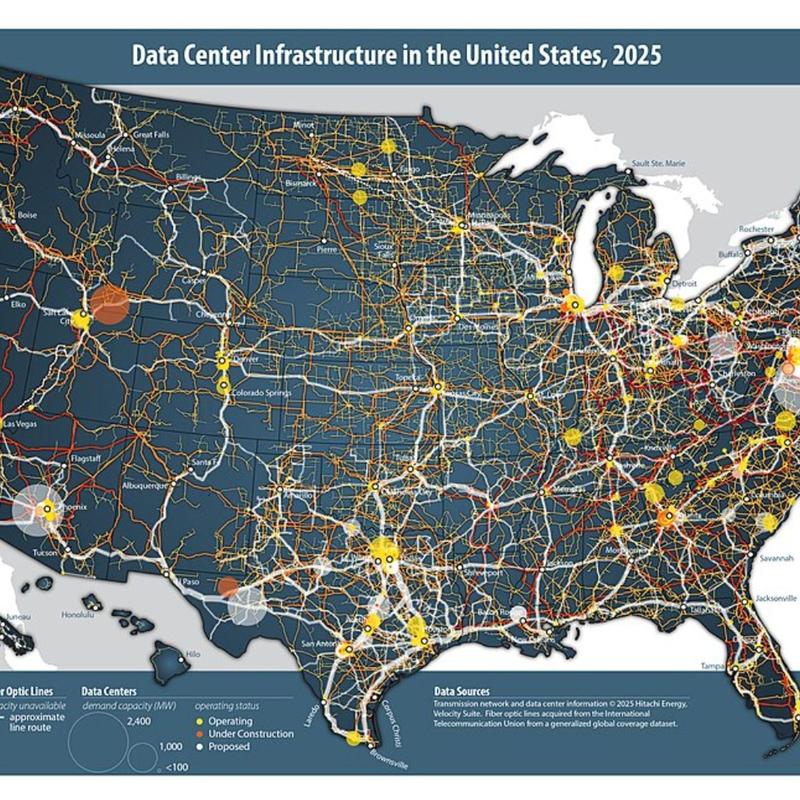
Amina Srna: It's The Brian Lehrer Show. I'm producer, Amina Srna, filling in for Brian today. As demand for artificial intelligence grows, so do proposals for new data centers. These are facilities where computers power AI, storing, processing, and sending out information, but data centers tend to be massive in both size and energy consumption. Who pays for the additional capacity? In her State of the State address, Governor Kathy Hochul announced plans to shift more energy costs onto tech companies themselves.
Governor Kathy Hochul: Now, data centers are vital for innovative future, but they guzzle up tremendous amounts of energy and leave ratepayers foot in the bill. If they want to build in New York, they have to pay their fair share for the power they use.
[applause]
Amina Srna: Here to walk us through that idea is Rosemary Misdary, science reporter for WNYC and Gothamist. Hi, Rosemary.
Rosemary Misdary: Hi, Amina.
Amina Srna: Let's start simple. What exactly are data centers? How do they power tools like artificial intelligence?
Rosemary Misdary: A data center is basically a large warehouse full of thousands of servers. They're the physical computers that store, process, and transmit digital information. When you stream a video, when you send an email, when you use a search engine, or run an AI chat bot, your request travels to a data center somewhere, gets processed, and the result comes back to you. They're the physical backbone of the internet and cloud computing. Companies like Amazon, Google, Microsoft operate massive ones globally, but so do banks, hospitals, universities, and governments.
Amina Srna: That is the clearest and most concise description I've ever heard. Thank you. How many data centers are there in the state, and where are they located?
Rosemary Misdary: Statewide, there's more than 130 data centers, and about half of them are located in the New York City metro area.
Amina Srna: Can you tell us why it's a widely held belief that data centers could increase costs for energy consumers?
Rosemary Misdary: Well, a modern AI data center, in particular, uses an enormous amount of continuous electricity. Unlike a regular industry like a factory that would power down at the end of the night, it's running 24/7. Because it's running 24/7, it also needs to be cooled. There's a lot of electricity and a lot of water consumption that goes into cooling these thousands of computers that are running 24/7.
It also costs a lot of money on repairs, because under the existing utility rate structures, when a large new customer like a data center connects to the grid, it triggers the need for infrastructure upgrades. We're talking about new substations, transmission lines, distribution system improvements. Those costs, which are in the billions, get spread out across all ratepayers in the form of higher utility bills.
Amina Srna: Some tech companies, though, they dispute that increased costs for energy is driven down to the customer. What is their argument?
Rosemary Misdary: Their feeling is that these technologies are needed. They are needed for innovation. All customers use these technologies. As I said before, whether they're streaming, they're banking, whatever it is they're using, the idea that it's not getting passed to the ratepayers is erroneous. It is getting passed down to the ratepayers.
Amina Srna: Listeners, we want to hear your thoughts. Are you skeptical of data centers, or do you support their construction? What do you think of the governor's plan to protect ratepayers from increasing energy demands? Maybe something about data centers still has you confused. You can reach us at 212-433-WNYC. That's 212-433-9692. As always, you can text that number as well. Rosemary, we just mentioned that data centers take a lot of energy. Give us some context around that. How does their energy consumption compared to, say, a private residence, or maybe even another industrial site?
Rosemary Misdary: It's hard to compare to a single household, but let's just take a large data center, a single one, that Amazon or Google or Microsoft might be operating. They usually use over 100 megawatts of power. Just to give you an idea of how much power that is, that's enough electricity to power about 80,000 households.
Amina Srna: A listener writes, "If data centers are required to foot the bill for their energy needs--" Oh, actually, let's walk through the governor's plan first. I think that's a better idea. Walk us through the plan to place responsibility for the cost of data centers more squarely on tech companies' shoulders. Does the governor have a specific proposal?
Rosemary Misdary: No, not at this point. Right now, where it stands is she has said that she is going to make data centers pay their fair share. We don't know what that actually means, but she has directed the Public Service Commission to investigate the costs associated with connecting data centers to the grid and figuring out how to charge them.
Amina Srna: All right. Now, for this listener question. "If data centers are required to foot the bill for their energy needs, won't they pass those costs on to customers? Don't customers end up paying for data centers' energy needs one way or another?" Do you have a take on that, Rosemary?
Rosemary Misdary: I'm not sure how it would work, how a data center would pass on the cost to a consumer. Maybe it would be passed on to the business, which would be passed on to the consumer, but it seems like passing the cost directly on to utility users is much more of a burden.
Amina Srna: Do the data centers use the energy from the same electrical grid as the rest of us?
Rosemary Misdary: Yes, they do.
Amina Srna: Is the electrical grid prepared to take on more and more building of data centers? If not, what would it cost to upgrade the electrical grid to accommodate increased energy needs?
Rosemary Misdary: The grid operators, called NYISO, they released a report last year. They estimated that, in the next decade, we are going to see an increase in energy demand of 50% to 90%. That is mostly driven by AI data centers. Right now, in the queue, we have almost 50 data center requests to connect to the queue. That is about 11 gigawatts of power. Just to give you a rough conversion for what a gigawatt is, 1 gigawatt can power about 1 million households.
We're talking about enough power right now on the queue of requests to power 11 million households. That is a lot of power. Right now, we already have a problem meeting our own electrical needs because we're also trying to electrify. We have electric vehicles. We're trying to electrify all our transportation. We're trying to electrify our buildings. That is also going to put added strain on the grid as well.
Amina Srna: We have a listener who wants to ask about fossil fuel usage. Here's Sharon in Livingston, New Jersey. Hi, Sharon, you're on WNYC.
Sharon: Hi, thanks for taking my call. I am always listening to complaints about the dollar cost of ratepayers paying for this energy, but can you please talk about the enormous, enormous, enormous use of fossil fuels that are being used to power these data centers, both to power the servers themselves and also to cool the data centers?
I don't hear people like Kathy Hochul or anybody else for that matter talking about the enormous impact this has in terms of climate change, fossil fuels. Also, to what extent are any of these data centers being powered by renewables like solar? The tech companies like Google, Amazon, are they making any kind of meaningful commitments to using renewable energy to power their data centers? Thank you.
Amina Srna: Sharon, thank you so much for your call. Rosemary?
Rosemary Misdary: In the state of New York, I am not aware of any data centers that are powered by renewable energy. If there are, it's very rare. It's interesting to note, when you talk about the environmental impacts, these data centers are subject to both the state and the city climate laws. They must reduce their greenhouse gas emissions. Let's face it. When we talk about climate emissions, the downstate grid, which powers the New York City metro area, is powered by about 90% fossil fuel sources.
Now, that means every time you use electricity, you're creating climate emissions. These data centers, because of the enormous amount of energy they use, they are creating climate emissions. I'll just give you a quick example of one. There's Greenwich Generation. It's technically a data center. It mines Bitcoin. It's not an AI data center. It owns its own fossil fuel power plant. It's just over 100 megawatts, and it's in the Finger Lakes.
Annually, it produces about 800,000 tons of carbon. Okay, that's a lot. That's just one data center with 20,000 computers going 24/7 mining Bitcoin. That's how much pollution it's creating. Also, in order to cool, we're talking about millions of gallons of water that is used to cool these facilities. It's definitely a burden on the environment, on air pollution, on our natural resources.
Amina Srna: You were talking about 800,000 tons of carbon pollution. What is that equal to? Is there any comparable? How many cars is that?
Rosemary Misdary: I don't know how many cars offhand that is. 800,000 tons is a lot. I don't have an equivalent for how much that weighs, but that's more--
Amina Srna: Is this from your reporting? The facility uses energy that produces 800,000 tons of carbon pollution, roughly equivalent to 170,000 cars, so the same amount of pollution. Sorry. I see my question there. Do you have a sense of how New Yorkers are feeling about Hochul's plan? Does it ease any concern of opponents of data centers and what they're feeling?
Rosemary Misdary: There is a growing strong opposition to data centers. More than 100 environmental groups and advocacy groups are strongly opposed to the state hosting any data centers. That's the growing strong sentiment. Well, a lot of other people think that, like, "Well, if they build their own clean energy, renewable energy, and power their own facilities, then they're not drawing from the grid and they're not creating pollution, so let them go do that." Most people do not want these data centers drawing from the grid.
Amina Srna: We have a council member calling in. Council Member Julie Won from Astoria. Hi, Council Member. You're on WNYC.
Council Member Julie Won: Thank you for having me. I want to point out that from my perspective, as someone who comes from 10 years of tech experience, AI data centers are the ones raising the cost of public utility bills. That is a false narrative that I want to push back on. American infrastructure hasn't been updated in decades. That's the core reason why these utility bills are really going up. It just so happens that right now, the newest technology like AI requires the latest infrastructure, which we do not have. We're not going to be able to compete with other countries when it comes to technology and innovation.
I think it's important for us to think of it like a road. If someone wants to drive a semi-truck on a road to deliver supplies for food, but the road is a one-lane road that has not been updated to scale to the size of the trucks and the volume of trucks that we need, that means the semi-truck won't be able to go and the construction companies will be forced to expand to make sure that we can respond to the need. It's the same thing that's happening with the utilities companies. They should not just be blaming technology for it, but we need to be honest and say, "We haven't updated our utilities in decades."
Amina Srna: Council Member, thank you so much for your call. Rosemary, what are you thinking?
Rosemary Misdary: She does have a point about the aging infrastructure. Our infrastructure, even without having to add AI data centers, needs upgrades from the distribution lines that come to the individual sites all the way up to added power sources and generation, but the AI data centers are another giant level of demand. It's one thing to say, "Okay, we already need to upgrade our infrastructure to meet demand," but this is a huge level of demand that's going to require an enormous amount of upgrades to meet. When you talk about the diesel truck, the freight trucks, as an analogy, if all people are doing on the highway is driving their car, then you design for people going to and fro.
Let's say, all of a sudden, there's a boom in shipping. Now, the roads need to be tripled in size in order to meet the need of all of this truck shipping. Now, should ratepayers have to pay now for their roads to be enlarged for all these businesses tripled or quadrupled in size? The analogy is correct, but also, we have to consider the fact that this is an enormous amount of electricity. This isn't just like 10%, 20%. We're talking a huge amount. As NYISO said in their report, we're talking 50% to 90% in increased energy demands over the next decade. Their report points out AI data centers as the main driver for this.
Amina Srna: Give us a little bit of the pushback. How are tech companies feeling about Hochul's plan?
Rosemary Misdary: Tech companies recognize that-- well, they feel these data centers are necessary for business. They have to. They have to. They need the energy. I've spoken to a few people who work in the tech industry. They say they just want the power. I think they're less concerned about the climate and environmental impacts as they want to find a way to be able to get the power for their systems and for their data centers, but there's no clear idea of what her plan will look like. It's too early to talk about opinions on what that's going to look like.
Amina Srna: Let's go to a call. Cal in Stanford, Connecticut, you're on WNYC. Hi, Cal.
Cal: Hi. I'm thinking back in time, and I seem to remember there were different rate structures. If you had your home, you paid one rate structure. If you had a factory, you paid another rate structure. Why isn't there just a separate rate structure for data centers?
Amina Srna: Cal, thank you so much for your call. Rosemary?
Rosemary Misdary: Oh, that is such a good question. That's something we should ask Hochul and the Public Service Commission. You know what? I'm glad you brought this up because commercial rates are far cheaper than residential rates. All of us living in our homes, we're paying more. Now, I can't give you exact numbers of how much, but I have seen percentages thrown around. We're paying around 25% or more for our electricity than a commercial ratepayer. Now, that's not an exact one, but it's some of the percentages I've seen in some reports. Yes, we are paying significantly more for power.
Amina Srna: A listener texts, "Are there proposals to force the data centers to provide their own power sources?" I see that some other states have allowed data centers to build microgrids, which work like their own electrical grids to power an individual facility or data center. Is that something New York has explored?
Rosemary Misdary: The governor has hinted at this when she said, "Pay your fair share or build your own clean energy." It doesn't sound like she's going to force them to build their own energy sources. It seems like either you pay more money or you pay and build your own clean energy source, which might be the reality if the grid can't handle all of the requests for data centers.
Amina Srna: Governor Hochul floated this plan during her State of the State address in January, so where does the initiative stand today?
Rosemary Misdary: As far as I know, it stands as this. She has directed the Public Service Commission to begin reviewing the costs associated with connecting data centers to the grid, to figure out how much to charge them and how to reduce the burden on ratepayers. That's where it stands right now. Now, there's other actions going on for data centers. There's a moratorium. There's a bill for a moratorium that was introduced last month. In this bill, it's around three years of a pause on permitting new large-scale data centers. During this pause, the state would have to do a rigorous investigation of the environmental impacts and also direct the Public Service Commission to look at the costs associated for ratepayers and in order to be able to proceed with permitting data centers.
Amina Srna: Let's go to a caller. Gwen in East Harlem. Hi, you're on WNYC.
Gwen: Hi, I didn't expect to get on. I just wanted to say that a couple of years ago, I noticed that my electricity absolutely went through the roof, and then I started to talk to people at my favorite restaurant. The tone of the people got pitchfork high. People were furious because I am paying more than double what I used to pay. I'm not even using my electricity half of the time. All of this, I took to Con Edison and tried to get to the bottom of it.
They never had an answer for me, except for that, now, you have to pay $50 a month just to have your electricity hooked up. Just to have that hooked up, it costs you $50. I really take issue with these jacka**es calling up and talking about what a great thing this is to have us, the taxpayers, pay for yet another burden that the rich is laying at our feet. As far as Kathy Hochul is concerned, I am very, very upset that she wants to open up.
I don't care if there's smaller nuclear power plants. They should not be here. They did not work. Until you can figure out where you're going to put that radioactive material, which is a half-life of 300,000 years, we still have a huge problem. I also take issue with her dumping radioactive material in the beautiful Hudson River. I think Americans really need to get a grip. What on earth? How many people do you really know that know anything about Bitcoin? Probably you can count them on your hand. Not too many people.
It just seems to me that the masses are being asked to lay out more money and prop these people up that have nothing to do in their spare time, except to be pedophiles and to violate American citizens' middle class most of the time. We keep being asked to pay for it. My idea is what they're doing in Minnesota. How about a good old general rent strike on everything? I feel like so many Americans, we can't keep paying for these rich fat cats that give back nothing, that continue to take away our rights and continue to assault us.
Amina Srna: Gwen, let me get a response for you here from our reporter. Rosemary, what are you thinking as you're hearing Gwen talk? Are you feeling that passion?
Rosemary Misdary: You're right. A large part of why your utility bill is going up is you are paying for infrastructure upgrades, okay? That's both residential and commercial upgrades. That is what you are paying for. Now, some of it is also the guaranteed rate of return for Con Ed's investments and national grids investments. That's a large part of the burden. Now, I was looking at not New York State, but nationwide. They did a study. It showed that people who live within 50 miles of a data center had larger, higher utility bills. Yes, there is a correlation between that. As they grow, it's going to be more noticeable.
Amina Srna: We have a couple of callers on energy, what sources can be used to power these data centers. Here's Susan in Summit, New Jersey. Hi, Susan, you're on WNYC.
Susan: Oh, great. I was just concerned because they said they need a lot of water to do this cool down. Well, I always see the commercials about water in New York, but out west, and now heading towards the middle west or middle of the country. Here, we're not so bad. What makes us think that with all these data centers that our water is going to be reduced? My one thought is, I don't know who said it, was that water is the new oil. No one's talking about the water that's going to be used to cool down all the data centers. How much are we going to lose?
Amina Srna: Susan, thank you so much for your call. I thought Susan was going to go in a slightly different direction. Rosemary, are you thinking about this?
Rosemary Misdary: No, this is a good point. Susan, I'm going to note one thing. You live in New Jersey. New Jersey spends a majority of the year in some form of drought warning. You have a water problem there, too, to keep in mind. Yes, that is one of the things that we don't talk about when we talk about these data centers coming online is that we need these millions and millions of gallons of water in order to cool them down. In a state like New Jersey that spends most of the year in some kind of drought, and New York, which goes through drought as well, this is a serious concern.
Amina Srna: Another text, "I work in the power industry. While I agree their consumption pushes up energy prices, they don't, in aggregate, pay less for power. Data centers pay less for power. They have enormous demand charges. It's not just kilowatt per hour charges." I think I read that correctly. Rosemary, do you have a take on that?
Rosemary Misdary: [chuckles] I don't think I can answer that question. [laughs]
Amina Srna: Got it. Well, as we wrap up, how much is the energy use from data centers expected to grow in the future, given the current rate of development?
Rosemary Misdary: Well, as I mentioned before, the grid operators predict 50% to 90% in the next decade. We already have about 50 requests sitting on the queue waiting to come online for about 11 gigawatts. The thing is this is just the beginning. This is just the beginning. It's going to be an explosion. This is just the small beginnings of things. We're going to see an explosion in the request for power from data centers.
Amina Srna: Rosemary Misdary, health and science reporter for WNYC and Gothamist. Rosemary, thank you so much for your time today.
Rosemary Misdary: Thank you, Amina.
Copyright © 2026 New York Public Radio. All rights reserved. Visit our website terms of use at www.wnyc.org for further information.
New York Public Radio transcripts are created on a rush deadline, often by contractors. This text may not be in its final form and may be updated or revised in the future. Accuracy and availability may vary. The authoritative record of New York Public Radio’s programming is the audio record.
