
Gov. Hochul Hopes to Delay Implementing Climate Law
[MUSIC]
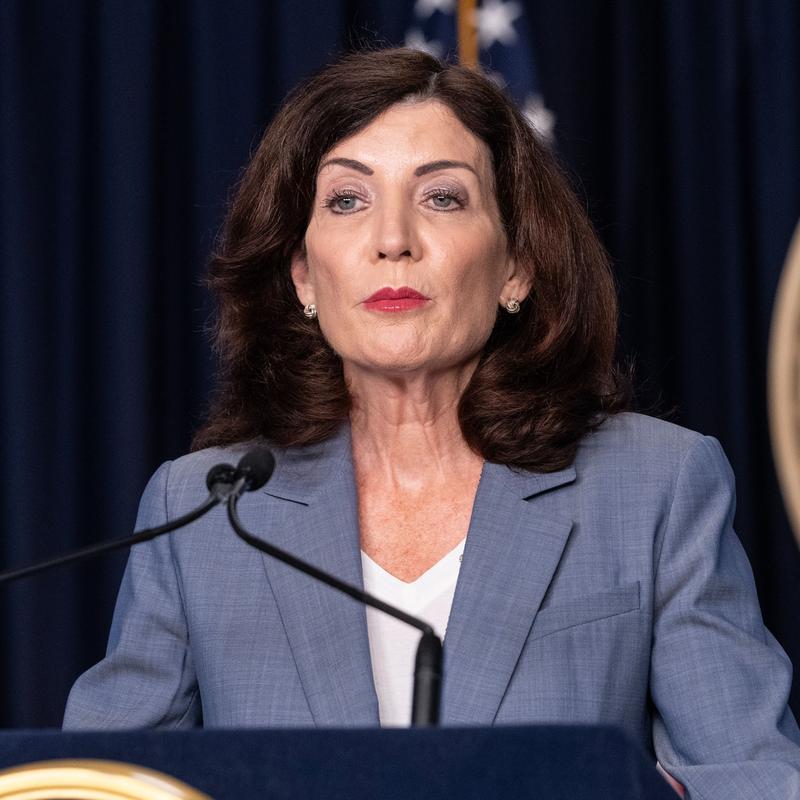
Brian Lehrer: The Brian Lehrer Show on WNYC. Good morning, everyone. Here's the dilemma for the Democratic Party. Their affordability agenda is colliding with the party's climate goals, and it's a very direct conflict right now in New York. Governor Kathy Hochul wants to delay the state's carbon reduction timetable, saying it will cost New Yorkers too much as it stands. Now, as a reminder, the current goals are currently the law.
A 2019 climate law passed by the legislature and signed by then-governor Cuomo requires the state to cut emissions 40% from the baseline by 2030. 40% by 2030, that's just a few years from now, obviously, and 85% by 2050, all while significantly boosting renewable energy. What's the alternative if Hochul doesn't want to meet that timetable? What scaled-back climate goals would help New Yorkers afford life? How much more? Hochul hasn't said yet. She hasn't announced her alternative goals, but
Governor Kathy Hochul: We'll be announcing them this week. I think we need a longer runway.
Brian Lehrer: A longer Runway then to 2030 she's referring to. It has to be this week because this is part of the budget for the new fiscal year, which begins in two weeks, April 1st. Obviously, this move has put her at odds with environmentalists and also prominent Democrats who have hailed the landmark climate law. There's the dilemma for the Democratic Party, their affordability agenda colliding with the party's climate goals. Joining us now to break down the latest is Jon Campbell, Albany reporter for WNYC and Gothamist. Hey, Jon, welcome back to the show.
Jon Campbell: Hi, Brian. Thanks for having me.
Brian Lehrer: Can you first remind us in a little more detail of New York's 2019 climate law? How big of a deal was it? For that matter, how much did then-Lieutenant Governor Kathy Hochul support it in the beginning?
Jon Campbell: It was a really big deal. It was passed in 2019 by then-Governor Andrew Cuomo and the Democratic state Legislature. It set these really ambitious climate goals into state law, made them mandates that includes a 40% cut in greenhouse gas emissions across the entire New York state economy by 2030 and an 85% cut by 2050. The mandate also calls for 70% renewable energy by 2030. It's a big deal. They're very ambitious goals. So far, the state is way behind in trying to hit them.
Right now, there's been about a 9% reduction in emissions when compared to 1990 levels, which is the benchmark here, which is just about a quarter of the way to the state's goal to 2030. Somehow, 2030 is not that far away. Then, on the renewable energy side, there's about 45%. By the way the state's calculating it, which is two-thirds of the way to that 2030 goal. The state is way behind, and the governor has made the calculation that she needs more time to hit these goals. Her administration has made the calculation that there would be a pretty significant upfront cost to New Yorkers to meet these goals as it is.
Brian Lehrer: Has she crunched the numbers for the public specifically? I see that she's saying meeting these goals by 2030 would push utility costs skyward, they're already going up, and also cause gasoline prices to spike by more than $2 a gallon. Really?
Jon Campbell: The Hokul administration has crunched the numbers through what's known as the New York State Energy Research and Development Authority, or NYSERDA. It's basically the state's research arm for energy issues. What they found is using the law as it's currently implemented, currently in law, without any changes, they claim that by 2031, gas prices could go up by $2.23 over whatever the current price is at the time, that natural gas prices would go up, other fuels would go up. They say a New York City natural gas household, a household that uses natural gas for heat or perhaps appliances, they could anticipate annual costs of about $2,300.
Now, this memo, which is being called the NYSERDA memo, which came out late last month, is a source of a lot of controversy in Albany. It's what the governor is using to push for a rollback of the climate law, to scale back the climate law. A lot of Democrats and environmentalists are really, really mad about the design of this memo, the methodology of this memo. It is based on a form of what's known as a cap and invest program that wouldn't have any cap on costs, which environmentalists and Democrats say is pretty unrealistic. They think that this is kind of cherry-picked data to make the governor's case.
Brian Lehrer: Yes, Cap and Invest which, as you report, would require climate polluters to purchase allowances from the state if they exceed a limit on greenhouse gas emissions.I guess her argument is if they have to purchase at an elevated price to them, because this would be a new expense, greenhouse gas permission slips, then they're going to pass those costs on to consumers. Oh, go ahead, Jon.
Jon Campbell: No, no, no, I was just gonna agree.
Brian Lehrer: Senator Pete Harckham, by contrast, a Westchester Democrat who chairs the Senate Environmental Conservation Committee, one of those who doesn't agree with the governor's memo, here he is speaking on the Senate floor on March 4th in some very strong terms.
Senator Pete Harckham: We keep hearing about the so-called NYSERDA memo, which I would characterize as Governor Hochul's the Iraqis have weapons of mass destruction moment. This is a completely fabricated memo. It's a fabricated number, cherry-picked from the most extreme circumstances.
Brian Lehrer: Do people like Senator Harckham have alternative numbers to argue that meeting these climate goals as aggressively as they are in the law would not push up utility costs or gas prices very much?
Jon Campbell: It's not so much that. There's little doubt that it would push up costs in the short term. The argument from the environmentalists and some Democrats is the long term benefits far outweigh the short term costs. Even the state's scoping plan, which was this plan laying out a pathway to meet these climate goals, that scoping plan came out in 2022. It estimated that "the cost of inaction exceeds the cost of action by more than $115 billion".
That report makes the argument that not reducing greenhouse gas emissions would have significant costs over the long term. Implementing energy efficiency projects and improving air quality, all of these things come with a cost-benefit. The environmentalists are pretty angry that the NYSERDA memo did very little, nothing really, to try to quantify those benefits. I don't think anybody disagrees that there would be short-term costs.
Think of what you would have to do to meet these goals. You have to increase renewable energy, that it requires all sorts of infrastructure improvements. You have to electrify buildings and decrease building emissions, which building emissions are a huge source of emissions, particularly in New York City. You'd have to really, really increase the sale of electric vehicles. That comes with all sorts of infrastructure improvements for charging stations and the like. There's no doubt that there would be a short-term cost. It's just that the proponents say that the long-term benefits far outweigh those short-term costs.
Brian Lehrer: I guess politics is often a short-term enterprise, right? Here in a New York State election year, maybe it's a hard sell for the governor who's running for reelection and anybody else to say, yes, the longer-term gain is worth the shorter-term pain, because by saying that, they're saying [chuckles] you're going to experience financial pain right now.
Jon Campbell: Yes. It comes at a time where anybody who pays a utility bill has just gotten socked in the last few months. ConEd down there, National Grid up here in Albany, bills have just gone up hugely. This is at a time where the governor has based her entire reelection message on affordability, affordability, affordability, putting more money in your pockets. She pushed rebate checks last year. She's pushing for universal childcare along with Mayor Mamdani. She has made affordability her entire theme of her campaign.
By scaling back the climate law, if she is successful and she can convince the legislature to go along with it, it could potentially neutralize a Republican attack. Republicans have hated this climate law ever since it was passed and have warned of those significant short-term costs. This could, in theory, neutralize an attack from Bruce Blakeman, her Republican opponent, the Nassau County executive.
Brian Lehrer: If you've looked into this, is there any evidence that the recent spike in utility prices, which has already happened, are to any degree from the 2019 climate law being implemented?
Jon Campbell: I'd be hesitant to say no entirely, but that has been largely based on market prices. You have your delivery charge and your supply charge, and one of those is based on the current market. That cold spell that we had, it was a very, very cold winter, helped spike prices, spike demand for various fuels. That helped push up the utility costs. That is generally the cause of that. I think blaming it on the CLCPA, as the climate law is known, would be probably a step too far, but I can't go as far as saying that it had nothing to do with it.
Brian Lehrer: Listeners, can you help us report this story in any way? Are you experiencing higher prices for utilities, gasoline, anything in any way that you think is New York State Climate Law related? 212-433-WNYC. Do you have a position on what trade-offs, if any, are worth it that make the 2019 law worth implementing as aggressively as it's written? 212-433-WNYC, or anything related for our Albany reporter Jon Campbell? 212-433-9692. Call or text as we talk about this dilemma, which is coming to a head for Democrats in Albany.
Of course, Democrats control both houses of the legislature and the governorship. Their own 2019 climate law versus Governor Hochul's interest now in delaying the deadlines for carbon emission reductions in that law, because she says they will cost New Yorkers too much if they stick to the current 2030 deadlines. Nick in the Catskills, you're on WNYC. Hi, Nick, thank you for calling in.
Nick: Hey, Brian. Thanks so much for taking my call. Huge fan of your show. Thanks for your work.
Brian Lehrer: Thank you.
Nick: I built a house up in the Catskills in 2021. I was encouraged to do the heat pump and fully electric house, which overall I love performance-wise, but the bills are really killing us in the last year. Anything that will relieve some of the pain, we as climate advocates, as I consider myself, we need to consider how these-- Anything that's going to make costs higher for normal people as a way to achieve some climate goals seems really dangerous and it's going to turn people against the movement. It's basically like a regressive tax. My energy increases would be no problem for a wealthier person, but it's really hitting us hard as a low and middle-income family.
The other thing Upstate that I think we need to be wary of is alienating the movement from local communities where these massive solar farms are going in. I'd love the reporter to talk about these because you're taking premium farmland where communities grow food, and we're always going to need food. Instead of doing parking lots in abandoned malls, somewhere where it's already environmentally degraded, they're going in, and it's really affecting bee populations.
Creating these massive farms in communities with very little input from the community, it's another thing that's going to turn people away from the movement. I do think there are better forms of clean energy. I'm really pro-nuclear. I think wind is great as well, although there are some of the same considerations there. Thanks for taking my call. Appreciate it.
Brian Lehrer: Nick, thank you very much for making it. Jon, he put a couple of things on the table. Are you familiar with that solar farms issue?
Jon Campbell: That's an issue across much of Upstate New York, the Hudson Valley. There have been pushes to install solar farms, and it always gets into the not in my backyard situation. There's often pretty aggressive protests or neighbors organizing against those because some find them to be unsightly and detracting from the ruralness of the areas where they generally go in. That said, in order to achieve the climate goals, there needs to be a pretty massive expansion of renewable energy of all forms.
The New York Independent System Operator is the organization that runs the state's power grid. You can go on their website and see a real-time mix of the fuels that are powering the grid at this very moment. There's a lot of hydropower thanks to Niagara Falls. There's a good amount of wind power, a lot of natural gas, and fossil fuels. Solar energy is just a tiny, tiny sliver of that mix. Even that, that's in part of a category known as other renewables. It's thrown in the mix with other stuff. There is a push to expand all sorts of renewable energy, but solar energy in particular is just a tiny piece of that mix right now.
Brian Lehrer: In contrast, I think, to Nick and the Catskills, we have Samantha in Ditmas Park, Brooklyn. Samantha, you're on WNYC. Hello.
Samantha: Wonderful. Hi, Brian. Thank you so much for taking my call. I'm calling because, for starters, I just want to say that the way that you introduce this segment of the show is very problematic. It's not true that the Democrats' affordability agenda is in conflict with our climate agenda. It's really, really important that people understand that that is actually just playing into the hands of the fossil fuel industry. That's one of their talking points. That's what they want people to believe, but it's not true. Our energy bills are going up because we keep investing and having to fix gas infrastructure, spending billions of dollars on pipelines. That's what ratepayers are paying for.
This Williams pipeline that Kathy Hochul just approved, that's going to cost rate payers billions of dollars. The rest of the world seems to understand that solar is actually the cheapest form of energy available in the world right now. That's why the vast majority of new energy around the world is solar. Solar is the cheapest to install. It's the cheapest way to get energy. Even if it weren't, which it is, there's nothing more expensive than climate catastrophe. It's just insane at this moment in time to be having a conversation comparing. Solar is the cheapest form of energy.
Governor Kathy Hochul should be absolutely 100% doubling down on investment in solar energy instead of forcing ratepayers to pay billions of dollars for gas infrastructure, for new pipelines that are going to poison our waters and our beaches, and worsen the climate crisis. I really resent being called an environmentalist, actually, when I am just a parent in New York who cares about affordability and who cares about having a livable planet. All these fossil fuels that we're burning are just going to heat our planet and make storms worse and make floods worse, which cost New Yorkers billions of dollars in damages.
Brian Lehrer: Let me play for you, Samantha, another clip of the governor, and I'll give you a chance to respond and continue to make your case. Okay?
Samantha: Okay.
Brian Lehrer: The governor says she's in support of the law, but that it's not realistic. She's pointing her finger at a lawsuit that she said will make things more difficult. Here's 20 seconds of the governor speaking to reporters yesterday.
Governor Kathy Hochul: The timeline, now, because we lost to a judge, because advocates brought us to court when we were trying to make all this happen with a very unpredictable environment, we cannot meet them. The judge is saying all the goals you're supposed to meet would have to be met by 2030, '31. That's not possible without prices going up. We need a longer runway.
Brian Lehrer: We need a longer runway. If you feel capable of engaging on that level,
Samantha: Absolutely.
Brian Lehrer: -is your argument that prices are going to go up in the short run to meet all these goals that are currently in the law by 2030, and that's okay because it's worth it for the longer-term goals, or are you saying you think that even that assumption is false?
Samantha: I'm saying that that assumption is absolutely 100% false. Governor Kathy Hochul is lying to New York families, and that is because she is in the pocket of the fossil fuel industry. These are falsehoods. If people want to know what's really going on, what's really driving up energy costs, they should start getting emails from places like Sane Energy. These people are doing the research, doing the math. Bill McKibben's organization, Third Act, Climate Families, all of these organizations are trying to counter the falsehoods spread by the fossil fuel industry that now seem to be spreading at the very top of leadership on the left in New York State.
Governor Kathy Hochul has had countless opportunities to implement that law. She hasn't implemented Cap and Invest, which is a really brilliant thing that could be taking billions of dollars from the fossil fuel industry profits and investing them every year in renewables. She's had years to implement that and hasn't done it. Instead, what is she doing? She's approving things like the Williams pipeline that's been shut down multiple times by the Department of Environmental Conservation because it's going to completely poison our public beaches in New York City, making it unsafe for families to even use it.
Ratepayers, all of us New York families are going to be paying billions of dollars to this pipeline. New York State isn't paying for that. Donald Trump isn't paying for that. The company, Williams Company, isn't paying for that. We are. it is building these new gas pipelines and keeping up, maintaining this gas infrastructure, and wars over oil and gas that make the price of fossil fuels fluctuate. That is what's driving up New York families' energy costs. It's so unfair that she is standing with the fossil fuel industry, spreading falsehoods, and raising our prices-
Brian Lehrer: Samantha,-
Samantha: -while worsening the climate crisis.
Brian Lehrer: -thank you very much for your call. We really appreciate it. Jon, very interesting. Two contrasting callers there. We have a few other people in our text thread who are also saying something similar to what Samantha accused the governor of there, which is being in the pocket of the fossil fuel companies. Do you hear this a lot, and are there campaign donations or anything else to back that up?
Jon Campbell: Yes, you do hear that a lot from the climate advocacy side, climate change advocacy side, I guess you should say. The governor is a prolific campaign fundraiser who has taken donations from many, many, many corporations, deep pocketed individuals. I don't have the fossil fuel and the utility side of things fresh in my mind right now, but I'd be shocked if she doesn't have any of those donations, because she has many, many campaign contributions from all sorts of really big players in New York State. Some of the things Samantha said, she brought up the Williams pipeline, that's a reference to the Northeast Supply pipeline off the New York Harbor.
Yes, she's right in the sense that Governor Hochul essentially revived that pipeline after it had been left for dead. It's natural gas infrastructure, so that ties the state to natural gas further. One of the things that people on the green energy side say is that's shortsighted, because they would make the argument that we're shifting toward renewables, why are we tying ourselves to fossil fuels? To which the governor says we need an all-of-the-above approach right now. We're not ready for 100% renewables, and we need an all-of-the-above approach that, in her mind, includes natural gas.
Brian Lehrer: When we come back from a break, I'm going to ask you to describe to the best of your ability, because it hasn't been officially announced yet, what the governor's alternative is to the current climate law which would require these reduction in carbon emissions by 2030 that she says would be too expensive for the people of New York. What is the Hochul alternative that would have to get through the legislature in the next two weeks? That part of the story after this.
[MUSIC]
Brian Lehrer: Brian Lehrer on WNYC, as we continue with WNYC and Gothamist Albany reporter Jon Campbell, his reporting on Governor Hochul wanting to delay the timeline of New York State's landmark climate law passed in 2019. It requires a 40% reduction in climate-polluting emissions by 2030. The governor says that's now too fast. She needs what she calls a longer runway. Otherwise, utility and gasoline prices are going to go up for New Yorkers too much. This is a big source of debate in Albany.
Jon, I'm going to ask you in a minute what her alternative is that still respects the imperative to cut down on climate-polluting emissions. What are the politics of this in the legislature? It is Democratic controlled in both houses, as well as the governorship. Do you have any headcount so far on where her fellow Democrats are lining up, pro or con?
Jon Campbell: The closest thing we have to a headcount is in the Senate, where 29 Senate Democrats signed a letter saying, "Hey, we are uninterested in changing this climate law. We're committed to these goals. We don't want to do it." That number, that is short of the 32 votes you need to pass legislation in Albany. That leaves 10 to 12, I believe it's 12, Senate Democrats who did not sign onto that.
There is a contingent of moderate Democrats within the state Senate, in particular, and certainly within the assembly as well, that I bet would probably be more in line with Governor Hochul, even if they're not know speaking out publicly at this moment. There's also perhaps a bigger contingent that is more left-leaning that wants this to stay in place. That said, this is all tied up in state budget negotiations.
Wacky things happen in state budget negotiations because this issue gets tied to that issue, which gets tied to that issue, and they all get crammed into one of the budget bills. Then, suddenly, you're forced to vote on a measure that includes scaling back the climate law, but also includes maybe Mayor Mamdani's free bus program or a pilot program for that. All sorts of things can get tied together, and that can swing a lot of votes, even if people are opposed to, say, scaling back the climate law.
Brian Lehrer: On this political analysis, which is what it is, of the climate agenda running into the affordability agenda for Democrats, Politico reports this morning, "Hochul's political stock has risen significantly as she's executed a pronounced pivot on energy policy that's also included embracing a controversial gas pipeline-" caller was talking about that, "-and delaying a mandate she once championed for new buildings to electrify," from Politico today. What is the alternative?
Jon Campbell: The alternative, as it relates to the climate law, we don't have a proposal on the table from the governor at this moment. However, I find myself pretty proficient in Hochulese. She's dropped hints in the recent days. We played the clip earlier where she said she's going to have a proposal later this week. It seems pretty clear that she wants to move the goals back, those timelines back. That 40% cut in greenhouse gas emissions by 2030 and 85% by 2050, she's going to want to push that back.
How far she wants to push that back, whether she wants to make other changes to the law or the regulations, the Cap and Invest regulations that are tied up in that court case that she referenced, that remains to be seen. At the very least, she's made pretty clear through dropping hints that she's going to want to move back the timeline for this law. That is going to be perhaps a sticking point in negotiation with Democratic lawmakers.
Brian Lehrer: Here's another clip of the governor. She was asked yesterday about potentially lowering the state's gasoline tax. Let's take a listen to about 40 seconds of this exchange with the reporter. The reporter speaks first.
Reporter: Governor, would you consider dropping the state gas tax if it goes up to $4? This just keeps climbing every week.
Governor Kathy Hochul: We're all witnessing this. I would say this, we've done it before. What happens is the companies increase their costs by the same amount, so the consumer only sees it continue to go up. That's the reality of what happened last time we did this. Also, this is a problem created by the federal government. If the federal government wants to give some relief, almost 20 cents per gallon of gas is a federal tax as well. We need them to give relief and also help us out here. They created this. You need to solve it. You break it, you fix it.
Brian Lehrer: Sounds like the governor is kicking at least part of this problem to the federal government or trying to. Is she right? Has the state tried and failed to lower gasoline prices by axing the state gas tax or part of it before?
Jon Campbell: Yes, this is something that the governor and the legislature tried in 2022 for about seven months. It was called a gas tax holiday. This was at a time where a lot of states around the country were doing this. It was in vogue at that moment to declare a gas tax holiday, where you temporarily suspend some state and local taxes that are on gas in hopes of driving prices down. In New York, that meant about a 16-cent gas tax holiday between sales tax and a motor fuel tax.
The general consensus after that was that some of the savings was passed on to the consumer, but not all of the savings. When the governor is talking about how prices still went up, et cetera, et cetera, in general, experts seem to believe that the consumers didn't really feel as much of that gas tax holiday as perhaps they had hoped. She's making pretty clear that she doesn't want to go that route this year.
There's a little tiny bit of a movement in the legislature to try to push her that way, but seems as though she's trying to blame this on the federal government as much as she can. The context for that clip was she held an event at a-- You heard it was very windy. It was outside at a gas station in Tonawanda, New York, near Buffalo. She's trying to paint this as a federal issue. Certainly, with the war in Iran, it is a federal issue. She's trying to keep that focus on the feds rather than do something on the state level.
Brian Lehrer: It's interesting for people who've been listening to this segment long enough to have heard the caller Nick in the Catskills who says he supports delaying the 2013 deadline for some of these emission goals because he can't take utility bills going up any more than they've already gone up, and the second caller, Samantha in Ditmas Park, who said that's a false choice, Nick has now texted and he wrote, "This is Nick in the Catskills. I just want to say I agree with all of what Samantha said." That's really interesting, right? At very least, it shows the complexity of this issue.
Jon Campbell: Yes. It's also the needle that the governor is trying to thread. She says she still supports the goals of the climate law and the broader goals, I should say, that she supports moving to zero emissions and electric vehicles, and electrification, but she says at this moment in time, the short-term costs are too much. If you want to look at that cynically, those short-term costs line up with her reelection campaign this year. Is this about getting it beyond this year so that you can spread that pain out in non-election years? Certainly, there are going to be some critics of the governor that feel that way. The governor would never say that, but certainly that is the practical effect here as well.
Brian Lehrer: Of course, part of the context for Nick's call is that he built a house in the Catskills that he made all electric with heat pumps instead of other, more conventional, more fossil fuel-oriented heat and air conditioning sources. He's on that track, but also feels the need for some relief in the short term, even as he agrees big picture with the other caller.
Here's a text that maybe furthers that conversation. Listener writes, "Nobody has talked about how data centers are using more and more energy, making the climate law goals more unattainable. Where does that come in? Because Hochul and other governors, and even President Trump in Congress, are trying to deal with the pressure on electricity prices being caused by the huge demands of the data centers."
Jon Campbell: That is an issue that's being debated in Albany right now. How do you account for these data centers that are popping up or trying to pop up in rural areas of the state? They use these huge amounts of power that can stress the grid in some areas of the state. How do you ensure that they are paying their fair share to ensure that energy rates don't go up for everybody else? That is something that is being debated as part of this budget.
The Senate and the assembly had some plans to perhaps levy some taxes that would recoup some of that cost. It's something that we're going to be watching as the budget debate goes on here. The budget's due at the end of the month in theory, but in practice, this is Albany, and they frequently miss that deadline, especially under Governor Hochul. She's missed it every year since she's been in office.
Brian Lehrer: A listener writes, "Maybe I came in late, but why would adding solar and other clean forms of energy increase our energy bills?" Which again brings us back to the fact that there are two pieces of this law which are being debated, right? Both how much the carbon emission reduction goal for 2030 can be met, but also whether it can be met by adding more renewable sources.
Jon Campbell: It's not so much adding solar would increase your bills. It's more the economy-wide shift that would have to happen. In order to meet the goals, that scoping document that we talked about, it called for as many as three million zero-emissions vehicles on the road by 2030. If you do that, then you need to increase charging stations so people have a place to charge that. Now, the state is nowhere close to that. I believe, if I'm not mistaken, it's about 300,000 EVs on the road right now in New York. Anyway, that's just one example. All these things that would have to happen to have a societal shift toward renewable energy and require all sorts of different infrastructure shifts.
Nick in the Catskills was talking about his heat pump. That is something that millions of homes across the state would have to shift toward if you're going to meet this goal. How are you going to incentivize people to do that? Maybe you have to make grants available, or maybe you need to increase grants that are available. That comes with a cost. To have that dramatic shift, there needs to be a lot of incentives, and there needs to be money that goes toward that, that at least in the short term, some of that gets passed on to the taxpayer or the consumer. Again, even the state's own scoping documents make the case that long-term, there is much more benefit than there is the short term cost.
Brian Lehrer: The texts, as we run out of time, are continuing to come in on both sides of this. One listener, for example, writes, "Our board boiler is old and breaking all the time, costing us a lot of money, but we can't replace it because of a law that requires electrification that is enormously expensive."
Another person who doesn't like the idea of a gasoline tax holiday says, "I have issues with the idea of a New York state rebate check to help consumers pay their bills. Oh, I guess this is really a utility bill rebate. The state should use that money to build more green infrastructure." Looking longer term rather than shorter term in that context. We're going to leave it there. Jon, I guess we'll see in a matter of days what the specific alternative to the current climate law is that the governor comes out with. Then they'll have to debate it by the April 1st budget deadline, right?
Jon Campbell: Yes, unless they blow through the deadline, which is quite likely. I'm sure we'll be talking.
Brian Lehrer: Jon Campbell, Albany reporter for WNYC and Gothamist. Thanks as always.
Jon Campbell: Thank you, Brian.
Copyright © 2026 New York Public Radio. All rights reserved. Visit our website terms of use at www.wnyc.org for further information.
New York Public Radio transcripts are created on a rush deadline, often by contractors. This text may not be in its final form and may be updated or revised in the future. Accuracy and availability may vary. The authoritative record of New York Public Radio’s programming is the audio record.
