
Getting Unhoused New Yorkers Inside in Bad Weather
( Beth Fertig / WNYC )
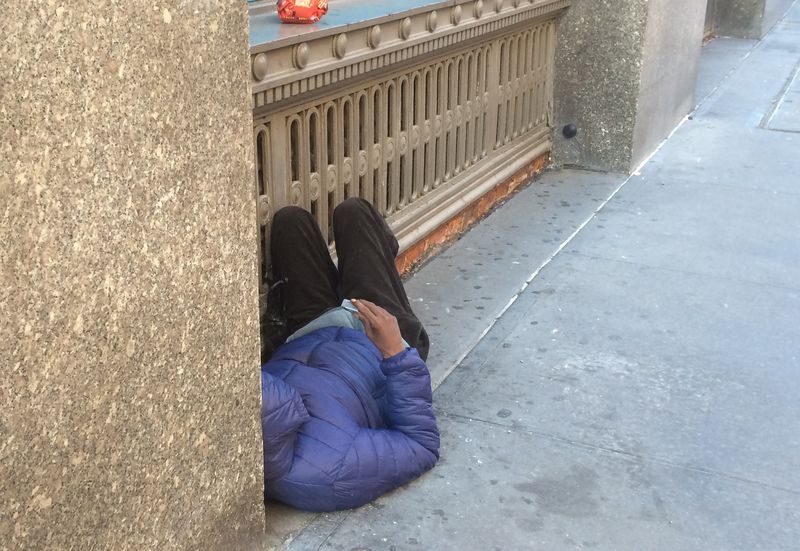
Brian Lehrer: Brian Lehrer on WNYC. Ahead of Sunday's snowstorm, New York City residents were repeatedly advised to stay indoors and protect themselves from the dangerous cold, but this advice is difficult to follow if you are one of the thousands of New Yorkers living on city streets. Of course, the cold is continuing well past the snowstorm. On Thursday, Mayor Mamdani called a Code Blue, triggering enhanced outreach. They call it enhanced outreach efforts and requiring shelters to accept anyone seeking refuge, regardless of capacity.
Despite the city's efforts, eight people have died due to freezing conditions since Saturday, according to the city. Yesterday, the mayor told members of the press that some of the deceased had "interactions" with our shelter system in the past. The cold snap is set to linger for at least another week. With me now to discuss how the city can prevent more deaths and better protect homeless New Yorkers is Dave Giffen, executive director of the Coalition for the Homeless. Dave, thank you for joining us. Sorry, it's under these circumstances. Welcome to WNYC.
Dave Giffen: Thank you, Brian. Yes, it's terrible that we even have to talk about this.
Brian Lehrer: Last Thursday, as I said, the mayor announced that enhanced Code Blue protocols would be in effect. What is Code Blue, and how has it been enhanced?
Dave Giffen: Sure. Code Blue is issued when the weather gets below a certain temperature, and it becomes dangerous, even more dangerous for people to be sleeping outside. At that point, the city deploys more outreach workers to go out and try to find people who might be exposed to the cold and not know that they have this option of coming into the shelter system, and then all of the standard rules of how you access shelters are eased up and broadened up. Normally, if you want to enter the shelter system, you have to go into one of the few intake facilities, or if you've been in a shelter, you have to return to the shelter that you had been in within the last year. During Code Red, you can go into any city shelter, and they have to find a warm place for you to be.
Brian Lehrer: How many people are currently living on the streets in New York City? I know there's an annual count, which happens around this time of year. Has it been done yet, or what's your best count at the Coalition for the Homeless if it's different from the city's?
Dave Giffen: Well, I'll tell you, Brian, nobody really knows the number. The count is not, in fact, a count. It's an estimate, the hope estimate. That count was supposed to be happening tonight, but they just pushed it to next week. The methodology behind that count is very Flawed. It does not come up with a number that has much utility. According to the city, there's 4,500 people that are sleeping unsheltered on the streets, but that count is generally done on one of the coldest nights of the years and conducted by volunteers. They're only counting those people who they happen to find and see.
During weather like this, a lot of the people who are sleeping unsheltered are in places where you can't see them. They're purposely out of sight and in places where they might be able to get warmth. The count has never been a good estimate of the number of people. Furthermore, it's just on one night, right? The number of people who are sleeping outside really changes from night to night. People might come inside, stay on a friend's couch for a night, or maybe save up enough for a hotel room. I can't tell you how many people are sleeping unsheltered, but I can tell you it's many more than is reflected in the hope estimate.
Brian Lehrer: What is the city doing right now to get people inside? Would you describe the efforts under Mayor Mamdani so far as being any different from what previous mayors have done in similar cold weather?
Dave Giffen: Well, the response, whether under the previous administration or this one, has the same categories of response. The city needs to make sure that they have enough space indoors for anyone that wants to come in. Right now, the city has 28 warming centers or warming buses opened up in all five boroughs. There's information about that on the city's website.
I would really urge anybody that's hearing this to let any person you know on the streets know about the availability of the warming buses. The problem is there are so many people on the streets that have had negative experiences in the shelter system. They're reticent to take up offers to come into that system. Right now, they don't have to. They can just come into a warming bus. It's not intrusive. It's just a place to come in and get warm.
Brian Lehrer: Has Mayor Mamdani been doing anything differently from past mayors?
Dave Giffen: The number of outreach workers that have been deployed during this could, in fact, be higher than in previous storms. I don't know the actual numbers, but I've heard that there were more than 400 outreach workers that were deployed in the storm. The scale of this might be larger than in the past. I can't tell you exactly how many warming buses and warning centers were opened in previous storms.
Brian Lehrer: Here's the mayor at a news conference yesterday, responding to a question along these lines from chief political correspondent for WCBS-TV, Marcia Kramer.
Mayor Zohran Mamdani: For me, this is a moment where the city can show itself as a government that can meet the needs of New Yorkers, and also one that has to listen to New Yorkers because, Marcia, you had flagged in the past that you'd spoken to a homeless New Yorker who didn't want to go to a shelter because they didn't think that they would be offered a single bed on their own. Part of our outreach has also been, how do we ensure we're offering a wide variety of options for a New Yorker to come in? Because the most important thing is to get that New Yorker off the street, get them into the warmth.
Brian Lehrer: Mayor Mamdani yesterday. Dave, that clip points to one of the reasons why people might refuse shelter, but can you help our listeners understand the broader picture? Why are so many people choosing to brave the cold rather than enter the city shelter system?
Dave Giffen: Well, that's exactly the question. It's why we're here now. Why did eight people die over the weekend if, in fact, those people were unhoused? That's because these systems that are in place to serve and help those individuals have, frankly, failed to do so pretty miserably for the last 40 years. Those that are on the streets now, and these are people we see every day at the Coalition for the Homeless, they come to us because the city agencies and state agencies have failed them over and over and over again. They're making a rational decision of where they think they have the best chance of getting what they need.
What we need to see and what the mayor just said in that interview is exactly right. You need to listen to the individuals that are out there and who need help and understand what their needs are, and to be flexible and provide those needs. That's not been the approach of the city. It was definitely not the approach of the previous administration that leaned on criminalization and involuntary hospitalization. We hope to see the mayor changing the bad practices of the past and bringing people indoors and getting them into permanent supportive housing.
Brian Lehrer: Also, at yesterday's news conference, to what you were just talking about, the Department of Homeless Services Commissioner, Molly Wasow Park, revealed that three New Yorkers were involuntarily removed to hospitals. Let's hear about 15 seconds of what she said.
Molly Wasow Park: If an individual is in danger to themselves or to others, we will involuntarily remove individuals to the hospital. That is our solution of last resort. Wherever possible, we really try to build relationships and trust with the individuals that we serve.
Brian Lehrer: The commissioner mentioned involuntary removals to hospitals as a last resort. Obviously, everybody says that. I think different administrations have applied a different standard for when they hit that last resort. What's your view on that approach under these weather circumstances?
Dave Giffen: Well, I don't disagree with what Commissioner Park said there. Again, the previous administration relied on involuntary removal as a policy. There are times, but few times, but there are times occasionally when somebody does need to be involuntarily removed in order to save their life. First and foremost here is to save lives, make sure that people are able to make it through the night. Involuntary removal needs to be something that's exceedingly rare and only done when somebody's life is in danger.
Brian Lehrer: Here's a text from a listener who writes, "How does it work when a homeless person has a dog? They say there's a homeless man on Broadway on 41st, and he has a dog that's clearly suffering. I wish someone would help him and his dog find shelter." What would you say to that listener?
Dave Giffen: Yes, that's always tricky. I'm sorry. I'm just blanking on the term right now. Not emotional support animal, but if it's a pet that the person has a medical reason for needing, then there are shelters that can take them. If it's just a pet, that's a very, very tricky situation, and one that we come up with against, not infrequently.
Brian Lehrer: The difference in approach between the Mamdani administration and previous mayors, not just Adams and de Blasio, maybe even further in the history of New York City, are there any sort of best practice models, no matter how far back you want to reach?
Dave Giffen: Oh, absolutely. Look, 10 years ago, the city, state, and federal government worked together to address chronic homelessness among vets. It worked. It worked. They got chronic homelessness among vets down to what they call functional zero. That's because it was a coordinated effort that placed those individuals into supportive housing using the Housing First model. This model was so successful. It's mind-boggling that the city isn't implementing it now for everybody who's unsheltered on the streets. We have a model that works, that was proven to work, and all we need to do is to see the Mamdani administration implement that now for anyone who's living unsheltered.
Brian Lehrer: Adrienne in Hell's Kitchen, you're on WNYC with Dave Giffen from the Coalition for the Homeless. Hello, Adrienne.
Adrienne: Hi. I'm calling because during the worst part of the storm, I live in Hell's Kitchen, right near the Port Authority, which is a center for homeless people. The whole Port Authority was cordoned off with gates and police. Even if you wanted to get on the subway, you couldn't, which was inconvenient for me. That's a warm place where people go, and you couldn't even get in. Why is that?
Dave Giffen: Yes, I have to say I was unaware that the Port Authority was cordoned off and people weren't allowed in, so I don't have an answer to that. This is a constant fight we have with--
Brian Lehrer: It's always possible that it looked like that at a given moment, but that's not actually a policy they implemented. I guess we don't really know, but it certainly appeared like that to the caller.
Dave Giffen: Yes. Yes, there's a constant push and pull about access to transportation hubs for people who are homeless. Those are public facilities, and your housing status does not impact your status as a member of the public. Any place that's providing shelter and warmth to somebody, especially in conditions like this, should be available to those individuals.
Brian Lehrer: Are you calling for any different policy with respect to the subways than has been followed recently?
Dave Giffen: Well, we definitely do want the administration to stop this policy of relying on involuntary hospitalization just to remove people without homes from public spaces. It's not only inhumane and counterproductive, but it's expensive. The police don't want to do it. The hospitals don't want to do it. It doesn't provide any solution to the problem. If you don't want to see people sleeping in subway stations, then give them a place to live. It really is that simple, Brian.
Brian Lehrer: Wade in Montclair, you're on WNYC. Hello, Wade.
Wade: Hello. Thanks for taking my call. I'm a clergyman and retired, but churches and synagogues, houses of worship, enjoy tax-free benefits. The least they could do is show compassion to the homeless and provide warming centers or shelter as part of their obligation of being compassionate. Very disturbed about the lack of compassion on the parts of houses of worship.
Brian Lehrer: What are some of the policies from houses of worship that you're referring to?
Wade: They are closed during non-service when they're not having worship times. They end up being closed, denying the warmth in their space to the people who are hovering outside.
Brian Lehrer: Wade, thank you very much for your call. Is this an issue that the Coalition for the Homeless has taken a position on, Dave?
Dave Giffen: No, houses of worship really address this issue in their own way. Even within a certain religion, all the houses of worship within that religion have a lot of autonomy as to how they're addressing homelessness. We work with quite a few houses of worship that are very, very helpful, but there are many of them. They all manage this in their own way. If I had authority over houses of worship, I'd have a different title than I do now.
Brian Lehrer: Hah. One more call. Michael in the East Village, you're on WNYC. Want some advice? Michael, hi.
Michael: Hi. Thank you so much. I'm so glad you're doing this call-in. I pass a block on Avenue A every morning, getting the paper between 11th and 12th. There's a new building, relatively new, but nothing's moved into the storefront yet. There's a couple of little niches where the same people are sleeping every night, and they're bundled up. You can't see their faces. It's nice when you see a little movement because you know they're not dead, but I feel frustrated because I have no idea what to do or what my obligations could be or how I might be helpful.
Brian Lehrer: Can you advise Michael and then go broader, and then we're out of time? Answer Michael's specific question, but also, what should people in general do if they either know people who are in such situations or if they are those people themselves?
Dave Giffen: Well, we're always free to connect them with the Coalition for the Homeless. On our website, we have a crisis hotline. Anybody is welcome to call that hotline. One of our case managers and our advocates here will help those individuals to address their needs. We try to be miracle workers, but there's only so many resources for people without homes in New York City. Anybody who calls us will get a call back from our team. We're very knowledgeable about what's available for anyone in New York City who lacks a home and needs shelter services, homes. Feel free to give them information about the Coalition for the Homeless.
Brian Lehrer: Do you want to just say contact information on the air?
Dave Giffen: Yes, hang on one second.
Brian Lehrer: As you're looking it up, I'll just say that my guest has been Dave Giffen, executive director of the Coalition for the Homeless. Go ahead and finish up.
Dave Giffen: Okay, the crisis hotline number, sorry, is 888-358-2384.
Brian Lehrer: I'm going to repeat it because it goes by fast on the radio. 888-358-- Finish it.
Dave Giffen: 2384.
Brian Lehrer: And?
Dave Giffen: You can also just go to our website to get that number and to get all kinds of information about the things that are available for homeless New Yorkers. That's coalitionforthehomeless.org.
Brian Lehrer: 888-358-2384. I think people can also call 311, per the mayor, if they are concerned about folks on the street. Dave, thank you for joining us.
Dave Giffen: Thank you, Brian.
Copyright © 2026 New York Public Radio. All rights reserved. Visit our website terms of use at www.wnyc.org for further information.
New York Public Radio transcripts are created on a rush deadline, often by contractors. This text may not be in its final form and may be updated or revised in the future. Accuracy and availability may vary. The authoritative record of New York Public Radio’s programming is the audio record.
