[MUSIC - Brooklyn Raga Massive]
Brian Lehrer: All right, this is obviously not The Brian Lehrer Show theme. Listen for a minute, and then we'll tell you why we're playing it.
[MUSIC - Brooklyn Raga Massive]
Brian Lehrer: That's good, right? Now we're beginning a little miniseries on some of the lesser-known music worlds of New York City. Not the top of the chart arts types of music, but some of the groups supporting styles of music that maybe could only be found in a city like ours. For the rest of the membership drive, we, at the end of the show, will introduce you to musicians and composers of distinctive kinds to talk about the programming or the community they represent, and how you can get involved if you're interested as an artist or a listener. They will give you the scoop on the often difficult life of an artist in a not super-pop genre in New York City.
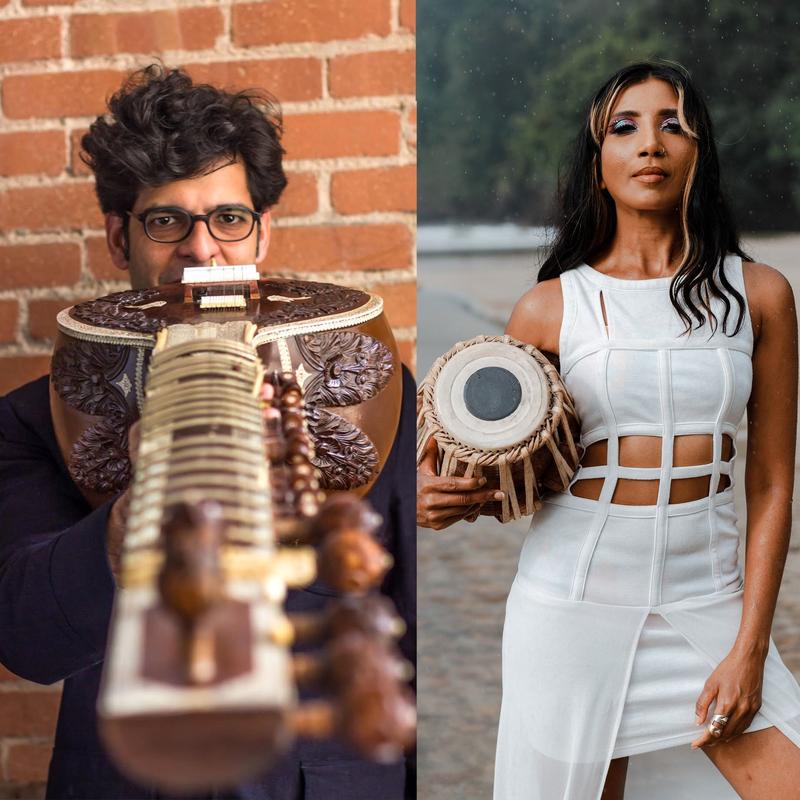
Our first guests in this series are Neel Murgai, a sitarist we were just hearing to a sitar-oriented piece, sitarist, overtone, singer, percussionist, composer, and teacher, and Roshni Samlal, a Trinidadian tabla player, composer, and teacher. They are the artistic directors of the Brooklyn Raga Massive. The Brooklyn Raga Massive, a raga-inspired musicians' collective. We heard a little of their music coming in. Neel and Roshni, welcome to WNYC. Thank you so much for joining us today.
Neel Murgai: Thank you for having us.
Roshni Samlal: Thank you so much, Brian. Thank you for having us.
Brian Lehrer: Neel, you want to introduce people who don't know to what raga music is?
Neel Murgai: Sure, I'd be happy to. Raga literally means that which colors the mind. It can be conceived of as a painting in your mind where each note is a different color, a different mood, a different feeling, and then you string them together. More practically, it's a scale. The scale can be different, ascending or descending. Say, major ascending or minor descending, something like that. That's the form for the classical music in South Asia.
Brian Lehrer: I'm going to go right on to another selection of your music. This is from Brooklyn Raga Massive's In D. For some of you who think that sounds familiar, it does. It sounds like the minimalist composer Terry Riley's iconic In C. As you may recognize, if you know In C, that is intentional.
Neel Murgai: That's right.
[MUSIC - Brooklyn Raga Massive: In D]
Brian Lehrer: Love it. Roshni, is it unusual for raga artists to take on contemporary music and interpret it? Roshni, do you want to answer that?
Roshni Samlal: Yes, I'd love to. I think that, especially from a taable player's perspective, any classical musicians and in classical-inspired musicians have always been interacting a lot with contemporary forms of new music being created ever since. We've got the Beatles, we've got La Monte Young, and there's just been a history of that kind of interaction and collaboration. I think now, too, especially in a place like New York, where we have so many global musicians thriving here and working together, we have a lot more contemporary expressions of that, be it jazz or cross-connected global music as well.
Brian Lehrer: I see that, along with your own compositions, you've also covered a number of pieces that Western listeners might know or Western music listeners might know, including much of John Coltrane's work, even a remix of the classic theme song to The Fresh Prince of Bel-Air. What? With many of these covers, though, drawing from the work of Black American artists, has Black American music specifically inspired your own work, jazz in particular, or anything else?
Neel Murgai: Definitely for all of us, I would say, Brooklyn Raga Massive, big jazz fans. We started this in 2012, having a weekly concert series and a jam session based on a jazz jam session model, but with raga music as the foundation. Then we were free to maybe start with the raga, but then there would be a saxophonist showing up and a guitarist and a Middle Eastern oud player and going all over the map, but jazz has been fundamental to what we're doing.
That's why we also were inspired to do some of John Coltrane's music, because he famously took a lesson or two with Ravi Shankar, the famous Indian sitarist, and was inspired by Indian music. Of course, Alice Coltrane went way beyond that and really was inspired by Indian music. We're bringing it full circle in our tributes to John and Alice Coltrane.
Brian Lehrer: Roshni, I know both you and Neel are teachers as well as composers and performers, so I'm wondering how much is education a part of the mission of your collective? Are the younger generations interested? Some of our older listeners may be hearing all of this and saying, "Yes, I've heard raga music. I remember Ravi Shankar," but the kids aren't interested in that.
Roshni Samlal: I think that I'm definitely starting to see and feel the momentum of new interest, people who grew up, even older students, in addition to younger children who want to carry on that connection with the tradition. The more this music gets spotlighted, I think, and the more work and theory that's being generated about how the music's put together, I think that people have a lot of interest in learning about the history, where did it all come from. Even a lot of femmes now within the percussion world, too. I'm noticing a lot more women are learning. I do think that there's a lot of expression of interest and that it'll keep growing for sure.
Brian Lehrer: Neel, as one of the founding members of Brooklyn Raga Massive, which I see has been around for 14 years, that's an impressive feat for any business in New York City, and Roshni just said it's growing. Have you seen big changes in the music scene in New York over that time? How have you made it survive 14 years?
Neel Murgai: Definitely big changes. I've been playing music in New York since '98, so really over that time, so many venues have come and gone. Honestly, that's one of the biggest things, the biggest challenges, is to find a good relationship with the venue, and that the venue does not close down and stays open. We've been fortunate to have our what was once a weekly jam session, now monthly, in many different venues around the city. Currently at Barzakh Café, beautiful small place in Brooklyn.
That's been really at the pandemic, of course, changed everything a lot. We went from having our weekly concert at least once a week, probably many times, twice or three times a week, to fully online. Then we had this very strong community that we had built around these sessions. That community dissipated in the pandemic. I have noticed and been encouraged that there's a new generation of younger musicians who are coming in, and they're participating in our jam. Every time we have the jam, there's somebody new, "Oh, I just moved to New York." I have hope for the future. Definitely.
Brian Lehrer: Roshni, just in our last 20 seconds, I happen to know that this Friday there will be a tribute to your fellow tabla player, the late, great Zakir Hussain, at Carnegie Hall, who I happen to be a big fan of and have seen twice in the year before he died last year. How much of an impact did his playing have on you? Roshni?
Roshni Samlal: It's changing to have-- Hello?
Brian Lehrer: Go ahead. Sorry, we've got 10 seconds.
Roshni Samlal: It's been a life-changing experience learning of his work. I grew up as a child in Trinidad listening to him play. I was able to be in his camp that last year in August, right before he left us. I know for myself, globally, he's just been such a great influence and cosmically raised the bar. We're grateful for all he's left for us.
Brian Lehrer: Roshni Samlal and Neel Murgai, artistic directors of the Brooklyn Raga Massive. You can find their work at brooklynragamassive.org. It's been a pleasure having you both on the show.
Neel Murgai: Thank you, Brian.
Roshni Samlal: Thank you so much for having us.
Brian Lehrer: Alison Stewart's going to be talking about a lot of music, too. We told you that she was doing these segments yesterday, like about Chick Corea and other things, but that was a mistake. It's really today. Let's listen to a few more seconds of raga music heading to the news.
Copyright © 2026 New York Public Radio. All rights reserved. Visit our website terms of use at www.wnyc.org for further information.
New York Public Radio transcripts are created on a rush deadline, often by contractors. This text may not be in its final form and may be updated or revised in the future. Accuracy and availability may vary. The authoritative record of New York Public Radio’s programming is the audio record.