Brian Lehrer: Brian Lehrer on WNYC. Now we continue our pledge drive miniseries on some of the lesser-known music worlds of New York City. Not the top of the charts types of music, but some of the music scenes around genres that could maybe only be found in an arts-loving city like ours, which is a magnet, of course, for artists of all types. We're hearing about some of these niche music communities and how you can get involved if you're interested as an artist or a listener, and how they make it work in this expensive city when you're not making pop charts kind of art.
Our guest for today is Patricia Nicholson Parker, a dancer, choreographer, and poet who is the executive director of Arts for Art, an organization that embraces music, movement, and improvisation in the arts and in activism. We'll hear another clip or two that's relevant to her work as we go for the fun of it. Patricia, welcome to The Brian Lehrer Show.
Patricia Nicholson Parker: Hello. Thank you for inviting me.
Brian Lehrer: I noticed that the Arts for Art website features a quotation from saxophonist Ornette Coleman on your homepage. It says, "Jazz is the only music in which the same note can be played night after night, but differently each time." I love that. It even applies to this show. Is jazz central to the organization's work?
Patricia Nicholson Parker: Yes, it is, especially what we call free jazz or avant jazz or what I now often just call creative improvised music. That is central to what we do.
Brian Lehrer: Let's give our listeners a little taste of who you quoted from there. Here's Ornette from 1959, a track that's good fodder for this week, as it turns out, called Peace.
[MUSIC - Ornette Coleman: Peace]
Brian Lehrer: Ornette Coleman. I love Ornette Coleman. Your genre happens to be in one of my sweet spots. He comes from a type of jazz known as free jazz, as you said, free improv, not limited to the usual playing around a standard chord progression. You might say more musically exploratory. John Coltrane, Eric Dolphy, others like that from that era, but you know, Patricia, I didn't know there's still a scene. Where could I find it in New York?
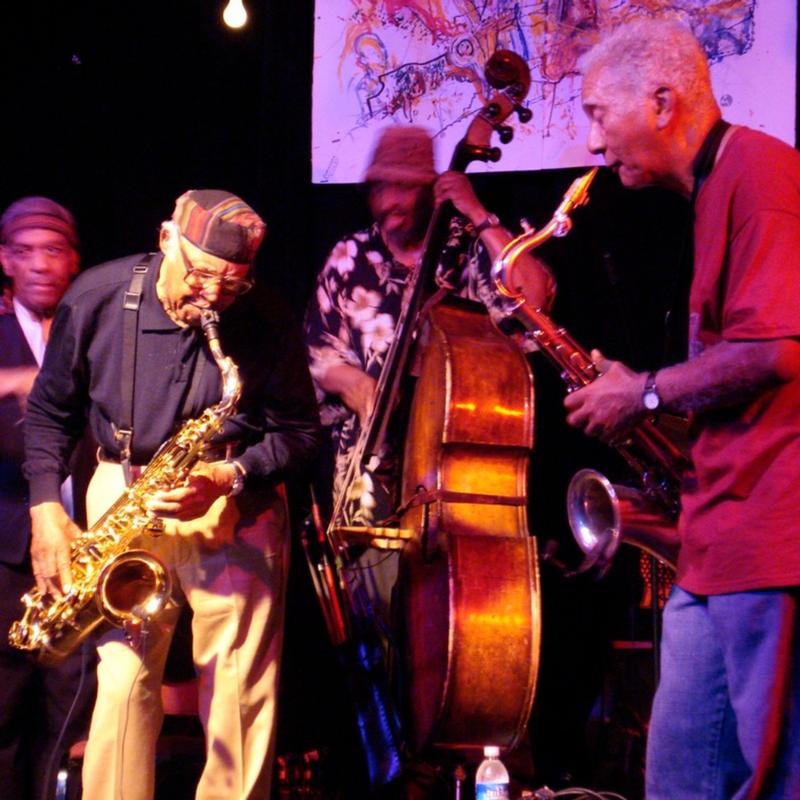
Patricia Nicholson Parker: Well, we partner with people. Mostly right now, we're partnering with the Loove, the Loove Annex on 238 North 12th Street in Williamsburg, near McCarren Park. We're doing a weekly series there, but we'll be doing the Out Festival there in just a couple of weeks, or in 10 days. Then we're going to do the Vision Festival, which is our flagship event, which we began 30 years ago.
Brian Lehrer: Nice.
Patricia Nicholson Parker: That's going to be at Abrons Art Center on Grand Street.
Brian Lehrer: Tell us a little bit about the Vision Festival. What kinds of work do you feature, and how have you kept it going for 30 years?
Patricia Nicholson Parker: I'm stubborn. That's how I kept it going. [laughter] I don't let people stop me when I feel something is important. I feel like creative improvised music is important, especially we began it to make the music more diverse, because especially in this free jazz genre that began largely, not exclusively, but largely by Black musicians from the '50s through the '70s, those were the origin years of that genre. We see it as a continuation of jazz itself, but jazz, really, the way I define it, is a disciplined disregard for traditional boundaries.
Brian Lehrer: Love it. Are you seeing, though, a younger generation get into it in this age, when genres like hip hop or reggaeton or others might seem more relevant to the Black experience, for example? Can you talk about how you see this genre as still relevant?
Patricia Nicholson Parker: Well, it's becoming more relevant to them now. Some of these things, you can't really explain. You just observe. It sounds different because they're making it their own. They're bringing elements from where they're coming from. There's a lot more electronics, and the electronics are different now because, of course, Sun Ra used the electronics anyway. It's just arising. I don't exactly know why, except that we have kept it going. We've made space for it. I use younger--
Brian Lehrer: Maybe because it breaks rules, right? Almost by definition, which maybe is a good thing for right now. I do want to mention, before we run out of time, that aside being an incredible artist, you are also an activist, and you have used improvisation as part of that, as in jazz. Talk about how improv connects with your activism.
Patricia Nicholson Parker: In two ways. It's really, I title the events, usually with a political title. That gives the artists a chance to-- I talk to them about it, and then they use that as a way-- I incentivize it, I guess. I also started back in 2017, Artists for a Free World, which is a marching band that originally was led by William Parker. Now, William Parker isn't as active. He's still active, but sometimes, Elijah J. Thomas, a much younger musician, is taking the lead, along with Elizabeth Frickey and myself.
We're continuing because free jazz, to me, makes the most sense when it's heard in the streets, because as long as there's a good rhythm to it, that you hear the drumbeat, the horn, the free horn sound, is the cry of the people. It just makes sense.
Brian Lehrer: Patricia Nicholson Parker, executive director of Arts for Art. You can find more about the organization's upcoming events at artsforart.org. It's been a pleasure having you. We're going to play a little more music to go out, but I want you to set it up. This will be from the 2022 Vision Festival. It's James Brandon Lewis' Red Lily Quartet with sax, trumpet, bass, and drums. While the music was going, the visual artist William Mazz did live painting and video art, I understand. Were you there for that, or can you say why add that visual element to a music show?
Patricia Nicholson Parker: His name is Bill Mazza. That's how we call him. He was very closely connected for a bunch of years, and he's good friends with James Brandon Lewis, so it made sense. I mean, the world is much more visual now. Maybe because of the way our phones are, but I always believe that the art should come together. That--
Brian Lehrer: Patricia, thank you.
Patricia Nicholson Parker: Yes.
Brian Lehrer: Thank you. Thank you so much for coming together with us. All right, here's that Red Lily Quartet, as we head toward the news. Then Alison Stewart in All Of It.
[MUSIC - James Brandon Lewis' Red Lily Quartet]
Copyright © 2026 New York Public Radio. All rights reserved. Visit our website terms of use at www.wnyc.org for further information.
New York Public Radio transcripts are created on a rush deadline, often by contractors. This text may not be in its final form and may be updated or revised in the future. Accuracy and availability may vary. The authoritative record of New York Public Radio’s programming is the audio record.